


TL;DR - Dave Edelman has been working on personalization since 1986, back when databases were the new thing in marketing, and he watched it grow into what he and his co-author call a $2 trillion prize. Then last week he published a warning that we’re about to drown our customers in a tidal wave of hyper-personalized garbage. We got into the piece of junk mail that made him buy solar panels without ever looking at a competitor, the cheapest move almost nobody makes, and what separates personalization that earns trust from personalization that just makes somebody feel watched.
What You Can Expect
A test you can run on your own next campaign: are you orchestrating what reaches a customer, or letting four departments hit the same person independently?
The one question Dave asks every company he walks into, and why most of us can’t answer it honestly.
🎥 Catch all future interviews, subscribe!
🎧 Prefer audio? Listen on Apple Podcasts
Outline
(00:35) – Marketing since 1986, and riding every wave since
(03:55) – Why he wrote the book: slop was the danger
(07:35) – The solar mailer: Google Earth, Zillow, and 21.3%
(11:55) – Test and learn, and how Sungevity actually got there
(13:52) – Zero-party data, and the companies that never just ask
(17:15) – The front desk secretary who tested every new tool
(18:28) – Morgan Stanley, and ten hours a week back
(22:31) – One customer, four departments, all bombarding
(25:45) – Where trust turns into feeling watched
(28:26) – Why this is a strategy decision before it’s a marketing one
(31:15) – Call center transcripts, and catching a bug in fifteen minutes
(32:11) – The one thing: the high road
My Takeaways
The junk mail that worked. Dave’s town offered a property tax discount for solar panels, which set off an avalanche of mail. One envelope did something the others didn’t. He typed in a personalized URL and got a Google Earth image of his own roof with panels drawn onto it, sized to his roof’s orientation and latitude, with his likely annual usage estimated from the square footage on Zillow.
“So they had the numerator from Google Earth, the denominator from Zillow. It came to 21.3%. They said they would guarantee 20%.” — Dave Edelman
He bought without looking at a competitor, stayed seven years, and cleared 20% every year but one, when they sent a rebate check instead. And you don’t get there without 25 iterations, but it started with thinking, how can we truly delight our customers?
Delight is where almost everyone stops. The book runs on five promises: empower me, know me, reach me, show me, delight me. I don’t think we normally get to the delight area, it usually stops way before that, and the delight-me ones are exactly the ones that hold customer trust for years. What I hadn’t thought about is that AI is what finally makes that last promise affordable, because the testing that gets you there also feeds the thing doing the testing.
“It also feeds your AI. You get more data from the tests that make that AI smarter.” — Dave Edelman
Orchestrate, or bombard. One retailer ran every department on its own marketing budget, and the best customers of one category turned out to be the best customers of most of the others, so the same people got hit from every direction at once. Response rates fell.
“The customer isn’t a customer of a category, a department. Customer is a customer of our brand overall.” — Dave Edelman
They pooled the data, used AI to rank the top three things any given person would actually care about, and governed every message down to those three. Loyalty memberships up, sales up over 20% a year, cited at their investor day. To me that tells the customer we value your attention, which is the same line I’ve drawn before on when personalization crosses it.
It’s a strategy decision before it’s a marketing one.
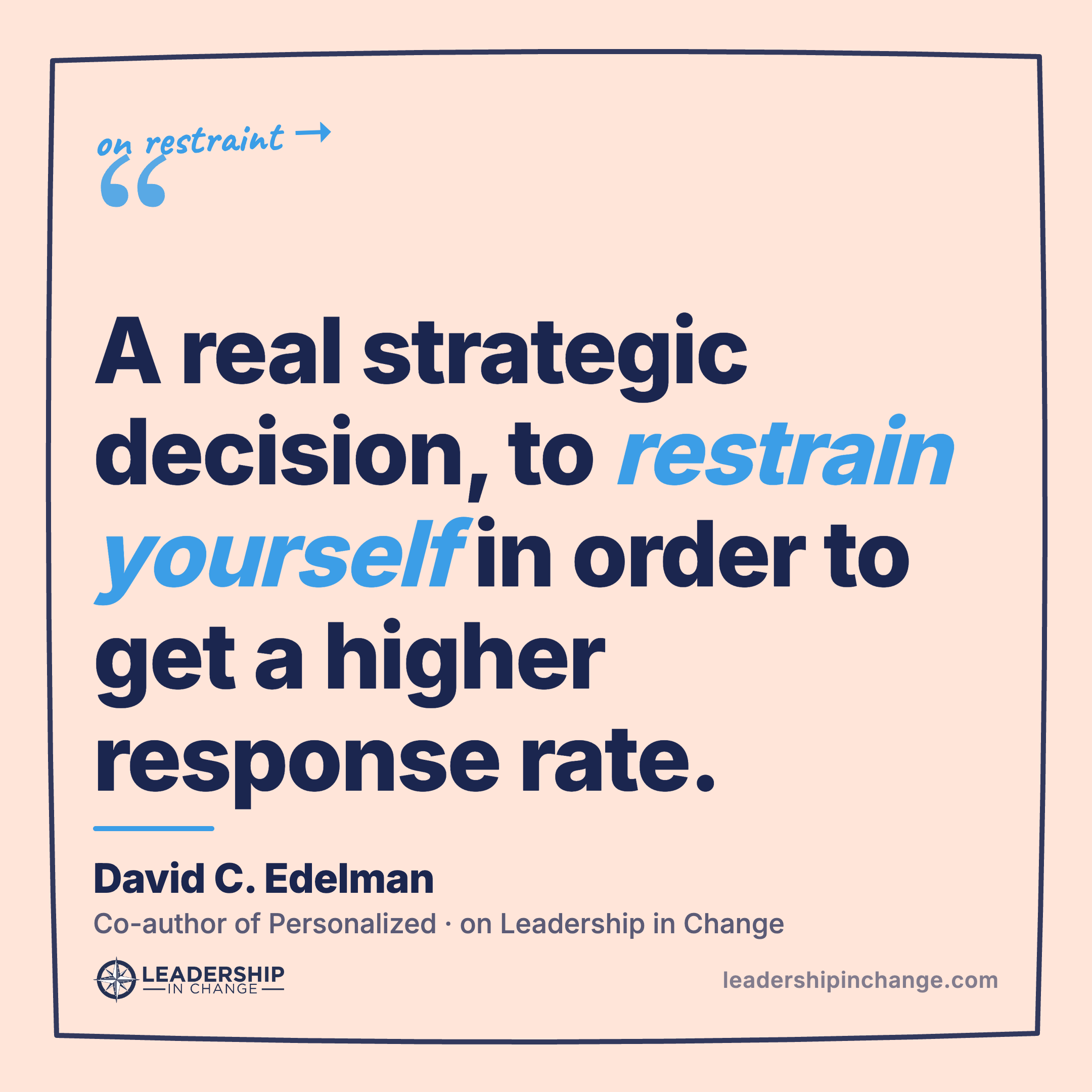
“The first step is, this is a strategy decision. This is about how you want to compete. And that’s a real strategic decision, to restrain yourself in order to get a higher response rate.” — Dave Edelman
I coach CEOs on AI strategy, and time and time again I see the left hand of an organization with no idea what the right hand is doing, both of them touching the same customer, sometimes to the detriment of the other. And the customers just don’t feel known. Now, every company Dave named is enormous, so the fair question for the rest of us is what this looks like at forty people. His cheapest fix scales all the way down: poll your own employees first. Which reminded me of a CEO I worked with who had his front desk secretary, about 55 and not remotely techie, walk every new sign-up flow before launch and report back to marketing. It’s not hard, but it’s so rare. Same gap I keep running into when AI initiatives stall.
One Question Before You Go
Dave’s own test is the one I’d carry out of this hour.
“What is your intent? Is your intent to add value to the customer and be the brand that’s known for that, or are you just manipulating them?”
He calls the first one the high road, and he’s watched it build brands since 1986.
So put yourself in the shoes of your customer, of your audience. Would they like what you’re doing, would they trust you, and would they be delighted?
Watch the full conversation above, and go follow Dave on LinkedIn, where he publishes on this constantly.
About David Edelman
David C. Edelman teaches marketing at Harvard Business School and advises CEOs and CMOs through Edelman Advisory Services. He was Chief Marketing Officer at Aetna, co-led McKinsey’s global digital marketing and sales practice for eight years, and was an EVP at Digitas and a partner at BCG before that. Personalized: Customer Strategy in the Age of AI, co-authored with BCG’s Mark Abraham, came out from Harvard Business Review Press in October 2024. More than a million people follow his writing on LinkedIn.
About me
Joel Salinas is an AI Strategy Coach for founders and leaders, from solopreneurs to teams. AI is everywhere; judgment is scarce. Joel helps leaders adopt AI without outsourcing their judgment to it, through the AI Judgment Workshop and the 90-Day Judgment Engagement. Creator of the AI Leadership Triad. He writes Leadership in Change.
Written by a human, for humans.


