



TL;DR - Nir Eyal wrote Hooked, the book a generation of product teams used to build habit-forming apps, and then wrote Indistractable to hand the rest of us the counter-move. In this Substack Live, he made a case I wasn’t expecting: only about 10% of our distraction comes from pings and notifications, the other 90% comes from inside us, and the fix isn’t more willpower but a calendar. We got into why to-do lists are broken, why checking email is the most dangerous distraction there is, and why he thinks self-regulation is the skill of the century.
What to Remember
The one-sentence test Nir uses to tell traction from distraction, which has nothing to do with what the activity actually is
Why he calls the to-do list a broken tool, and the timeboxing move he replaced it with

🎥 Catch all future interviews, subscribe!
🎧 Prefer audio? Listen on Apple Podcasts
Outline
(1:19) – Hooked and Indistractable are complements, not opposites
(5:07) – Internal triggers, and the month I deleted every news app
(6:24) – The book about focus Nir can’t stand
(7:22) – Only 10% of distraction comes from the pings
(8:56) – Traction, distraction, and the Latin root of both
(10:49) – The email trap: work that isn’t the work
(12:27) – Name one product built to help you use it less
(14:20) – Effort pacts, and Viktor Frankl’s space
(15:43) – Why to-do lists are broken
(17:22) – Timeboxing, and the real metric of success
(22:30) – Self-regulation is the skill of the century
(28:36) – Persistence, belief, and Beyond Belief
My Takeaways
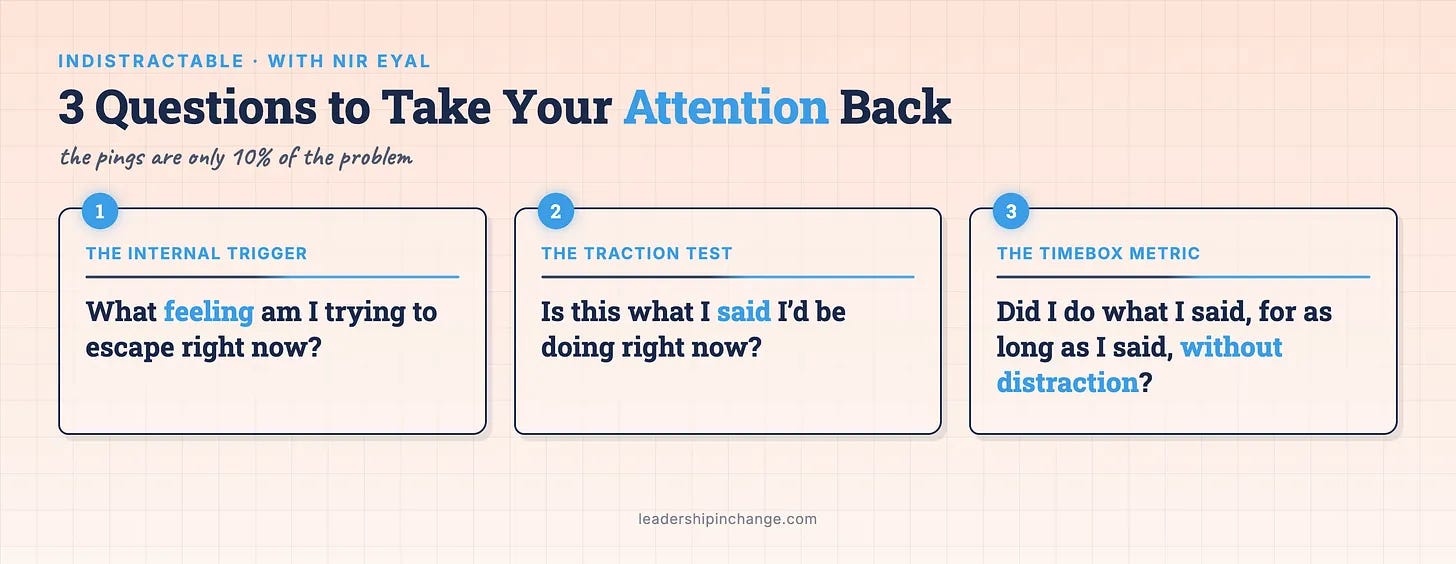
Ninety percent of it is coming from inside the house
So this is the number I had to go back and check twice. We blame the pings, the dings, and the rings, and Nir puts those at roughly 10% of the problem. The other 90% is an internal trigger, which is really just a feeling:
“Loneliness, boredom, fatigue, uncertainty, anxiety.”
Then he closes the escape hatch.
“It’s not your fault. You didn’t create these digital technologies. But it is your responsibility because who else is responsible?”
Traction and distraction are the same word
Here’s the reframe I’ll actually use. Both come from the Latin root trahere, to pull, and both end in the same six letters, action. So the test is simple:
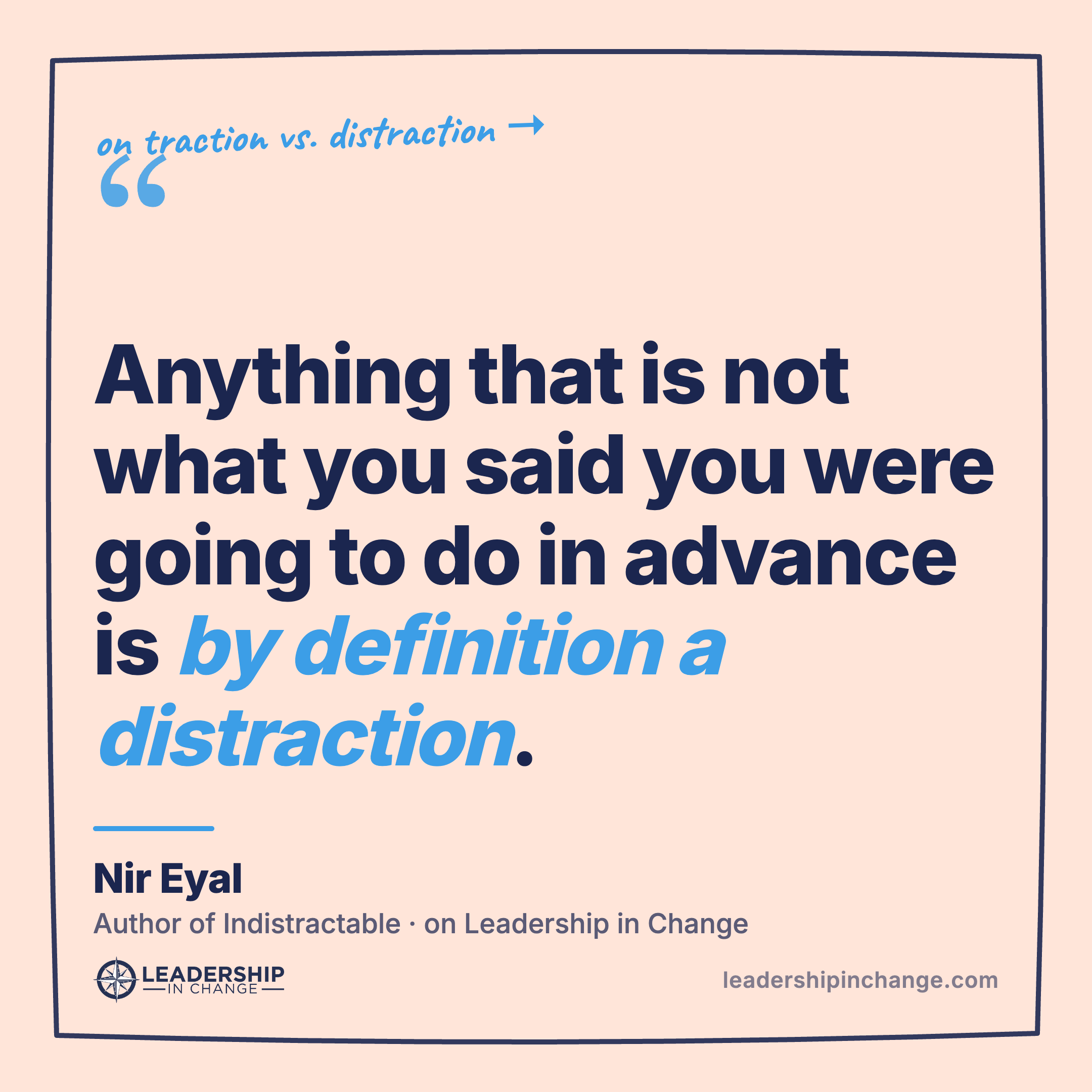
“anything that is not what you said you were going to do in advance is by definition a distraction.”
Watching football isn’t a distraction if you planned it, and answering email is one if you didn’t. That second half is what got me, because Nir says the work-shaped distractions are the worst kind, “because you don’t even realize you’re distracted.” I said on the recording that this was hitting close to home, and I meant it.
The to-do list is a register of things you failed to do
Honestly, this is the part I didn’t want to hear because I tend to live by my to do list. A to-do list has no constraints, so you always add more and you always pick the easy item over the important one, and then you read back the leftovers night after night until you’ve built a fairly convincing case against yourself.
“There’s nothing wrong with you. You’re not broken. It’s this stupid time management technique we call to-do list that’s broken.”
His replacement is timeboxing, and it moves the finish line: success isn’t the checked box but “did I work on what I said I was going to work on for as long as I said I would without distractions?”
Be stingy with your time and generous with your money
This is the line I’d put on a wall. We clip coupons, we split checks at lunch, we hunt for deals, and then we hand our hours to whoever asks. “You can’t make more time. I don’t care if you’re Bill Gates or Elon Musk.” He carries it into parenting, calls self-regulation “the skill of the century,” and describes sitting down with his six-year-old to build her calendar, video games included. My version is a Bloom card that locks my work apps at 8 p.m., so getting back in means walking to my bedroom and tapping my phone against it. That walk is the whole point.
One Question to Sit With
What’s on your calendar this week that’s still only on your to-do list?
Then watch the full conversation above, and go subscribe to Nir And Far, grab Indistractable, and pick up his new one, Beyond Belief.
About Nir Eyal
Nir Eyal is the author of Hooked, Indistractable, and Beyond Belief, which are built on his work in behavioral design and human motivation. Hooked and Indistractable have sold more than a million copies in over 30 languages, and Beyond Belief is an instant New York Times bestseller. He’s a former lecturer at the Stanford Graduate School of Business and the Hasso Plattner Institute of Design at Stanford, and his writing has appeared in The New York Times, Harvard Business Review, and The Atlantic. He writes Nir And Far on Substack and gives away a deep library of free tools at nirandfar.com, including a schedule maker and a habit tracker.
About me
Joel Salinas is an AI Strategy Coach for founders and leaders, from solopreneurs to teams. AI is everywhere; judgment is scarce. Joel helps leaders adopt AI without outsourcing their judgment to it, through the AI Judgment Workshop and the 90-Day Judgment Engagement. Creator of the AI Leadership Triad. He writes Leadership in Change.
Written by a human, for humans.


