


Travis Rosser co-founded Kajabi, the platform creators have used to sell more than $10 billion in courses, coaching, and knowledge, and he joined me on Substack Live to trace the whole arc.
We went from a Shark Lagoon PDF he sold as a kid to a company that put publishing tools in everyone’s hands. Along the way he unpacked why he tells builders to fall in love with their customer’s pain instead of their idea, his Four P’s of knowledge capital, and why AI is turning all of us from creators into builders. If you’re sitting on expertise and wondering what to do with it, this is the one to watch.
🎥 Catch all future interviews, subscribe on YouTube
🎧 Prefer audio? Listen on Apple Podcasts
🤝 Want to chat one-on-one? Book a free intro call.
Outline
(00:04) – Welcome, and going live on Substack
(00:53) – A sprinkler toy, a taco, and a lifelong side-hustle habit
(02:39) – Shark Lagoon: the first thing he ever sold online
(04:36) – Kajabi’s first customer
(05:28) – Launch day, and a million dollars in 24 hours
(08:44) – The Saturday the support tickets caught fire
(09:56) – The survey that revealed what Kajabi really was
(10:32) – From $10 billion to “we’re all becoming builders”
(12:13) – “Fall in love with your customer’s pain, not your idea”
(15:24) – Knowledge capital and the Four P’s
(22:57) – Skills as the new digital product, and taste as the new edge
(36:43) – What Travis is building now: Wazi and PageSumo
My Takeaways
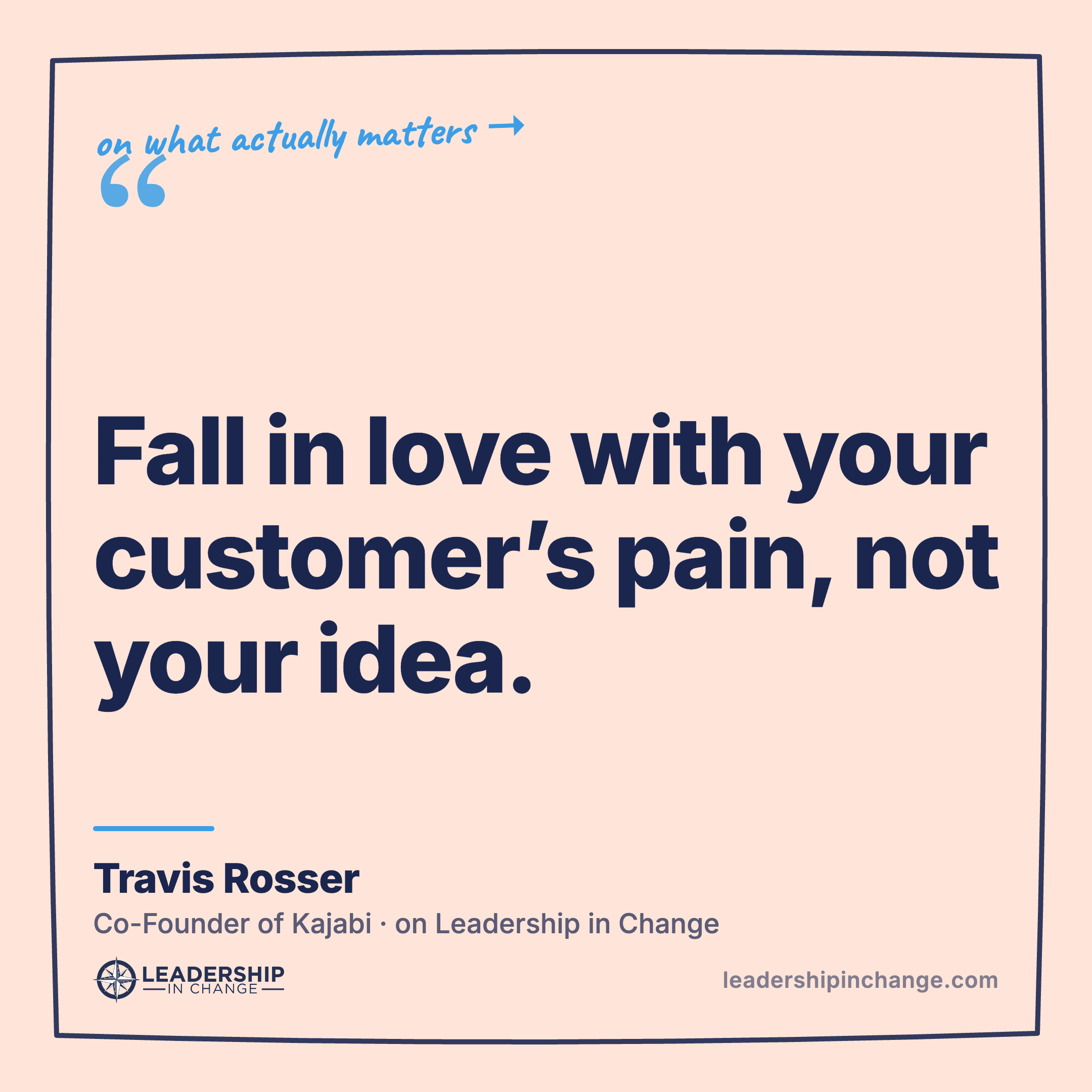
Fall in love with your customer’s pain, not your idea. Here’s the line I keep coming back to from the whole conversation. Travis has been building things his entire life, and the thing he kept circling back to is that being good at creating stuff is exactly what makes you fall in love with the wrong part of it.
“When you’re good at creating things, you fall in love with the idea too much,” he said. “But if you’re not helping someone, if you don’t provide value to them, it doesn’t matter.”
What I pushed on with him is how much sharper that line cuts right now, because once anyone can build almost anything over a weekend, a lot of us are going to mistake “I can make this” for “someone actually needs this,” and those two things were never the same.
Everybody is sitting on knowledge capital, and most of us take it for granted. So here’s the framing from his book You, Inc. that I want more leaders to steal. Travis calls it the Four P’s: Profession, Passion, Pain, and Problems. His claim is that all four are knowledge somebody else would pay for, and we discount them because they come easy to us.
“Everybody is an expert in their own life,” he said, and the example that got me was his kids yelling across the house about how to beat a level in Minecraft. In that one small section of life, his oldest son was the expert. So the thing he leaves you with is simple and a little uncomfortable: you already have something worth teaching, and the only real work is looking back at your own trail long enough to notice what it is.
We’re shifting from a creator economy to a builder economy. This is the part I was leaning in for, because it’s exactly what I’ve been living. Travis’s take is that AI has handed everyone the capacity to build, not just to make content.
“AI has given us the capacity to build, where anybody can build software, anybody can build agents, workflows,” he said, “and I really encourage anybody that watches this to go start doing that just for fun on the side.”
I told him about the workout app my wife and I both wanted but couldn’t find, so one weekend I sat down in Claude Code (Anthropic’s coding tool you run by talking to it), took screenshots of the two apps we were each paying fifteen dollars a month for, listed the features we actually wanted, and built our own. I’ve used it almost every day for six months. That used to take a team and a budget, and now it takes a curious Saturday.
In the age of infinite output, taste is the edge. So if anybody can build anything, what’s actually scarce now? Travis’s answer is taste, and taste comes from being an expert who knows what to leave out. He pointed to In-N-Out here in Southern California, how the whole brand is a curated menu, a few things done well instead of a wall of options.
“It’s really good at producing a lot of stuff quickly,” he said about AI, “but how do you have taste? How do you curate the good? That’s the next real expert, the person who knows how to navigate that and still produce high-quality stuff.”
His advice for getting started is to build in a vacuum for a while and be your own first customer, because the fastest way to develop taste is to make something you’d actually use. That’s the same thread of adaptability and creativity I keep writing about in the AI Leadership Triad. The tools got cheap, so judgment is the job now.
One Question to Sit With
What’s the one pain, yours or a customer’s, that you’d build for first now that the tools aren’t the hard part anymore?
Watch the full conversation above, and then go follow Travis Rosser and check out what he’s building at Wazi and PageSumo.
About Travis Rosser
Travis Rosser is the co-founder of Kajabi, the platform creators have used to sell more than $10 billion in courses, coaching, and digital products. He’s the author of You, Inc., a book about turning your own knowledge into a business through what he calls the Four P’s. These days he’s building two new tools with AI: Wazi (wazi.ai) and PageSumo (pagesumo.com). Follow his work on LinkedIn.
About me
Joel Salinas is an Executive AI Coach for leaders at small and mid-sized businesses and nonprofits. 1:1 coaching, team workshops, and AI strategy work built around amplifying what your team is already good at. Creator of the AI Leadership Triad. He writes Leadership in Change. If you want help thinking through your own AI strategy or online presence, start here.
Written by a human, for humans.
Thank you Colette Molteni, Claire Machado, Duncan The Sage, Tiffany Farley, Chris Winter, and many others for tuning into my live video with Travis Rosser! Join me for my next live video in the app.