



TL;DR: Charlene Li has been standing at the front of every big technology shift since newspapers went online in the early nineties, and she just published Winning with AI with Dr. Katia Walsh. We spent most of this conversation on the thing most of us won’t say out loud, which is the fear that we already missed it. Her answer is that we are all absurdly early, that fluency is the whole game, and that the only way to get it is to be bad at this in public for a while. Watch this one if you’ve been measuring yourself against everybody on LinkedIn who looks like they have AI figured out already.
🎥 Catch all future interviews, subscribe!
🎧 Prefer audio? Listen on Apple Podcasts
Outline
(00:25) – Who Charlene Li is, and why it’s never about the technology
(01:39) – From the newsroom to Forrester to Altimeter Group
(03:41) – Electricity, steam-powered factories, and why AI moves faster
(06:24) – The biggest misconception, and “you’re not even close to beginning”
(08:44) – Fluency vs. literacy, and why the only way through is through
(11:36) – The trust wall, and how a leader destigmatizes AI in one meeting
(13:48) – Why write a book on AI when everything keeps changing
(16:42) – Step one, and the one line to add to the end of every prompt
(19:27) – Pick your lane, and the board member who owned ethical AI
(25:35) – “You’re not behind. You’re just getting started.”
(33:09) – Curiosity, imagination, and using AI to find your blind spots
My Takeaways
You’re not behind. So this is the piece I keep coming back to, because I hear that fear from almost every leader I sit with and I’ve felt it in myself. Charlene has been in this since she helped a newspaper go online in 1993, she wrote the book on it, and she still took three weeks off in January to care for loved ones, came back to Claude Cowork, and had no idea what had happened while she was gone. She felt behind too. Then she took a breath and turned it around on the rest of us.
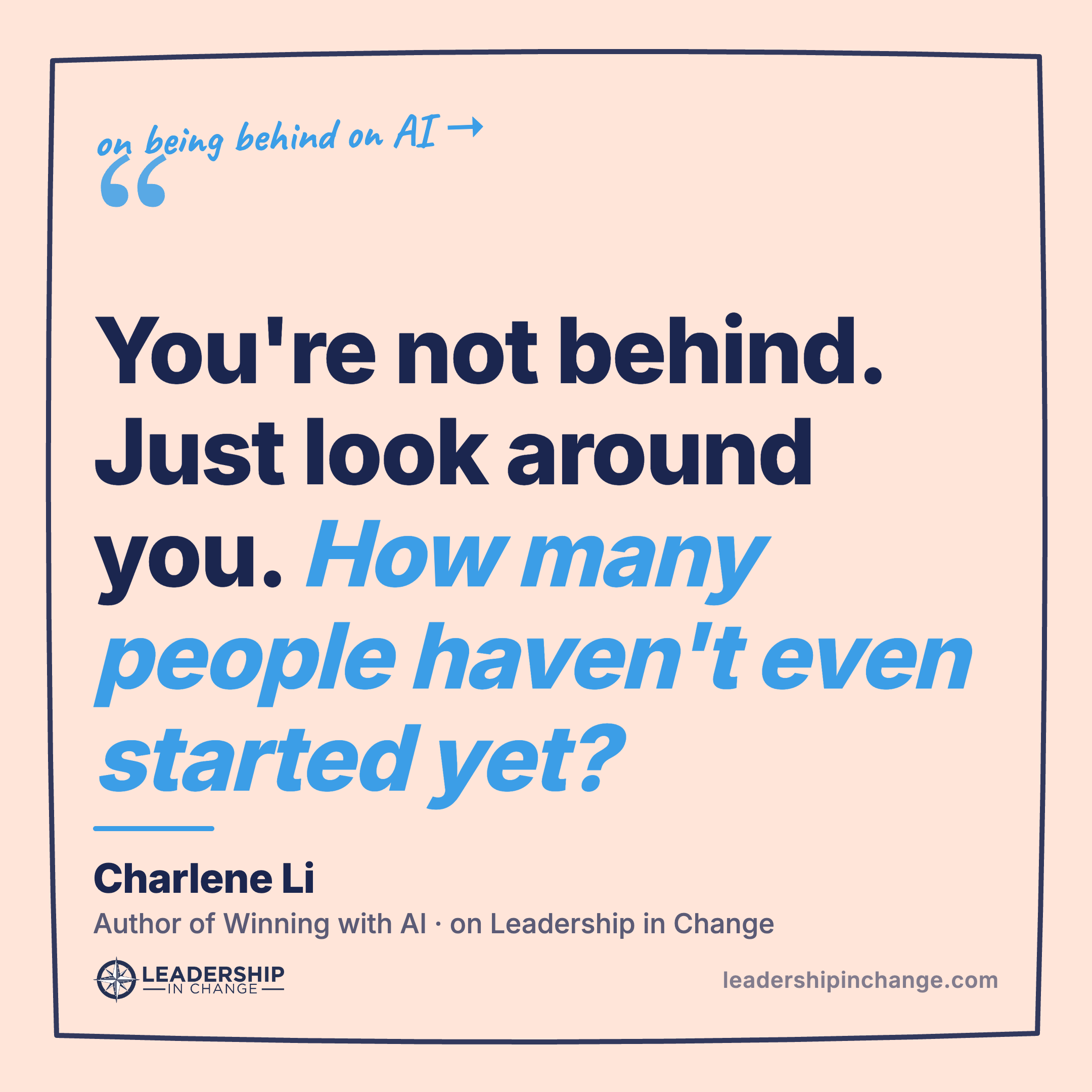
“You’re not behind. Just look around you. How many people haven’t even started yet? So if you start today and just do one thing, you’ll be ahead of the vast majority of people.”
One of my clients is a CEO with over 45 years of practice who started sending me links to artifacts he’d built in Claude, and he could not believe he made them himself with nobody helping him. That’s what starting looks like.
Fluency is a practice, and practice is the only door. Honestly, this is where most AI advice falls apart, because it tells you what the thing is and then leaves you standing there. Charlene splits AI literacy, knowing what it is, from AI fluency, which is what happens once you’ve used it enough that you stop thinking about it. There’s one way to get there and she doesn’t pretend otherwise.
“It will feel messy. It will feel like you don’t know what you’re doing... But there is no way around it. You have to go through it. The only way through it is through it.”
I said something close to this on the live about electricity, that plugging AI into an organization nobody wired for it does nothing, but hers is the harder version, because wiring a house is a project you finish and this is a thing you only get by being bad at it for a while. She also gave the best beginner tip of the night: add “before you start, ask me any clarifying questions you may have” to the end of your prompt, and the whole thing turns from a vending machine into a conversation.
Mindset comes before tools, and before governance. Look, most of us hand AI to the CIO, buy everyone a license, and call that a rollout, and I keep watching it play out the same way. Her line on it was the sharpest thing she said all evening.
“This is not something you delegate. And what I’ve seen now is that leaders are abdicating this role.”
The fix she gave is almost embarrassingly small. Use AI to prep for your next meeting, tell the room you did it, then ask them how they used it, which sets the expectation and takes the shame out of it in the same breath. If your people think using AI counts as cheating, no tool budget on earth saves the rollout. That’s the same wall I wrote about in the empathy gap in AI implementation.
The thing I’m stealing from her. Here’s the part I hadn’t thought of, and I said so on air. Charlene feeds her own meeting recordings to AI and asks it what went wrong in the room.
“Take a transcript of my last meeting because something in it didn’t feel right. Something went off the rails and I’m not sure what’s happening. Diagnose that and give me suggestions.”
It comes back and tells her she never set an agenda, or that she talked for 70% of a call she should have been listening through. I’ve fed transcripts into Claude plenty of times to build a post out of them, and it never once occurred to me to point that back at myself and ask where I got in my own way. I use Granola to capture the calls, so the raw material has been sitting there the whole time, which is really the argument for why none of us is behind. The thing that moves you forward this week is probably already open on your screen, and you just haven’t pointed it at anything that matters yet.
The mindset work Charlene is describing, getting your own hands dirty before you ask your team to, is exactly what I walk leaders through in the AI Judgment Workshop, which is open for registration now. If you’d rather go deeper inside your organization, that’s the 90-Day Judgment Engagement.
One Question to Sit With
Charlene left this one hanging and I haven’t been able to put it down:
What could you actually do if everybody in your company was fluent with AI, not licensed, fluent? What would you build that you’ve already talked yourself out of?
Watch the full conversation above for her answer, and for the line I keep repeating to myself, that you’ve never been in control anyway. When you’re done, go subscribe to Charlene Li on Substack.
About Charlene Li
Charlene Li is a New York Times bestselling author whose books include Groundswell, Open Leadership, and The Disruption Mindset. Her latest, Winning with AI: The 90-Day Blueprint for Success, is co-written with Dr. Katia Walsh, one of the world’s first chief AI officers, and it’s a leadership and strategy book rather than a technology book. She founded Altimeter Group in 2008, spent years as a Principal Analyst at Forrester Research covering the rise of social media, served as Chief Research Officer at PA Consulting, and now leads her own firm, Quantum Networks Group. She’s just moved her newsletter to Substack, and the book is at winningwithaibook.com.
About me
Joel Salinas is an AI Strategy Coach for leaders at small and mid-sized businesses and nonprofits. AI is everywhere; judgment is scarce. Joel helps leaders adopt AI without outsourcing their judgment to it, through a monthly live workshop and 90-day engagements. Creator of the AI Leadership Triad. He writes Leadership in Change.
Affiliate links included.
Written by a human, for humans.


