



TL;DR: AI initiatives stall because of people, not technology. Brennan McDonald offers three questions to reset a stuck AI rollout: what are we making better, what will change for our team, and how will we do this properly. Answering them upfront surfaces both the blockers and the boosters before licences ever get handed out.

So, when an AI rollout stalls, what actually stalled?
Most of us reach for the tool answer first. The model, the licences, the integration, the training that nobody showed up to. I’ve come to think that’s the easy thing to look at, because the harder thing is the people, and the people are where these projects really live or die.
The way I think about AI is the way I think about fire or electricity. World-changing to have around, but just having it doesn’t make anything better on its own. You have to be deliberate about how your people actually pick it up and use it.
That’s exactly the ground Brennan McDonald works on. Brennan spent a career in financial services technology and change, and now he writes Getting AI To Work, where the whole premise is that AI initiatives stall because of people, not technology.

What to remember from this piece
When an AI project stalls, look at the people and the operating model before you look at the tool.
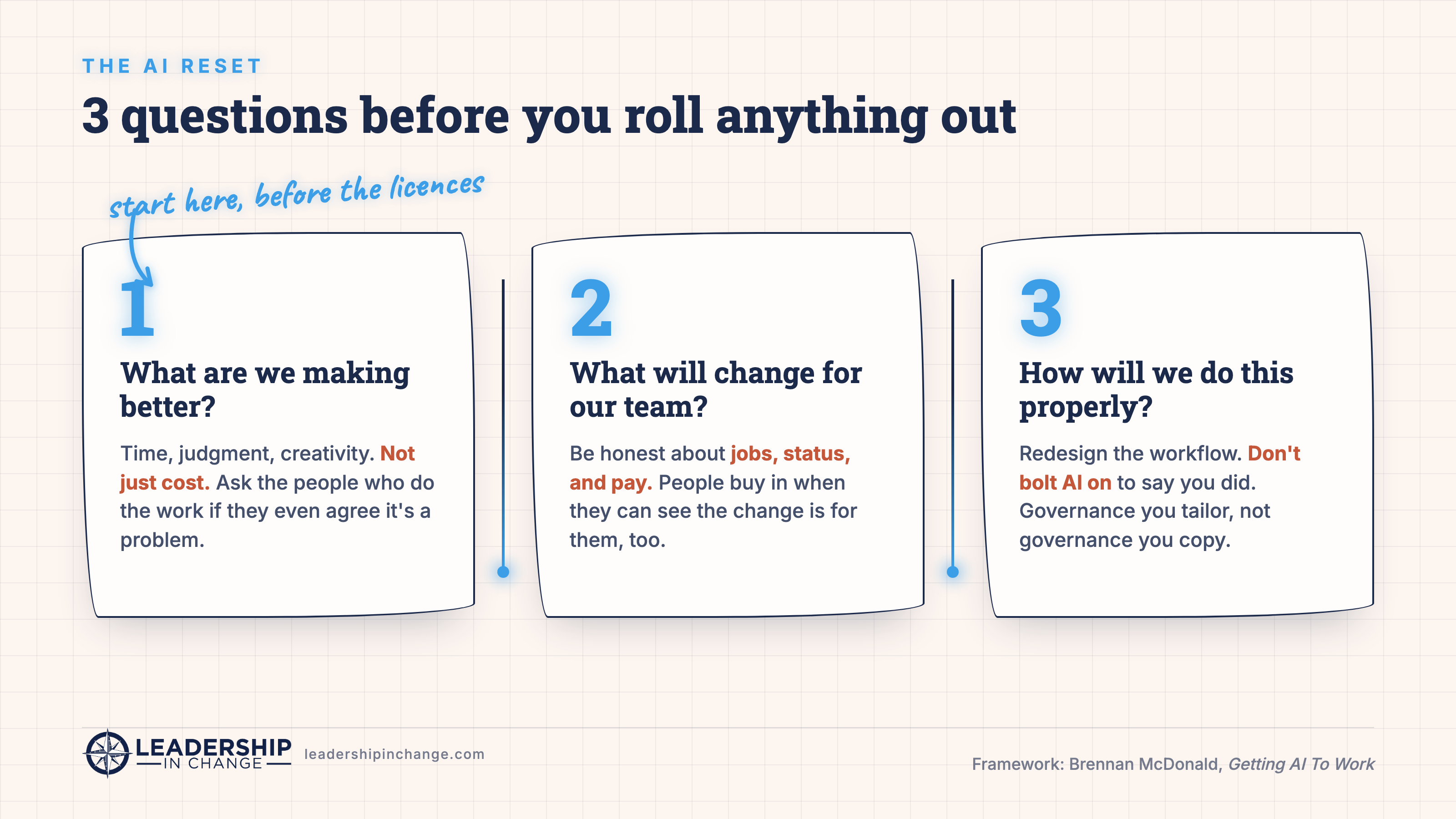
Run three questions before you roll anything out: what are we making better, what will change for our team, and how will we do this properly.
“Making better” is about time, judgment, and creativity, not just cost. Ask the people who do the work if they agree it’s a problem worth solving.
Here’s Brennan.
Reframe Your AI Change Initiative
There are clear benefits to deploying AI for leaders. You can do things more efficiently, reduce costs, or increase outputs. What I’ve found over the course of my career, and in my AI experimentation and work, is that the focus is too often on the tools. We fall in love with the solution and forget about the people required to get it over the line.
The idea of a vision and the concept of putting people first are sometimes dismissed as corporate cliches. Yet the lesson of many AI projects so far is that successful projects have great change management, cultural buy-in, and leaders who have thought carefully about how to bring their people on the journey.
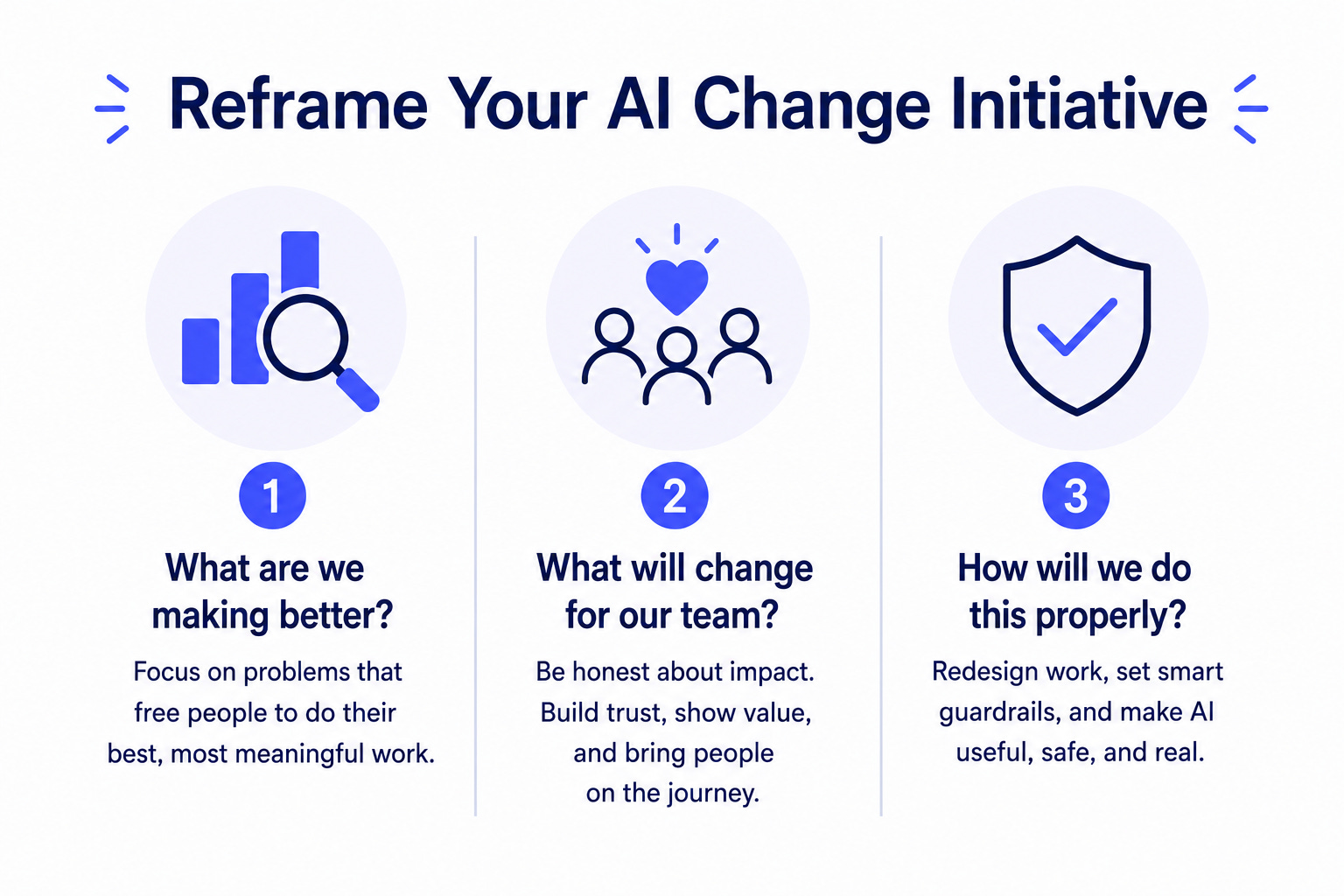
In today’s article, I’m going to share three questions to reflect on when you are setting up your AI initiative, especially if you are struggling to get that cultural shift and need a reset.
What are we making better?
What will change for our team?
How will we do this properly?
If you run through these questions, you’ll surface some of the blockers in your business, but also the boosters that will help you land important AI projects. We are in the age of technology, but people matter more than ever.
What are we making better?
Meaningful work matters more than it ever has before. What leaders want to think about in AI transformation is: what are we making better? This isn’t just about cost. We want to understand where people are wasting time, losing the chance to apply expert judgment, wasting energy, or not being able to exercise creativity today.
AI is an opportunity to make things better by automating repetitive tasks and simpler decision-making processes, freeing people up to focus on putting their best energy into the most important problems that your business faces.
What are we really trying to improve? By implementing these AI changes, what is better? Do the people who do the work agree that this is a problem to be solved?
A good answer here sounds like faster decision-making cycles or shorter feedback loops, a reduction in admin or manual tasks, improved customer service standards and responsiveness, or safer operational flows with lower levels of risk.
What will change for our team?
One of the biggest reasons for project failure of any kind is people not buying into the future state. They do not feel that they benefit from the change that is happening.
We want to ask questions like: Who gets spare capacity or the opportunity to work on different problems if this works? Who loses control of gateways or status in the workplace? Are there ways of working that have been in place that people feel invested in, or that they feel their ongoing job security is linked to?
If we roll this change out, what happens to that, and to people’s comfort with how things are done? Are we being open and honest about exactly why we’re making this change? Can people see through the messaging?
In my Substack and in my videos, I speak a lot about how what people see in their social media feeds interacts with what they hear in the workplace. Leaders need to be open and honest about what the change genuinely means for career growth, job security, pay and benefits, and other workplace issues people care about.
This matters because you are operating in an information environment that tells many people the only change that is going to happen to them because of AI is that they lose their job.
As part of your AI initiative, you can do things better, faster, and cheaper. You can help people solve more interesting problems. You can help them become more technical so that they can get leverage out of their unique skills, experience, and domain knowledge in using AI tools to solve problems.
How will we do this properly?
This is the execution question. This is where a lot of the thinking about governance or risk management comes into play.
All these topics are important. Too often, companies fall into a governance theatre arrangement. They have all the policies, frameworks, and security controls. They miss how they make AI adoption safe, useful, and real.
When I think about how to do AI transformation properly, I mean taking advantage of the technology. I don’t want to be trapped by the limitations of an existing operating model.
That comes down to whether you are redesigning workflows end to end, or just adding AI as another step in a process and putting it into a standard operating procedure. Can your people challenge, override, or question which AI models are used and how they are used? What guardrails are in place? Where is it okay to use AI-generated content, and where is it not? What thresholds require a human in the loop?
One thing I observe and hear in the conversations I have is that firms that have copied and pasted their approach to governance and risk management, without tailoring it to their own business, often run into problems that make it harder to realise the project benefits.
When you think about how you do this properly, this is like letter-of-the-law compliance versus spirit-of-the-law thinking. If you put AI into a workflow to be able to tell your stakeholders that you are doing AI, you absolutely are not doing AI properly.
If you take a step back and think about your operating model, your people, your processes, and your platforms, and think carefully about the bare minimum you actually need if you push this technology to its logical extent over the next few years, that is what I mean with this question.
Are you doing AI properly? Very few companies are. Even some of the biggest companies in the world are still making incremental changes to how they do things. They are risk averse. There is a lot of cost, complexity, and skill required to execute complex change of any type, let alone change involving an emerging technology that brings a whole set of other risks that must be managed alongside its deployment.
And that’s why taking a step back and getting clarity upfront about what you’re making better, what will actually change for your people, and how you are going to do AI properly is worth the time. Rushing licences to people with no operating model change is a recipe for lukewarm adoption and internal pushback. When it’s easier than ever to get AI to help generate a project plan, spending more time at the whiteboard thinking about how to make the work better has more leverage than ever.
Thank you, Brennan!
Brennan’s three questions do one thing well: they move the conversation off the tool and back onto the people who have to live with it. That’s really a test of adaptability, which is the first skill in the AI Leadership Triad I write about here, because the reset only works if you’re willing to change how the work actually happens, not just what software sits on top of it.
Rushing licences to people with no change to how the work happens is just a more expensive way to stall.
If this resonated, subscribe to Brennan’s Getting AI To Work. He goes deep on exactly this kind of reset every week.
If you want help resetting your own rollout, that's what we build in the AI Judgment Workshop. Ninety minutes live, $99, and you leave with a written 90-day plan instead of another framework to file away.

Questions Leaders Are Asking
Why do most AI initiatives stall? Most AI initiatives stall because of people and operating models, not the technology itself. Teams don’t buy into the future state, no one is honest about what changes for their jobs, and governance gets copied instead of designed. The tool usually works. The rollout around it doesn’t.
How do I get my team to actually adopt AI? Start by naming what the change means for them: job security, career growth, pay, and status. People adopt AI when they can see a real benefit for themselves, not just for the company’s cost line. Ask the people who do the work whether the problem you’re solving is even a problem worth solving.
What is governance theatre in AI adoption? Governance theatre is having all the policies, frameworks, and security controls in place while missing the actual point: making AI adoption safe, useful, and real. It usually happens when a company copies another organization’s governance approach instead of tailoring one to its own operating model and risks.
What questions should I ask before starting an AI project? Ask three before you roll anything out. What are we making better, and do the people doing the work agree it’s a problem? What will change for our team, honestly? And how will we do this properly, meaning are we redesigning the workflow or just bolting AI onto the old one to say we did.
How is AI change management different from regular change management? The fundamentals are the same: vision, buy-in, honesty. What’s different is the information environment. Many people already believe AI’s only effect on them is losing their job, so leaders have to be more direct than usual about what the change actually means for careers, pay, and day-to-day work.
Should I redesign workflows or just add AI to a step? Redesign the workflow. Bolting AI onto an existing standard operating procedure so you can tell stakeholders you’re “doing AI” is the fastest route to lukewarm adoption. The payoff comes from rethinking the operating model around what the technology can actually do, not from adding one more step.
Joel Salinas is an AI Strategy Coach for founders and leaders, from solopreneurs to teams. AI is everywhere; judgment is scarce. Joel helps leaders adopt AI without outsourcing their judgment to it, through the AI Judgment Workshop and the 90-Day Judgment Engagement. Creator of the AI Leadership Triad. He writes Leadership in Change.
Brennan McDonald writes Getting AI To Work, where he helps leaders get stalled AI initiatives unstuck after a career in financial services technology and change. Find him on YouTube and LinkedIn.
Written by a human, for humans.

"Rushing licences to people with no operating model change is just a more expensive way to stall." This hit the nail on the head; tech only amplifies the culture and workflows you already have in place!
Focus on the people and why they're not adopting the technology, rather than just throwing tools at them and forcing them to use it.