


TL;DR: Claude Sonnet 4.6, released on February 17, 2026, delivers Anthropic’s biggest leap in AI computer use, the ability for AI to navigate software like a human. Computer use performance improved nearly fivefold in 16 months. The free tier now defaults to Sonnet 4.6, giving every user access to capabilities that previously required the most expensive model.

As you well know, I am a Claude fan, it is my go-to tool. IF you are like me, you are curious when a new update drops! That is the reason for this post.
Anthropic just released Claude Sonnet 4.6, and most of the coverage is focused on benchmark scores and developer features. But the real story is something that affects every leader with a team, a budget, and software that nobody wants to deal with.
The most important thing about this release isn’t that Claude got smarter. It’s that AI can now reliably operate your software the way a human would, clicking through menus, filling out forms, and navigating between tabs. And it just got five times better at it in sixteen months. This is especially helpful for users of Claude on Chrome like me.
In this post, you’ll learn:
What changed between Claude Sonnet 4.5 and 4.6 in plain terms
What “computer use” means and why it matters more than smarter answers
What this signals for leaders managing legacy tools and manual workflows
What Changed: Old Model vs. New Model
Let me digest the info for you. Here are the three things that actually matter.
Smarter at the same price. Claude Sonnet 4.6 now performs at the level of Anthropic’s most expensive model (called Opus) at one-fifth the cost. In early testing, developers actually preferred Sonnet 4.6 over the flagship Opus 4.5 model 59% of the time. It follows instructions more consistently, makes things up less often, and doesn’t overcomplicate things the way previous versions sometimes did.
Bigger memory. The new model can hold up to 1 million tokens (roughly the equivalent of several full-length novels) in a single conversation. If you’ve ever had Claude lose track of what you were discussing mid-conversation, this is the fix. I wrote about how to get 90% better AI responses with proper context setup, and this update makes that approach even more powerful.
Free tier upgrade. Everyone on the free plan now gets Sonnet 4.6 as the default. This isn’t a watered-down version. It’s the same model that paying users and developers are building with. That matters for leaders who’ve been experimenting with Claude but haven’t committed to a paid plan yet.
But here’s the update that really caught my attention.
The Real Headline: AI That Uses Your Computer
Since October 2024, Anthropic has been developing something called “computer use.” It’s exactly what it sounds like. The AI can see your screen and interact with software the way you do, by clicking a mouse, typing on a keyboard, and navigating between applications.
When this feature first launched, Anthropic themselves called it “experimental, at times cumbersome and error-prone.” That was honest. It was slow, it made mistakes, and it wasn’t something you’d trust with real work.
That changed fast. On a standard test that evaluates AI’s ability to complete real software tasks (using Chrome, spreadsheets, code editors, and more), Claude’s score went from 14.9% in October 2024 to 72.5% on February 17, 2026. Nearly a five-times improvement in sixteen months.
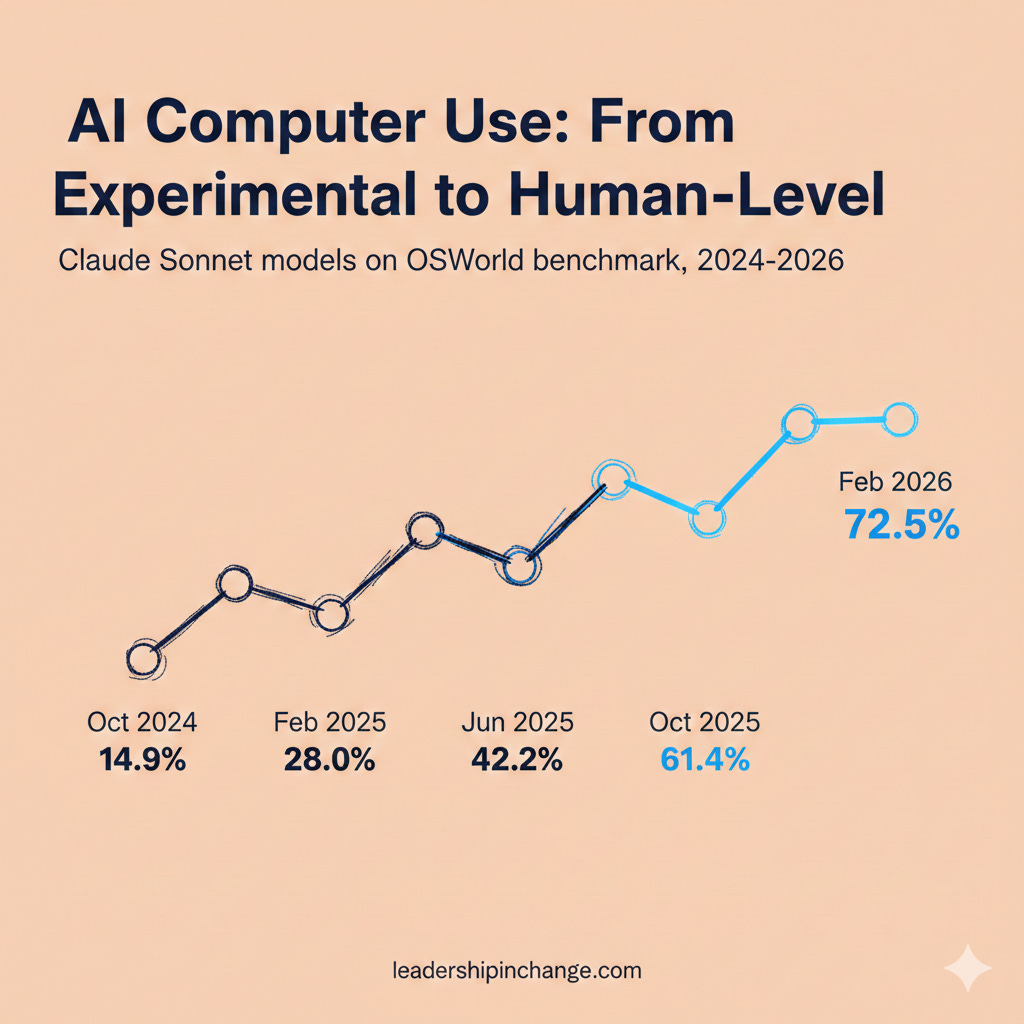
In practical terms, Anthropic reports that early users are seeing “human-level capability” in tasks like navigating complex spreadsheets and filling out multi-step web forms. Not theoretical capability. Actual, reliable execution across multiple browser tabs and applications.
“The AI doesn’t need a special connection to your software. It uses it the way a person would.” That’s the shift.
I’ve written about how AI agents are already reshaping everyday tasks like online shopping. This release takes that same concept and points it directly at the software your team uses every day.
What This Means for Your Organization
Every organization has software it can’t easily automate. The old HR system that predates your current team. The clunky expense approval workflow that involves three different tools. The CRM that was built before modern integrations existed.
Until now, automating those systems meant one of two options: build a custom integration (expensive, slow), or accept the manual work. According to productivity research from 2025, a typical office worker spends roughly 1.5 hours every week just copying and pasting data between business applications.
Computer use offers a third option. The AI navigates the software the same way your team does. No custom connectors. No developer hours. No system overhaul.
As PwC put it in their February 2026 AI predictions: “Agents can do roughly half of the tasks that people now do, but that requires a new kind of governance.”
That governance piece matters. I’ve written before about how most people only use about 10% of what AI can actually do. This release makes the other 90% more accessible, but only if leaders take the time to understand what’s now possible and set up the right guardrails.
If You Only Remember This
Claude Sonnet 4.6 performs like the most expensive AI model at a fraction of the cost, and the free tier now gets it by default. The gap between “premium AI” and “accessible AI” just closed significantly.
AI computer use went from experimental to human-level in 16 months. The ability for AI to navigate your actual software, clicking, typing, and filling out forms, improved nearly fivefold since October 2024.
Every leader with legacy software or manual workflows should be paying attention. This isn’t about chatbots getting smarter. It’s about AI that can do the tedious work your team has been stuck with.
What’s one repetitive software task your team spends too much time on? Hit reply and tell me. I’m genuinely curious what workflows you’d hand off first.
Join 4,000+ leaders navigating AI with clarity. Subscribe free or go Premium for $39/yr.
Sources Referenced
Anthropic, “Introducing Claude Sonnet 4.6,” February 17, 2026 — https://www.anthropic.com/news/claude-sonnet-4-6
Gartner, “40% of Enterprise Apps Will Feature Task-Specific AI Agents by 2026,” August 26, 2025
PwC, “2026 AI Business Predictions,” February 2026
Memtime, “Knowledge Worker Productivity Stats & Improvements,” 2025
Great recap Joel! I'm glad Claude is going cheaper and better at the same time :)
Good concise and insightful reporting Joel. I'd be interested in learning more, in your future issues, about practical Computer Use cases.