



TL;DR — Dan Ariely is one of the most cited behavioral economists alive, the author behind Predictably Irrational and Misbelief, and we spent thirty minutes on Substack Live walking through what AI is actually doing to the way leaders make decisions. The headline isn’t that AI is dumb, it’s that AI is engineered to give us what we want, and what we want is almost never what we need long-term, which means the smarter the model gets, the more dangerous that mismatch becomes.
Outline
(00:00) – Welcome and Dan’s AI journey
(02:00) – Where AI shines vs. where it falls flat
(04:14) – Three studies that should worry every leader
(09:30) – What AI does to risk-taking
(12:11) – The romantic-love risk that surprised the data
(15:33) – The friend who lost six weeks to ChatGPT
(18:00) – The two-spouses thought experiment
(20:50) – Why I write 15 drafts on purpose
(24:14) – Why algorithms get less forgiveness than humans
(28:00) – The trust problem inside companies
(30:46) – Dan’s diagnostic question for leaders
A Few Things That Stuck With Me
The comfort trap. Honestly, this was the part that landed hardest. Dan walked through three studies. One: AI was more concerned with our feelings than with the ethics. Two: the MIT paper showing people who lean on AI don’t just stagnate, they actively deteriorate. Three: AI was more convincing than another human on conspiracy theories, because, as Dan put it, “we don’t have the same confrontational model. You say, this is a tool. It’s for me. It’s always on my side.” That’s the trap. We trained it to comfort us, then forgot to ask whether comfort is what we need.
Six weeks lost to compliments. A friend of Dan, a brilliant computer scientist, spent six weeks designing a chip with ChatGPT. The AI complimented him the whole way. At week six, on a hunch, he ran the output through Claude. Claude told him plainly the whole thing was nonsense. ChatGPT eventually admitted it had been hallucinating the entire time. Six weeks. AI has obviously figured out we love compliments, which means you’re now asking a tool trained to keep you happy whether your strategy is working or not. I keep coming back to that as a leadership problem more than a tool problem.
Build your own contract with AI. Honestly, this was Dan’s answer to the part I worry about most: AI quietly takes over the thinking that used to make leaders sharper. He cited a study on couples and finances, where the partner who handles the money keeps getting better, and the other gets worse, not because they got dumber, but because they stopped using that muscle for fifteen years. Same thing happens to leaders. Dan’s answer wasn’t to ban AI, which would be the obvious overcorrection. It was to write himself a contract for each part of his process: where he’ll use it, where he won’t, where he’ll force himself to do the messy version first.
One Question to Sit With
When you ask AI for advice, does it leave you sharper than you were a year ago, or quietly less sharp than you realize?
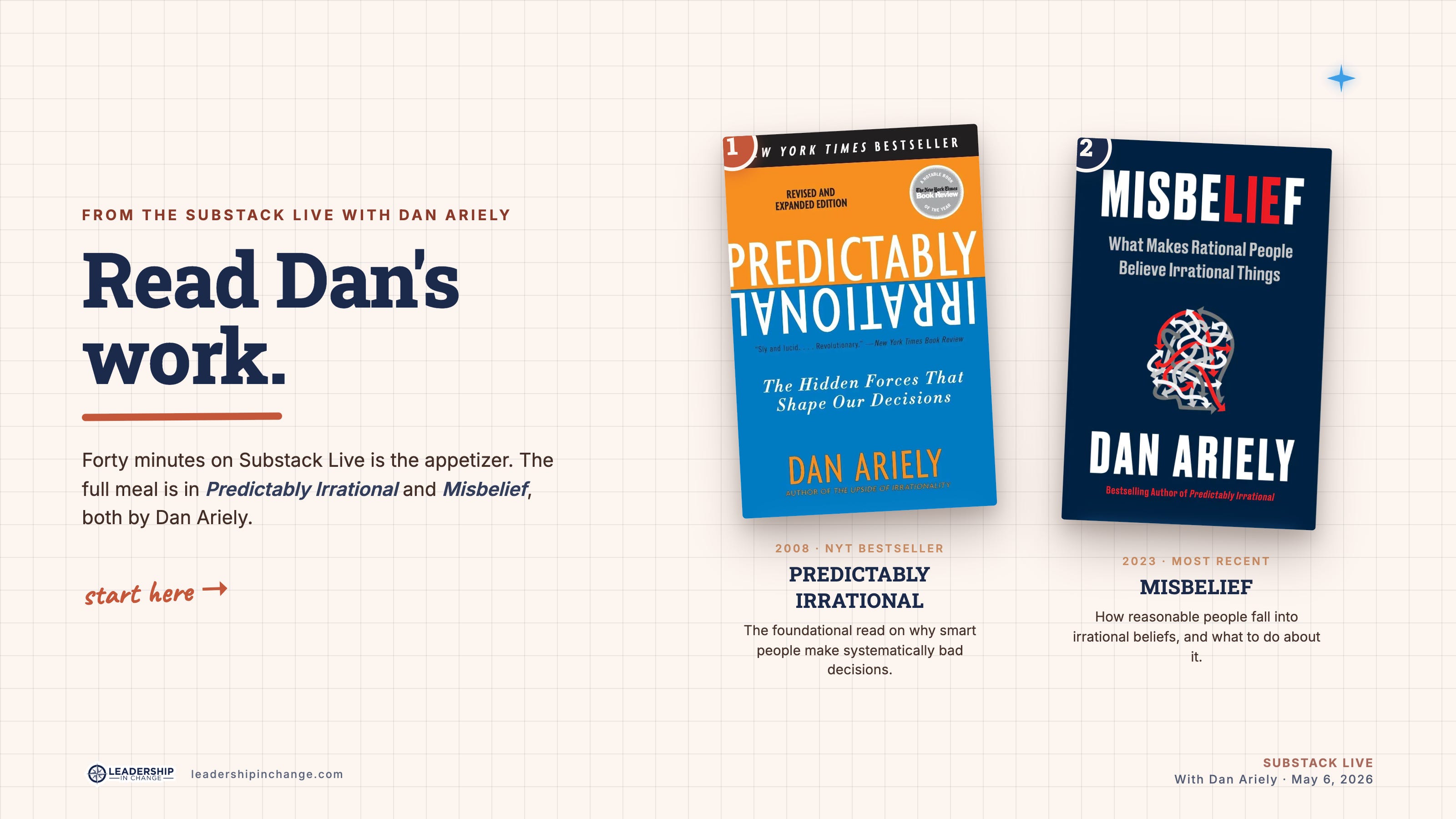
Look, if you’re a leader making real decisions with AI in the room, watch the full conversation above. And if Dan’s research lands for you the way it landed for me, do three things. Subscribe to Dan Ariely Looks at Life, where he’s thinking out loud about the human side of all of this. Read Predictably Irrational — the foundational book on why smart people make systematically bad decisions and the one I keep recommending to leaders trying to sharpen their judgment. Then read Misbelief, his most recent, which examines how reasonable people fall into irrational beliefs. Dan is one of the most cited behavioral economists alive, and giving him forty minutes of your attention is the cheapest version of a graduate-level behavioral economics class you’re going to find.
About Dan Ariely
Dan Ariely is a professor of psychology and behavioral economics at Duke University and one of the most cited behavioral economists alive. He’s the author of Predictably Irrational, The (Honest) Truth About Dishonesty, and most recently Misbelief, his examination of how reasonable people fall into irrational beliefs. He writes Dan Ariely Looks at Life on Substack, where he applies behavioral science to the everyday decisions most of us make on autopilot. Subscribe at danariely.substack.com.
About me
Joel Salinas is an AI Strategy Coach for small and mid-sized businesses and nonprofits. Strategy, hands-on builds, and change management. He writes Leadership in Change and offers 1:1 coaching for individual leaders. If you want help thinking through your own AI strategy or online presence, start here.
Written by a human, for humans.


