



TL;DR — Compound With AI is a Substack newsletter teaching 50,000 long-term investors how to compress six hours of stock research into about sixty minutes using AI prompts, Claude skills, and deep research workflows. We sat down on Substack Live this week and unpacked the actual mechanics, the prompt library, the multi-agent setup, the break-my-thesis move, the way he turns deep-research reports into NotebookLM podcasts to listen to while he’s training.
Outline
(00:00) – Welcome and how I found Compound With AI
(02:30) – The deep research “cheat code”: six hours becomes sixty minutes
(06:30) – Index funds for 99% of people, individual stocks for the rest
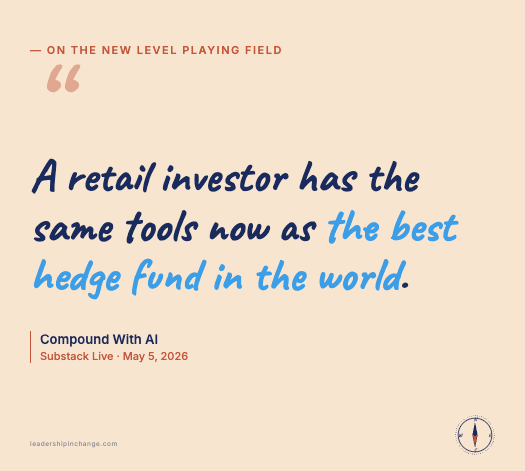
(08:50) – Why retail investors now have the same tools as the best hedge funds
(12:30) – The multi-agent setup: industry, earnings, risk, stock analyst
(14:00) – The coffee shop walkthrough: thinking like an owner, not a buyer
(17:30) – Reading ten years of management track record in minutes
(22:00) – The professional learner edge
(24:50) – Pen and paper before the prompt: why one prompt takes an hour
(29:30) – Walking through Exxon from zero
(32:30) – Turning deep research into a training-podcast with NotebookLM
(34:00) – The “break my thesis” agent
(43:30) – Where AI in investing is heading next
A Few Things That Stuck With Me
The deep research cheat code. So Compound With AI said something I want every leader to hear, because it lines up with what I’ve been seeing across coaching engagements all year. He said deep research changed everything for him about a year ago. Before that, getting to a real understanding of a new business took five or six hours of reading reports, and getting to a new industry from zero could take weeks. Now he runs the right prompt against deep research in Gemini or Claude or ChatGPT, walks away, and comes back to a structured ten-page report he can actually act on. “When this started working for me, I said, okay, this is a game changer. I used to do this and it would take five, six hours. And if you don’t know the industry, it would take weeks because you’re starting from zero.” The leaders I keep watching get unstuck are the ones who finally let AI do the part of the work that was burning their hours, the part that was always research disguised as judgment.
The coffee shop walkthrough. This was the cleanest explanation of what real stock analysis is that I’ve heard live. He said, look, if you and I were going to open a coffee shop together, the first thing we’d do is walk down the street and count how many other coffee shops are already there. Then we’d think about what makes people walk into one shop instead of another, branding, margins, location, the way the staff smiles. He treats every stock the same way, and his prompts force AI to do the exact same exercise. “When people buy Starbucks the stock, they say, ‘Starbucks is a big brand, let’s buy it.’ They don’t do all the work because it’s kind of virtual money. And that’s the big issue for me.” This is the single most useful frame in the conversation. If you can explain out loud how a business actually makes money, you can prompt AI to dig into it, and if you can’t, no prompt in the world is going to rescue you, which is why I keep telling the leaders I coach that AI literacy starts with business literacy.
Pen and paper before the prompt. Here’s the moment I most wanted to slow the conversation down on. He builds his prompts on paper first, by hand. He sits with a question, writes ten or fifteen sub-questions a smart human analyst would actually ask, and only then translates that to a typed prompt. One prompt takes him about an hour. Then he tests it on five or six stocks he already knows cold, so he can spot what the AI is missing. “To build one prompt I take one hour. I write pen and paper. Not everybody is willing to do the work.” Honestly, that admission was worth the whole hour for me. The hype industry sells AI as effortless, and the people I see getting real results are doing the slowest, boring part of the work, the part nobody puts in the demo videos: writing down the questions a smart human would ask before they ever touch the tool.
The “break my thesis” agent. Here’s the move that landed hardest for me. Once Compound With AI has built a real reason to invest in a stock, instead of running another agent to confirm the thesis, he runs one specifically built to argue against him, hands it the bull case, points it at his own frameworks, and tells it to break the thesis. “Tell me what are the problems. And sometimes, honestly, AI will point to things you didn’t think about. And that’s very interesting.” I love this move because it flips the default way most leaders touch AI. Most people are quietly using AI to confirm what they already think, which is the fastest way to get a worse decision than if you’d just asked nobody at all. The investors who actually outperform are pointing AI at their own conclusions and asking it to break them, which is closer to how Buffett and Munger have always operated together, with Charlie’s whole job being to find the holes in Warren’s reasoning.
(If you’re a leader thinking about where AI actually belongs in your own work and you’d like another set of eyes on it, this is the kind of thinking I do every week with the leaders I coach. You can start here if it would help to talk one through together.)
One Question to Sit With
What’s one domain in your own work where you’ve been prompting AI generically, when you could be sitting down for an hour and building a prompt library you’d use for the next ten years?
Honestly, the floor is rising for everyone with AI in their hands now, the ceiling moved up with it, and the only thing left to decide is whether you choose to be a professional learner.
Look, if you invest your own money, watch the full conversation above. And honestly, go subscribe to Compound With AI. Fifty thousand long-term investors are already inside, and the prompt library and weekly workflows are some of the most rigorous AI-for-investing material I’ve found anywhere on Substack.
About me
Joel Salinas is a Fractional Chief AI Officer for small and mid-sized businesses and nonprofits. Strategy, hands-on builds, and change management. He writes Leadership in Change and offers 1:1 coaching for individual leaders. If you want help thinking through your own AI strategy or online presence, start here.
Written by a human, for humans.


