



TL;DR — AI made content production almost free, which means producing it is no longer what separates the creators who grow from the ones who stall. Trust, voice, and the depth of your actual expertise are. Call it the trust premium. In a Substack Live with Philip Hofmacher, cofounder of Write × Build × Scale, we walked through the litmus test that tells you whether AI is amplifying you or quietly replacing you, and why the creators winning the next 12 months are the ones loading their context, not their prompts.

Outline
(00:00) – Welcome and how I found Write × Build × Scale
(02:00) – Building a business and a marriage with your cofounder
(03:35) – From tennis to Skillshare to Substack: the platform-pivot lesson
(09:30) – The value of community and masterminds
(13:34) – How AI changed content creation in two years
(17:25) – The sameness problem and the trust premium
(22:00) – Lazy AI vs. strategic AI
(24:54) – The litmus test: are you more of an expert than a year ago?
(28:54) – Philip’s ChatGPT workflow and my Claude workflow
(32:18) – Personal brand: stories beat lists
(39:42) – Advice for creators stuck at 200-500 subscribers
(45:46) – Philip’s billboard: AI amplifies you, or replaces you
A Few Things That Stuck With Me
The trust premium. So Philip Hofmacher said something on the live that just landed for me.
“It got so easy to create products compared to how hard it is to sell something.”
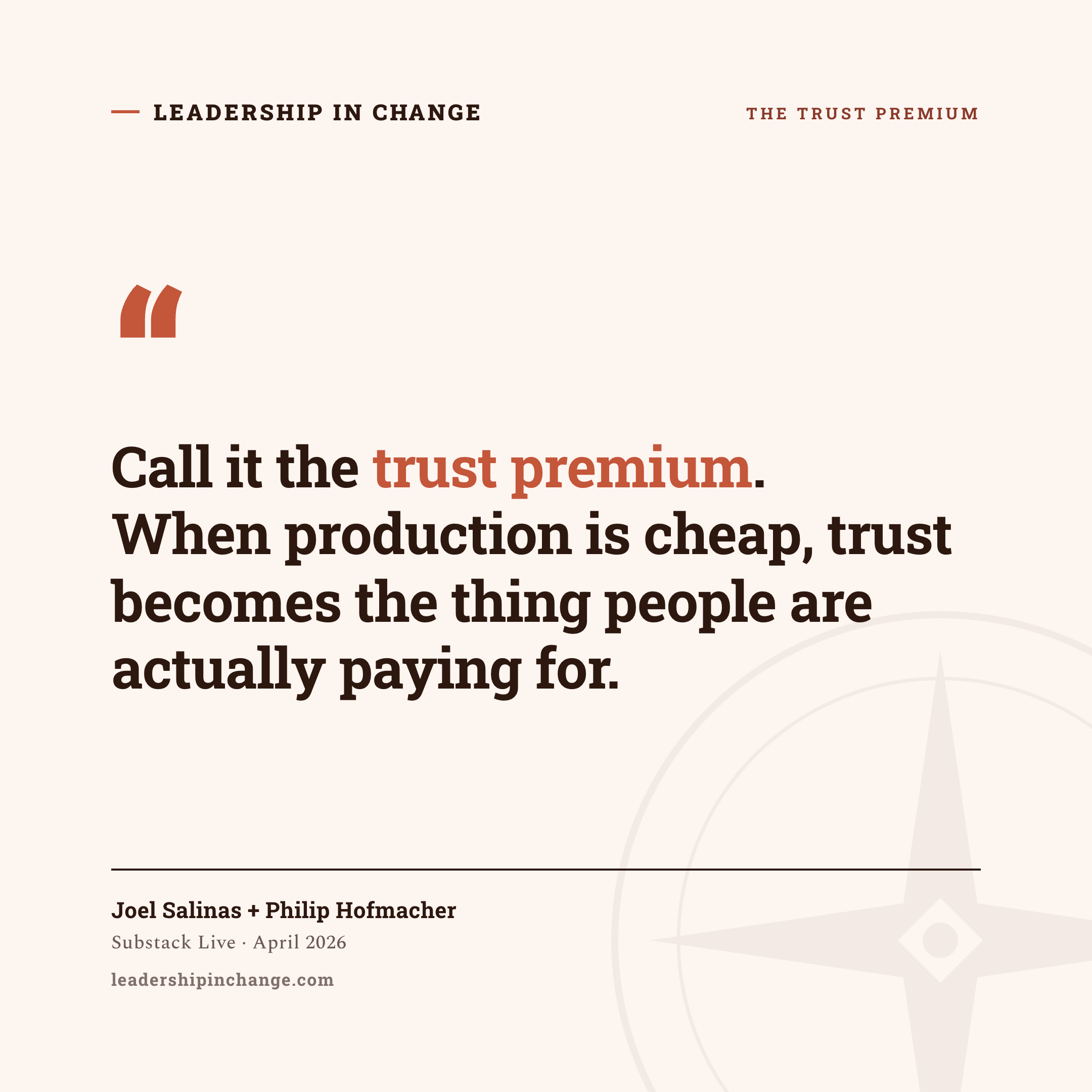
Ten years ago, when he was selling Skillshare courses on Instagram growth, the work was eighty percent making the course and twenty percent selling it. Now he says it’s the inverse. Building the product is the cheap part. Earning the trust to get somebody to actually consume it, that’s the expensive part. Honestly, the whole conversation lives in that one sentence. Call it the trust premium. When AI made production almost free, trust became the thing people are actually paying for.
The research-assistant analogy. I used this on the live because it’s the analogy I keep coming back to with the leaders I coach. Look, if you hire a research assistant and you tell them, “find me information on Write × Build × Scale,” they’re going to go out and pull whatever’s public. They don’t know your angle. They don’t know what you’re actually trying to do, who your readers are, or what your point of view is on the topic. So they bring back the most generic version of what’s out there. That’s not on the research assistant though, that’s on you, because you sent them out empty-handed. AI is the exact same thing. The creators who use AI well aren’t smarter than everybody else. They figured out one boring thing earlier than most people, which is that AI on its own gives you the same average answer it gives everybody, and unless you take the time to load up the context first, the version you publish is going to look exactly like the version everybody else publishes.
The litmus test. Here’s the question I tell every leader I coach to ask themselves, and I asked it on the live. Look at yourself a year ago. Are you more of an expert at what you do than you were twelve months ago? If yes, you’re using AI right. It’s compounding you, freeing the time you used to spend on grunt work and routing it back into the work that actually grows your craft, and you can feel it because you’re sharper than you were. If no, AI isn’t actually amplifying you, even if it feels like it is. What’s happening is slower and quieter than that. It’s doing the thinking that used to make you better, and the longer that goes on, the more your expertise quietly hollows out, until one day somebody notices you don’t actually know more than the model does. Philip closed the loop on the live, after I floated the idea. He said, “Basically using AI to become a better version of yourself, a better operator, a better business owner.” Same thing.
Stories beat lists. Here’s the part of the conversation I keep coming back to. Philip mentioned his cofounder Jari’s dog, who apparently shows up in their community so often that when they announced an in-person event, the first question people asked was whether the dog would be there. He talked about his wife Sinem, who’s also his cofounder. I mentioned my seven-year-old, who’s been campaigning for a dog all month. None of that was strategy talk or monetization advice, just two real people talking shop on a Monday morning, occasionally laughing about their kids and their dogs. That’s the part AI can’t reproduce yet, and honestly probably never will. That’s the moat.
I work with leaders on exactly this, executives, marketing VPs, nonprofit CEOs trying to figure out how to show up in the AI era without sounding like every other person on Substack. If it would help to talk this through, here’s my calendar.
Let us know in the comments…
Are you better at your craft than you were a year ago? If the answer’s no, what’s AI actually doing for you?
Look, if you write or build anything online, watch the full conversation above. And honestly, go subscribe to Write × Build × Scale. Philip Hofmacher, Sinem Günel, and Jari Roomer are running the most useful creator-economy publication I’ve found, and most of what I’ve actually figured out about Substack in the last six months traces back to their work.
Joel Salinas is a Fractional Chief AI Officer for small and mid-sized businesses and nonprofits. Strategy, hands-on builds, and change management. He writes Leadership in Change and offers 1:1 coaching for individual leaders. If you want help thinking through your own AI strategy or online presence, start here.
Written by a human, for humans.


