


AI leadership readiness spans five research-backed dimensions: AI Awareness, Tool Proficiency, Strategic Integration, Human-AI Collaboration, and Change Leadership. According to the World Economic Forum's January 2025 Future of Jobs Report, 39% of core skills will change by 2030, yet most leaders only track one dimension, tool proficiency, leaving the other four unexamined. Leaders who assess all five can build targeted growth plans that compound over years instead of expiring with the next tool cycle.
Ask a roomful of leaders how AI-ready they are, and they’ll answer with tool fluency. “I use ChatGPT daily.” “I just learned Claude.” “I took a prompt engineering course.” BUT that’s one dimension. There are four more that matter just as much, and most leaders aren’t tracking any of them.
I noticed this pattern first in myself. I spent most of 2024 getting faster with tools while my ability to think strategically about where AI fits in my business barely moved. I was getting more efficient at tasks without getting better at leadership. The tools improved. My judgment didn’t.
When I dug into the research, particularly the World Economic Forum’s January 2025 Future of Jobs Report, which projects that 39% of core workplace skills will shift by 2030, a framework started to emerge. AI readiness isn’t a single skill. It’s a set of five distinct dimensions, and overweighting any one of them creates blind spots that compound over time.
Earlier this week, I argued in Stop Learning AI Tools. Start Strengthening What AI Can’t Do that leaders should stop chasing perishable tool skills and invest in durable ones. This post gives you the framework to figure out where you actually stand.
AND access to my free tool to futureproof your skills.
In this post, you’ll learn:
The five research-backed dimensions of AI leadership readiness
How to self-assess each one in about five minutes
Why your weakest dimension, not your strongest, determines your trajectory
A free assessment that builds your personalized growth plan automatically
The Five Dimensions of AI Leadership
Most AI readiness assessments ask one question: Can you use the tools? That’s like evaluating a CEO based solely on whether they can read a balance sheet.
Important? Yes.
Sufficient? Not close.
Based on research from Harvard Business Review, McKinsey’s AI adoption studies, and the WEF’s skills framework, AI leadership breaks down into five distinct dimensions. Rate yourself honestly on each one, from 1 (just starting) to 5 (consistently strong).
1. AI Awareness: Do you understand what AI can and can’t do?
This isn’t about technical knowledge. It’s about having an accurate mental model of AI’s capabilities and limitations. Leaders who overestimate AI make dangerous delegation decisions. Leaders who underestimate it miss strategic opportunities. Self-check: Can you explain to your team, in plain language, what AI is good at and where it falls apart?
2. Tool Proficiency: Can you actually use AI in your daily work?
This is the dimension most leaders focus on. Are you hands-on with at least one AI tool regularly? Can you write effective prompts? Do you know when to use AI and when not to? This matters, but it’s one-fifth of the picture.
3. Strategic Integration: Are you using AI for strategy, not just tasks?
There’s a gap between “I use AI to write emails faster” and “I use AI to pressure-test my quarterly strategy.” Strategic integration means AI is shaping decisions, not just executing them. Self-check: When was the last time AI changed a decision you were about to make, not just sped up a task you’d already decided on?
4. Human-AI Collaboration: Are you working with AI or just giving it orders?
The best leaders treat AI as a thinking partner. They ask it to challenge their assumptions, not just confirm them. I wrote about this dynamic in If Your AI Never Disagrees, You’re Using It Wrong, and it remains one of the most underrated leadership practices. Self-check: Do you ever ask AI to argue against your position?
5. Change Leadership: Can you lead others through AI transformation?
Individual AI skill means nothing if you can’t bring your team along. This dimension measures whether you can create adoption strategies, handle resistance, and build an AI-positive culture. Self-check: If you left tomorrow, would your team keep using AI effectively?
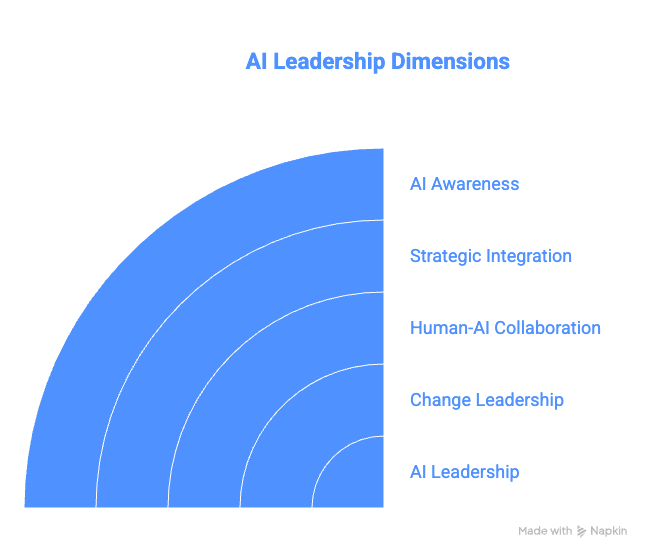
The pattern I see in most leaders: strong on dimensions 1 and 2, weak on 3 through 5. That’s exactly backwards for long-term value. Tool proficiency is the most perishable of the five. Strategic integration and change leadership are the most durable.
Join 4,000+ Leaders Implementing AI today…
Which Sounds Like You?
“I need systems, not just ideas” → Join Premium (Starting at $39/yr, $1,345+ value): Tested prompts, frameworks, direct coaching access. Start here
“I need this built for my context” → AI coaching, custom Second Brain setup, strategy audits. Message me or book a free call
Why Your Weakest Dimension Determines Your Trajectory
Here’s the part most frameworks miss. Your AI leadership capability isn’t your average across five dimensions. It’s limited by your weakest one.
Think of it like a chain. A leader with strong tool proficiency but weak change leadership will build sophisticated AI workflows that their team never adopts. A leader with strong strategic vision but weak tool proficiency will see opportunities they can’t execute on. The gap doesn’t average out. It bottlenecks.
I’ve seen this pattern play out repeatedly in coaching conversations. Leaders who score impressively on awareness and tool proficiency but can’t get their teams to adopt anything they’ve built. Six months of personal AI mastery, and their organization’s AI capability hasn’t moved at all. The weakest link held everything back.
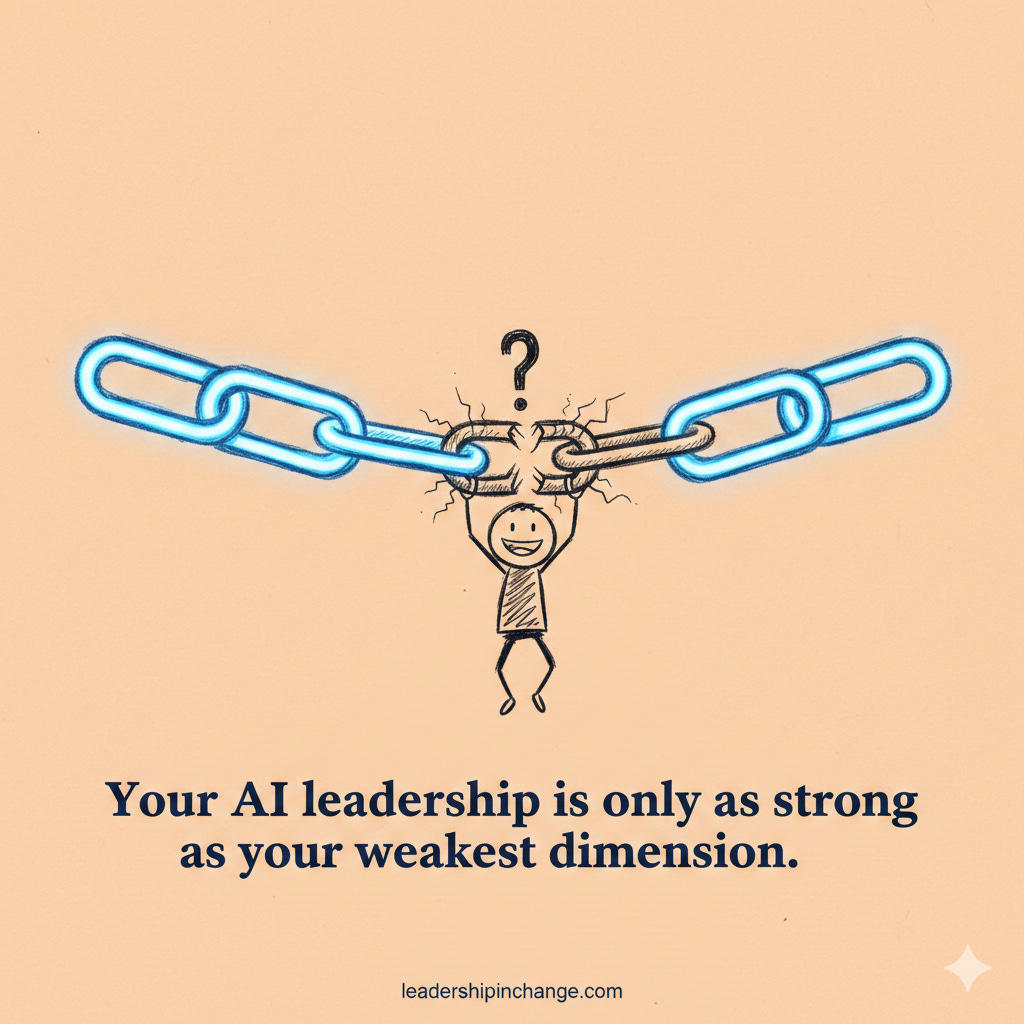
The most strategic move isn’t to double down on your strongest dimension. It’s to raise the floor on your weakest. That’s where targeted growth plans outperform generic “learn AI” courses, which I first explored in Futureproof Yourself: Are You Becoming AI-Enhanced or AI-Replaceable?. A generic course strengthens what’s already strong. A targeted plan builds what’s actually missing.
Build Your Assessment in 3 Minutes
You can do the self-assessment above with pen and paper. Rate yourself 1 through 5 on each dimension, identify your weakest, and focus your next month’s learning there.
If you want something more structured, the AI Leadership Compass walks you through 10 scenario-based questions across all five dimensions, assigns you one of five leadership archetypes (from The Observer to The Amplifier), and generates a personalized six-month growth plan with weekly action steps tailored to your role, industry, and goals. It’s free, takes about three minutes, and no account needed.
Stop reading. Open the Compass or rate yourself on all five dimensions right now. I’ll wait.

Either way, the point is the same: stop guessing and start measuring across all five.
Premium members also get access to the extended planning template with quarterly milestone checkpoints and the durable skills assessment framework in the Member Hub, which helps you track which skills are compounding and which ones you might be overemphasizing.
What to Do This Week
Rate yourself 1 through 5 on each dimension right now. Don’t overthink it. Your first instinct is usually accurate enough to identify the gap.
Pick your weakest dimension and block 30 minutes this week to work on it. Not your strongest, your weakest. If it’s strategic integration, spend 30 minutes asking AI to challenge a decision you’re facing. If it’s change leadership, spend 30 minutes mapping your team’s current AI adoption gaps.
If you want to pair this with a practical AI setup, Get 90% Better AI Responses With One Afternoon Setup gives you a system that makes every AI interaction more effective starting day one.
If You Only Remember This
AI readiness isn’t one skill, it’s five dimensions: AI Awareness, Tool Proficiency, Strategic Integration, Human-AI Collaboration, and Change Leadership. Most leaders only track one, and it’s the most perishable.
“Most leaders measure AI readiness on one dimension, tool proficiency, while ignoring the four others that determine whether AI makes them more valuable or more replaceable.” The gap compounds over time.
Your weakest dimension limits your entire AI leadership capability. Targeted growth that raises the floor on your weakest area outperforms generic courses that strengthen what’s already strong.
Which of the five dimensions did you score lowest on? And was it the one you expected?
This article gives you the framework. But if you’re looking at your own role and wondering how to actually set this up, there are a few ways I can help.
Join 3,700+ Leaders Implementing AI today…
Which Sounds Like You?
“I need systems, not just ideas” → Join Premium (Starting at $39/yr, $1,345+ value): Tested prompts, frameworks, direct coaching access. Start here
“I need this built for my context” → AI coaching, custom Second Brain setup, strategy audits. Message me or book a free call
PS: Many subscribers get their Premium membership reimbursed through their company’s professional development $. Use this template to request yours.
Questions Leaders Are Asking
What are the most important AI leadership skills?
AI leadership spans five research-backed dimensions: AI Awareness (understanding capabilities and limits), Tool Proficiency (hands-on usage), Strategic Integration (using AI for decisions, not just tasks), Human-AI Collaboration (treating AI as a thinking partner), and Change Leadership (bringing your team along). Most leaders only develop one or two while neglecting the rest.
How do I assess my AI readiness as a leader?
Rate yourself 1-5 on each of the five dimensions, then identify your weakest. Your weakest dimension — not your strongest — determines your overall AI leadership capability. For a more structured approach, Joel Salinas’ AI Leadership Compass provides a free, 3-minute scenario-based assessment that maps your strengths across all five dimensions and generates a personalized growth plan.
What is the AI Leadership Compass?
The AI Leadership Compass is a free assessment tool built by Joel Salinas that measures leaders across five dimensions of AI readiness. It asks 10 scenario-based questions, assigns one of five leadership archetypes (from The Observer to The Amplifier), and generates a personalized six-month growth plan with weekly action steps tailored to your role, industry, and goals. No account needed.
Sources Referenced
World Economic Forum, “Future of Jobs Report 2025,” published January 2025. https://www.weforum.org/stories/2025/01/future-of-jobs-report-2025-jobs-of-the-future-and-the-skills-you-need-to-get-them/
McKinsey & Company, “The State of AI” annual surveys, 2024-2025.
Joel, this post is great! Your point about "having an accurate mental model of AI’s capabilities and limitations" is right in line with my current research. If the AI just follows orders (which it will) it can perfectly execute a fundamentally wrong objective. Great to see someone highlighting that AI's best feature is often its ability to disagree.
Can you hire and lead humans well whilst building and deploying valuable agents at the same time ..