


AI leadership skills matter more than tool mastery. According to the World Economic Forum’s January 2025 Future of Jobs Report, 39% of core workplace skills will change by 2030, yet 8 of 10 most-requested skills remain fundamentally human. Leaders who treat AI as an amplification layer for their judgment see productivity gains of 30-35%, while leaders who outsource thinking to AI gradually lose the very expertise that makes them valuable.

There’s a river current running under every organization right now, and it’s splitting leaders into two groups.
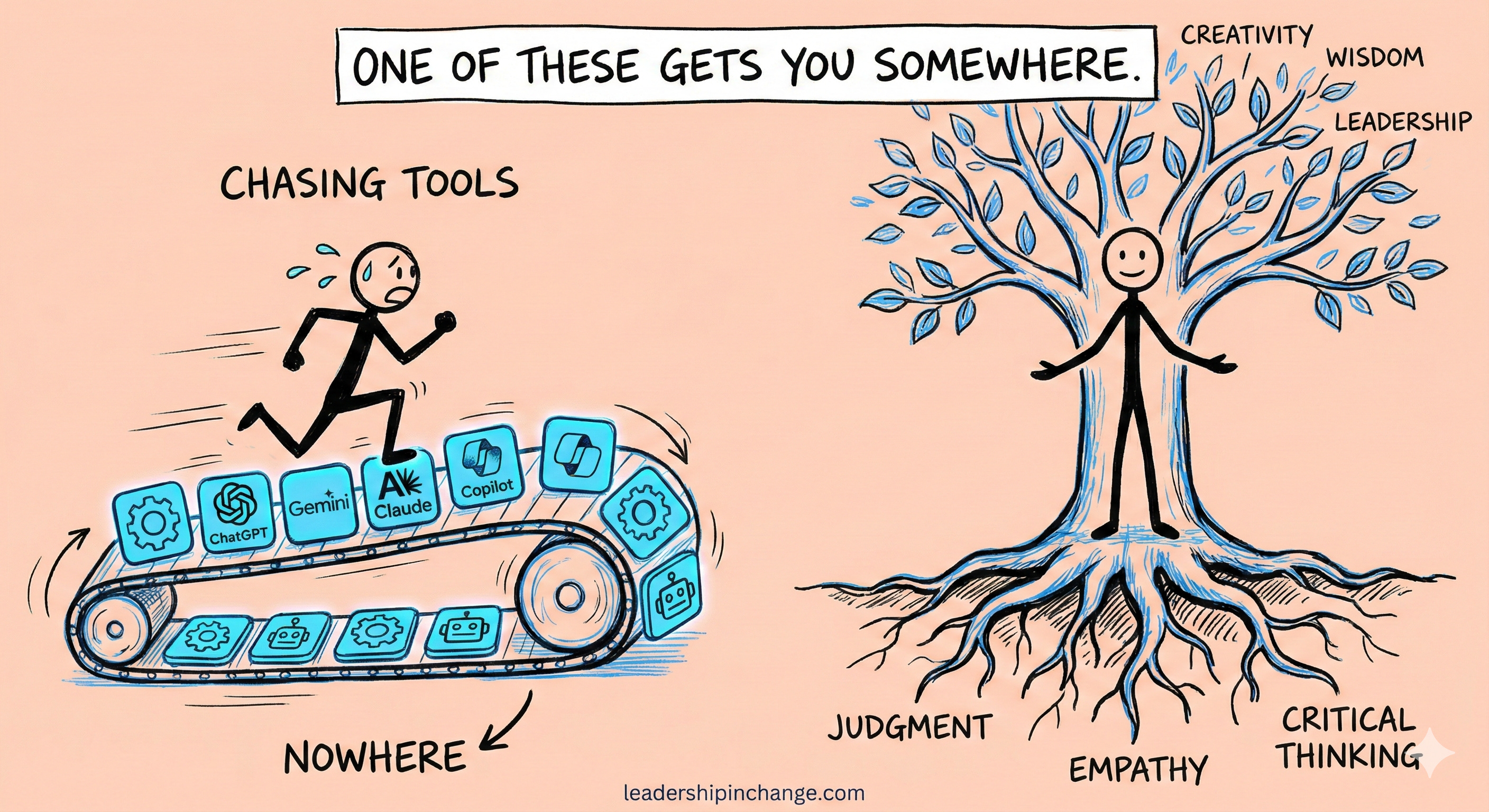
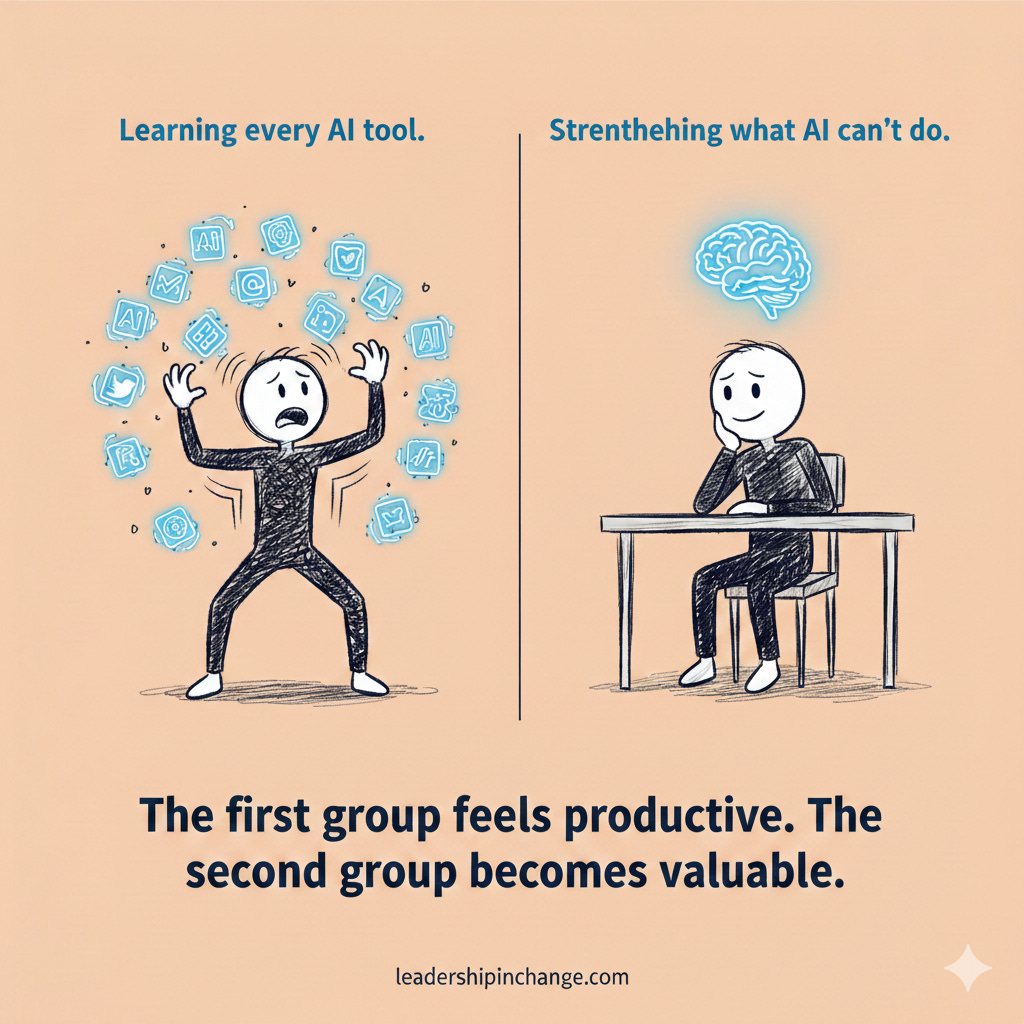
On one side: leaders who are learning AI tools faster than they can name them, chasing certifications, collecting prompts, staying ahead of the latest feature drops.
On the other side: leaders who decided to stop chasing tools and start thinking differently about how they work.
The first group feels productive. The second group actually becomes more valuable.
For two years, I feel like I treated AI like every other technology wave that comes through. Learn the tool. Master the feature. Move to the next one. I spent hours researching Claude vs. ChatGPT vs. whatever new model dropped and was all over Substack. Familiar? And I got good at the tools, but I wasn’t getting better as a leader.
Then, I realized the divide isn’t between people who use AI and people who don’t. It’s between leaders who use AI to amplify their real strengths and leaders who use AI as a shortcut that slowly dulls their own thinking. One approach makes you more dangerous… the other makes you essential.
In this post, you’ll learn:
Why the AI skills you’re chasing have a guaranteed expiration date
The framework that separates productivity gains from hollow efficiency
One question that changes how you allocate your learning time entirely
Why the AI Skill You’re Chasing Has a 2-Year Shelf Life
Here’s something that should concern you more than ChatGPT’s latest update: according to the World Economic Forum’s January 2025 Future of Jobs Report, 39% of core workplace skills will shift by 2030. That’s not coming eventually. That’s five years from now.
But there’s a hidden detail in that same report that most leaders miss. While nearly 40% of skills are changing, research from IBM’s Skills Transformation initiative reveals something else entirely. Durable skills, the ones built on judgment, pattern recognition, and adaptation, have a half-life (the time it takes for a skill to lose half its value in the marketplace) of 7.5 years or longer. Perishable skills, the tool-specific ones, become obsolete in less than 2 years.
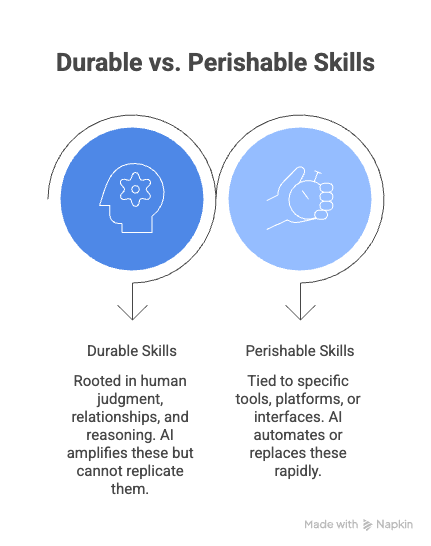
You’re probably spending your time on the wrong pile.
Join 4,000+ Leaders Implementing AI today…
Which Sounds Like You?
“I need systems, not just ideas” → Join Premium (Starting at $39/yr, $1,345+ value): Tested prompts, frameworks, direct coaching access. Start here
“I need this built for my context” → AI coaching, custom Second Brain setup, strategy audits. Message me or book a free call
When I looked at the America Succeeds job posting data, the pattern became clearer. Eight of the ten most-requested skills weren’t about technical tools. They were about judgment, communication, strategic thinking, and the ability to synthesize complex information. The tool changed. The skill didn’t. The tool changes again next year. The skill survives the next decade.
The gap between learning tools and strengthening judgment is widening. The tools are becoming more accessible, which means tool mastery is becoming less differentiated.
What actually separates leaders isn’t whether they know how to use Claude or ChatGPT. It’s whether they kept their own thinking sharp while outsourcing execution.
What Amplification Looks Like: From 6 Hours to 90 Minutes
Let me give you a real example. I worked with a client who writes opinion pieces for a national publication. Each piece took him six to eight hours. Strong ideas. Original voice. Good research. But everything took time because he was doing everything.
We brought AI into the execution layer. His ideas, his expertise, his voice, those stayed exactly where they belong: with him. AI helped him organize research faster, test the structure of his arguments before committing to a draft, and clean up prose he’d already shaped with his own judgment.
The result? His workflow dropped to around ninety minutes. Same quality. Same voice. Same editorial standards. His editor didn’t notice a difference because there wasn’t one. The difference was in how much of his life he got back. He focused on what only he could do, and left repetitive execution and most of the research to AI.
When you outsource thinking instead of execution, AI doesn’t amplify you. It replaces you.
I explored this risk in more depth in Don’t Outsource Your Thinking (Even to AI), and the stakes have only gotten higher since.
The One Question That Changes Everything
Stop for a moment and ask yourself this: where am I spending my learning time? On tools that will change in six months, or on capabilities that will compound for the next decade?
Here’s a concrete exercise. Spend 15 minutes doing this: list your ten most-used skills as a leader. Go through each one and mark whether it’s durable or perishable. Is it something that will be valuable in 2035? Or does it have an expiration date?
If you want a more structured version of this, the AI Leadership Compass is a tool I built for the executives I coach, which maps where you actually stand across five research-backed dimensions of AI leadership in about three minutes. It's free, no account needed, and the results include a personalized growth plan built around your role and goals.

What you’ll probably find: the skills that made you valuable are the durable ones. And they’re getting weaker because you’re spending your energy on the perishable stuff.
This is not a call to ignore AI. This is a call to rethink how you engage with it. Use AI as relentlessly as you want. But use it on the execution layer while you’re actively strengthening the judgment layer. Ask harder questions. Read deeper. Disagree more often. These are the skills that survive tool obsolescence.
If you started this year with an AI tool detox as we recommended in Start 2026 With an AI Tool Detox (co-authored by Mia Kiraki 🎭 ), you already know what I’m talking about. The tool wasn’t the bottleneck. Your judgment was the asset. That clarity alone puts you years ahead.
If You Only Remember This
Durable skills compound for 7+ years; perishable skills (tools) expire in under 2.5 years. The question isn’t whether to use AI, but whether you’re spending learning time on things that will still matter in five years.
“The divide isn’t between people who use AI and people who don’t. It’s between leaders who use AI to amplify their real strengths and leaders who use AI as a shortcut that slowly dulls their own thinking.” One keeps you valuable. One gradually replaces you.
Professionals who keep judgment in the loop see 30-35% productivity gains, while those who outsource thinking gradually lose the expertise that makes them essential. Amplification beats shortcuts every time.
Of your ten most-used leadership skills, how many would still be valuable in 2035? And which ones have you been neglecting while learning new tools?
This article gives you the framework. But if you’re looking at your own role and wondering how to actually set this up, there are a few ways I can help.
Join 3,700+ Leaders Implementing AI today…
Which Sounds Like You?
“I need systems, not just ideas” → Join Premium (Starting at $39/yr, $1,345+ value): Tested prompts, frameworks, direct coaching access. Start here
“I need this built for my context” → AI coaching, custom Second Brain setup, strategy audits. Message me or book a free call
PS: Many subscribers get their Premium membership reimbursed through their company’s professional development $. Use this template to request yours.
Questions Leaders Are Asking
What are durable skills vs. perishable skills in AI?
Durable skills are capabilities built on judgment, communication, and strategic thinking that retain value for 7+ years. Perishable skills are tool-specific proficiencies (like mastering a particular AI interface) that become obsolete in under 2.5 years as tools update or get replaced. The World Economic Forum’s January 2025 report confirms 8 of 10 most-requested skills remain fundamentally human.
Should leaders stop learning AI tools?
No. The goal is to use AI tools relentlessly on the execution layer while actively strengthening the judgment layer. Leaders who keep their thinking sharp while outsourcing repetitive execution see 30-35% productivity gains. The mistake is spending all learning time on tools that expire instead of capabilities that compound.
How long do AI tool skills stay relevant?
According to IBM’s Skills Transformation research, perishable tool-specific skills have a half-life of less than 2.5 years. That means the prompt engineering course you took last year has already lost significant marketplace value. By contrast, durable skills like strategic thinking and pattern recognition retain value for 7.5+ years.
Sources Referenced
World Economic Forum, “Future of Jobs Report 2025,” published January 2025. https://www.weforum.org/stories/2025/01/future-of-jobs-report-2025-jobs-of-the-future-and-the-skills-you-need-to-get-them/
America Succeeds, “The Future of Work is Human: Why Durable Skills Are the Key to Workforce Success.” https://americasucceeds.org/the-future-of-work-is-human-why-durable-skills-are-the-key-to-workforce-success
IBM, “Skills Transformation for the 2021 Workplace.” https://www.ibm.com/new/training/skills-transformation-2021-workplace
‘
Should leaders stop learning AI tools?
No. The goal is to use AI tools relentlessly on the execution layer while actively strengthening the judgment layer.
‘
💯. fully agree with this sentiment. it’s what i wish every leader in my company would hear.
What landed most for me was your framing of “durable vs perishable” skills and the half-life of each; it’s a simple mental model that immediately changes how you allocate learning time. I’d love to see a follow-up where you walk through 3–5 concrete “durable skill practice loops” leaders can run each week so AI becomes a force multiplier on those muscles instead of a quietly corrosive shortcut.