


TL;DR - Claude has four levels of use, not one: Basic chat, Projects, Skills, and Claude Code. Most leaders stop at Level 1 and use Claude like a chatbot, getting average answers back. This four-level climb takes non-technical leaders from their first prompt to building and running their own AI tools.

The first time I opened Claude Code, I almost closed it. Black screen, blinking cursor, and every instinct I had told me I didn’t belong there. I’ve never written a line of code in my life. I typed one plain sentence anyway, watched it go to work, and felt the same ground shift I felt the first time I ever used AI back in 2022.
Here’s the thing. I didn’t get to that screen in one leap. I got there by climbing, one level at a time, starting with the most ordinary uses you can imagine. Most leaders never make the climb, because they’re using Claude (Anthropic’s AI assistant, the main rival to ChatGPT) like a chatbot. They ask it the occasional question, get an average answer back, and decide that’s all there is.
The gap between where they’re standing and what’s actually possible is enormous, and almost nobody has handed them a map across it.
So I built one.
I put the whole climb, every level, with screenshots of every step, into a 51-page field guide called Leading with Claude.
Before you read another word, here’s the part that matters:
If you’re a Premium subscriber to this newsletter, that guide is already yours, free, sitting in the link below.
If you’re not, you can grab it on Amazon for a few dollars, or get it free by upgrading to premium, which includes the book plus everything else I publish.
I’ll come back to that. First, let me give you the map itself, because you can climb every one of these levels on your own, and by the end of this post you’ll know exactly where you stand.
In this post, you’ll learn:
The four levels of Claude, from basic chat to building your own tools
A simple way to find which level you’re actually on right now
The one real example I use at each level to run four businesses, with no coding
AI isn’t one giant step
Most leaders treat AI as one giant step they’re either ready for or they’re not. That framing is the whole problem, because it isn’t a single step you take, it’s a climb you make in four levels, each one building on the last, and the first level is lower and more ordinary than anyone tells you. Here are the four bearings:
Level 1, Basic Claude. Talking to it well.
Level 2, Projects. Claude that remembers your world.
Level 3, Skills. Claude that does your repeatable work the way you’d do it.
Level 4, Claude Code. Claude that builds.
Most people are parked at the bottom and don’t know the other three levels are even there. Let’s climb.
Quick Win (under 60 seconds) Open any Claude chat. Before your next question, paste one sentence of context first: who you are, who the answer is for, and what a good answer looks like. Then ask the same question you were going to ask anyway. Put that answer next to the one you’d have gotten cold. The gap you just created is the entire point of Level 1.
Level 1: Basic Claude (talking to it well)
Level 1 is plain conversation, and the whole skill is context. When you type a bare question with no context, Claude does the only thing it can: it scans everything it knows, finds the most average answer, and hands it back. Give it the context first, who you are, what you’re working on, what good looks like, and you get something built for your actual situation. Same tool, completely different output.
Start where the stakes are zero. As of June 2025, 73% of ChatGPT messages were non-work, up from 53% a year earlier (OpenAI economic-usage research with the National Bureau of Economic Research, 2025). That’s not a knock on people, it’s how comfort gets built. My own Level 1 reps were ordinary: I had Claude translate my parents’ prescription instructions into Spanish, I used it to vet whether a book my kid wanted was age-appropriate, and I turned a dry geometry worksheet into right-triangle problems starring dinosaurs so a homework fight turned into a laugh. None of that mattered, and that’s exactly why it worked. The low-stakes reps are where you learn to tell a good answer from a weak one, and that judgment is what every level above this one stands on.
If you want to go deeper on this one move, I wrote a whole walkthrough on how one afternoon of setup gets you 90% better AI responses.
Level 2: Projects (Claude that remembers your world)
Plain chat has amnesia. Every new conversation, Claude wakes up knowing nothing about your company, your last decision, or the rules you spelled out yesterday. For low-stakes reps that’s fine. For real recurring work, that amnesia is a tax you pay in the five minutes you burn re-explaining yourself before you can ask the actual question.
A Project is how you stop paying it. It’s a workspace inside Claude that remembers. You load it once with the documents and the standing instructions for one slice of your work, and from then on every conversation inside it starts already up to speed. Think of it as guardrails on a road: it keeps one long stretch of work pointed the same direction so you don’t re-steer from scratch every morning.
The Project I lean on hardest is the one I write this newsletter in. Its knowledge holds two documents, my writing guide and a set of humanizing rules, and its standing instruction is one line: follow the guide, step by step, and don’t jump ahead until I sign off. That system took my article time from the better part of a day down to about 90 minutes. The setup tax went from “every time” to “once.”
Want the guided version of this climb, not just the overview? That’s the book, and it’s the one place I walk you up all four levels step by step. Premium members get the full 51-page Leading with Claude field guide free, plus the tested prompts, frameworks, and skill library. Become a premium member ($8/month or $49/year).
Level 3: Skills (work that sounds like you)
A Skill is a small, reusable package that teaches Claude how to do one specific job your way. You build it once, and from then on Claude recognizes when a job calls for it and follows your exact approach on its own, in any conversation. A Project keeps one road on course. A Skill is a tool in your pocket you can pull out on any road. The way I explain it: a Skill is the difference between asking a smart stranger at a conference for advice and asking your own COO. Both know business. Only one knows you.
You don’t write any code to build one. You describe how you do a job, then in Cowork (Claude’s desktop chat) you say “turn that into a Skill for me,” and Claude writes the whole thing. I run four businesses, and each one has its own brand Skill. When I ask for a one-pager to hand out at a conference, I never say which brand, Claude loads the right Skill on its own and uses the correct colors, voice, and messaging. I once built one live on a Substack session in a few minutes, an A/B title tester that takes any headline and returns three versions in the voices of writers I admire. The room watched a two-page prompt collapse into one sentence. I broke down five of the Skills I actually use in 5 Claude Skills That Save Me 40 Hours Monthly if you want the specifics.
Level 4: Claude Code (Claude that builds)
Every level so far happened inside a chat window. Claude Code (Anthropic’s coding-focused version of Claude) is different in kind. It’s an AI agent that doesn’t just talk about the work, it does it: it reads files, builds things, runs tasks, and connects to the apps you already use. You still talk to it in plain English. I named mine Alfred, because the moment you name something you start onboarding it like a teammate instead of poking at a tool.
I almost closed that black screen, the terminal (the plain text window where you type commands), the first time I opened it. Then I typed one sentence and the ceiling came off. Having never written code, I built the website for my coaching business, I built my own fitness app instead of renting one, and I moved my entire newsletter system into it. These days Alfred keeps a living document on how each business is doing, knows all four brands cold, and when a job is big it splits into a team of sub-agents, one writing code, one making PDFs, one running research, while I watch. I barely touch the terminal.
I’m not going to pretend this level is as easy as the first three. It rewards real time and study, and most leaders I work with don’t have months to learn a new craft on top of running their organization. If a seven-year-old can do the simple version (mine built an app in 12 minutes), you can cross the edge once. If this is the level you want built into your business properly, that’s the work I do one-on-one, and a free discovery call is the fastest way to start.
Find your starting line
You don’t have to start at Level 1. Find the line that sounds most like you right now, and start there.
If you’ve barely touched Claude, or just ask the occasional one-off question, start at Level 1, Basic Claude.
If you use Claude most days but retype the same background every time, start at Level 2, Projects.
If you’ve set up a Project or two but are still writing giant prompts to sound like you, start at Level 3, Skills.
If your Skills are humming and you want Claude to actually build things, start at Level 4, Claude Code.
Want a sharper read before you pick? I built a free assessment, the AI Leadership Compass, that shows where you sit on two axes: how you think about AI, and how much you’ve actually put it to work.
The whole climb, in your hands
That’s the map. If you want the guided version, the do-it-as-you-read walkthrough with a screenshot of every step, a small challenge at the end of each level, two of my own Claude Skills with the full prompts, and a four-week climb plan, that’s the book.
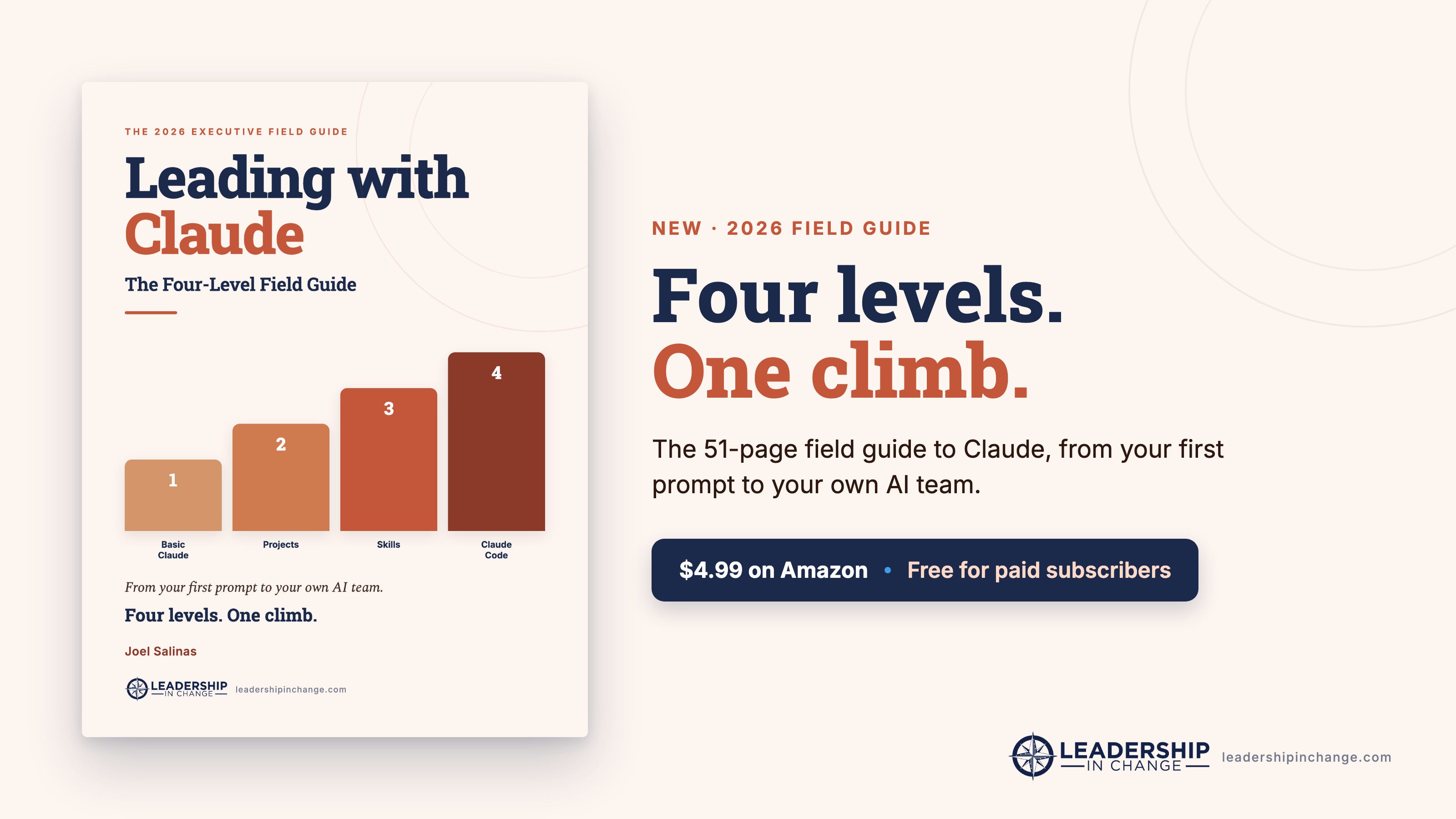
Get your e-copy for only $4.99: Get Leading with Claude.
Or become a Leadership in Change premium subscriber ($8/month or $49/year), and it's yours free, along with the full prompt and skill library, the frameworks, and everything else I publish: Become a premium member.
You don’t need to be ready for Level 4. You need one low-stakes rep at Level 1 tonight.
Which level are you actually on right now, and what’s kept you from climbing to the next one? Tell me in the comments, I read them.
Joel Salinas is an AI Strategy Coach for leaders at small and mid-sized businesses and nonprofits. 1:1 coaching, team workshops, and AI strategy work built around amplifying what your team is already good at. Creator of the AI Leadership Triad. He writes Leadership in Change.
Written by a human, for humans.
Questions Leaders Are Asking
What are the four levels of using Claude? The four levels are Basic Claude (plain conversation done well), Projects (a workspace that remembers your context), Skills (reusable packages that do a job your way automatically), and Claude Code (an AI agent that builds and runs things for you). Each one builds on the level before it.
Do I need to know how to code to use Claude Code? No. Claude Code runs on plain-English instructions. I’ve never written a line of code and I use it to build websites, apps, and tools. You talk to it the same way you talk to the chatbot, and it does the technical work. There’s a real learning curve, but the entry point is one sentence.
What’s the difference between a Claude Project and a Claude Skill? A Project holds context for one slice of work and stays put inside that workspace. A Skill travels: it’s a reusable capability Claude carries into any conversation and uses on its own when a job calls for it. Most leaders use both, Projects to stay on course and Skills as the tools they carry everywhere.
Is Claude free, and which plan do I need for Skills and Claude Code? Claude’s Free plan ($0) covers basic chat, web search, memory, and basic Projects. Skills and Claude Code need a paid plan, starting with Pro at $20 per month. For most individual leaders, Pro is the level that opens the full climb.
Where should I start if I’ve barely used Claude? Start at Level 1 with something low-stakes from your everyday life, not work. Translate a document, plan a trip, vet a decision. The goal is comfort, not mastery. Those early reps build the judgment that every higher level depends on, and they take minutes.
What an incredible article. Thank you for sharing this information with us. Right now I’m on level one. So this would be useful.
The levels framing names why most leaders plateau. They stop at drafting and never reach the level where the model runs a standing process for them. The climb from asking to delegating is where the leverage sits. Bookmarking the 51-page version.