


TL;DR - Claude Cowork can run a scheduled morning brief that reads the news for you and reports only what you decide on. The Morning Filter sets four dials: beat, sources, standards, and shift. Most leaders never set any of them, so they scroll instead. Setup takes about thirty minutes.
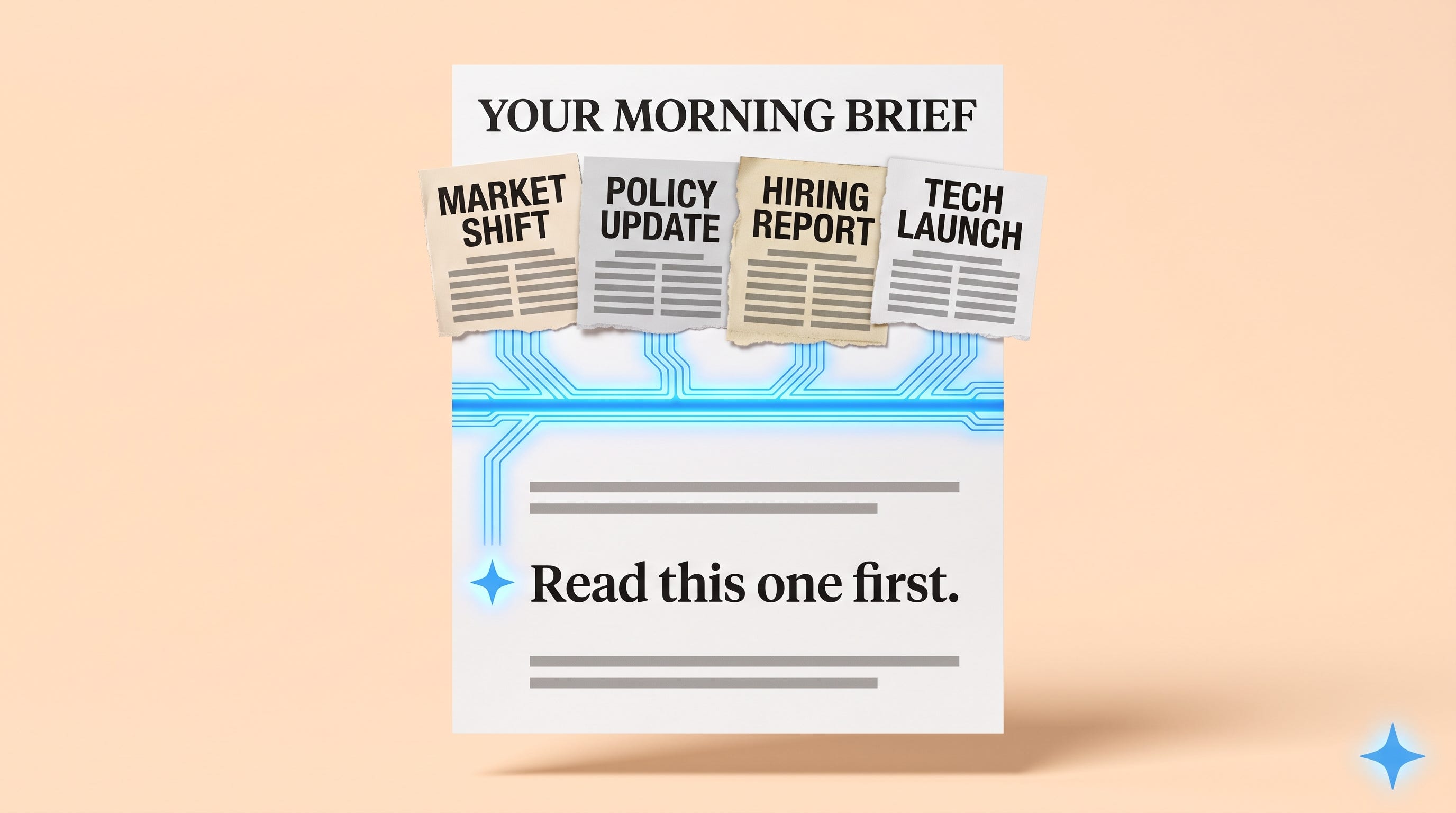
Honestly, the thing that finally pushed me to build this wasn’t the news, it was the time I was wasting.
I was spending a lot of my morning scrolling, getting lost in news that didn’t benefit me at all, news I didn’t need to know, news that just stressed me out. Then I’d spend even more time narrowing it down to the handful of things I actually needed to read, which meant I was paying twice: once to consume the noise, and again to sort it. I’m a person who seeks efficiency, and I really see time as my biggest resource, so wasting it makes me mad.

I had the CNN app and the Apple News app, and supposedly their algorithms would focus on the kind of news that I like, but they kept giving me so much trash that I didn’t need. Both are personalized, so the failure wasn’t missing data about my taste. They were learning the wrong thing, because they’re tuned for engagement, and engagement in practice means alarm.
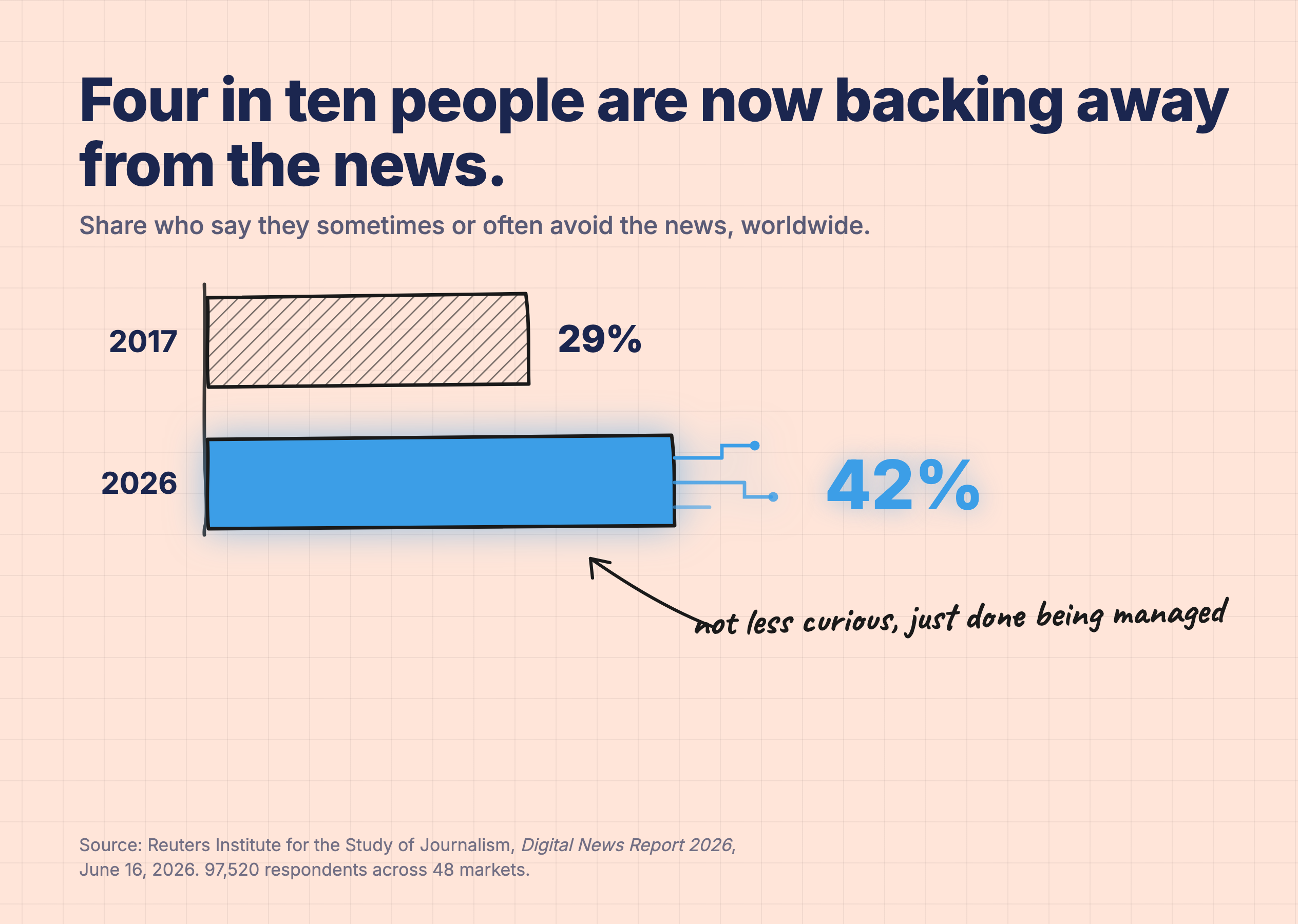
I’m not the only one at the end of that rope. 42% of people now say they sometimes or often avoid the news, up from 29% when the Reuters Institute began measuring it in 2017 (Digital News Report, June 16, 2026, 97,520 respondents). That isn’t a public losing interest in the world, but a public backing away from a delivery system that hurts to use.
So I deleted my news apps, and the strange part is that I didn’t feel less informed. I felt less managed.
Most of us think we have a news problem, so we go hunting for a better source.
We don’t have a news problem.
We have a filter problem, and somebody else has been holding the filter (at least for me).
So I built my own. It runs three mornings a week inside Cowork (Claude’s chat interface that runs on your computer), on a schedule that fires whether or not my laptop is open. It reads what I actually need, throws out what I don’t, checks every story against its original source, and flags the one thing worth writing about that week. Getting it right took weeks of trial and error, and that’s the part you don’t have to repeat.
What You Can Expect
The four dials that decide what reaches you every morning, and the one almost nobody sets
A 60-second exercise you can run right now that sets the hardest dial before you open a single tool
How to get your own brief running this week, filtered to your work rather than mine
My Morning Filter
Every story that reaches you already passed through one, chosen by an editor or ranked by an algorithm that was never built around what you decide on. Which is where the hiring frame helped me more than any productivity advice did. If you brought someone on to keep you current, you wouldn’t hand them a phone and say “read everything.” You’d tell them what your work turns on, which sources you trust, what to throw away without asking, and when to report. Four things, said once, and after that they’d work without you.
That’s all a brief is, and those four things are the four dials of what I call the Morning Filter. Today I’ll show you how to create yours.
Never scheduled anything in Cowork before? Start here instead. Claude Cowork Scheduled Tasks: How to Set Them Up walks the mechanics end to end in about ten minutes. You only learn it once. Then come back, because this post is about the part that decides whether what arrives is worth reading.
Quick Win (under 60 seconds) Open your notes app. Write the three topics you never want to see again. Not the ones you should care about, the ones that reliably cost you twenty minutes and change nothing about your week. That short list is the hardest dial to set and you just set it.
Dial 1: Beat, what it covers
The beat is the ground your brief walks every morning, and most of us draw it far too broadly. “AI news” is the classic version of that mistake, because it returns whatever is loudest rather than whatever matters to us.
The test is simple. For each line, ask what you'd do differently if it turned something up. Differently counts broadly: a decision you'd make, a call you'd have, and if you make things, anything you'd write or record because of it. If the honest answer is nothing at all, it isn't a beat but a hobby and hobbies belong somewhere other than the top of your morning. My first draft failed that test on four lines out of six.
A quick plug: Wyndo and I built the tool I wish I’d had when I started this newsletter.
It’s called Newsletter Compass, and it’s live. It writes titles, content ideas, Notes, and welcome sequences in your voice, not a generic AI voice. If you create content online, it’s worth a look.
Use code WELCOME for 50% off for life, 7-day free trial.
Dial 2: Sources, where it’s allowed to look
This is the dial that took me longest, and the one that matters most.
A search result is a lead, not a source. The web is full of pages whose entire business is summarizing other people’s reporting, and an AI finds those first because they’re written to be found. Left alone, my brief would hand me a valuation it got from an aggregator that got it from another aggregator that got it from a rumor.
“Use reputable sources” does nothing, because the machine already thinks it is. What works is naming the offenders by domain and forcing it to open the original first. Same instinct as catching AI hallucinations: it isn’t lying to you but repeating what it found, and what it found is the problem.
Dial 3: Standards, what it throws away
A new hire who brings you everything they found isn’t helping. The value is in what they leave out.
Left to itself, a brief pads. Ask for five stories and it returns five, whether or not five exist that day, and the whole difference between a brief you trust and one you stop opening lives in what happens to that fifth slot. Three real items beat five with one invention in them.
Fixing it takes a few specific standards, and the most important is counterintuitive enough that nobody writes it by accident: you have to give the machine explicit permission to come back with less. Without that line it fills the gap, because filling the gap is what it was built to do. Same failure as an AI that never disagrees with you.
Dial 4: Shift, when it reports
The last dial is the one people set first and regret, because the instinct is to make it daily.
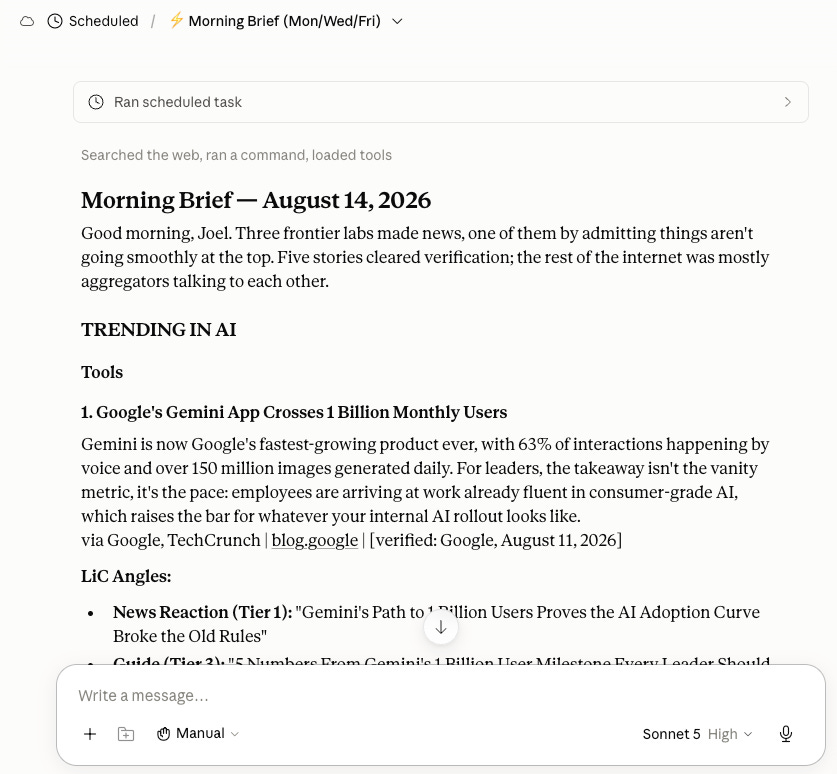
Mine runs three mornings a week. Daily was noise wearing a schedule, and it rebuilt the exact thing I was escaping with better sourcing. Three is enough to stay current and rare enough that I read the whole thing instead of skimming it out of obligation. It arrives inside Cowork, which I have open every day next to Claude Code (Anthropic’s coding-focused version of Claude), and it lands with a notification. It runs in the cloud, so it doesn’t care whether my laptop is open, and it never touches email, where it would join the pile it was meant to save me from.
Want my whole system, live?
I take three diagnostic calls a month. Thirty minutes, free, and you leave with a two or three page Judgment Brief that's yours whether we work together or not.
Book one →
What’s below the line
You have the four dials now. What you don’t have is the settings, and skipping straight to the scheduling gets you a beautifully automated version of the same noise, which is worse than doing nothing because now it arrives on time.
I should be straight about the thirty minutes in the title, because it took me weeks. Those weeks weren’t setup, they were me deriving the settings one failure at a time, and that’s the part you don’t have to repeat. Thirty minutes is what it takes when someone hands you the settings:
The Builder. Paste it into Cowork, answer seven questions, and it writes your finished brief prompt for you, tuned to what you actually care about. No hand-editing.
The three standards that stop it padding, in my exact wording, including the permission-to-return-less line.
Where the scheduler lives, with my actual settings: days, time, notifications, and which model to pick.
What a real run looks like, so you know what you’re aiming at.
Thirty minutes gets it running. Reading a few real briefs and tightening one line is what turns it into something you trust, and that part takes a couple of weeks.
Paid subscribers, it’s all waiting below. If you’re not one yet, this is what the membership is for, and one afternoon should save you hours a week for as long as you keep it running.
