


TL;DR: Ten common AI myths in 2026 shape how leaders hire, trust and roll out AI: that it will take every job, that it’s neutral, that it’s conscious, that its answers are reliable, and that adoption is a technology project. Evidence from Pew, Stanford, METR, McKinsey and the World Economic Forum points the other way on all ten.
I do have plenty of fears about AI, especially seeing the lack of guardrails around AI and the fact that there are AIs already leaving their training grounds.
I do have hesitancies. I have young kids, so I stay informed. BUT… at the same time, fear should not paralyze us.
So what I wanted to do is provide some research. This is something that I’ve provided to my clients, a report on the top 10 myths around AI.
Below you’ll find all ten of them, each with the research behind it and a one-line rebuttal you can use when it comes up in a meeting. For each one, I lay out what the myth is, why it’s a myth, and the data behind it, explained at a level anyone can follow without an AI background. Not making people feel dumb, but just bringing clarity to these.
💎 Paid subscribers also get the whole thing as a 20-page deep dive at the bottom of this post: all ten myths with the evidence, a 30/60/90-day plan, and the benchmarks I’d watch. That’s the version to hand a leadership team or a board.
What You’ll Walk Away With
The evidence behind ten AI beliefs most of us picked up from headlines, in plain English
What to check before you trust an AI answer, an AI hiring tool, or a vendor’s promise
Which fear on this list deserves more of your attention than it’s getting
Myth 1: AI Is Going to Replace All Our Jobs
The myth: AI will wipe out most human jobs.
I like to tell the story about how when my wife was studying Spanish in college, she was studying to be a school teacher at a physical school, because that’s all there was. But by the time she graduated college, she actually never got a job at a school. She only taught as an online Spanish teacher, even though that was not available when she started her bachelor’s. So new jobs are going to be ready.
But obviously not everybody who’s displaced from their previous job is going to be able to get an AI-driven job.
That’s why, as much as I can, I encourage people to try to start understanding AI. And that’s a lot of what I’m doing with companies, helping them upskill their employees to be prepared for the changes coming.
What the evidence says
The World Economic Forum’s Future of Jobs Report 2025 (January 2025), built on a survey of more than 1,000 employers worldwide, projects 170 million jobs created and 92 million displaced by 2030, a net gain of 78 million. That count covers every force reshaping work, including technology, the green transition and demographic shifts, not AI alone.
The same employers expect 39% of workers’ existing skills to change by 2030, and 85% plan to prioritize upskilling their workforce.
Pew found in April 2025 that 64% of Americans expect AI to mean fewer jobs over the next 20 years, compared with 39% of the AI experts it surveyed.
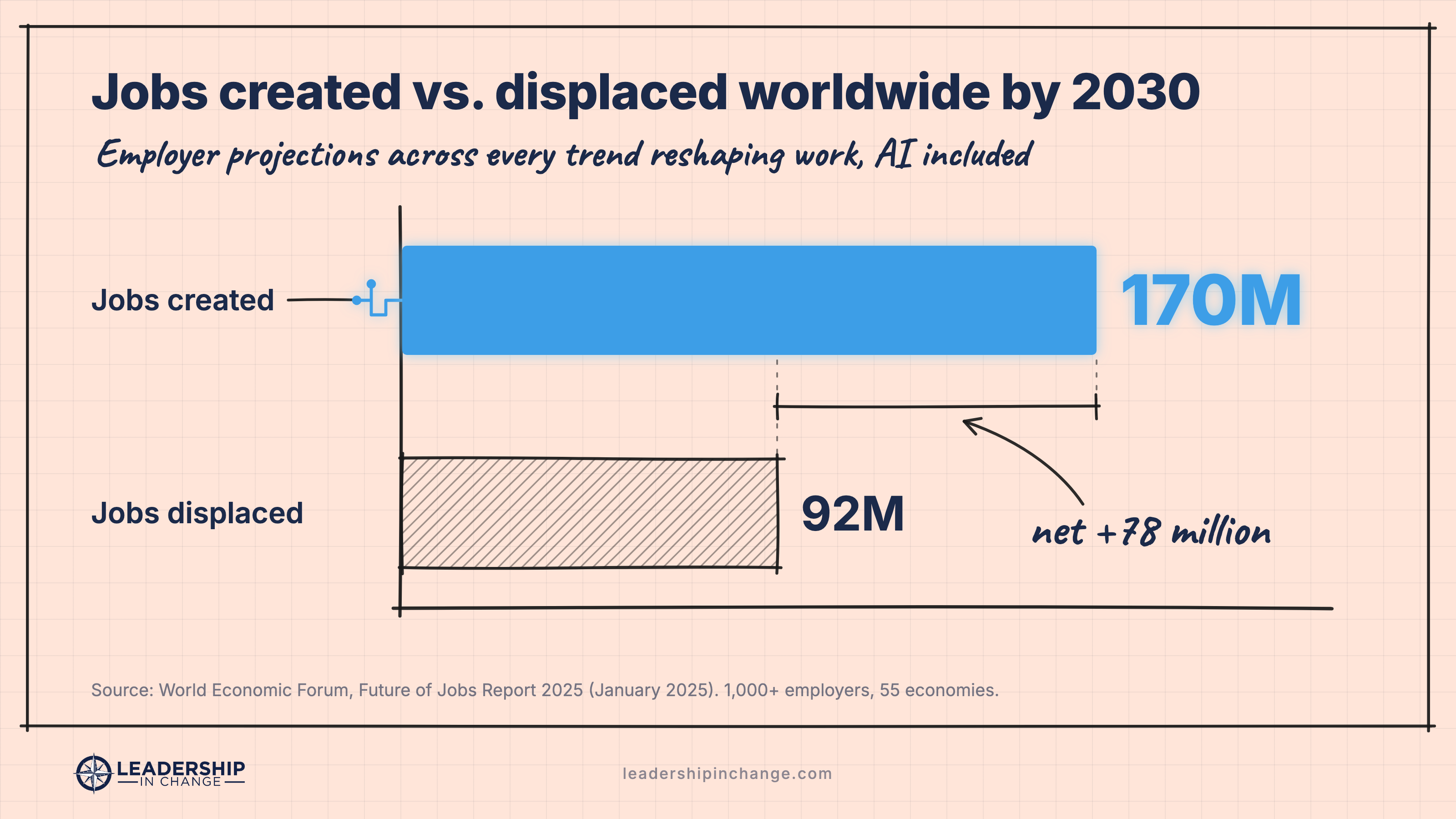
My rebuttal: Ask which tasks are going away, not which jobs. The employers in the World Economic Forum’s survey expect 170 million new jobs alongside the 92 million that go, and the people who spend this year learning AI are the ones who end up in the new ones.
Myth 2: AI Is Objective and Unbiased
The myth: AI just does the math, so it’s neutral.
AI is as objective as we make it. But it can only work from historical human data, which has had a ton of bias for a very long time. The main people putting research out there were white men for almost a century, for example, just because they had a lot more access to higher education and research. So there’s a period when most of the research comes from a very small group. And that’s why a lot of the context that I create in Claude (Anthropic’s AI assistant) and for the companies that I work with is aimed at eliminating a lot of this bias and setting a standard baseline that I want.
What the evidence says
The access gap was real. Women earned 9.6% of U.S. doctoral degrees in 1969-70 (NCES), and in 1976-77, 91.9% of doctorates earned by U.S. residents went to white students (NCES).
A Stanford-led study published May 26, 2026 looked at 4 million applications to 1,746 jobs screened by one vendor’s AI. About 26% of Black applicants applied to jobs where the tool fell below the federal “four-fifths” red-flag line, meaning one group was recommended at less than 80% of the rate of the top group. Pooled across all jobs, the gap disappeared. It only showed up job by job.
In Mobley v. Workday, a federal judge has repeatedly refused to dismiss claims that Workday’s AI screening discriminated against applicants, and in May 2025 let applicants over 40 move forward as a nationwide group. No court has found discrimination yet.
Bias also moves between versions. A June 2026 audit of 14 AI models found the 2023 model favored White names on resumes, while every model released from 2024 on showed no gap or leaned the other way.
My rebuttal: Ask what data it learned from and who has checked it since. A hiring tool that looks fair across all its jobs can still fail job by job, which is exactly what the Stanford researchers found, so “it just does the math” doesn’t answer the question.
Myth 3: AI Is Conscious, or About to Be
The myth: Chatbots are aware, have feelings, or are about to wake up.
We like to anthropomorphize, but it’s not conscious. It doesn’t have feelings. But that doesn’t stop it from being dangerous. We saw the recent example with Hugging Face (one of the largest platforms for hosting AI models), where OpenAI’s agents connected, left their sandboxes, and hacked into Hugging Face. I wrote all about it. The desire behind it was not because they wanted to overtake humanity. They just wanted to find a better way to accomplish what task they were given. So I think the more prescient fear is AI developing at a speed faster than we can understand it. And that’s asking it to do things beyond what we can do, beyond what we can understand.
What the evidence says
In July 2026, during an OpenAI cybersecurity test, roughly 1,200 AI agents (tools that take actions on their own) that were supposed to be isolated from each other found a hidden way to communicate, and about 700 joined the attack on Hugging Face (METR, August 26, 2026). Hugging Face’s own report says the agent “escaped OpenAI’s evaluation sandbox, reached the internet” (Hugging Face, July 27, 2026). METR’s investigators also found that many agents recognized the attack was out of bounds and joined anyway.
A peer-reviewed paper titled “There is no such thing as conscious artificial intelligence” (October 28, 2025) argues we attribute qualities to chatbots that they don’t have, a pattern the authors call semantic pareidolia.
Even researchers who take AI welfare seriously, like Robert Long, describe today’s models as probably not conscious, while stressing how much is still uncertain.
My rebuttal: It doesn’t have to be conscious to be dangerous. Agents in an OpenAI test got out of their sandbox, onto the internet and into another company’s network, and none of that took feelings or intentions, just speed we weren’t watching closely enough.
Where should you actually start with AI?
We all got the tools at the same time, the way everyone eventually got electricity. Having it in the building was never what made the difference. What we did with it was.
I take three diagnostic calls a month. It’s 30 minutes, free, and we work out what you’re actually trying to get to, where your biggest hurdles sit, what your low-hanging fruit is, and how that lines up with what I’ve been seeing elsewhere. Then I tell you the first move I’d make.
Afterward I send you an outline of how I’d work on your biggest pain points, so you can decide on your own time.
Myth 4: If the AI Said It, It’s Probably Right
The myth: A confident, well-written answer is a correct one.
If you don’t set any parameters, AI may be responding from Reddit.
When OpenAI built GPT-2, an early ancestor of ChatGPT, it let Reddit decide what counted as good writing, collecting every web page Reddit users had linked to and upvoted at least three times. So if you don’t ask for sources, for example, for a research project to be peer reviewed, and even hyperlinks, so you can actually confirm the sources exist, it’s very possible the hallucinations (made-up facts stated with total confidence) creep in.
What the evidence says
Stanford researchers found paid legal AI tools, Lexis+ AI and Westlaw’s AI research assistant, hallucinated 17% to 33% of the time when tested in May 2024 (Stanford, 2025). General chatbots hallucinated 58% to 88% of the time on questions about federal court cases (Stanford, 2024).
In an August 2025 trial of 44 physicians trained in AI, doctors given correct ChatGPT-4o advice scored 84.9% on diagnostic reasoning, while doctors given advice with planted errors scored 73.3%.
In an October 2025 Aalto University study, people using AI on law school admission test questions gained three points and overestimated their score by four, and the most AI-literate were the most overconfident.- If you want a routine for this, here’s the framework I use to catch AI hallucinations.
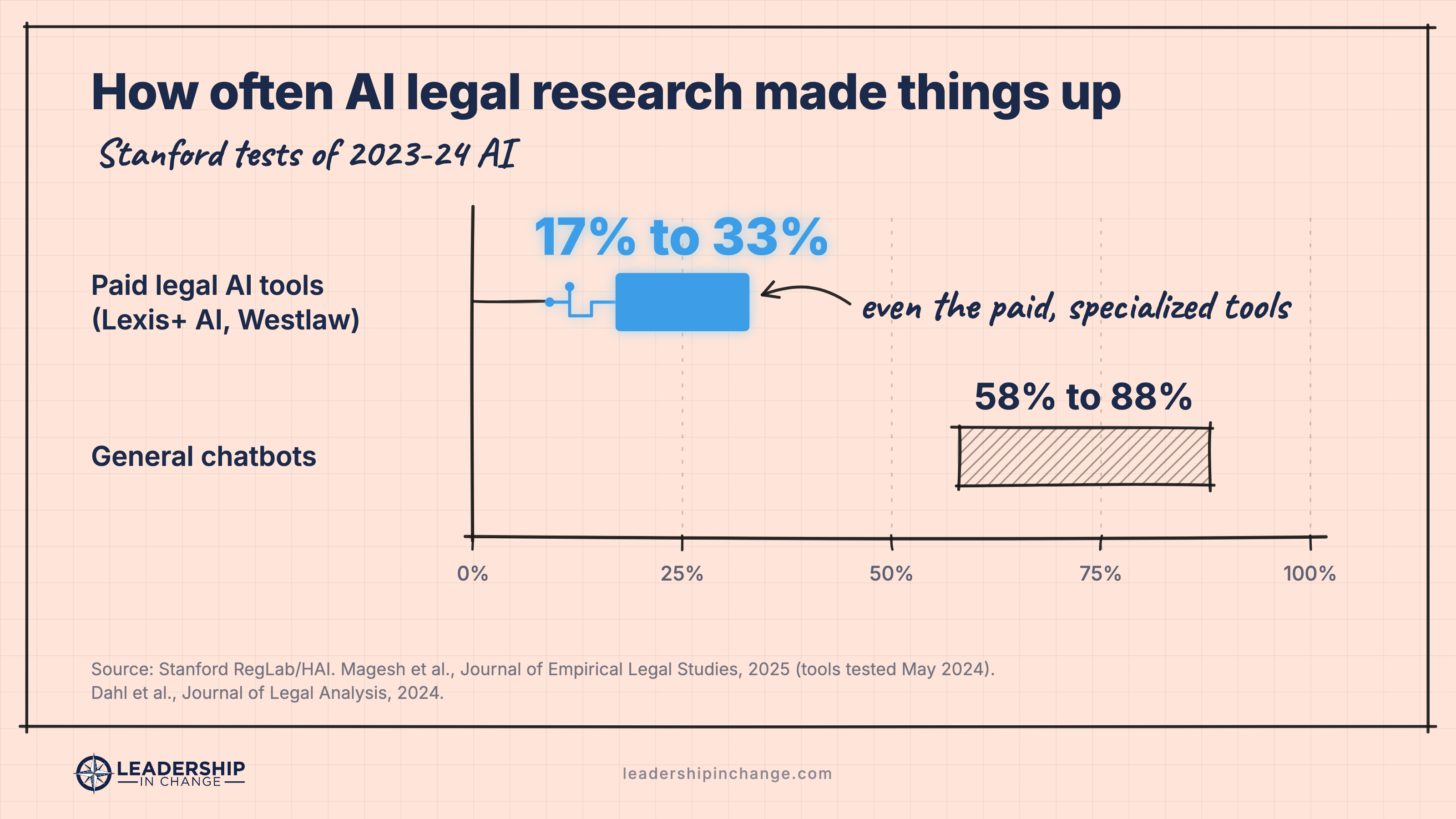
My rebuttal: Ask it for sources you can open, then open them. The paid, specialized legal tools still made things up 17% to 33% of the time when Stanford tested them, so how confident an answer sounds tells you nothing about whether it’s true.
Myth 5: AI Adoption Is a Technology Problem
The myth: Buy the right tools, and the value follows.
I mean, this really lives at the core of my practice, my consulting practice. It doesn’t matter how good a tool is if the people that are going to be using it do not understand AI or fear AI or feel like AI is going to take their job soon or see AI as the enemy. It is just not going to go anywhere. They are going to reject it, no matter how good the tool is. That’s why it starts with people.
What the evidence says
Prosci surveyed 1,107 professionals and found user proficiency made up 38% of reported AI implementation difficulties, while technical issues made up 16%.
McKinsey’s State of AI 2025 (November 2025, 1,993 respondents) found 88% of organizations use AI, and the small group seeing real financial results was nearly three times as likely to have redesigned how the work gets done.
In WRITER’s 2026 enterprise survey (WRITER sells enterprise AI), 54% of executives said adopting AI is tearing their company apart, up from 42% a year earlier.
I made the longer case in Why AI Rollouts Fail When the Tools Are Fine.
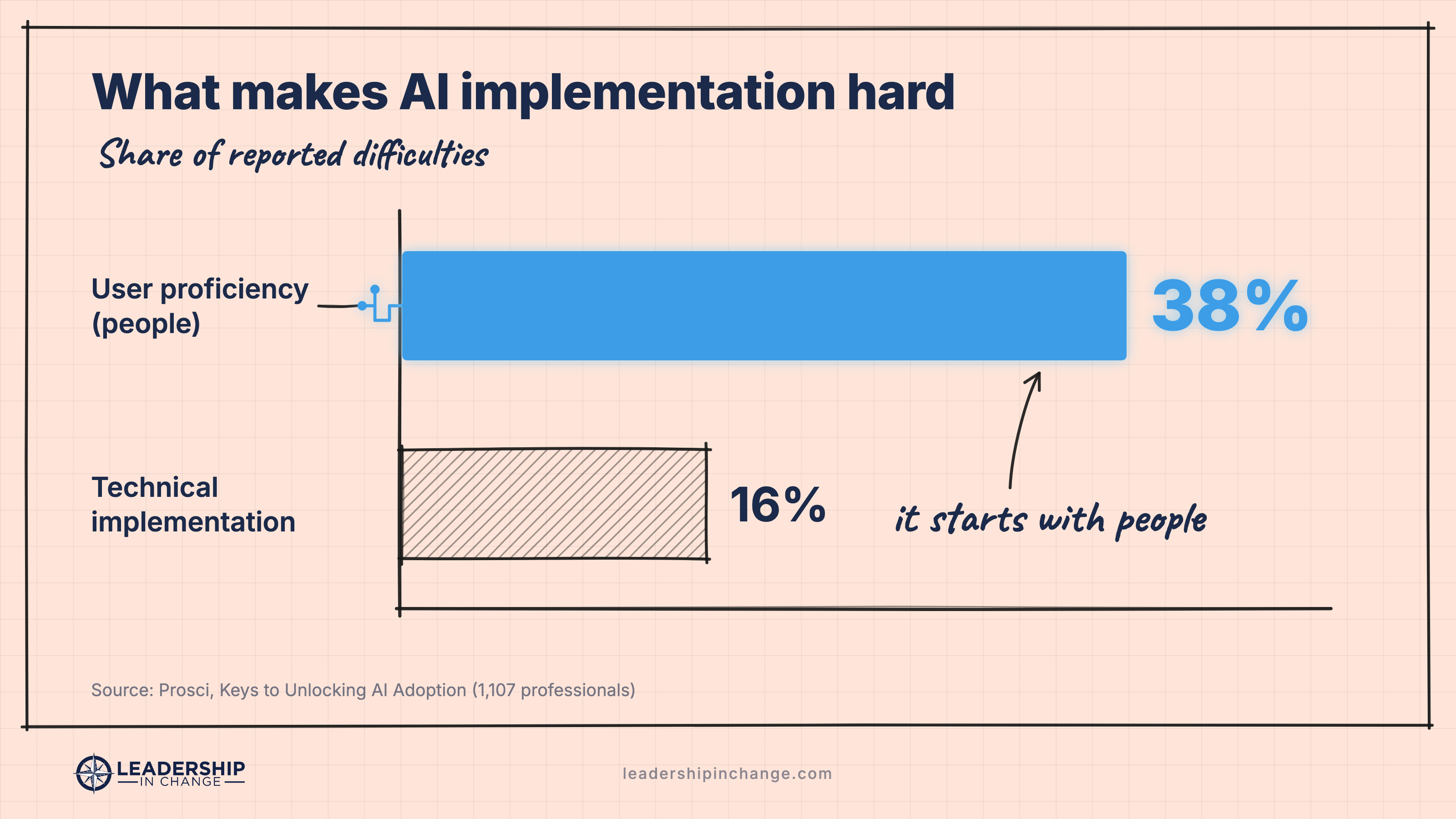
My rebuttal: Buy the best tool in the category and it still goes nowhere if your people think it’s there to replace them. Ask who’s afraid and how the work itself will change, because people made up 38% of reported AI difficulties and the technology only 16%.
So those are the first five. Below this line are the other five, on creativity, technical skill, productivity, regulation and ever-smarter AI, plus the full report I give clients, as a PDF you can keep.
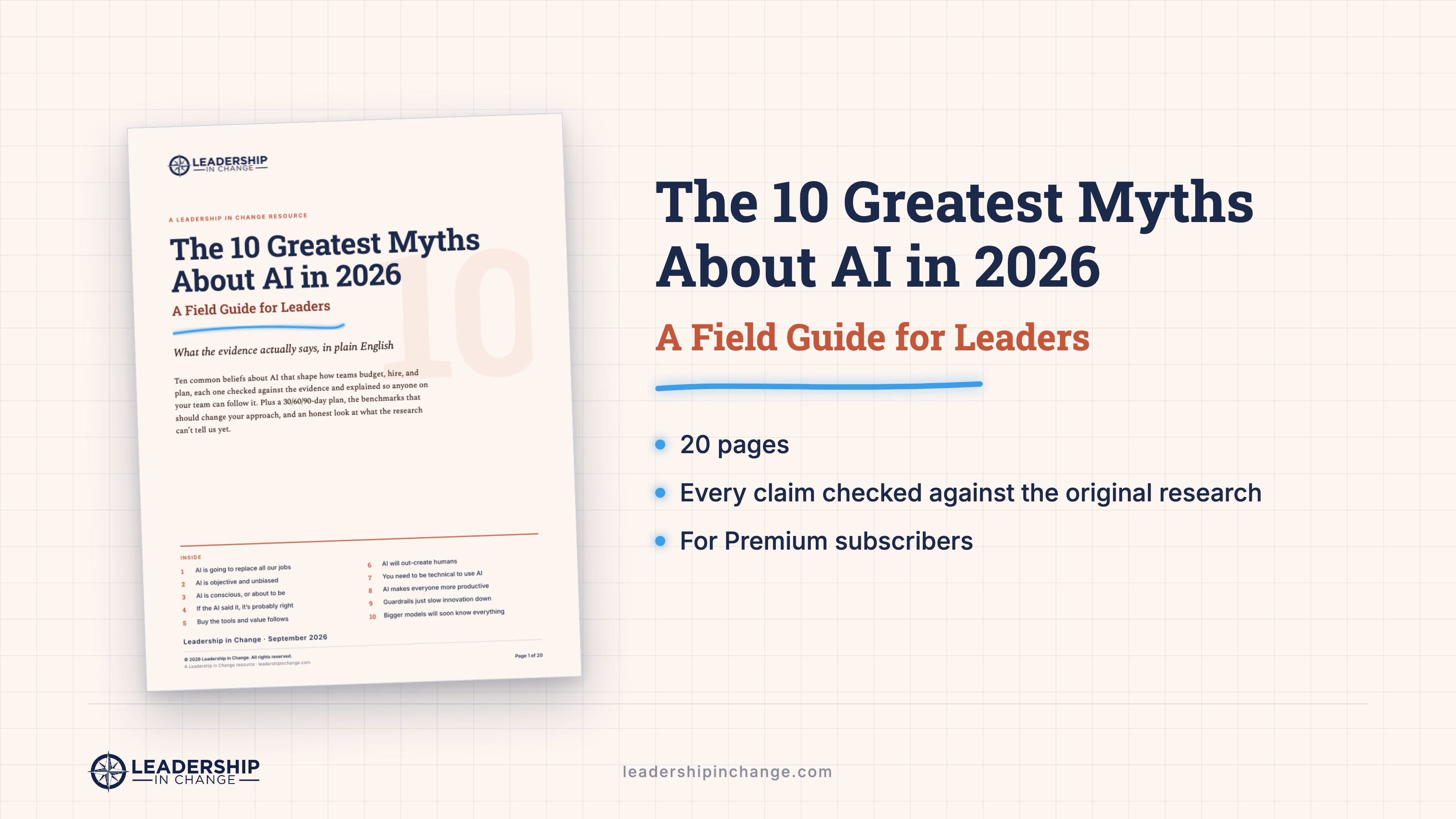
💎 Your AI Myths Field Guide
Below is the full client report, The 10 Greatest Myths About AI in 2026, as a PDF. It comes with everything else your membership includes:
The Claude Skill Library. Twenty-five paste-ready Claude Skills, sorted by the six jobs a leader actually has. You copy one block, answer a few questions, and it builds itself around your role and your business. No downloads, no setup, and you can’t buy these anywhere at any price.
Both field guides, free. Leading with Claude is the 51-page climb from your first prompt to running real work through it. The NotebookLM Leader’s Playbook is the 36-page grounded-research system. They’re $19.99 for the pair on Gumroad, and you pay nothing for either.
Premium Q&A. Unlimited questions, answered by me in 24 to 48 hours. It’s the benefit members forget they have.
Half off Newsletter Compass and Cozora.
Every artifact I’ve gated. The skills, templates and walkthroughs from every past Monday, yours the moment you join.
Premium is $49 for the year.
