


TLDR: AI rollouts rarely fail because the tools are weak. They fail because AI lands on top of trust gaps that already existed, in the tool, in the leader, or across the team. The leadership work is to read what AI reveals about those gaps and repair them human-first, before any training.

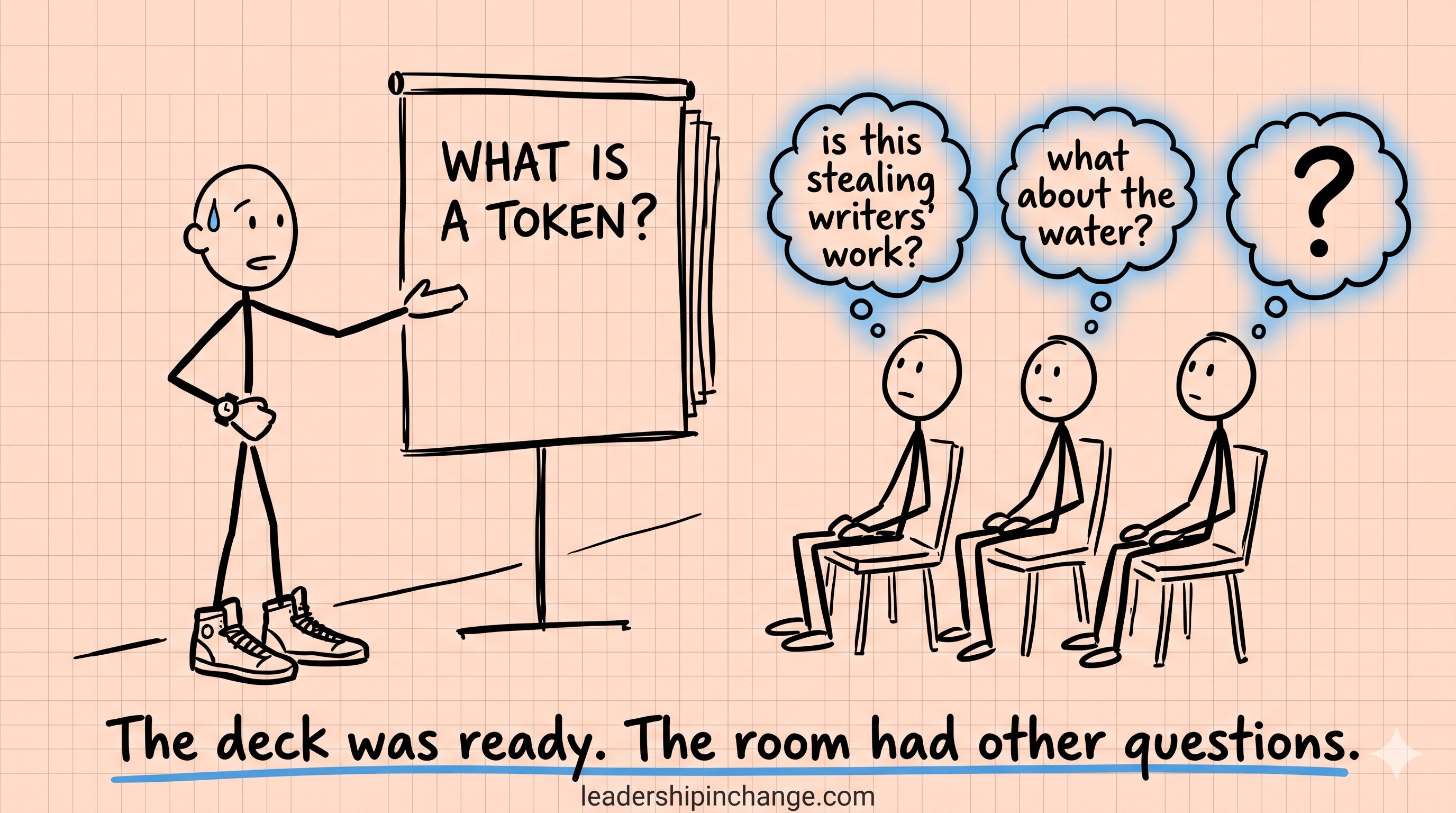
So, last year, I was standing in front of about twenty-five people on my team, all of us working to help people hit by disasters, war, and displacement. I had a forty-slide deck loaded and ready… What a prompt is. What a token is (the small unit of text an AI reads and writes in). Why AI sometimes makes things up. The whole stack.
A few minutes in, I closed my laptop.
I didn’t close it because the deck was bad. The deck was solid. I closed it because I’d opened with a simple icebreaker, “what does AI bring up for you?" and the first two answers told me the slides were the wrong work entirely.
The first came from a writer on the team. She asked how she was supposed to use something built by scraping copyrighted work from creators like her. I felt the weight of that. She’s a writer, and there I was, the guy bringing the tool in. So I just listened.
The second came from someone whose whole reason for being there is the mission. As an organization that cares about the climate, how do we use something this hard on the environment, from the data centers to the water it burns through?
Neither of those is a question about prompts. Two of the people who’d have to use AI every single day were telling me, without quite saying it, that it doesn’t matter how good the tool is. They weren’t going to touch something that cut against who they are.
That was the moment I understood the thing I now build most of my coaching around: AI doesn’t create trust, it reveals it.
If the trust is already there, the rest of the work gets easier fast. If it isn’t, no amount of training fixes what’s actually broken underneath. AI just turns the lights on and shows you what was there the whole time. I’ve written before about why most AI implementations fail, and after enough of them, the pattern underneath gets hard to miss: the tech is rarely the thing that actually broke.
Why AI Exposes Trust More Than Any Tool Before It
Here’s why AI does this in a way the last few tech rollouts didn’t.
The first reason is speed. The tool is genuinely different every few months. Which means the trust can’t live in the tool, because the tool won’t sit still long enough. It has to live in your judgment as a leader, because that’s the only steady thing your team can hold onto while everything else keeps shifting under them.
The second is identity. AI reaches straight into what people actually do all day. Adopting it means admitting out loud that part of your work might go away, while also betting that, done right, it frees you for the part only you can do. That’s a hard thing to ask of someone, and pretending it’s easy is how you lose them.
The third is ethics. There are real questions here, about training data, about copyright, about the environment. Same as we had with social media. Same as we’re working through with crypto right now. Those concerns don’t disappear because you skipped them in the kickoff meeting. They go underground, and underground is exactly where trust quietly rots.
A quick aside, since a lot of you reading this also write a newsletter, or have been meaning to start one.
Newsletter Compass: grow your newsletter without the guesswork. Know what’s working, what to write next, and where your growth is coming from, so you spend your time writing instead of staring at a dashboard. 50% off for a limited time with code WELCOME → newslettercompass.com
The Three Layers of Trust AI Tests
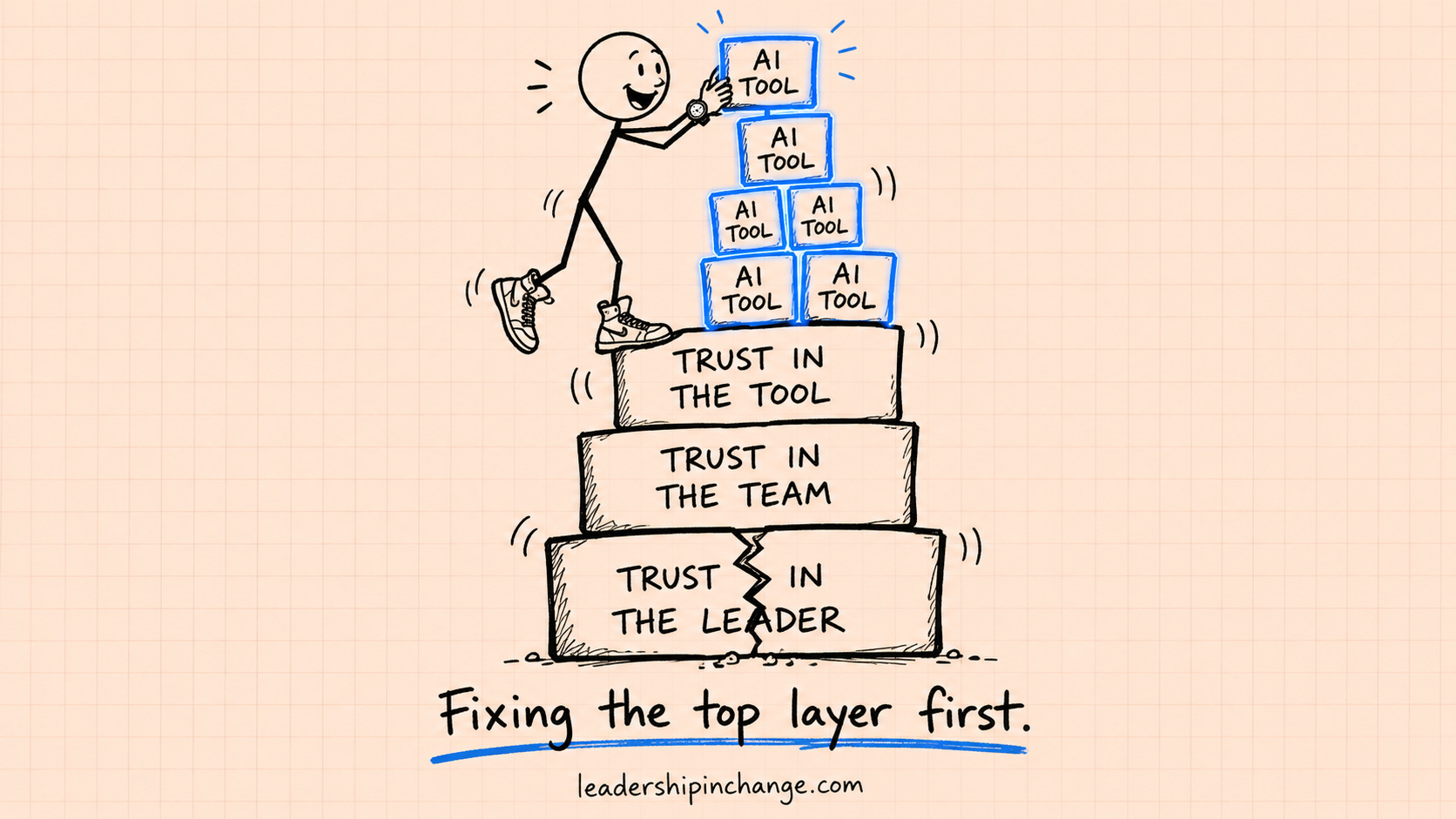
When I sit with a team now, I’m listening for three layers of trust. Trust in the tool. Trust in the leader. Trust in the team. Any one of them missing, and whatever you try to build on top of it cracks.
Trust in the tool
This is whether your people believe the thing actually fits what you claim to stand for. If you talk about privacy, are you using something that respects it, or something that ships every keystroke back to the vendor? If your mission is about ethics, have you said the copyright and climate questions out loud instead of hoping nobody raises them? When this layer is cracked, you get shadow AI usage (people quietly using it off the books), polite avoidance, and worries nobody will say in a meeting. The move is to listen first, say the concern back so they know you actually heard it, and then show with real data how the tool fits. That only works if it’s true. People know when a leader is reverse-engineering a justification for a decision they already made.
Trust in the leader
This is the hardest one to be honest about, because it’s about you. The symptoms are quiet. Polite compliance. No excitement. Silence after you propose the tool, on a team that would normally give you pushback. Underneath, your people aren’t sure whether you brought AI in to help them or to replace them, and if they don’t already trust you, they’re not going to ask. The move is to use the tool in front of them, name what you’re unsure about, and build a room where the hard question is allowed. I told my team early that if anyone thought we’d drifted from our principles on AI, they were expected to say so, and we’d deal with it. That’s not a policy document. It’s a stance, and it only holds because they’ve watched me act on it when it got tested.
Trust in the team
This one is built or broken in the small daily moments. In places where people quietly compete to climb over each other, you see solo workarounds, hoarded wins, nobody sharing what they figured out, and a real fear of looking dumb for asking a basic question. Underneath, the team doesn’t trust each other enough to be confused together. The move is to build a structure where confusion is safe. More on what that looked like for us in a minute.
The layers stack, and the repair order matters. If trust in the tool is shaky but they trust you, your team will still try, because they trust you. If they don’t trust you, no amount of tool quality saves it. So you fix leader trust first, then team trust, and tool trust gets dramatically easier once the other two are established.
The Person Hardest to Convince Is Usually Your Architect
A month or two after that workshop, I got an email that made me grin.
The team member who’d been most hesitant in the room, the same writer who asked the copyright question, had started something on her own. She put a recurring thirty minutes on the calendar and invited anyone who wanted in. She called it AI Coffee Time.
No agenda. No slides. No leader running it from the front. Just people, on company time, talking about what they’d tried, what worked, what worried them, what surprised them. It worked because it was theirs. The people who needed reassurance got it from each other, in their own words, at their own pace. The quietly skeptical ones got room to name what they were skeptical about without getting branded resistant to change.
Notice the inversion. The person most worried about the rollout became the person who built the thing that made the rollout work. That happens more than leaders expect. The people most worried about AI often see the human cost most clearly, because they’re the ones actually paying attention to it. Give them a real way in, and they build the structure. Try to argue them out of it, and they go quiet while the rollout stalls.
None of this is a soft skill you’re either born with or not. The capacities that make trust-based adoption possible at scale are the ones I’ve mapped as the AI Leadership Triad, Adaptability, Innovation, and Creativity, and you build them through reps, in the small decisions about what to defend and what to let go.
This is most of what I do with leaders now, helping them read what their AI rollout is actually revealing and repair it before they spend another dollar on tools nobody trusts.
If that’s the wall you keep hitting, that’s what my coaching is built for. Click below to learn more.
So here’s the charge, and it costs you nothing but nerve. Find the person in your organization who’s been hardest to convince on AI, and ask them what they’re actually worried about. Don’t argue. Don’t sell. Just listen. That conversation is where your real rollout starts.
Whether you end up loving AI or resenting it, you still have to understand it, because it’s working its way into nearly every tool your team touches. And understanding it starts with understanding the people you’re trying to lead through it. The organization you’ll be running in three years is being built right now, by the questions you’re willing to ask out loud and the ones you keep deciding to skip.
So which one are you avoiding?
Frequently Asked Questions
Why do most AI rollouts fail?
Most AI rollouts fail because of trust, not technology. The tools usually work and the training is usually fine. What breaks adoption is that AI lands on top of trust gaps that were already in the organization, in the tool, in the leader, or across the team. If those gaps aren’t addressed first, the rollout stalls no matter how good the tooling is.
Is AI adoption a technology problem or a trust problem?
At the foundational level it’s a trust problem. Speed of change, identity threat, and unresolved ethics questions mean AI exposes whether a team trusts the tool, the leader, and each other. Technical fluency still matters, but it only pays off once the trust foundation is in place.
What are the three layers of trust in AI adoption?
Trust in the tool (does it fit what we claim to stand for), trust in the leader (was this brought in to help us or replace us), and trust in the team (can we be confused and learn together without fear). A crack in any one layer undermines whatever you build on top of it.
What order should you repair trust in an AI rollout?
Leader trust first, then team trust, then tool trust. If the team trusts the leader, they’ll try a tool they’re unsure about. If they don’t trust the leader, no amount of tool quality fixes it. Tool trust gets much easier once the other two layers hold.
How is AI adoption like factory electrification?
Between roughly 1900 and 1930, factories that gave workers authority to redesign the work around electric motors pulled far ahead of factories that bolted motors onto the old assembly line. AI is the same pattern. Trusting people to rebuild the work around the new capability is a business decision, not a soft skill.
Who should lead an AI rollout on a team?
Often the best structure-builder is the person most hesitant about AI. They tend to see the human cost most clearly. Given a real way to participate, like an employee-led, no-agenda space to share what they’re learning, skeptics frequently become the people who make adoption work.
What’s the first practical step a leader should take?
Find the person hardest to convince and ask them what they’re actually worried about, then listen without arguing. That single conversation surfaces the real trust gaps faster than any training deck.
Joel Salinas is an AI Strategy Coach for leaders at small and mid-sized businesses and nonprofits. 1:1 coaching, team workshops, and AI strategy work built around amplifying what your team is already good at. Creator of the AI Leadership Triad. He writes Leadership in Change.
The laptop-closing bit is the whole piece.
Every AI rollout has someone waiting to say the awkward thing everyone else is politely avoiding.
Usually that person’s more useful than the deck.
Give people permission to voice their concerns and then actually respond to them.