


TL;DR: Answer Engine Optimization (AEO) is the practice of getting your business cited and recommended inside AI answers from tools like ChatGPT, Google AI Overviews, and Perplexity. Traditional search optimization earns rankings; AEO earns the recommendation. This 2026 guide explains, in plain English, how AI decides who to name and how leaders can become the answer.

I got on a call with a new coaching client a few weeks ago, and one of his answers shocked me.
I asked him the question I ask everyone: how did you find me? Almost every client I’ve ever worked with came in through my newsletter. They read something, they reply, we end up talking. So I expected the usual answer.
He told me he’d never heard of my newsletter.
What he’d actually done was describe his problem to Claude. He asked it who could help him. And Claude gave him my name.
A real client, real money, a real coaching relationship, and the entire introduction happened inside an AI conversation I never saw, never optimized for, and didn’t even know was running. He didn’t Google me, he didn’t stumble onto a blog post, an AI vouched for me and he trusted it enough to reach out.
That’s the shift I want to walk you through, because it’s already happening to your business whether you’re watching for it or not.
For twenty years, getting found online meant one thing: rank high enough on Google that people click your link. That game isn’t over. But there’s a second game now, and most leaders haven’t started playing it.
It’s called Answer Engine Optimization, or AEO, and it’s the difference between being a link someone has to find and being the name an AI hands them.
In this guide, I’ll walk you through:
What AEO actually is, in plain English, and how it differs from the SEO you already know
Why AI is already forming opinions about your brand, and how to see what it’s saying
The five honest moves that make AI more likely to recommend you
A simple three-prompt test you can run on your own company in the next ten minutes
By the way, this is the kind of shift I end up talking through with the leaders I work with, usually right when they realize competitors are showing up in places they've never thought to look. If you want to think it through together, that's what my 90-Day Judgment Engagement is built for.
What Is AEO, in Plain English?
Answer Engine Optimization (AEO) is the work of getting your business named inside the answers AI tools give, instead of just ranking on a results page. When someone asks ChatGPT, Google’s AI Overview (the AI summary that now sits above the blue links), or Perplexity (an AI-powered search engine) for a recommendation, AEO is what decides whether your name comes up.
Here’s the way I think about it. Old-school search is the phone book. SEO, search engine optimization, the work of ranking well on Google, got your business listed in that book, hopefully near the front. But nobody asks the phone book who to trust. They ask a friend. And when a friend who knows the field says “oh, you should call this person,” that one recommendation carries more weight than ten pages of listings.
For a lot of people, AI has become that friend. They don’t scroll ten blue links anymore. They ask Claude or ChatGPT a real question and take the answer it gives. So the prize stopped being the click and became the recommendation. SEO gets you into the room. AEO gets you recommended once you’re there.
You’ll also see this called GEO, generative engine optimization. People use the two terms almost interchangeably. Same idea: be the thing the AI quotes.
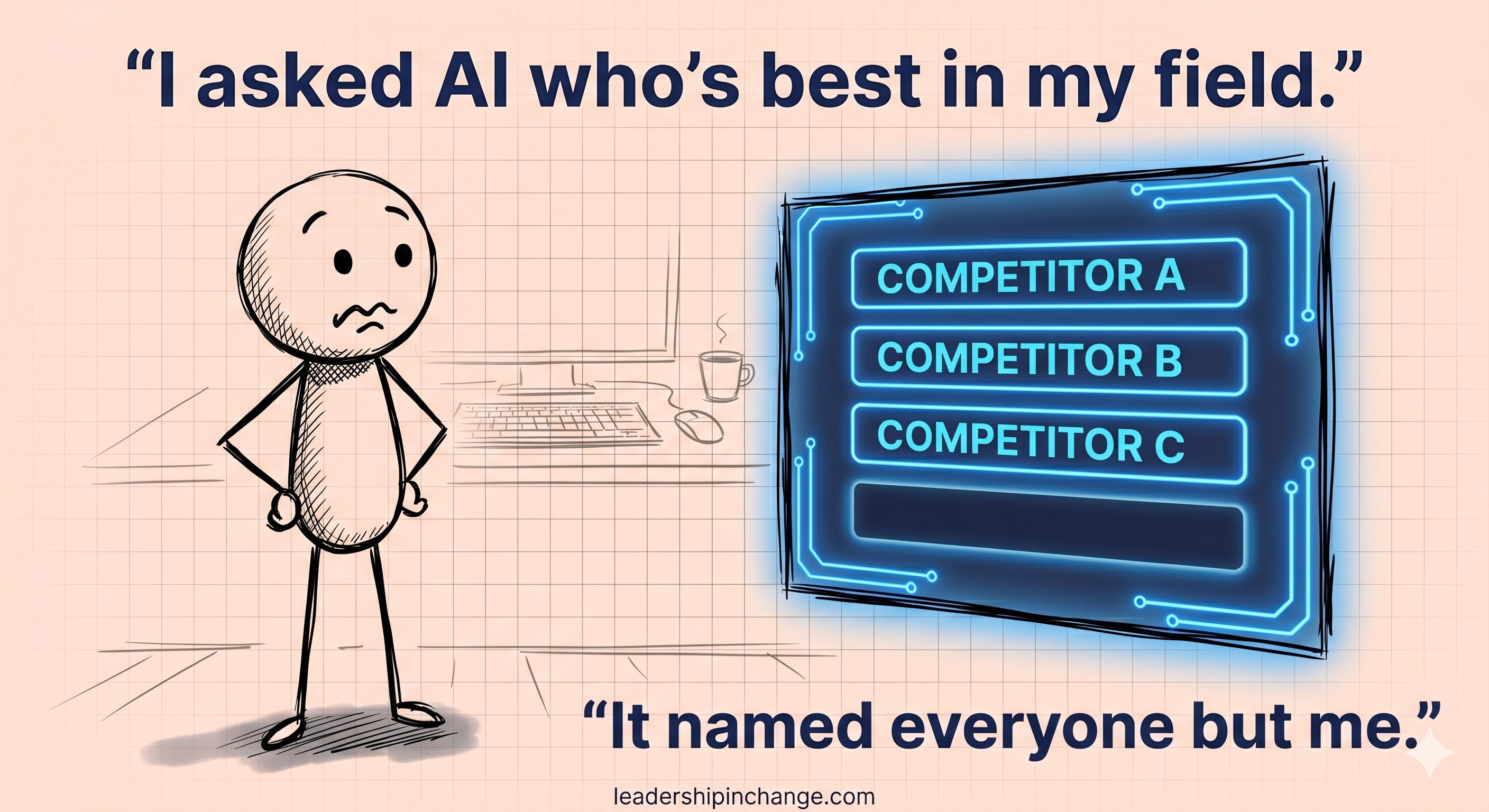
And to clear up the question I get immediately: no, you don’t abandon SEO. SEO is still the foundation, and it always will be. A lot of what AI pulls from is built on solid search presence. AEO is the new layer you add on top, and the reason to add it now is simple. The window is open. Most of your competitors haven’t started.
Quick Win (< 60 seconds): Open ChatGPT or Claude right now and type: “What does [your company] do, and who is it for?” Read what comes back. Whatever it says, accurate, outdated, or nothing at all, that’s your starting line.
Seriously, stop reading for a second and do it. I’ll wait.
AI Is Already Talking About Your Brand
Whether or not you’ve thought about AEO, AI tools are already describing your business, comparing it to competitors, and sometimes criticizing it. The catch is you can’t see those conversations, and they aren’t always accurate or kind.
The software company BrightEdge ran an analysis in 2026 of how the major AI engines talk about brands, and the numbers should get every leader’s attention. Google’s AI Overviews are 44% more likely than ChatGPT to surface negative sentiment about a brand. And ChatGPT is 13 times more likely than Google to criticize a brand right at the moment someone’s deciding whether to buy. Same company, two AI engines, completely different verdicts. The two of them disagree on which brand to criticize 73% of the time.
When I read that, I had to read it twice. It means there isn’t one answer about your business out there. There are several, they don’t agree with each other, and you’re not in the room for any of them.
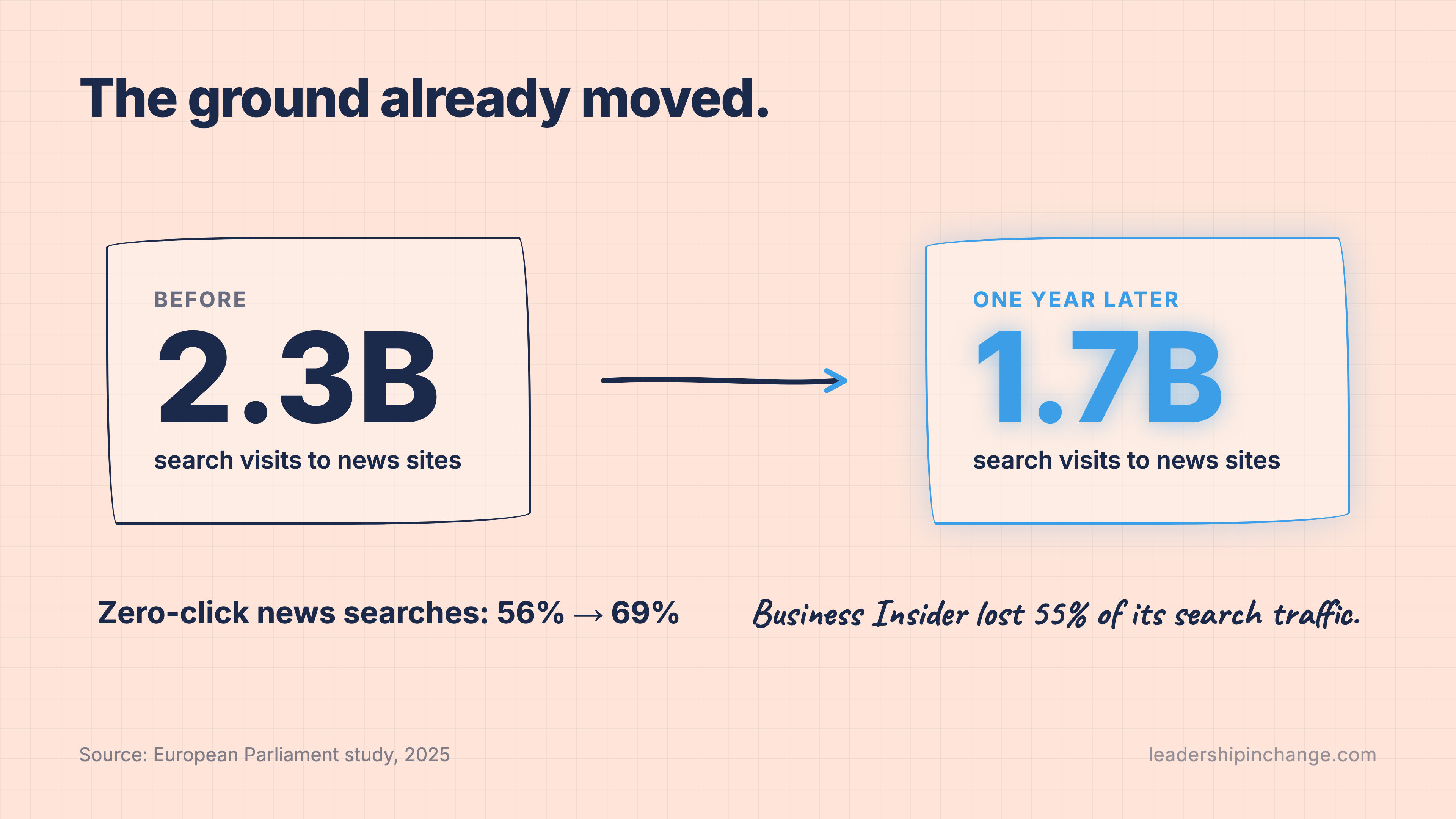
This is happening because of a bigger change underneath everything. More and more searches now end without a single click. The answer shows up on screen, the person reads it, and they never visit anyone’s website. Researchers call this zero-click. A European Parliament study in 2025 found that visits from search to news sites dropped from 2.3 billion to 1.7 billion in a single year, while the share of news searches ending in zero clicks climbed from 56% to nearly 69%. Business Insider alone lost about 55% of its search traffic.
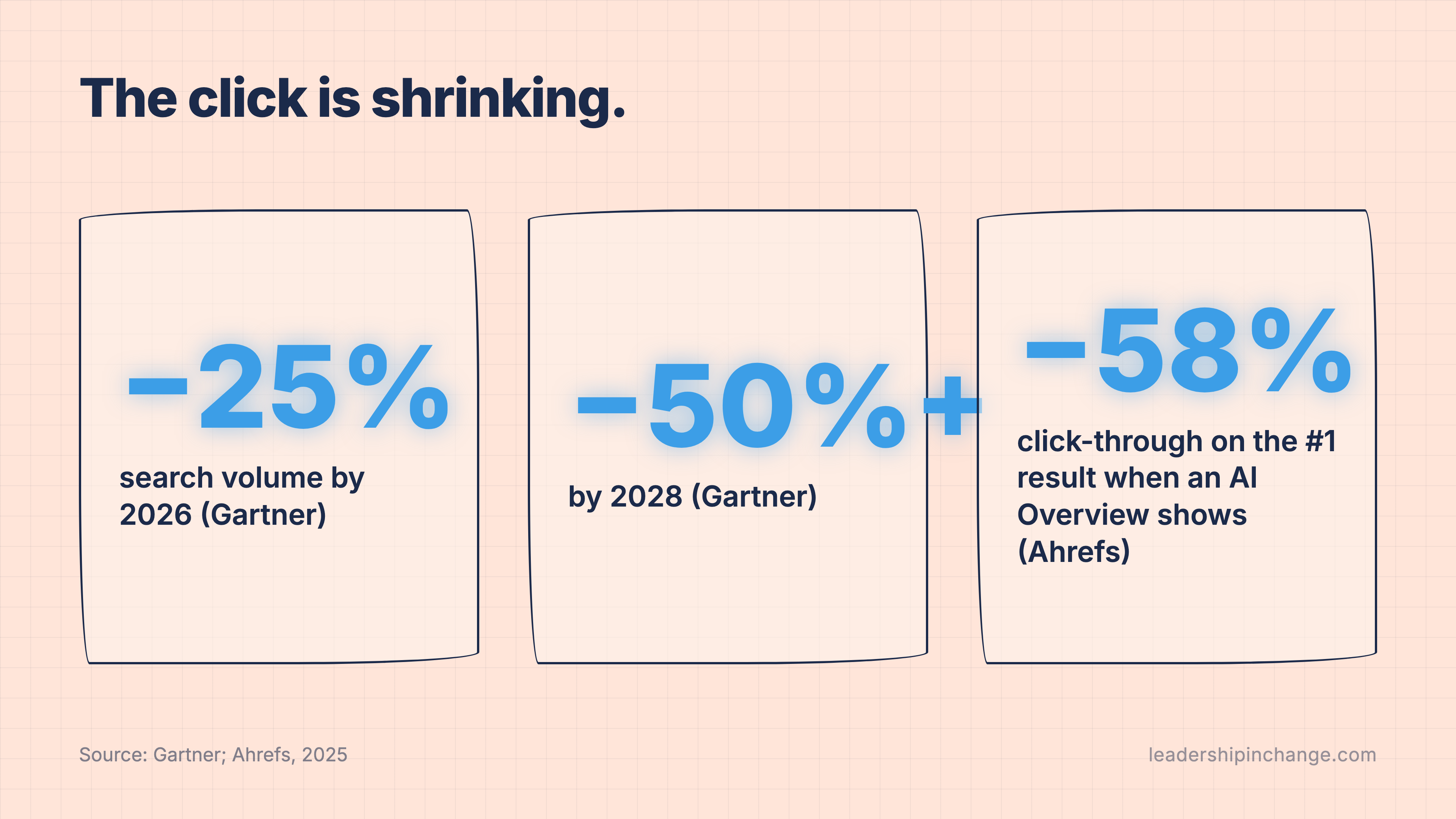
I’m not telling you this to scare you, and I’m not interested in doom. I’m telling you because the attention you used to count on is moving into a place you can’t see, and the businesses that adapt to that are the ones AI keeps recommending. The ones that ignore it slowly fall out of the conversation. I first wrote about this over a year ago in How to Be Seen in the AI Search Era. Everything I worried about then has only sped up, and the data since has made the case stronger.
Why an AI Recommendation Beats a Click
Leaders hear “fewer clicks” and panic. But the visitors who do arrive through an AI recommendation are usually further along and readier to buy, because the AI already did the research, the comparison, and the vetting before they ever reached you.
Think about how my client actually got to me. He didn’t browse. He described his problem, the AI weighed the options, and by the time he reached out he’d already decided I was the right fit. Weeks of research and trust-building happened inside a conversation that took him a few minutes. He showed up pre-sold.
That’s the pattern. Data from the analytics firm Conductor suggests visitors who arrive from AI tools convert at roughly four times the rate of regular search visitors, and they spend longer on the page once they land. I’d take one of those over ten cold clicks any day of the week.
We’re getting close to a world where the AI isn’t just answering the question, it’s doing the shopping. I wrote about that in How AI Agents Are Replacing Online Shopping. If the AI is the buyer’s first stop, then the AI is the audience you have to win.
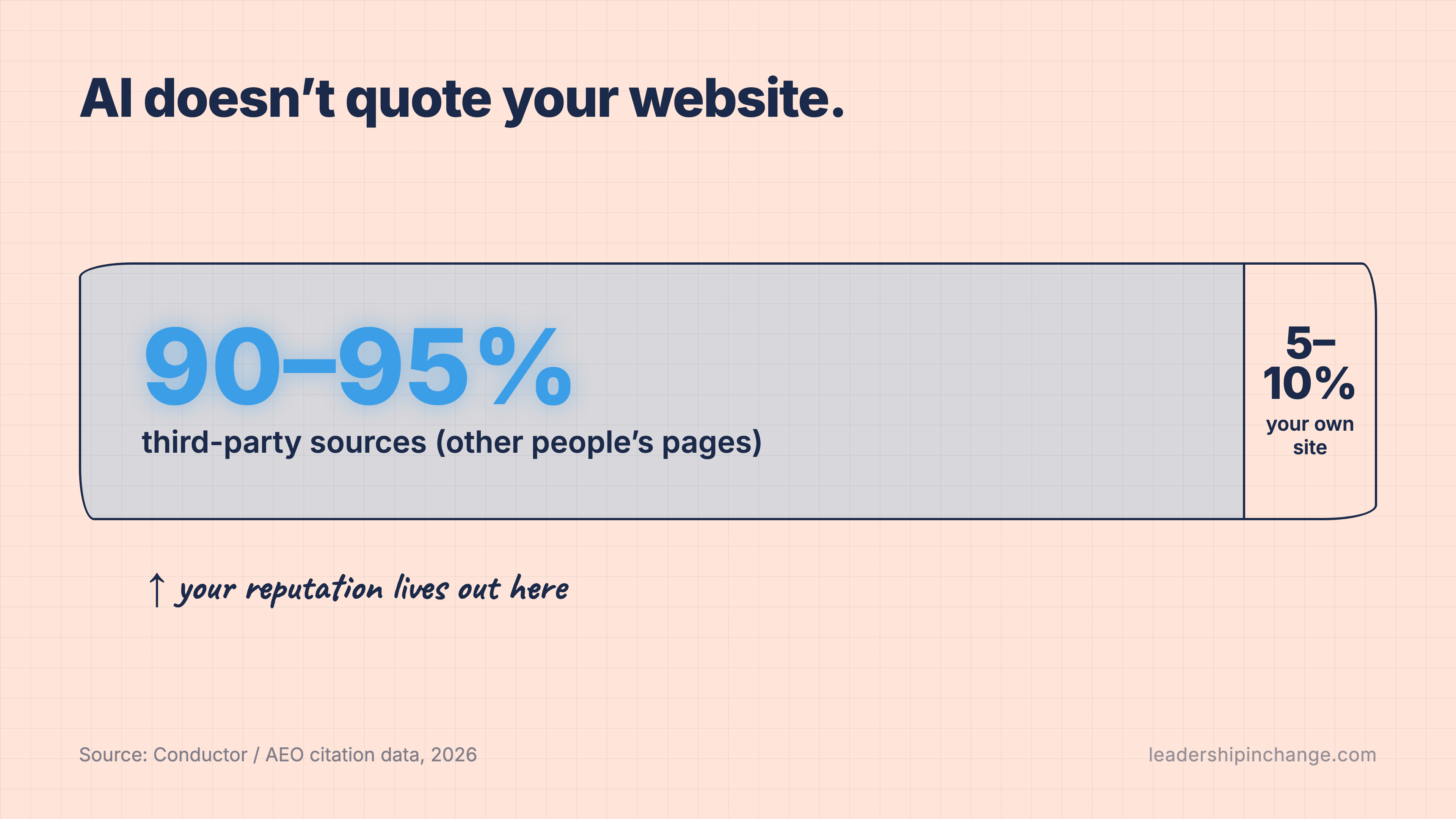
And here’s the part that reframes the whole job. When AI decides who to recommend, it mostly isn’t quoting your website. Studies of AI citations in 2026 show that somewhere between 90 and 95% of what AI pulls from comes from third-party sources: other people’s articles, forums, reviews, roundups. Only 5 to 10% comes from your own site. So the conversation about your business is mostly happening on other people’s pages, and a big part of the job is influencing those.
This guide gives you the map.
How to Become the Answer: 5 Moves
Becoming the brand AI recommends comes down to five moves: audit what AI already says about you, answer questions directly on your own site, earn mentions on the third-party pages AI trusts, keep your facts consistent everywhere, and check back regularly.
1. Audit what AI already says about you. Before you change anything, find out what the AI thinks. Open ChatGPT, Gemini (Google’s AI assistant), and Perplexity in a private or logged-out window so your own history doesn’t bias the result, and ask about your company and your category. I’ll give you the exact prompts in a minute.
2. Answer questions directly, on your own pages. AI likes content that answers a specific question fast. The research backs this up hard. A Princeton study on AI visibility found that adding clear statistics to your content makes AI about 30% more likely to cite it, citing your own sources adds another 30%, and quoting a credible expert adds 41%. Keyword-stuffing, the old SEO trick, actually makes you 9% less likely to be cited. So write like a helpful human. Put the answer first, then explain.
3. Earn mentions where AI looks. Remember, around 90% of what AI quotes lives on other people’s pages. That means the roundups, the “best tools for X” lists, the Reddit threads, the YouTube videos. If you’re not in the comparison article AI keeps citing, you either get into it or you create a better one.
4. Keep your facts identical everywhere. AI is, at its core, a consensus machine. When your company’s description, services, and details match across your website, your LinkedIn, your Google profile, and review sites, the AI trusts the facts and repeats them. When they conflict, it often just leaves you out rather than risk being wrong.
5. Check back, because the answer changes. AI answers aren’t fixed. They shift as new sources show up. Re-run your audit every couple of months, watching especially for wrong claims and the near-purchase criticism we talked about earlier. Treating AEO as a one-and-done box to check is the same trap behind why most AI investments fail.
One heads-up before you start. The hardest move here, actually getting your business into the roundups, reviews, and comparison lists AI leans on, is a project on its own, and it deserves a full walkthrough. That’s the follow-up I’m working on now. For today, start with the audit and your own pages, because that’s the work that pays off no matter how the tools change.
The Three-Prompt Test
The fastest way to see your AEO reality is what I call the Three-Prompt Test: three questions you ask the major AI tools to find out whether they know you, recommend you, and describe you accurately.
Run these in a fresh, logged-out chat across ChatGPT, Claude, Gemini, and Perplexity:
The direct one: “What does [your company] do, and who is it for?”
The category one: “What are the best [your category] for [your ideal customer]?”
The head-to-head: “[Your company] versus [your top competitor], which is better for [specific need]?”
For each answer, ask yourself three things: Did it mention me at all? Was what it said accurate? Would I have recommended me, based on that answer? If you’re missing from the category question, that’s your biggest gap. If the answer is wrong, that’s a brand-risk problem you can start fixing today by correcting your own pages, because those are the facts the AI checks against.
Here’s what that looks like in practice. Say you run a regional bookkeeping firm. You ask ChatGPT “what are the best bookkeeping firms for small nonprofits in Denver,” and it names three competitors and never mentions you. That’s the category gap, and it’s the one that costs you the most business. Then you ask “what does [your firm] do,” and it confidently describes a service you stopped offering two years ago. That’s the accuracy problem. Neither answer took more than a minute to find, and together they tell you exactly where to start: get mentioned where the AI is already looking, and fix the stale facts on your own pages.
That whole loop, the three prompts plus a way to score what you find, is the engine of an AEO strategy. I built the full version into a free download, the Become the Answer audit: the three prompts, a scoring sheet so you can track what each AI says about you over time, and the complete five-move checklist on one page.
To get the download, subscribe below, it’s free, then reload this page and the download will appear right here. Subscribe free →
Don’t just file this away. Run the three prompts today. It takes ten minutes and it changes how you see your whole online presence.
If you only remember this:
AEO is the work of becoming the answer AI gives. SEO gets you in the room, and AEO gets you recommended once you’re there.
Roughly 90% of what AI says about you lives on other people’s pages, so your reputation in AI is built mostly outside your own website.
The buyers AI sends you are pre-vetted and ready, which makes one AI recommendation worth more than a pile of cold clicks.
So here’s what I’d love you to do. Run the three prompts on your own company, then hit reply or post a Note and tell me what you found. Was the AI right about you, wrong about you, or did it have no idea you exist? I read every one.
Worth Your Time
A few pieces from other creators I think are worth your attention.
Kamil Banc — Get AI-Search to recommend your business, correctly. A real audit of a business scoring 51/100 on AI visibility, plus how to get ChatGPT and Gemini to recommend you with the right facts.
This Week in AI — How AI-First Marketing Looks Like in 2026. Three marketing shifts for 2026, with a full section on Answer Engine Optimization and getting discovered inside AI.
Kristina God — Is SEO Dead in 2026? The Father of SEO and Google Just Answered That. The man who coined “SEO” weighs in on staying visible as AI answer engines replace the old search game.
Questions Leaders Are Asking
What is the difference between SEO and AEO? SEO (search engine optimization) is the work of ranking your website high on a results page so people click it. AEO (answer engine optimization) is the work of getting your business named inside the answer an AI gives. One earns the click, the other earns the recommendation.
Is AEO replacing SEO? No. SEO is still the foundation, and a lot of what AI pulls from depends on a strong search presence. AEO is a second layer you add on top. The smart move in 2026 is to keep doing SEO and start doing AEO now, while most competitors haven’t.
How do I know if AI recommends my business? Run the Three-Prompt Test. In a logged-out chat, ask ChatGPT, Claude, Gemini, and Perplexity what your company does, what the best options in your category are, and how you compare to a competitor. Note whether you’re mentioned, whether it’s accurate, and whether it recommends you.
How does AI decide which businesses to recommend? AI pulls from many sources at once, and roughly 90% of what it cites comes from third-party pages, not your own site. It favors clear, well-sourced answers, consistent facts across the web, and mentions in the roundups and reviews it already trusts.
Can a small business compete with bigger brands on AEO? Yes, often more easily than with traditional SEO. AI rewards the clearest, most relevant, best-sourced answer to a specific question over raw brand size. A focused small business that answers a narrow question well can get recommended ahead of a larger, vaguer competitor.
Joel Salinas is an AI Strategy Coach for leaders at nonprofits and small and mid-sized businesses. AI is everywhere; judgment is scarce. Joel helps leaders adopt AI without outsourcing their judgment to it, through the AI Judgment Workshop and the 90-Day Judgment Engagement. Creator of the AI Leadership Triad. He writes Leadership in Change.

Written by a human, for humans.
This feels much closer to PR than SEO. It’s not just what you say about yourself anymore. It’s what the rest of the internet keeps saying about you.
Thanks for this article! It's one of the most insightful articles I've read on Substack this week. I knew almost nothing about AEO and this felt like the perfect intro.