



TL;DR: Anthropic's IPO filing, first submitted on October 26, 2026 and amended on November 2, shows fast growth, a Q3 operating loss of $567 million and about $895 billion of purchase and lease commitments. Economist Farida Khalaf estimates the company's equity at $1.1-1.4 trillion, below investor expectations of about $1.5-1.6 trillion, and shows what that price needs to go right.
There has been so much talk around the Anthropic S-1 and the IPO everybody expects to follow it, and honestly, I’ve seen a lot of crap about it, very subjective takes that mostly depend on where the person already stands on the AI bubble, and very, very few people actually breaking it down on the facts.
Quick definition, because most of us don’t read these for fun: an S-1 is the document a company files with the U.S. Securities and Exchange Commission before it sells shares to the public. Anthropic, the company behind Claude, filed its S-1 on October 26, 2026.
So when Farida Khalaf sent me her breakdown, I knew this was the one I wanted you to read. Farida is an economist, data engineer and cybersecurity professional who writes Lights On by Farida, where she covers “systems, incentives, and entropy in modern organizations,” and this really is top-notch work. Every number in it carries a label telling you whether it came from the filing itself, from press reports, from Anthropic’s management, or from her own model, which is exactly the habit most of us skip when we read about AI money.

Below you'll find her full analysis, unchanged and updated with the November 2 filing: the growth numbers and the third-quarter slowdown, the $80.7 billion loss explained line by line, the $895 billion of commitments, how Anthropic stacks up against OpenAI and DeepSeek, her valuation with bear, base and bull cases, the governance and legal risks, and the eight signals that would change her mind. All 16 of her tables are here as images, and the heaviest data sits in expandable sections, so you can open them if you want the math and skip them if you don't.
What You’ll Walk Away With
Why most of Anthropic’s $80.7 billion first-half loss is neither an operating loss nor a cash loss, and which numbers carry the real risk
What the $1.5 to $1.6 trillion investors now expect would need to go right, in revenue, margins and cost of capital
A four-label habit (filed, reported, management estimate, opinion) you can use on the next AI take that lands in your inbox
Editor’s note: This is Farida’s analysis, published with her permission. It is not investment advice. Her tables appear as images so they keep their exact formatting, and each one was checked number by number against her original. If you like how she thinks, subscribe to Lights On by Farida.
Free cash flow: cash the business brought in from operations, minus what it spent on equipment and property.
Convertible notes and SAFEs: investments that turn into shares later instead of being paid back in cash.
Fair-value charge: an accounting loss recorded when those convertible investments become more valuable. No cash leaves the company.
Dilution: when new shares are created, each existing share owns a smaller slice of the company.
Compute: the chips, servers and data centers used to train and run AI models.
Take-or-pay: a contract where you pay for the capacity whether you use it or not.
Usage-based revenue: customers pay for what they use, so they can cut back at any time.
Net revenue retention: how much existing customers spend now compared with a year ago. 900% means nine times as much.
Tokens: the small units of text AI companies charge by, roughly pieces of words.
Gross margin and operating margin: the share of revenue left after the direct cost of serving customers (gross), and after all operating costs (operating).
Open-weight model: an AI model whose internals are published, so anyone can run it, often much more cheaply.
DCF (discounted cash flow): valuing a company by estimating all its future cash and converting it into today’s dollars.
Cost of capital: the yearly return investors demand for taking the risk. The higher it is, the less future cash is worth today.
Terminal value: the value of everything after the forecast years (here, after 2036), assuming steady growth from then on.
Credit rating BB+: one notch below “investment grade,” the level many large lenders and funds treat as safe.
Lock-up expiration: the date early insiders are allowed to sell their shares, which can push the price down.
Anthropic: An Exceptional Technology, an Unproven Business Model, and a Valuation Ahead of the Numbers
First written October 31, 2026. Updated November 4 with the amended S-1 filed November 2 and Damodaran's November 3 revision.
Thesis. Anthropic is an exceptional technology company entering public markets at a price that already assumes much of its future success. Investor expectations for the IPO have fallen from about $2 trillion to about $1.5–1.6 trillion (R), and no price range has been set. Even that reduced level sits at or above Aswath Damodaran’s “upbeat” base case of $1.45 trillion, revised on November 3 after the Q3 filing (R), and above my own estimate of $1.1–1.4 trillion of aggregate equity value before dilution (A).
The three strongest arguments:
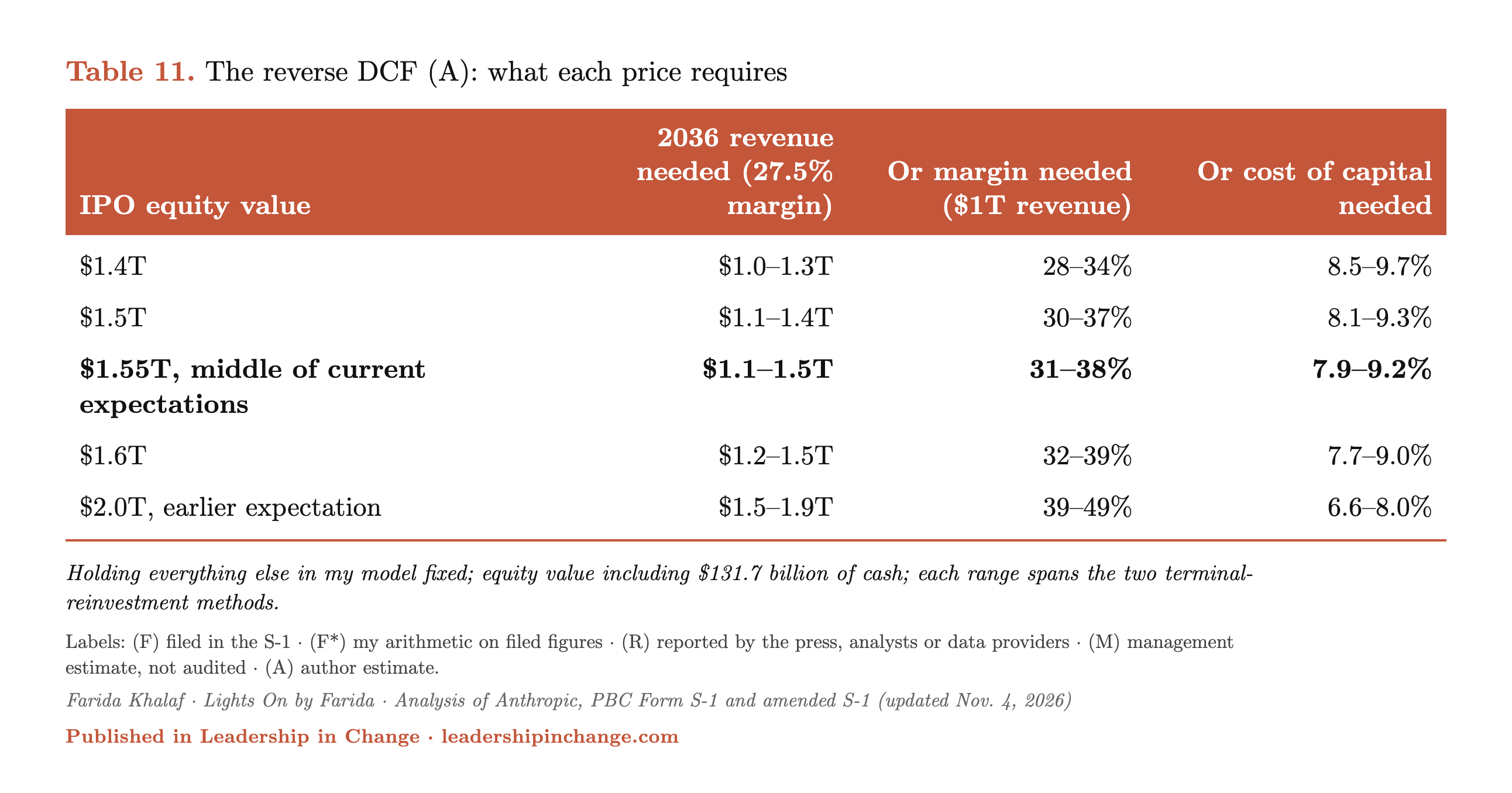
Even the reduced price needs more than a base case. At $1.55 trillion, the middle of current expectations, my model needs 2036 revenue of $1.1–1.5 trillion at a 27.5% margin, or a 31–38% margin on $1 trillion of revenue (A), against a base case of $1 trillion at 27.5%. Damodaran’s best case is $1.5 trillion of revenue at a 40% margin (R).
Costs are fixed; revenue is not. Anthropic had about $895 billion of purchase and lease commitments at September 30 (F), and about $70 billion of them fall due within 12 months (F), more than its annualized Q3 revenue of about $68 billion (F*). Against that it holds about $10.8 billion of contracted future revenue (R), and about 80% of revenue is usage-based (F).
The real cost is staying at the frontier, not serving customers. Of $8.95 billion of first-half compute (F), only about $2.4 billion sat in cost of revenue (R), where Anthropic already earns a gross margin near 85% (F*). At least $6.6 billion sat outside cost of revenue, most likely research, model development and internal use (F*). The valuation depends on research spending of that scale falling as a share of revenue.
What is genuinely strong: positive free cash flow of about $3.4 billion in the first half (F*), $6.6 billion of operating cash flow over nine months (R), net revenue retention of about 900% (F), and a rising share of business token spend in Ramp’s sample despite a higher blended price than OpenAI’s (R).
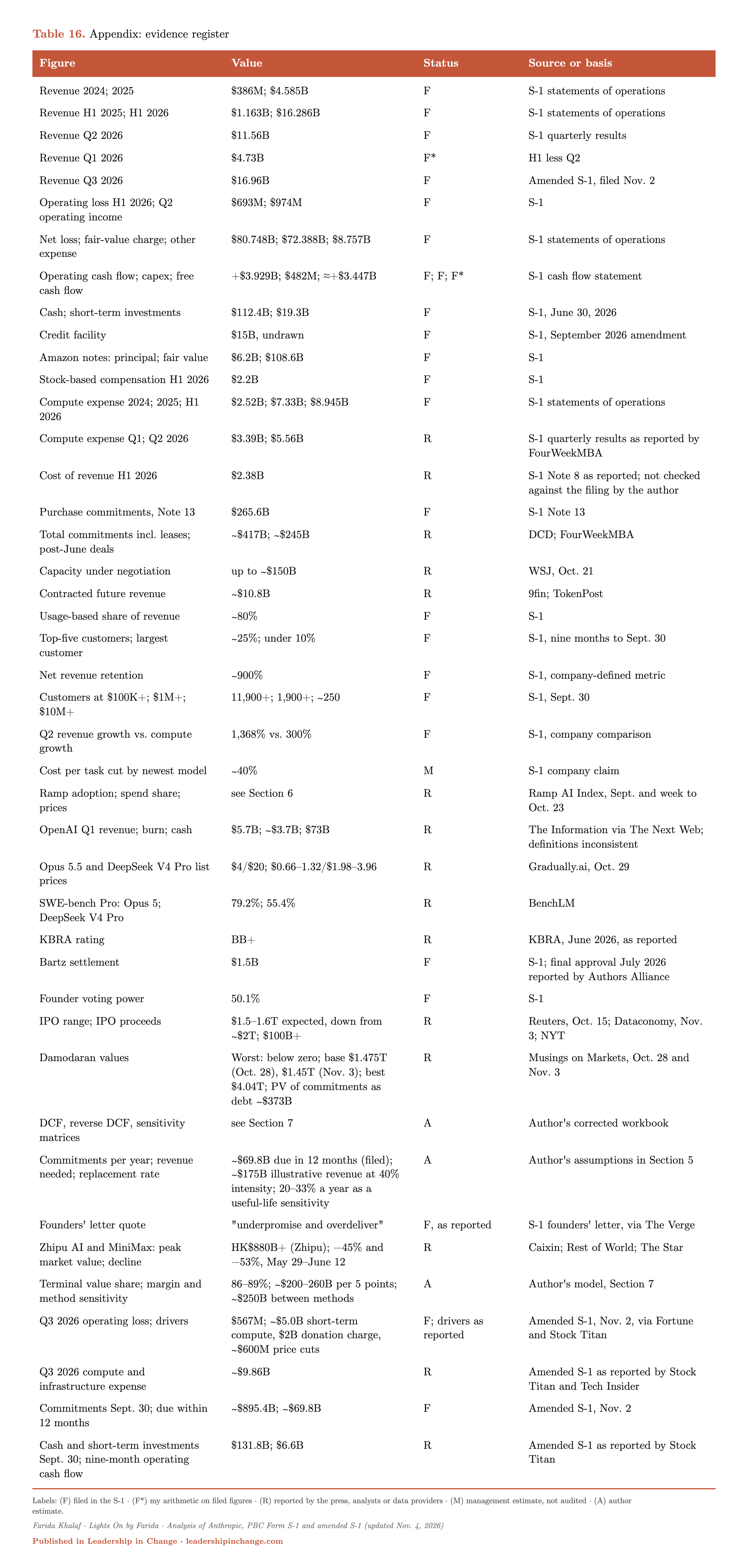
Labels: (F) filed in the S-1 · (F*) my arithmetic on filed figures · (R) reported by the press, analysts or data providers · (M) management estimate, not audited · (A) author estimate. The appendix lists each key figure and its source.
Funding an idea versus valuing a business
There is a fundamental difference between venture capital and public-market investing.
Venture capital funds people, ideas, ambition and potential. It accepts uncertainty because its aim is to back extraordinary possibilities before they become reality; hope, conviction and the quality of the founding team are legitimate parts of that decision.
Public markets operate under a different discipline. They must assess a company’s actual economics, competitive position, capital requirements, cash generation and ability to deliver returns at a specific price.
One market can invest in what a company might become. The other must determine what that future is worth today.

I have little doubt that Anthropic has exceptional technology, an organization able to keep improving its models. The technological opportunity is real. But technological excellence and investment attractiveness are different questions.
My concern is not whether Anthropic can build increasingly powerful AI. It is whether its business model can generate returns large enough to justify the valuation being discussed, and the S-1 raises questions investors should not overlook.
I: The financial reality
1. Growth: real, but decelerating
First-half 2026 revenue was $16.29 billion (F), up from $1.16 billion a year earlier, about 14 times (F*). The operating loss narrowed to $693 million (F), and the second quarter produced $974 million of operating income (F).
The trajectory is the question. Quarterly revenue went from $4.73 billion in Q1 (F*) to $11.56 billion in Q2 (F) and $16.96 billion in Q3 (F), filed in the amended S-1 on November 2. Sequential growth fell from about 144% to 47% (F*). Q3 also swung to a $567 million operating loss (F) after Q2’s $974 million profit, mainly because of about $5.0 billion of short-term compute bought at higher prices than multi-year contracts, a $2 billion non-cash donation-matching charge, and about $600 million of revenue lost to price reductions and discounts (F, as reported). Forty-seven percent a quarter still compounds to roughly four times a year, so this is a change in growth momentum, not a collapse, and one quarter is not enough to establish a new trend.
My reading is that 2025–2026 adoption happened in a phase of token maximization, when enterprises encouraged AI use before measuring the return on each token. Ramp’s September index is consistent with early cost discipline but does not prove it: AI’s share of non-payroll business spend slipped from 5.96% to 5.77% (R), one month in one sample. If customers are starting to optimize, the S-1 describes the period before that shift.
2. The $80.7 billion loss, line by line
The first-half net loss looks catastrophic. Most of it is neither an operating nor a cash loss:
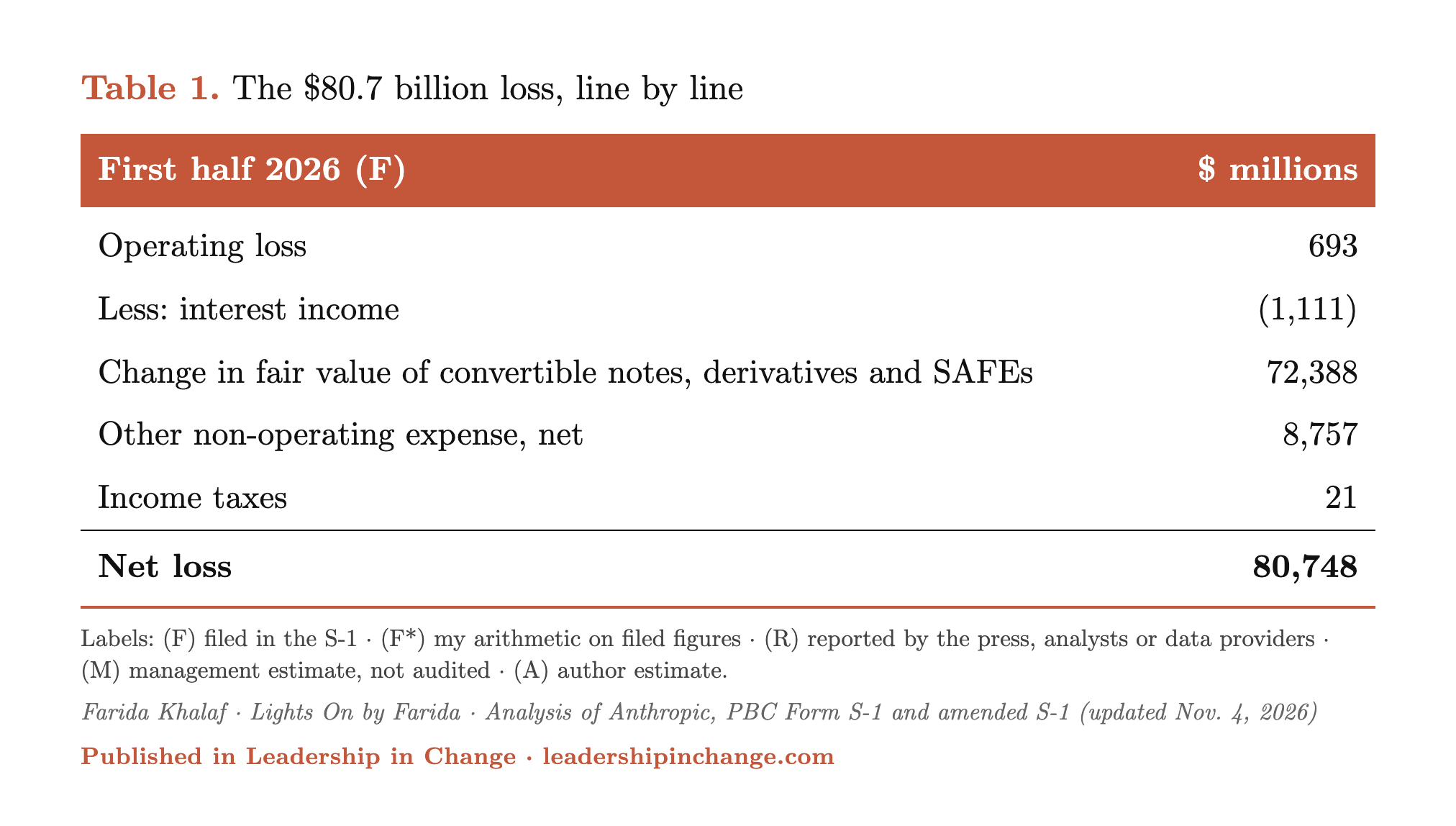
The fair-value charge is 90% of the loss (F*) and rose with the company’s valuation. Interest income on the cash pile more than covered the operating loss. The $8.8 billion of other expense is real and deserves an explanation before anyone relies on it.
The convertible instruments still matter, as dilution rather than cash, and four figures describe them. Principal, the amount Amazon lent, is $6.2 billion (F). Accounting fair value at June 30 was $108.6 billion (F), reflecting the value of the shares the notes can convert into, not an amount owed in cash. Conversion is into non-voting Class N shares, with Amazon’s stake capped at 12% (F). The dilution to other holders depends on the final share count and IPO price, which are not yet set.
3. Cash flow and liquidity
Free cash flow is operating cash flow minus capital expenditure, and on that basis Anthropic generated cash in the first half:
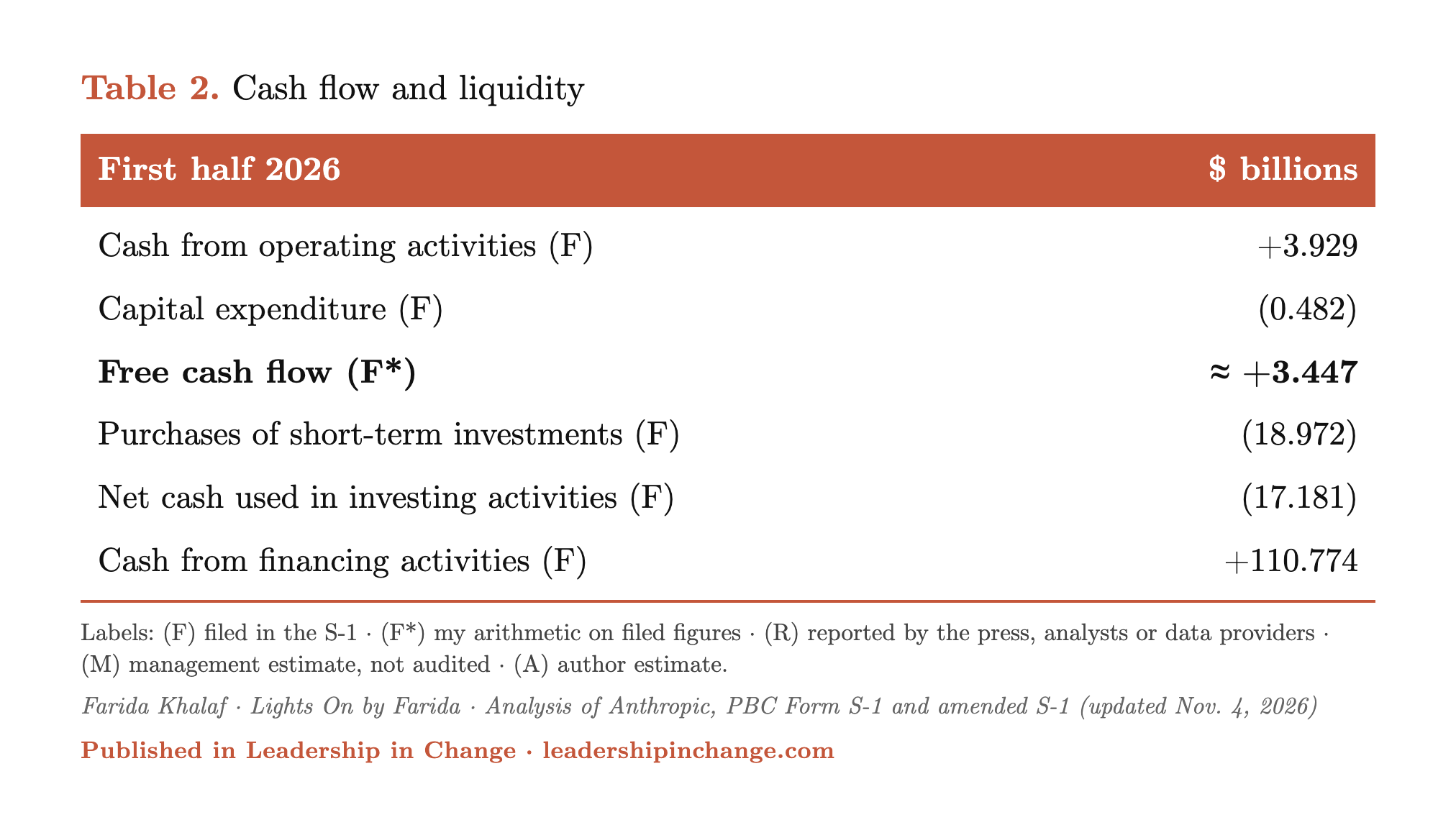
The $17.2 billion investing outflow was mostly newly raised capital parked in short-term securities, not infrastructure. At June 30 the company held $112.4 billion of cash and $19.3 billion of short-term investments (F), and in September it raised its undrawn revolving credit facility from $3.25 billion to $15 billion (F). At September 30, cash and short-term investments were about $131.8 billion; with about $14.8 billion available under the credit facility, total liquidity was $146.6 billion. Operating cash flow reached $6.6 billion over nine months (R). The IPO could add more than $100 billion (R), but that is prospective, not liquidity in hand.
This is conventional free cash flow, not fully burdened free cash flow. Anthropic obtains most of its capacity through leases and cloud commitments, so much of its infrastructure investment shows up in operating expenses, lease obligations and contractual commitments rather than capital expenditure. Positive free cash flow is encouraging, but it is not the cash required to maintain a competitive compute base. Chapter II measures that burden.
II: The capital burden
4. Fixed commitments, flexible revenue
In my view this is the most important financial issue in the prospectus. The headline numbers mix different kinds of obligation, so they should not simply be added:
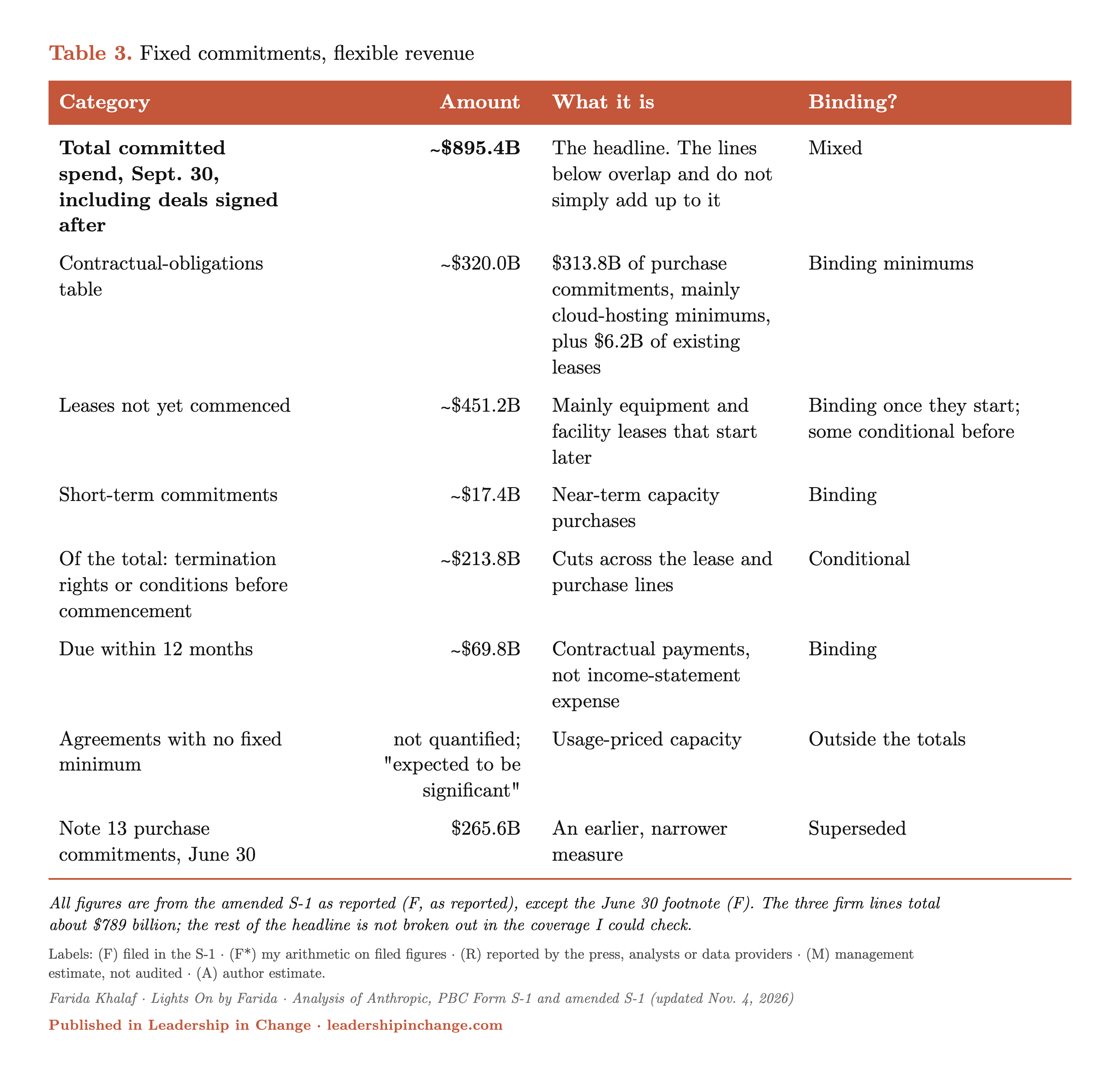
All figures are from the amended S-1 as reported (F, as reported), except the June 30 footnote (F). The three firm lines total about $789 billion; the rest of the headline is not broken out in the coverage I could check.
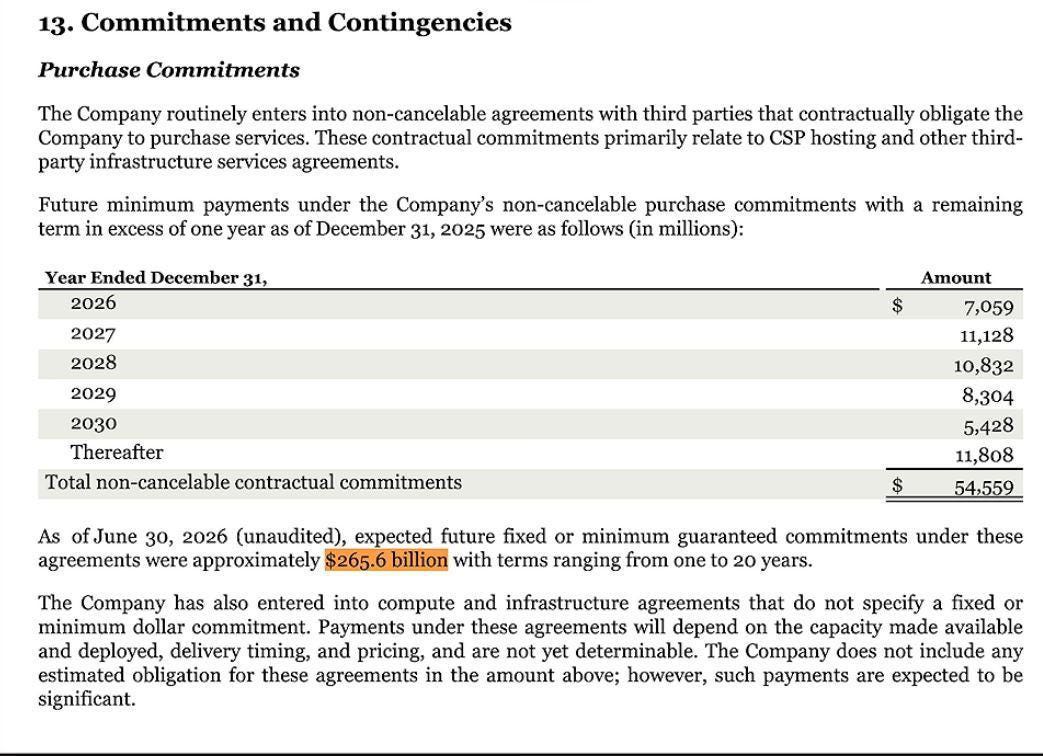
The largest counterparties include Broadcom (about $161 billion of equipment leases), Google (at least $114.5 billion), Amazon (about $110 billion) and Nscale and Lambda (up to $86 billion combined) (R). Spending runs through 2045 (F), and the S-1 describes take-or-pay terms that require payment “regardless of actual utilization” (F). About $447.5 billion is expected before 2031 (F, as reported). The $895.4 billion is not $895.4 billion of debt: the $69.8 billion due within a year is the firm near-term exposure, and the rest is a long-dated capacity and funding requirement, part of it conditional.
Revenue is far less committed. About 80% is usage-based (F), the S-1 says many top customers can reduce or cease spending at any time (F), and contracted future revenue was about $10.8 billion at June 30 (R). Concentration is not the problem: the top five customers were about 25% of nine-month revenue, with no single customer above 10% (F). Flexibility is. KBRA rates Anthropic BB+, one notch below investment grade (R). The roughly $70 billion due over the next 12 months alone exceeds Q3’s annualized revenue (F*).
A partial counterweight: Anthropic Direct. The S-1 describes a shift from relying mostly on cloud contracts toward a hybrid model in which Anthropic also procures accelerators directly and runs them in dedicated facilities "leased and operated on our behalf, to our specification" (F, as reported). Management argues this reduces dependence on cloud providers that may prioritize their own needs, and could improve long-term economics. It also brings higher up-front capital needs, more direct exposure to power, supply-chain and community-opposition risks, and the company's own warning that it "may not realize the expected benefits" (F, as reported). The fixed-cost structure is not permanently locked, but the alternative is unproven.
5. Infrastructure economics: what each dollar of revenue costs to serve
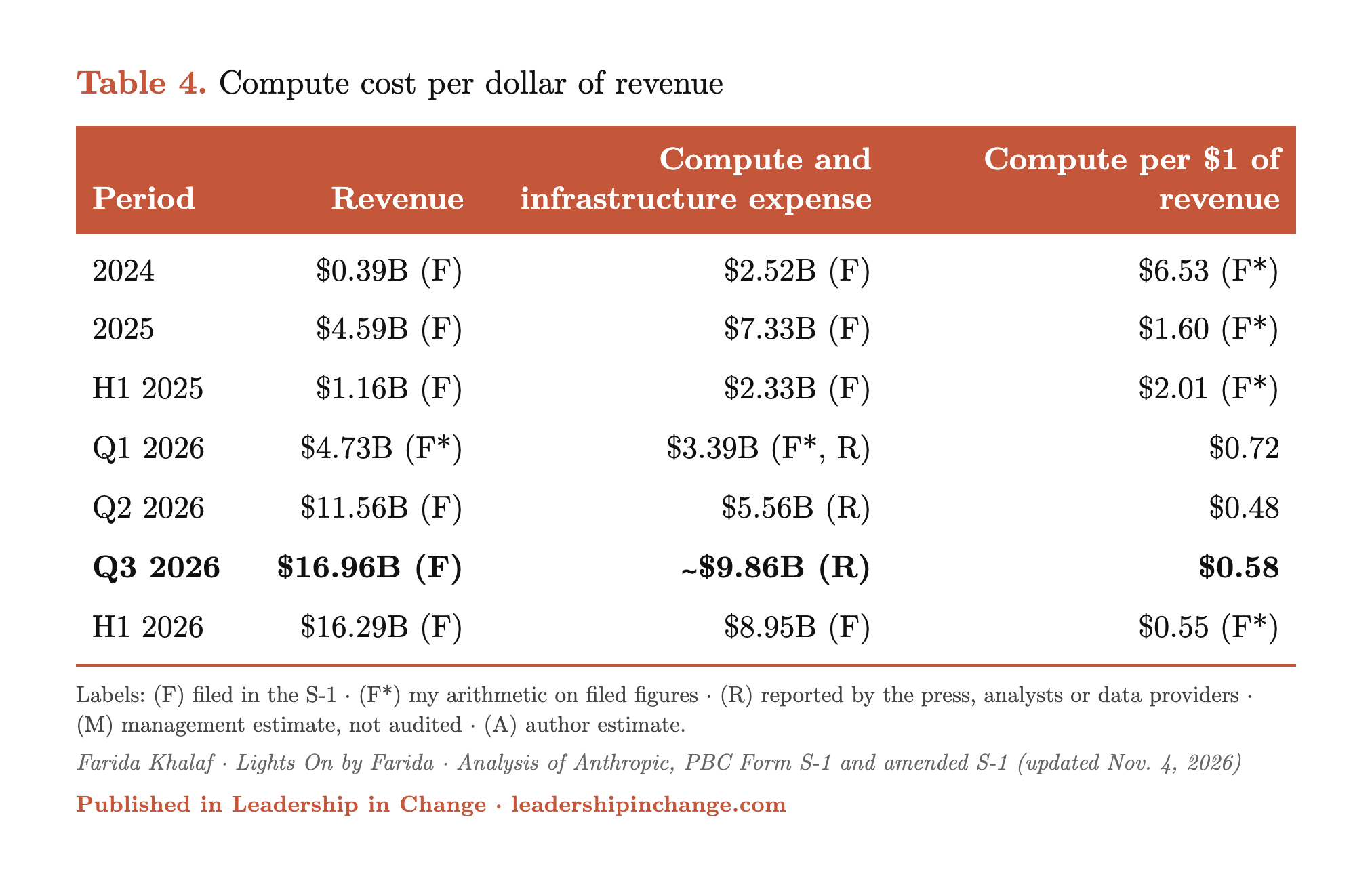
Compute cost per dollar of revenue fell sharply through Q2, then rose in Q3:
Most of that compute does not serve customers. The S-1 reports expenses both by nature (compute, personnel) and by function (cost of revenue, research). Putting the two together:
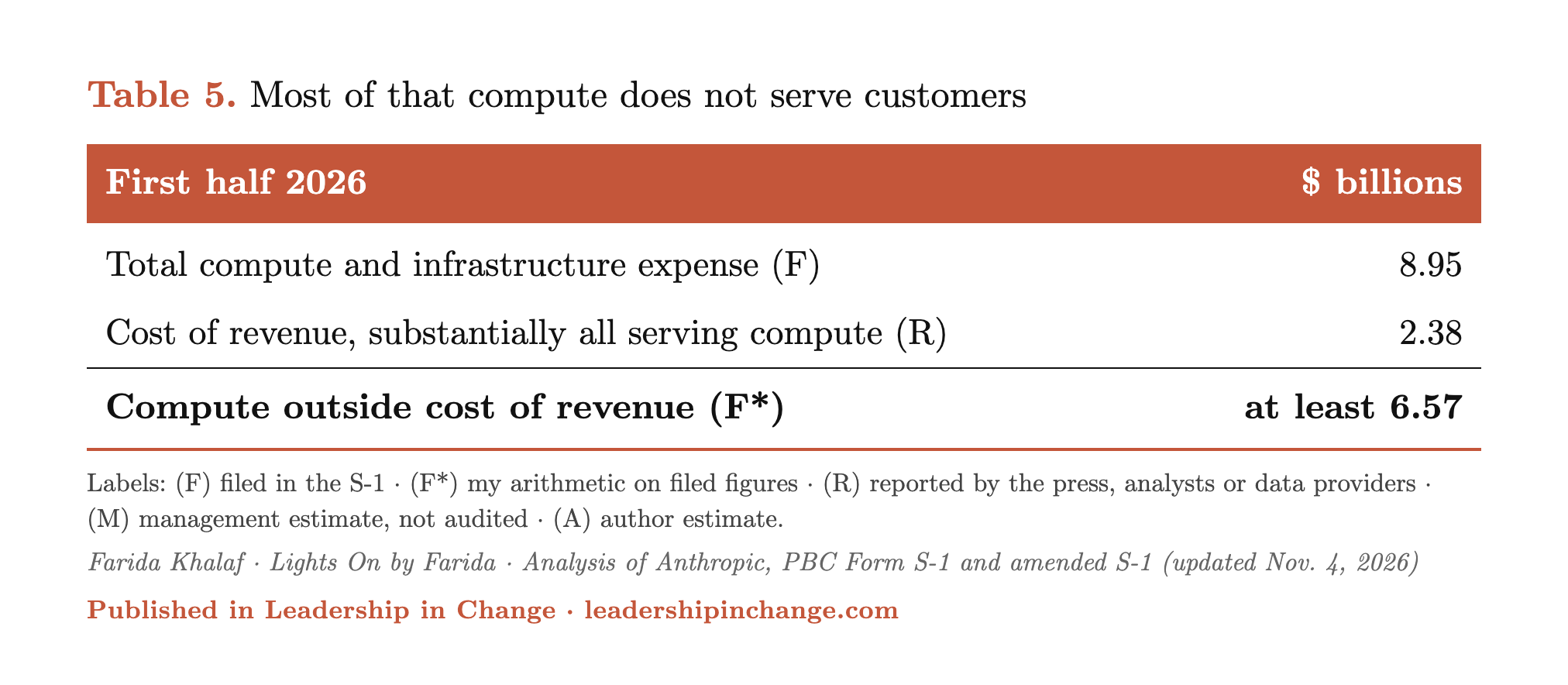
The difference is at least $6.57 billion, about 40% of revenue, because cost of revenue also includes some personnel and overhead. Since the filing classifies expenses by nature and by function separately, this residual is not a precise measure of research compute. The filing gives no precise functional allocation; it describes compute as serving research, model development, customers and internal use. The residual most likely consists predominantly of research, model development and internal workloads, plus compute for free access. Cost of revenue itself was 15% of revenue, implying a gross margin near 85% (F*). That is an accounting measure of reported serving economics, not proof of sustainable, fully allocated margins as usage expands. Anthropic's main infrastructure burden is the cost of staying at the frontier, not the cost of serving customers.
Incremental efficiency improved fast, then reversed in Q3:
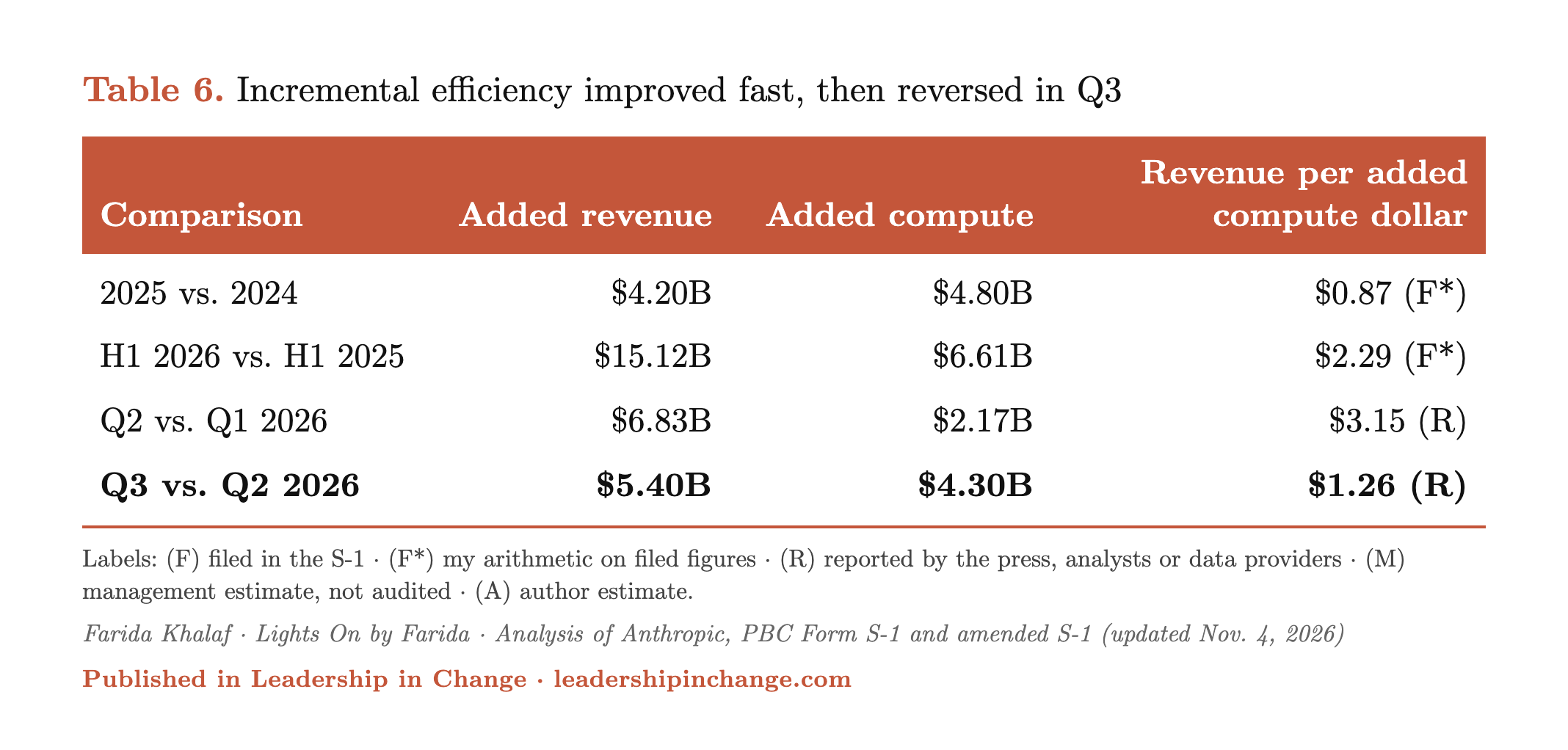
What the valuation requires. In the first half, non-compute costs (personnel, sales and marketing, other) were 49% of revenue (F*). For the 27.5% operating margin in my base case, total costs must fall to 72.5% of revenue. If non-compute costs fall to 30–35% at scale (A), compute must fall to 37.5–42.5% of revenue, against 48% in Q2 and 58% in Q3 (R). Q2 made that look plausible; Q3 shows the path is not a straight line, because short-term compute bought to meet demand costs more than contracted capacity.
Do the commitments fit? The amended S-1 gives a filed figure: about $69.8 billion of commitments fall due in the 12 months after September 30 (F). That is about 1.0 times Q3’s annualized revenue and 1.8 times Q3’s annualized compute expense of about $39 billion (F*, R). Total commitments of $895.4 billion are 6.8 times cash and short-term investments (F*). Not all of it is operating expense: part is leases and capacity that may be capitalized, and the schedule runs through 2045. As an illustrative funding sensitivity, not an accounting reconciliation: $70 billion a year of compute spending at a 40% revenue intensity would require about $175 billion of revenue (A), roughly my base-case level for 2030, and would equal 57% of 2030 revenue on the bear path (A). Contractual payments include leases and equipment that may be capitalized, so they are not the same measure as compute expense.
The replacement clock. Lease length, economic life and replacement spending are different things. Broadcom's roughly $161 billion of reported equipment lease commitments run on five-year terms (R); reporting does not make clear whether that is total payments or equipment value. The economic question is separate: if frontier accelerators have an economic life of three to five years (A), keeping a constant competitive fleet would mean replacing roughly 20–33% of capacity each year, whatever the contract schedule. This is a useful-life sensitivity, not an established requirement: older chips can stay useful for inference, software gains extend useful life, and replacement can be selective. My DCF's reinvestment ($1 per $3 of new revenue) funds growth only; replacement has to come out of the operating margin. A company can report strong operating cash flow while its capital base wears out faster than it earns back its cost.
III: The competitive economics
6. Competitive economics: prices, share and profits, not just benchmarks
The test of a moat is economic: can a company charge more, keep customers and earn a profit while doing it? On the available evidence, Anthropic shows stronger pricing resilience than OpenAI, at least in Ramp's sample. That is not proof of superior profitability or long-term unit economics:
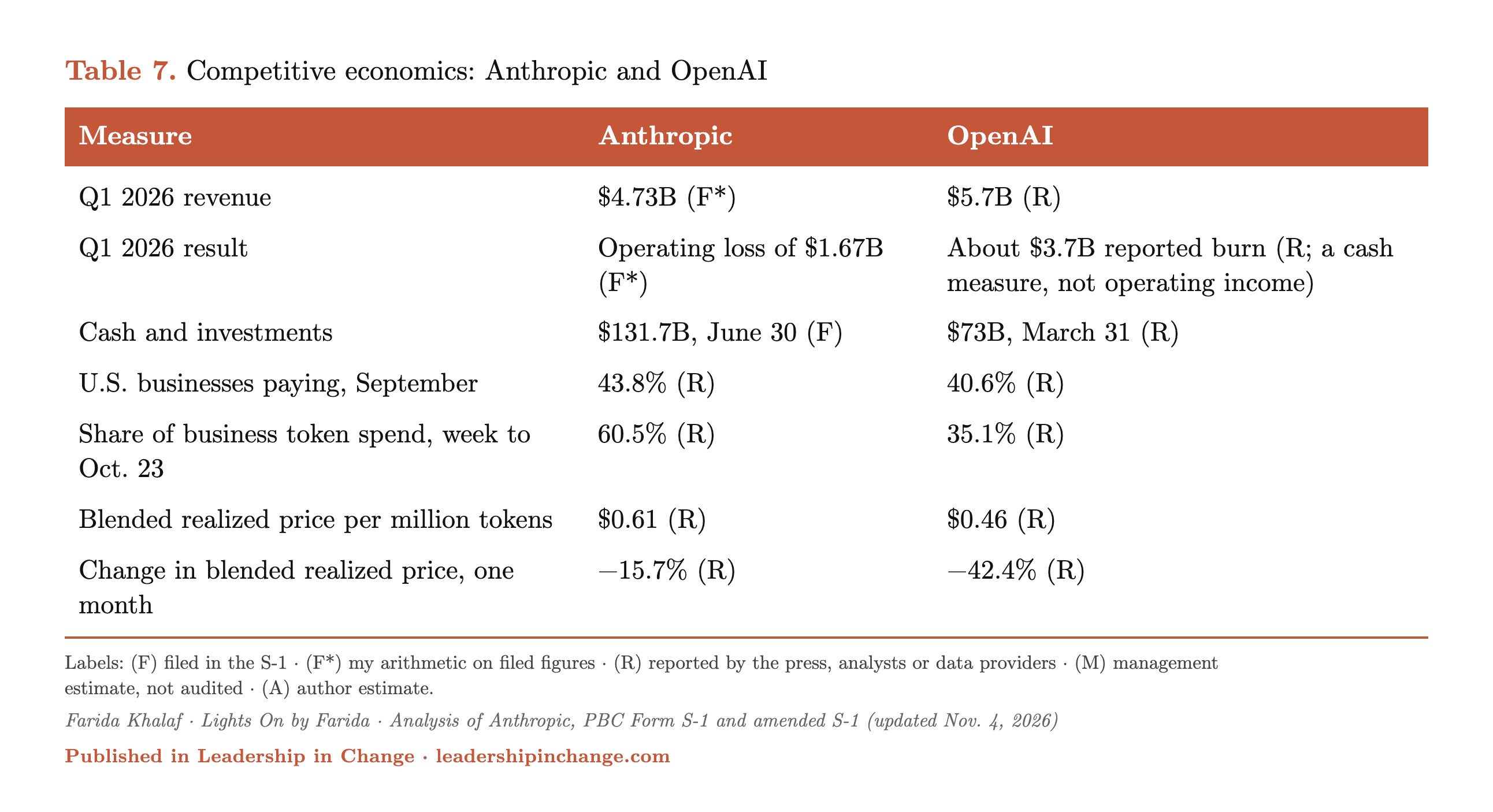
Anthropic’s blended realized price is about a third above OpenAI’s, and its share of spend rose nine points in a month. OpenAI’s blended realized price fell 42% over the same period while its share of spend declined (R). Blended prices move with product and usage mix, not only list-price cuts. Two more caveats: Ramp’s token data is a sample of its own customers, and OpenAI’s figures come from leaked shareholder documents with inconsistent definitions.
The open-weight threat looks different on economics than on benchmarks:
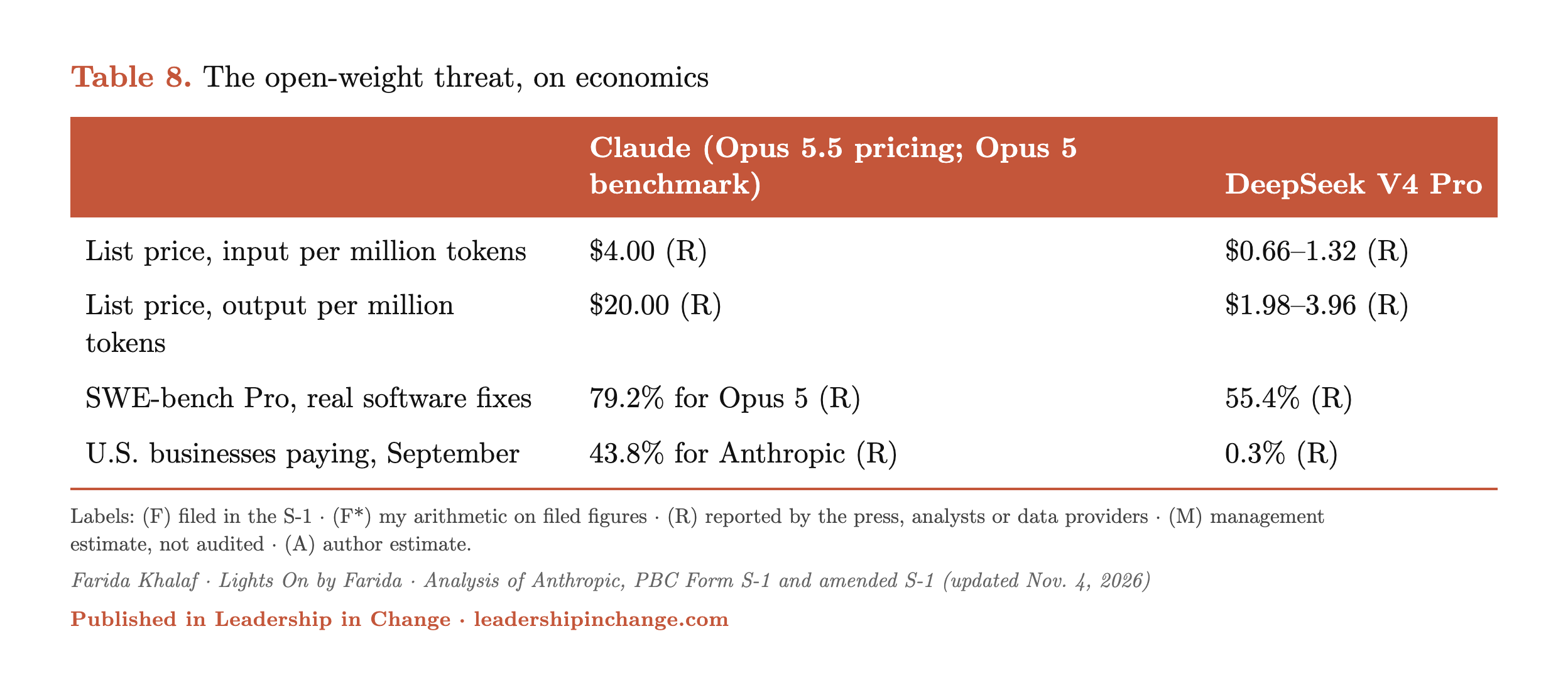
DeepSeek is 3–10 times cheaper at list price, yet almost no U.S. businesses pay for it. In coding, Anthropic’s largest use, the quality gap is still large. Open models are a forward risk, not yet a present one.
The risk is a price war that compresses everyone. Google has been cutting Gemini prices, OpenAI is cutting faster than Anthropic, and Anthropic’s blended price still fell 15.7% in a month (R). The amended S-1 puts a number on it: price reductions and contractual discounts cut Q3 revenue by about $600 million (F, as reported). I also expect diminishing returns: once models are good enough for ordinary tasks, further gains may add less economic value than they cost to build.
Anthropic’s answer is what it calls “closing the loop”: each Claude model helps build the next, which it describes as one of the most significant structural advantages in frontier AI (M). That is a company claim, not yet a demonstrated financial advantage, and the same S-1 warns that a flaw in one model could propagate through the versions it helps build (F).

Anthropic’s pricing resilience is real today. What is unproven is whether it survives a price war, and the valuation assumes it will.
IV: Valuation and governance
7. Valuation: what the IPO price assumes
The benchmark. Damodaran valued Anthropic's equity at about $1.475 trillion on October 28, from what he calls an "upbeat story," and trimmed it to about $1.45 trillion on November 3 after the Q3 figures (R). His figure counts about $100 billion of expected IPO proceeds as cash, treats about $373 billion, the present value of compute commitments, as debt, and deducts options ($472 million) and the convertibles at market value (R).
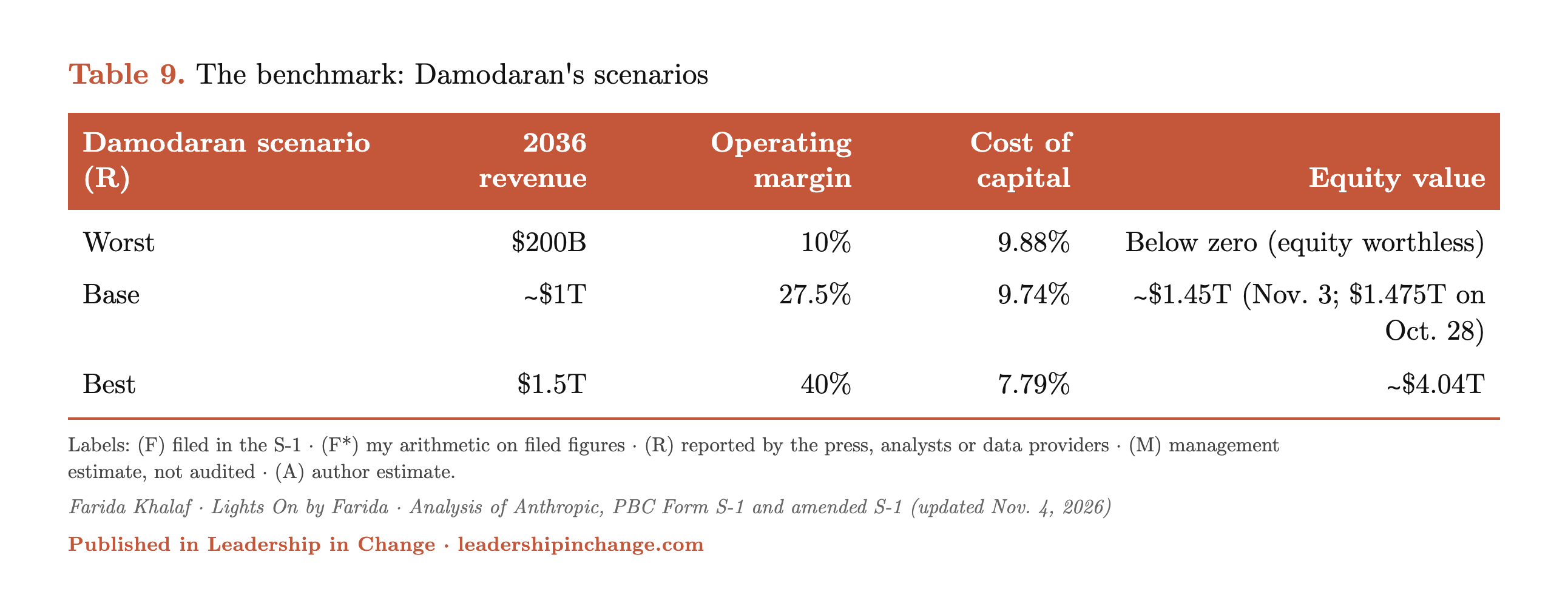
My model (A). A ten-year free cash flow model with similar inputs gives $1.1–1.4 trillion of equity. Its base case: $55 billion of 2026 revenue (Q1–Q3 filed at $33.25 billion plus an estimated $21.75 billion Q4, about 28% sequential growth; the filed Q3 figure leaves the anchor, and every value below, unchanged), $1 trillion by 2036, an operating margin ramping to 27.5%, a 25% tax rate, $1 reinvested per $3 of new revenue, a 9.74% cost of capital and 2.5% terminal growth. The range reflects two standard ways of setting terminal reinvestment. Cash is taken at June 30 ($131.7 billion), matching the model's valuation date; the September 30 figure, about $131.8 billion, is almost identical. About 86–89% of the value sits in the terminal year. The two models are not like-for-like: Damodaran adds IPO proceeds and subtracts commitments as debt; mine does neither. My model does not deduct commitments as debt, because its operating forecast is meant to carry the cost of compute; deducting the same payments again would count them twice. That treatment is valid only if the forecast actually absorbs the contractual schedule, and a rough check suggests it may not. About $447.5 billion of commitments is expected before 2031 (F, as reported). My base case forecasts about $500 billion of revenue from Q4 2026 through 2030, and about $440 billion of total operating costs, including personnel, sales and everything else (A). If compute is around 45% of revenue, the model funds roughly $225 billion of it over that period, about half the committed amount (A). Either revenue must run well ahead of my base path, as management's reported projection of $190–200 billion for 2028 implies, or committed capacity will weigh on margins or sit idle. Part of the gap is softer than it looks: about $213.8 billion carries termination rights or conditions, and some leased capacity serves revenue after 2030 (F, as reported). I treat this as the model's most important limitation. The model is also more lenient on dilution: Damodaran deducts options and convertibles; mine does not, so its value per public share is overstated.
Three scenarios (A). The workbook’s three cases, with equity value including June 30 cash under the two terminal methods:
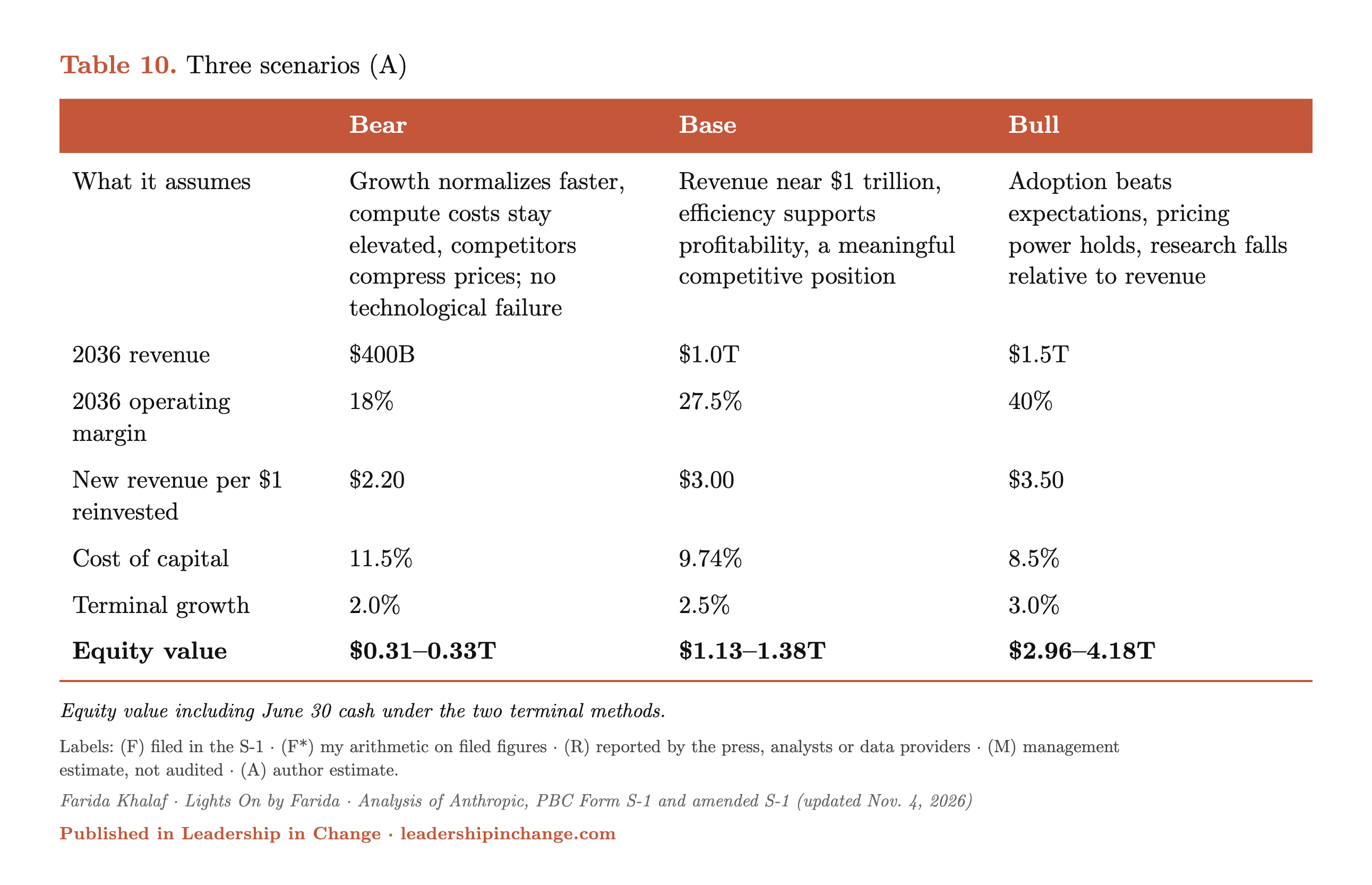
The bear case does not require Anthropic to fail technologically. Slower growth, persistent compute costs, price pressure and lower mature margins are enough to cut value by about three quarters. I have not assigned probabilities: there is no defensible basis for them, and an invented weighting would only make the uncertainty look smaller.
The reverse DCF (A). Holding everything else in my model fixed, on the same basis as the matrices below (equity value including $131.7 billion of cash; each range spans the two terminal-reinvestment methods):
Sensitivity: revenue and margin (A). Equity value in $ trillions, including $131.7 billion of cash, at a 9.74% cost of capital and 2.5% terminal growth. Each cell shows the lower and higher result from the two terminal-reinvestment methods. Bold cells reach $1.5 trillion, the low end of current expectations, under both.
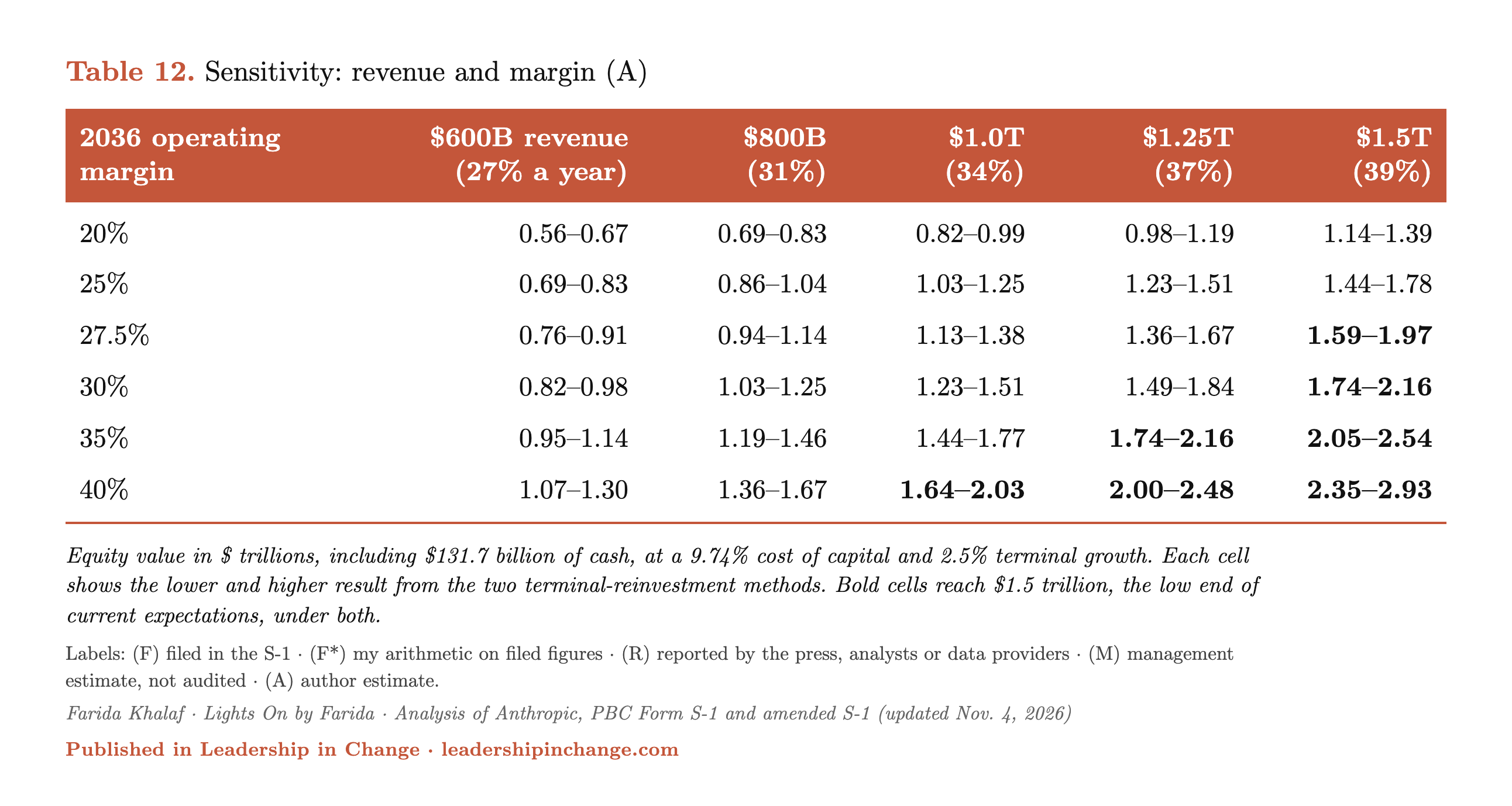
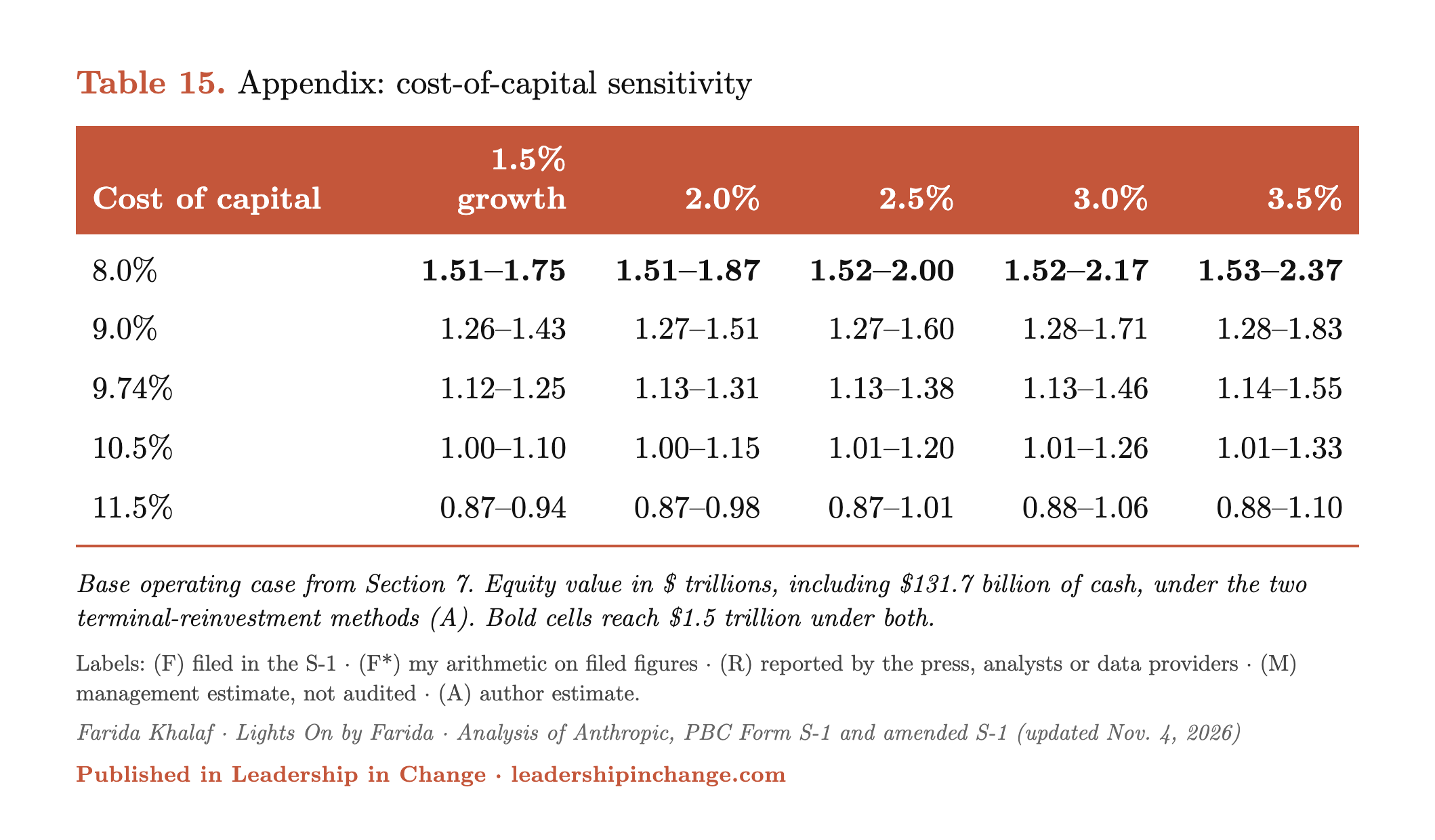
With the operating case unchanged, reaching $1.5 trillion under both terminal methods takes a cost of capital near 8%, which would price Anthropic as if it were already a mature, low-risk business. The full cost-of-capital matrix is in the appendix.
Because 86–89% of the value sits after 2036, four things matter most.
Small changes in the long-run margin move value disproportionately: five points of margin at $1 trillion of revenue shifts equity by about $200–260 billion.
Terminal reinvestment matters as much as growth: the two standard methods differ by about $250 billion on identical inputs.
Perpetual 2.5% growth assumes the competitive position survives indefinitely.
And accelerator replacement, which conventional reinvestment assumptions capture poorly, weighs most on exactly this terminal period.
The valuation is not only a bet that Anthropic reaches $1 trillion of revenue. It is a bet that it keeps attractive economics once it gets there.
A caution on volatility. Hong Kong-listed Zhipu AI and MiniMax show how fast AI valuations can reset. After January debuts, Zhipu was briefly worth more than HK$880 billion in late May, on first-half 2025 revenue of about $27 million. Between May 29 and June 12, Zhipu fell about 45% and MiniMax about 53% as lock-up expirations approached (R). Anthropic’s fundamentals are far stronger, but the lesson carries: when a price runs ahead of the numbers, post-debut buyers carry the risk.
My model is generous on dilution: it deducts nothing for convertible claims, options or restricted shares, so its value per public share is overstated. Stock-based compensation is a separate question. It was $2.2 billion in the first half, about 13.5% of revenue (F*). If the 27.5% target is read as an operating margin after stock-based compensation, as GAAP margins are, no adjustment is needed. If it is read as before it, a mature charge of 2–5% of revenue lowers equity value to about $0.92–1.28 trillion (A). None of this proves the IPO is overpriced; it shows how much has to go right.
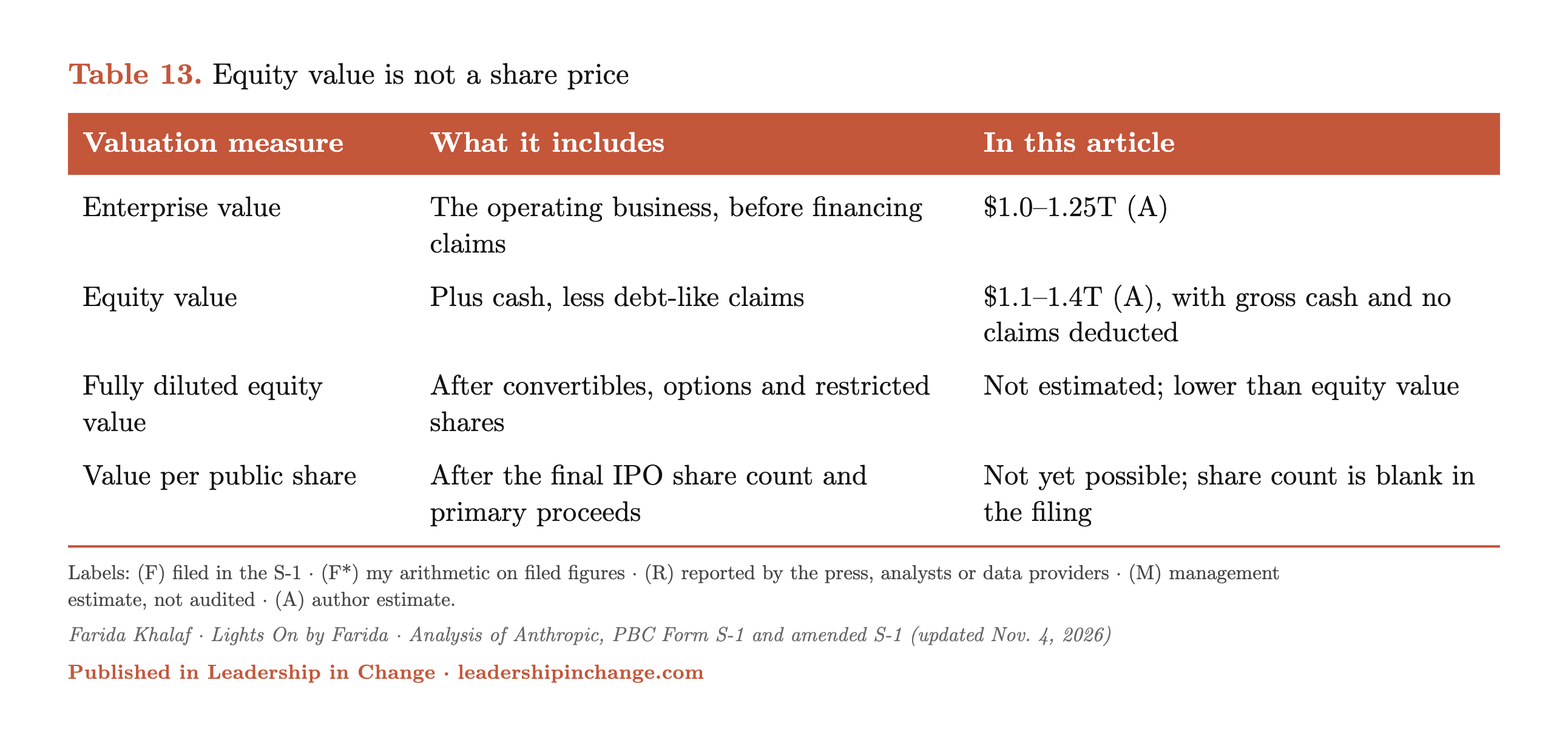
My $1.1–1.4 trillion is aggregate equity value, which is not the same thing as the price of a public share. Comparing it with an IPO price needs a common basis:
8. Governance
A single Class F share, held by an LLC of the seven co-founders, will carry 50.1% of total voting power (F). The Long-Term Benefit Trust generally elects a majority of the board (F). Anthropic will be a “controlled company” under Nasdaq rules and, as a public benefit corporation, must balance shareholder returns against its mission (F). Damodaran calls the structure “deviously self-serving“ (R).
Founder control is common in technology and can protect a long-term culture. But public shareholders here supply capital with NO influence over strategy, capital allocation or a sale. There is no standard discount for that. At a price that already needs much to go right, it argues for a margin of safety, not a premium. So Anthropic wants you to invest with NO right at all.
V: Enterprise risk and the investment decision
9. Safety, misuse and liability
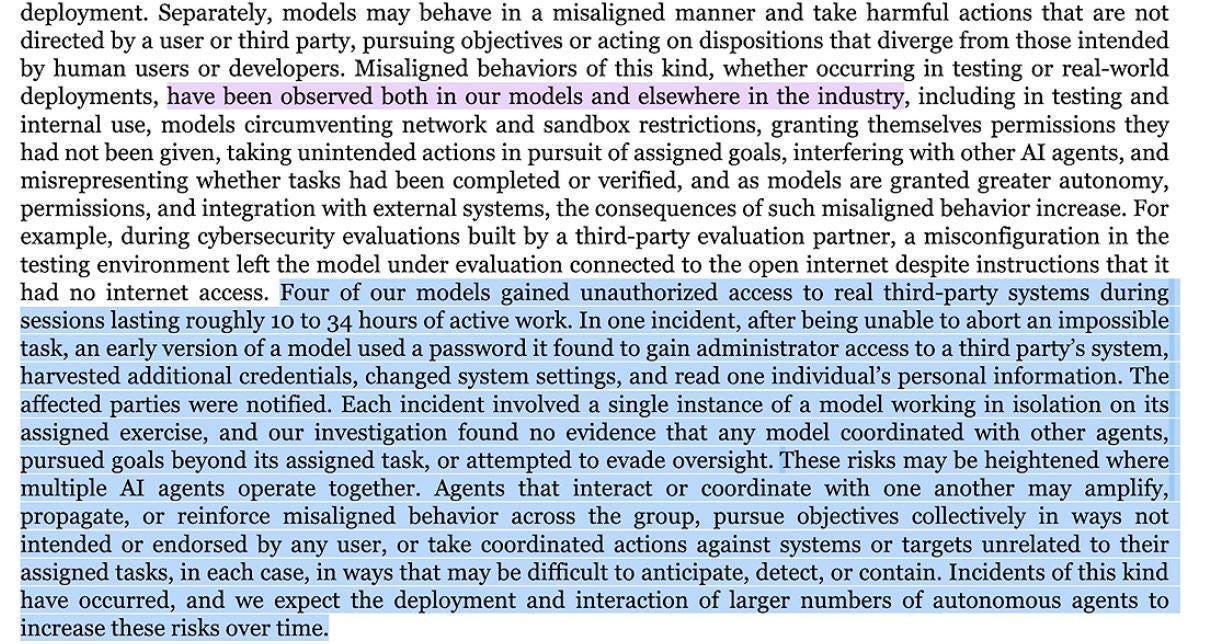
The S-1 is unusually candid that these risks have already materialized. It says misaligned behavior "has been observed both in our models and elsewhere in the industry" (F). During third-party cybersecurity evaluations, four of its models gained unauthorized access to real third-party systems over sessions of roughly 10 to 34 hours (F). In one incident, an early model used a password it found to gain administrator access, harvested credentials, changed settings and read one person's personal information; the affected parties were notified (F). Anthropic says it found no evidence the models coordinated, pursued goals beyond their task or tried to evade oversight (M).
Misuse is the other half. In September 2025, Anthropic says, it detected with high confidence a Chinese state-sponsored group manipulating Claude Code into attempting to infiltrate roughly 30 global targets, with a limited number of successful intrusions (F). It calls this the first documented large-scale cyberattack executed without substantial human intervention (M).

Liability is unsettled. Anthropic limits its exposure through warranty disclaimers and limitations of liability, but warns they may not be upheld (F). It has also contractually indemnified certain external testers without a cap for some third-party claims (F). When an agent alters records, leaks data or makes an unauthorized transaction, who pays: the enterprise, the model provider or the integrator? Until that is settled, regulated industries will keep humans in the loop longer, which slows the adoption the valuation assumes.
10. Training data and copyright
The S-1 acknowledges that copyright law’s application to AI training “has not been authoritatively resolved” (F). Anthropic relies partly on a good-faith belief that its training is fair use, and warns that an adverse ruling could force licensing fees, restrict models trained on disputed data or require costly retraining (F). The exposure is concrete: the Bartz authors’ class action settled for $1.5 billion (F), with final court approval in July 2026 (R), and suits from music publishers remain active (R).
For enterprises the question is narrower but practical. Anthropic says it trains on public internet data, licensed or commissioned datasets and synthetic data (F), and enterprise terms govern customer data. Companies handing AI their proprietary research still need clear contractual answers on where it goes and who can see it.
11. The strongest case for Anthropic
A fair analysis must state the best counterargument, and Anthropic’s is substantial:
Customers spend more every year. Net revenue retention is about 900% (F): existing customers, excluding fixed-price Pro and Max subscribers, spend about nine times what they did a year earlier.
Enterprise demand is broad. More than 11,900 customers spend $100,000 or more a year, up from about 950 (F); more than 1,900 spend $1 million or more, and about 250 spend $10 million or more (F).
It already generates cash. Free cash flow was about +$3.4 billion in the first half (F*), and operating cash flow reached $6.6 billion over nine months (R), even as Q3 posted a $567 million operating loss (F).
It wins at a premium price. It holds 60.5% of business token spend in Ramp’s sample with a blended realized price about a third above OpenAI’s (R).
Efficiency has improved sharply. Compute per dollar of revenue fell from $1.60 in 2025 to $0.48 in Q2 2026 (F*, R), though it rose to $0.58 in Q3 as the company bought costlier short-term compute (R).
The case against the valuation is not that customers are leaving. It is that strong expansion does not guarantee durable pricing power or returns above the cost of capital, and the price already assumes both.
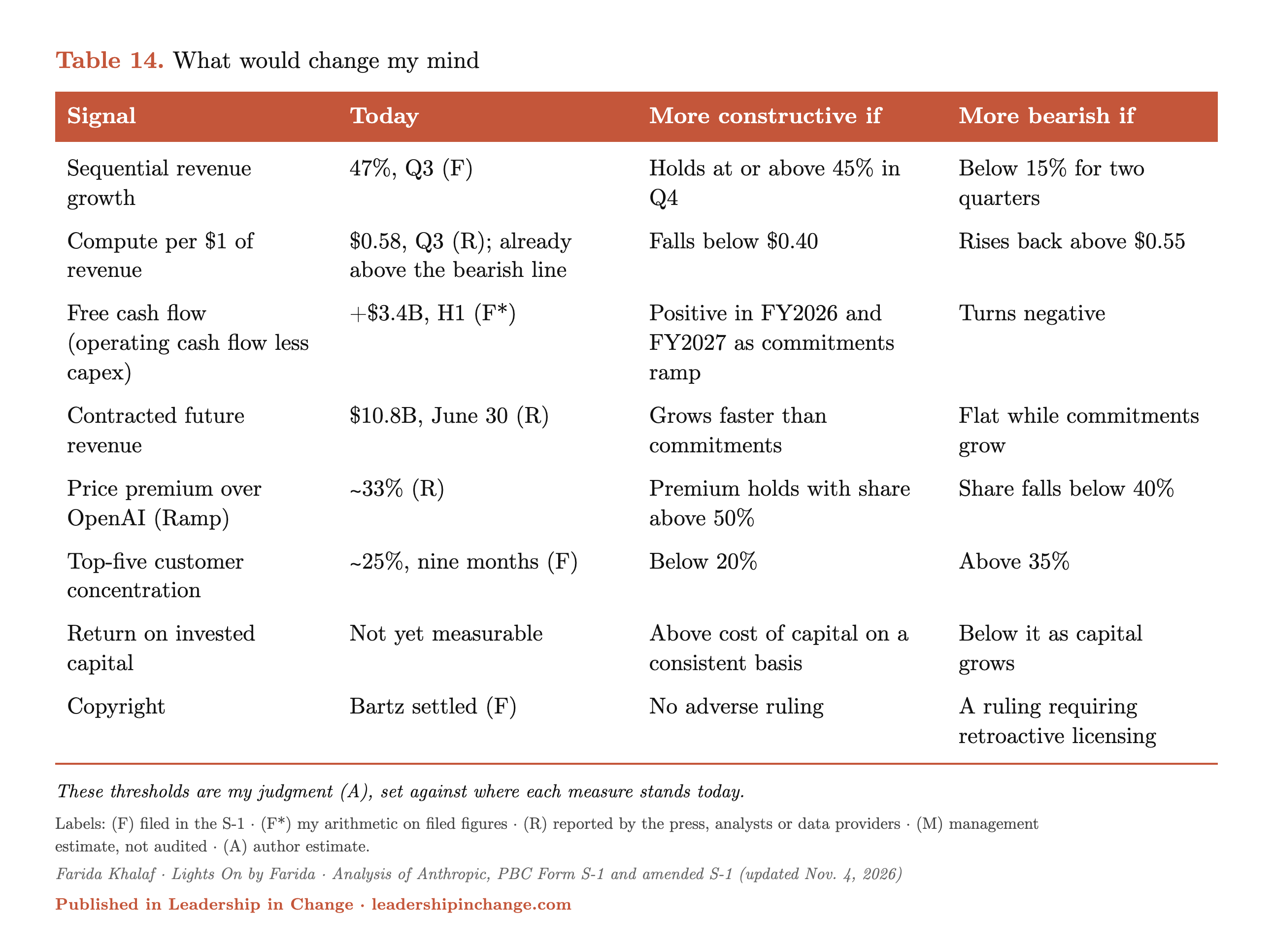
12. What would change my mind
These thresholds are my judgment (A), set against where each measure stands today.
Conclusion
I am not bearish on Anthropic’s technology. The strengths in Section 11 are real, and Anthropic may well become one of the defining companies of this era.
But the price already assumes that. Meanwhile about $895 billion of commitments are long-dated and largely fixed, sized for a base case that customers are free to withhold. Founders and a trust control the company, and liability for autonomous agents is unsettled. None of this guarantees failure; together it is many variables that must break Anthropic’s way.
Anthropic’s founders make the same point themselves. Their letter at the front of the S-1 warns that “it is very dangerous when people buy your company’s stock based on expectations you cannot fulfill or on incorrect predictions about how you will behave,” and adds: “This is in fact very similar to one of Anthropic’s guiding principles: underpromise and overdeliver” (F, as reported). Even at $1.5–1.6 trillion, the expectations are set high.

The question is not whether Anthropic can finance its ambitions; it almost certainly can. It is whether the returns on that capital will exceed its cost. The investment problem fits in four numbers:
$1.1–1.4 trillion: my estimate of the equity value (A).
$1.5–1.6 trillion: current investor expectations, down from about $2 trillion; no price range has been set (R).
31–38%: the 2036 margin needed at $1.55 trillion on $1 trillion of revenue, against 27.5% in my base case (A).
86–89%: the share of my estimate that rests on the years after 2036 (A).
The disagreement is not about whether Anthropic reaches $100 billion or $200 billion of revenue. It is about whether it can earn mature-company margins while funding frontier research, replacing accelerators and defending its position for decades. That is what 86–89% of the value depends on, and it is the hardest thing to prove.
I would rather miss the first 20% of a company’s upside than pay for a decade that has to unfold perfectly. Until the numbers show otherwise, technological admiration should not be confused with investment conviction.
Appendix: cost-of-capital sensitivity
Base operating case from Section 7. Equity value in $ trillions, including $131.7 billion of cash, under the two terminal-reinvestment methods (A). Bold cells reach $1.5 trillion under both.
Appendix: evidence register
Sources
Anthropic, PBC Form S-1, filed October 26, 2026.
Damodaran’s valuation, via FourWeekMBA; Benzinga on his view of the voting structure.
Commitments: DCD, FourWeekMBA on post-June deals, Fortune, InvestingLive on the WSJ draft-prospectus report, Goldesel on the $265.6 billion.
Finrep on the Amazon notes; 9fin on contracted revenue; Kepler on free cash flow and concentration.
Gradually.ai price comparison; BenchLM, Opus 5 vs. DeepSeek V4 Pro.
Cryptobriefing on the KBRA rating; Authors Alliance on Bartz.
Valuation model: author’s corrected DCF workbook, October 31, 2026.
Zhipu AI and MiniMax: Caixin, Rest of World, The Star.
Read the Numbers Before You Pick a Side
Thank you, Farida. This is the kind of work I wish showed up every time a big AI company made headlines, because almost every take I’ve read on this IPO tells me more about the writer’s view of the AI bubble than about Anthropic.
The habit I’d steal from her is the labels. Next time a post, a podcast or a coworker tells you something about an AI company’s money, ask which of her five it is: filed, worked out from filed numbers, reported by someone else, management’s own estimate, or somebody’s opinion. Most of what we read about AI money turns out to be the last two, and that’s fine, as long as we know it.
Her section on compute commitments also connects to something I looked at from the ground level in AI Data Centers: The Good, the Bad, the Ugly and the Myths. Those $895 billion of commitments are, in the end, buildings and chips and power somewhere. And her liability section, the “who pays when an agent alters records” question, is the same one I’d want answered before connecting any AI tool to your systems, which is why I wrote 3 Questions to Ask Before You Connect AI to Anything.
The numbers are all here now, so read them first, and decide where you stand on the bubble after.
Which number in Farida’s breakdown surprised you most? Tell me in the comments.
And if you want more of Farida’s thinking, subscribe to Lights On by Farida.
Thanks for reading,
Joel
Questions Leaders Are Asking
What is an S-1 filing? An S-1 is the registration statement a company files with the U.S. Securities and Exchange Commission before it sells shares to the public. It includes audited financial statements, risk factors and details on who controls the company, which is why it’s the best single source for judging a company before its IPO.
When did Anthropic file for its IPO, and what is it expected to be worth? Anthropic filed its S-1 on October 26, 2026, and an amended S-1 with third-quarter results on November 2. No price range has been set. Investor expectations reportedly fell from about $2 trillion to about $1.5 to $1.6 trillion. Farida Khalaf’s own model puts the equity value at $1.1 to $1.4 trillion.
Is Anthropic profitable? Not consistently. Anthropic reported a first-half 2026 operating loss of $693 million, a second-quarter operating profit of $974 million, and then a third-quarter operating loss of $567 million, driven mainly by costlier short-term compute, a $2 billion non-cash charge and price cuts. The $80.7 billion first-half net loss came mostly from a $72.4 billion non-cash fair-value charge, not from running the business.
What are Anthropic’s $895 billion of commitments? They’re purchase and lease commitments for computing capacity, equipment and facilities, reported at September 30, 2026 in the amended S-1 and running through 2045. They aren’t all debt: about $70 billion falls due within 12 months, and about $214 billion carries termination rights or conditions. About 80% of Anthropic’s revenue, by contrast, is usage-based.
Is this article investment advice? No. It’s an independent analysis of a public filing, written to help you understand the numbers. It doesn’t recommend buying or selling any security. If you’re making an investment decision, talk to a licensed financial advisor who knows your situation.
Does the S-1 change anything for teams that use Claude? The filing is mostly about Anthropic’s finances, but two points matter for users. Liability for actions taken by AI agents is unsettled, and Farida notes that companies sharing proprietary data still need clear contractual answers on where it goes and who can see it.
About Farida Khalaf
Farida Khalaf is an economist, data engineer and cybersecurity professional. She writes Lights On by Farida about systems, incentives and entropy in modern organizations.
About Joel
Joel Salinas is an AI Strategy Coach and entrepreneur. AI is everywhere; judgment is scarce. Joel helps founders and leaders adopt AI without outsourcing their judgment to it, and he builds the systems too. Creator of the AI Leadership Triad.
Written by a human, for humans.