


TL;DR: Ray Dalio encoded his personal decision-making principles into AI at Bridgewater, creating a system that performs at 95% of his effectiveness on life and work advice. Any leader can apply the same approach using Claude or ChatGPT. This article breaks down the method and introduces the Principles Stack, a three-step framework for building principle-based AI.
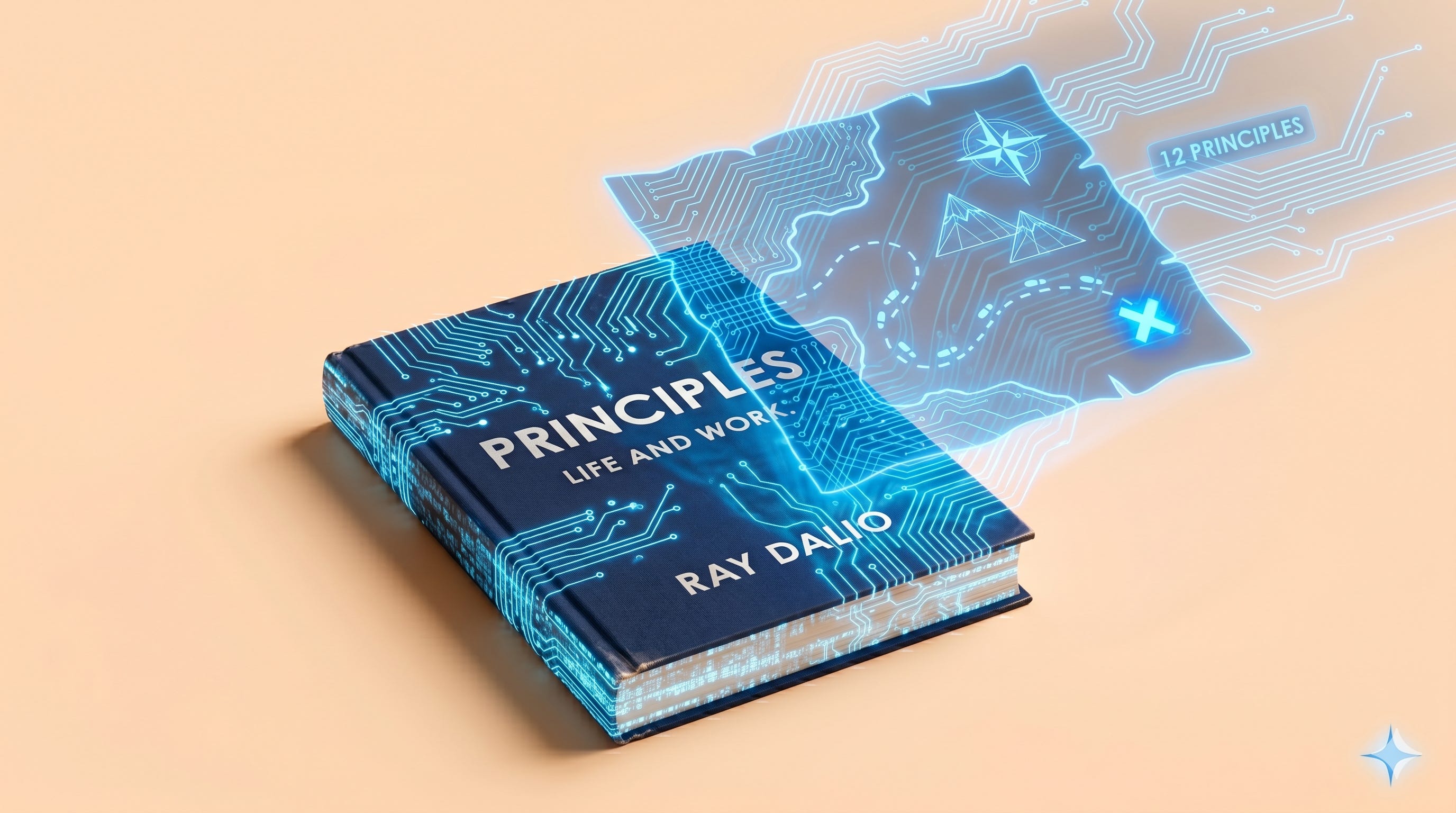
Ray Dalio built Bridgewater into one of the world's largest hedge funds on a set of written principles. At its peak, the firm managed $150 billion.
I‘ve read Ray Dalio’s Principles: Life and Work more than once. Re-listened to it last week, actually, and I keep coming back to it because it works. (If building that kind of operating clarity is something you’re working on, that’s exactly what I help leaders do.)
Dalio asks every leader to do something most never do: write down how you think, document the logic behind your decisions, and build a system that holds you to your own standards when you’re tired, distracted, or under pressure. That philosophy has shaped how I lead and how I coach, because great decisions come from consistency, not from being the smartest person in the room.
What I didn’t expect was to watch Dalio take that same philosophy and encode it directly into AI. What he built is harder to ignore than anything he’s said about leadership in years, and the part that applies to you doesn’t require Bridgewater’s budget or engineering team.
In this post, you’ll learn:
How Ray Dalio encoded his decision-making principles into AI at Bridgewater
The difference between reactive AI and proactive, principle-based AI
What the Principles Stack is and how to build one in Claude or ChatGPT today
How to download a free Claude skill built on Dalio’s 12 core principles (premium members)
What Dalio Actually Built
Most coverage of Bridgewater and AI focuses on investment returns. That’s the wrong lens for this conversation.
In early 2026, Bridgewater (Dalio's hedge fund, one of the largest in the world) launched an AI-driven strategy called AIA Labs that surpassed $5 billion in assets under management. The number matters less than the method. Traditional quant models follow pre-set statistical rules. AIA Labs uses machine learning that adapts, discovers patterns no human analyst would find, and gets better over time. Dalio moved from rule-following to principle-learning. That shift is the point.
Digital Ray is the part that stopped me. Dalio trained an AI on decades of his personal writings, values, and perspectives.
According to reporting on Bridgewater’s strategy as of March 2026, the result performs at 95% of his effectiveness on life and work advice, and 80% on market and economic analysis, with expectations to improve.
Not a search engine or a chatbot, but a thinking partner built in Dalio’s image.
Then there’s PriOS, short for Principles Operating System, the internal software Bridgewater uses to run management decisions. Four tools that automate management itself, but the two that matter most for leaders outside Bridgewater are The Coach and the Dispute Resolver. The Coach lets any employee input a question and receive guidance rooted in Dalio’s codified principles, not generic AI advice, but his specific decision-making logic available to everyone on the team. The Dispute Resolver provides a structured path of questions that guides disagreements to a principled resolution based on the framework, not on whoever has more authority.
The other two tools, a real-time peer rating system and an evidence-based performance profile for every employee, round out the suite.
The goal across all four: three-quarters of all management decisions at Bridgewater made and communicated by PriOS.
What strikes me about this is how directly it maps to something I see in coaching constantly. Leaders have good instincts, but they have no system for making those instincts consistent across their team. Dalio built that system. The question is whether the rest of us will.
Quick Win (< 60 seconds) Open Claude settings instructions and paste this: “Before giving me any advice, apply Ray Dalio’s 5-Step Process: ask me to clarify my actual goal, identify the specific problem standing in the way, diagnose the root cause rather than the symptom, suggest a solution that fixes that root, and define who does what by when. Now ask me what I’m working on.”
Use this today on any business or team decision you’re wrestling with. It changes the quality of Claude’s response immediately.
This article gives you the framework. If you’re looking at your own leadership situation and wondering how to set this up, here’s the best next step.
Join Premium ($49/yr): Get the full Dalio Principles Advisor skill as a free download, plus tested prompt libraries, frameworks, and exclusive resources every month. Start here →
Also, I want to thank my newest partner, Jotform.
Did you know that the premier form creator now integrates with Claude? Well, they do! And as a Leadership in Change Subscriber, you get 50% off. Try it today!

The Shift Nobody’s Talking About
Here’s what most AI articles miss about what Dalio built.
The standard way most leaders use AI, including most of the leaders I work with, is reactive. You have a problem, you ask the AI, it gives you an answer. It's useful, but it's limited, because you're still the bottleneck. The AI is waiting for your questions, and its answers are filtered through the internet’s statistical average, not your principles.
Dalio’s approach is different. His AI works in parallel with him. It doesn’t wait for questions. It processes the same information he does and reaches conclusions based on his specific values and reasoning style. He calls this “parallel decision-making,” and it’s the actual breakthrough buried inside the Bridgewater story.
For AI to function as a genuine thinking partner, it needs to understand three things about you:
Your preferences — the choices you consistently favor and why
Your decision-making style — the methodology you actually use to reach conclusions
Your principles — the specific, named rules you hold yourself to
Stop and look at this table. Which column describes how you currently use AI?
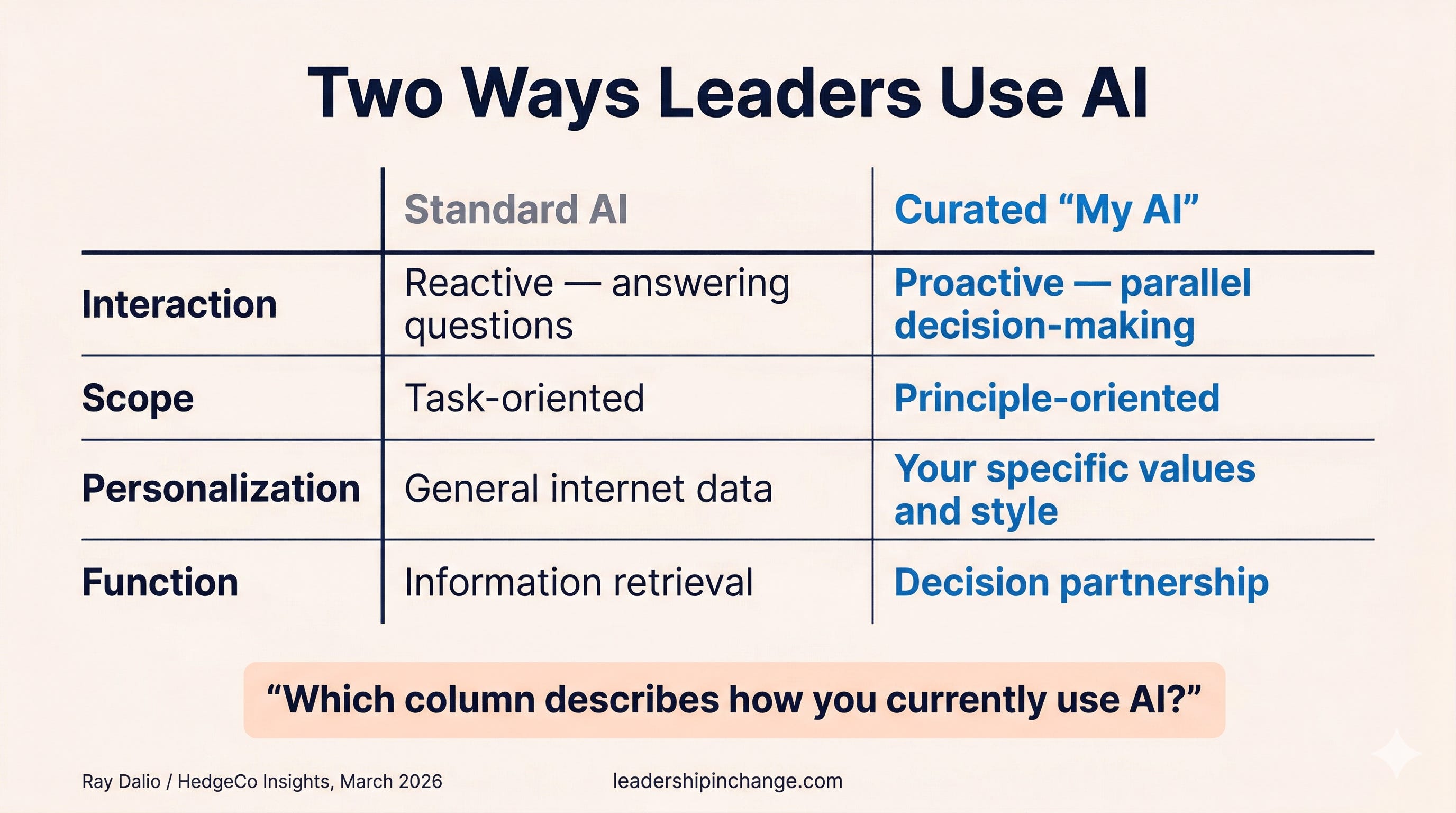
Most leaders are in the left column. Dalio built the right column. The Principles Stack is how you get there.
“AI is no longer optional. It is essential.” — HedgeCo Insights on Bridgewater’s Evolution, March 2026
The question isn’t whether you use it. It’s whether it knows how you think.
The Principles Stack
Here’s the framework: The Principles Stack.
The Principles Stack is the practice of encoding a proven decision-maker’s mental model into your AI, so every problem you bring to Claude gets filtered through that lens before it reaches you, rather than filtered through the internet’s average opinion on what you should do.
Dalio did it with his own principles. You can do it with his. Three steps:
Step 1: Choose a framework with named, specific rules.
Dalio’s Principles works because it isn’t vague. “Embrace reality and deal with it” is a rule you can act on. “Pain plus reflection equals progress” is a rule. Compare that to vague values like “be transparent” or “be curious” — those give AI nothing to work with. Named, specific principles do. This is also why I’ve written about the importance of building AI that actually pushes back on you — a principles filter creates the disagreement that makes AI useful.
Step 2: Load it as operating logic, not just context.
Most people give Claude information about their situation. The Principles Stack gives Claude a filter — a set of rules it applies to every response before it answers you. That’s a fundamentally different setup. I explored the foundation of this kind of system in How to Build Your AI Decision Partner. The Dalio skill takes that further by encoding an entire proven framework.
Step 3: Bring it your real decisions.
Stop asking “what should I do?” Start asking: “Here’s the situation. Run it through the framework. Give me an honest diagnosis, including where I might be fooling myself.”
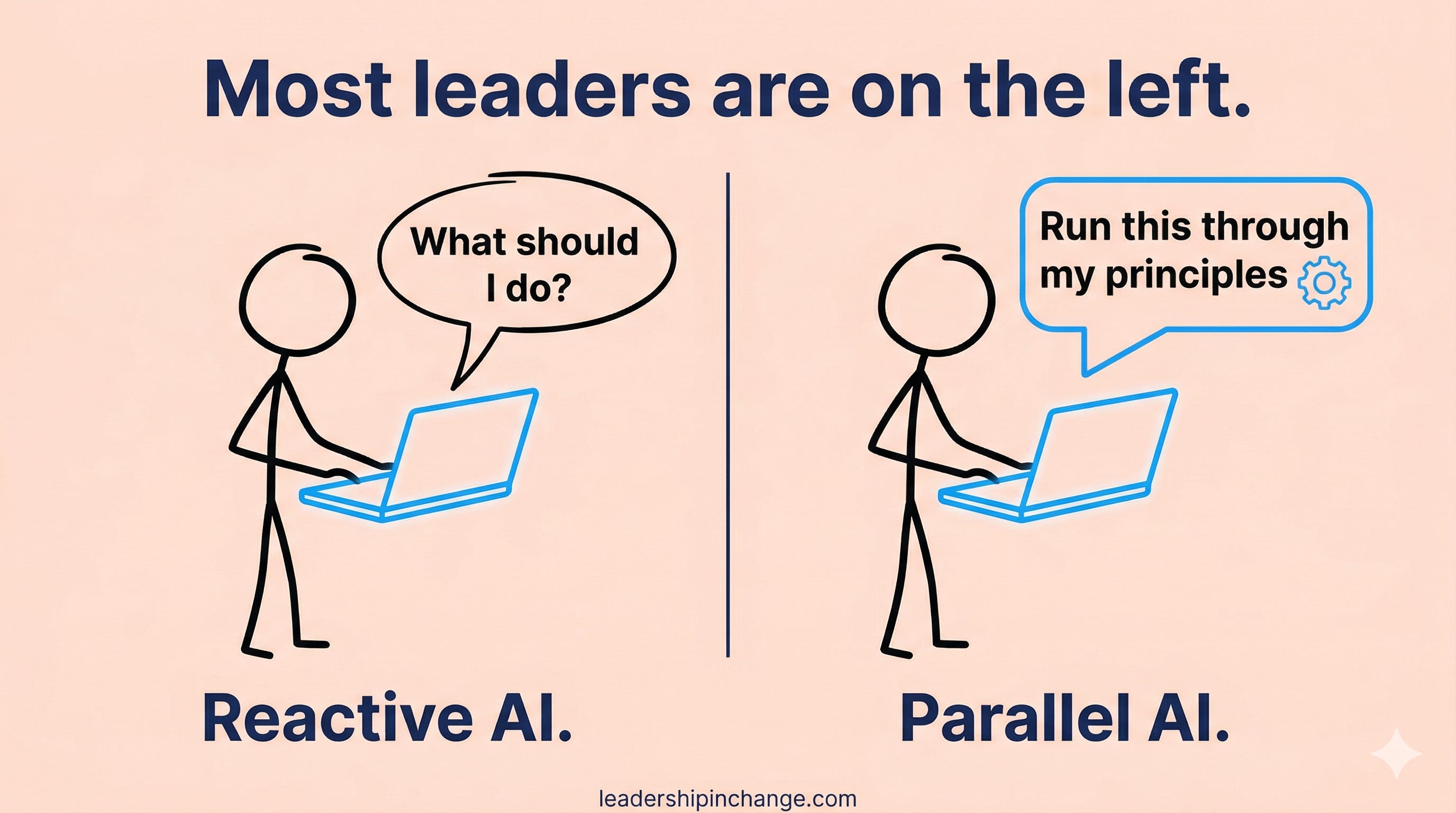
That last part, the blind spot check, is the piece most AI interactions skip entirely. Dalio built it into PriOS by design. I built it into the skill.
If you want help applying this to your specific leadership context, book a free discovery call and we’ll map it out together. ;)
What My Own Version Looks Like
I’m not Ray Dalio. I don’t run a hedge fund. But I lead four businesses, coach executives, and write a newsletter, and I’ve encoded three of my own principles into a Claude project I use every day:
Always ask “who is the human on the other side of this?” before drafting.
If the recommendation could be written by any AI leadership blog, kill it.
Push back on me when the easy answer is the wrong one.
Three sentences. That’s the entire stack. And it changes every single response I get back. The point isn’t to copy mine. The point is yours probably already exists, written down somewhere or living in your head, and you’ve never given AI access to it.
Now, I have built a Claude skill based on Dalio’s framework. It’s called the Dalio Decision Advisor.
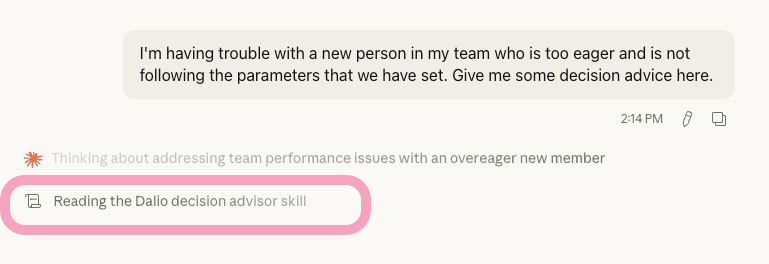
When you invoke it, Claude asks what decision you’re working through, then delivers a brief analysis: a Reality Check that separates fact from feeling, one clear Recommendation with a concrete first step, and a Blind Spot Check that names what you might be avoiding. If you need more, ask it to go deeper. It’ll run the full 5-Step root cause diagnosis and map the 2-4 Dalio principles most relevant to your situation.
It’s designed for Cowork. Paste the instructions, and it’s ready to run. If you want to see how I use Claude skills across my full workflow, 5 Claude Skills That Save Me 40 Hours Monthly is a good place to start.
This skill is built on Dalio's publicly documented framework from Principles, not an official Bridgewater product. It's my interpretation of his decision-making logic, encoded into a Claude workflow any leader can use.
Premium members download it free here…
Not a premium member? The Quick Win prompt above gives you the same logic manually. Try it today. Don’t wait on the perfect setup.
And if you want this kind of principled AI system built for your team or your specific role, I can help.
If You Only Remember This
Ray Dalio didn’t use AI to do more. He used it to think better, consistently, by his own principles.
The Principles Stack works because named, specific principles give AI a real filter. Vague values don’t. The more precise your framework, the more precise what comes back.
AI that doesn't know your principles will only ever give you the internet's average answer. Dalio refused to settle for that, so should you.
What about you? Is there another leader’s decision-making framework you’d want to encode into your own AI, maybe someone whose thinking you’ve studied for years? Drop it in the comments. I’m genuinely curious who else’s principles belong in a Claude skill.
Questions Leaders Are Asking
What is Ray Dalio’s Principles book about? Principles: Life and Work (2017) documents the decision-making framework Dalio built over five decades at Bridgewater Associates. The book covers radical transparency, believability-weighted decision making, and the 5-Step Process for turning goals into outcomes. It has sold over 4 million copies and is widely used in leadership development programs across industries.
How is Ray Dalio using AI at Bridgewater in 2026? Bridgewater’s AI strategy includes three components: AIA Labs (a machine learning investment strategy surpassing $5 billion AUM as of early 2026), Digital Ray (an AI system trained on Dalio’s personal values, achieving 95% effectiveness on life and work advice), and PriOS (a Principles Operating System that automates management decisions through tools like The Coach, Dot Collector, Baseball Cards, and Dispute Resolver).
What is the Principles Stack? The Principles Stack is the practice of encoding a specific, named decision-making framework into an AI tool so it filters every response through that lens. Rather than asking AI for generic advice, you give it a structured set of principles that shape how it diagnoses problems and forms recommendations. Dalio’s framework is one example — any named, principle-based system works the same way.
What is the difference between standard AI and a curated “My AI”? Standard AI is reactive — it answers questions using general internet data. A curated “My AI” (Dalio’s term) is proactive — it works in parallel with the user, making decisions based on that person’s specific values, preferences, and decision-making style. The goal is decision partnership, not information retrieval.
How do I use Ray Dalio’s Principles with Claude? The fastest approach is to paste the Quick Win prompt from this article into any Claude session. For a full structured experience, download the Dalio Principles Advisor Claude skill (available to premium members above) and install it in Claude Code or as Project Instructions in Claude.ai. The skill runs every challenge through 12 Dalio principles and ends every session with a blind spot check.
Sources
HedgeCo Insights, “From Principles to Algorithmic Intelligence: The Evolution of Decision-Making at Bridgewater and Beyond,” March 2026
Ray Dalio, Principles: Life and Work, Simon & Schuster, September 2017
Digital Ray efficacy data: 95% life/work advice, 80% market/economic analysis — March 2026 research brief
PriOS management target (three-quarters of decisions): March 2026 research brief
Joel Salinas is an Executive AI Coach who helps leaders at small and mid-sized businesses and nonprofits implement AI without the hype. He writes the Leadership in Change newsletter and runs jsalinas.org.
Written by a human, for humans.
The interesting part is that Dalio turned decision-making into a system that can be taught, tested, and scaled beyond one person
I love the Principles!