


TL;DR: Fractional AI leadership gives small and mid-sized businesses the strategic guidance of a Chief AI Officer without the $250,000-plus full-time cost. For organizations that can’t justify a permanent AI executive but know they can’t keep stalling, a fractional AI leader brings the strategy, governance, and experience that turn AI spending into real results.

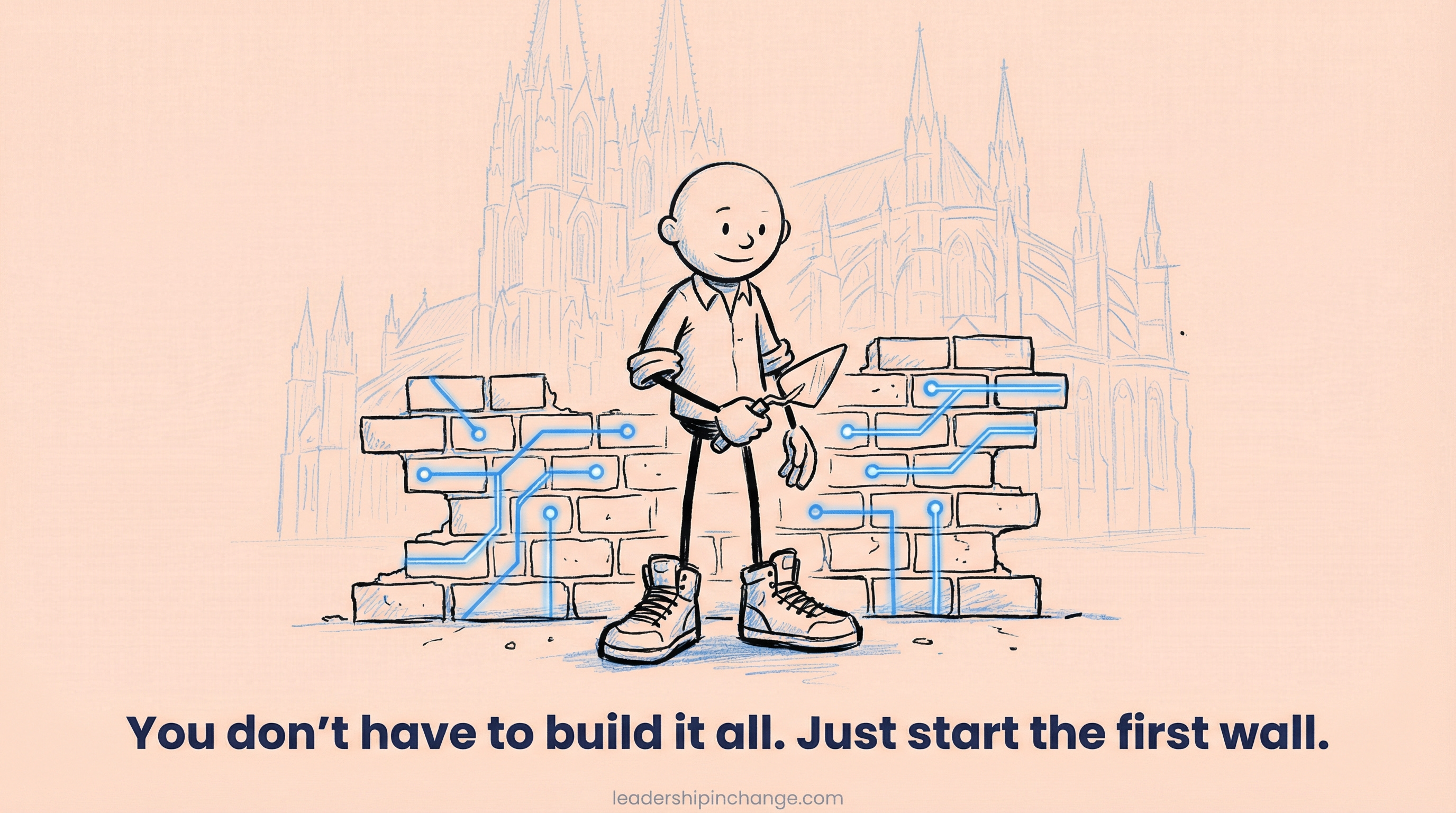
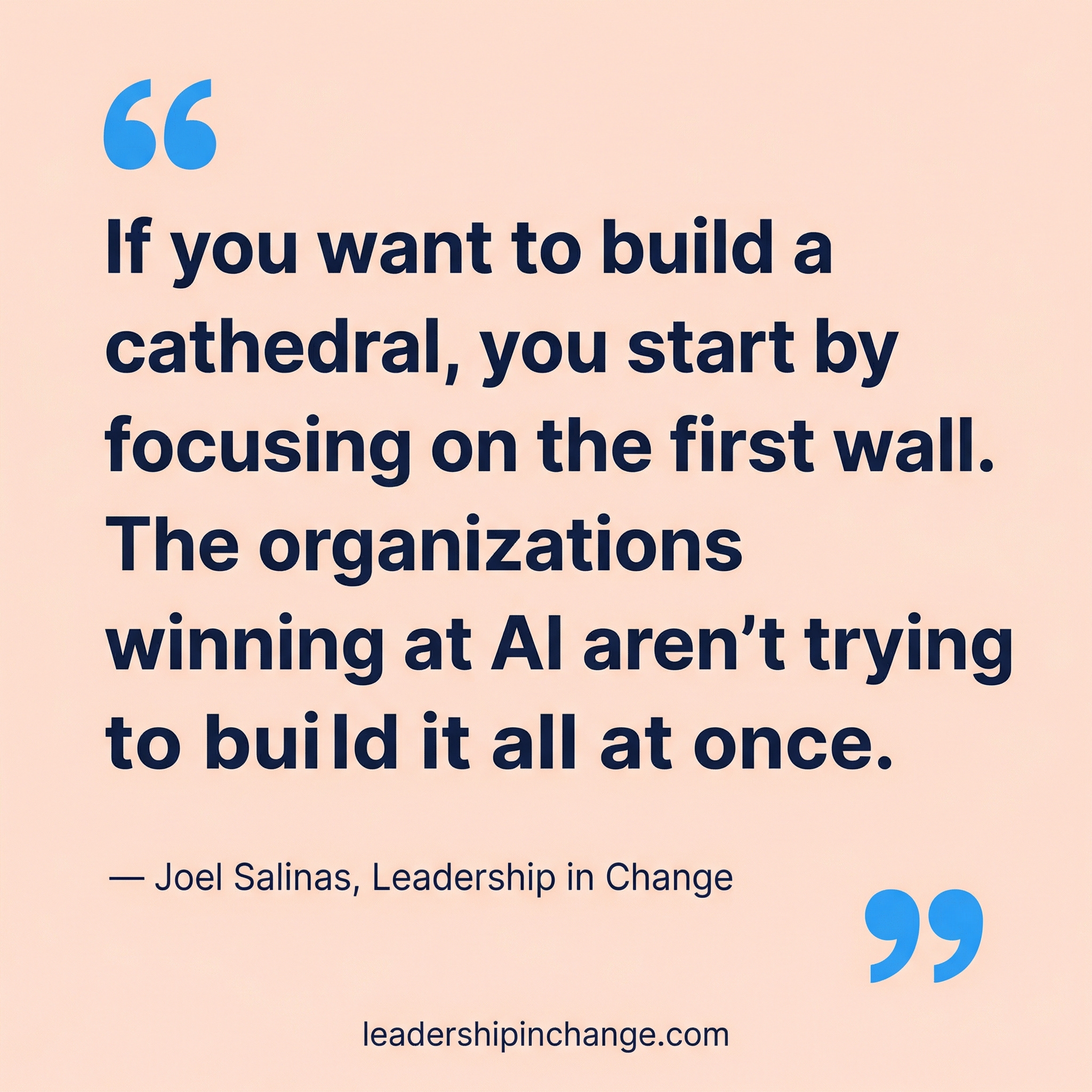
If you want to build a cathedral, you start by focusing on the first wall, with the first row of bricks (it’s a saying I first heard in Spanish a decade ago).
That sounds obvious until you watch what most organizations are actually trying to do with AI. They stand at the edge of a transformation they can feel coming, look at the scale of it, and either freeze or try to build the entire cathedral in one swing. Both reactions are understandable, and both leave the same result on the table: nothing built, nothing changed, nothing learned.
I decided to launch my fractional AI work because I kept seeing how many organizations, with just a little help, could do so much more with what they already had. They are already experts at what they do. They know their customers, their mission, their internal bottlenecks better than any outside consultant ever will. What they don’t always have is a strategy for how AI fits into the work they’re already doing well. That is the gap I keep seeing, and it’s not the gap most AI content is talking about.
In this post, you’ll learn:
Why most small and mid-sized businesses are stuck between two bad AI options
What it actually costs to do nothing on AI strategy, and why that number is bigger than leaders think
How fractional AI leadership fills the gap between “do nothing” and “hire a full-time Chief AI Officer”
What to look for in a fractional AI leader if you decide that path is right for your organization
Two Options, Both Bad
Here’s the reality most mid-market leaders are living with in 2026.
Option one is to hire a full-time Chief AI Officer (CAIO).
That role has become the fastest-growing C-suite title in recent memory, with 70% year-over-year growth, according to The AI Hat’s 2026 analysis. The problem is the price tag. A full-time CAIO runs $250,000 to $400,000 per year in total compensation, and that’s before benefits, equity, and the $25,000 to $50,000 in recruiting fees that typically come with executive search. The average search takes three to six months, and that’s before the new hire even starts ramping up. For a $20 million company, that full-time bet represents 2% to 4% of total revenue before a single AI initiative has produced any measurable return.
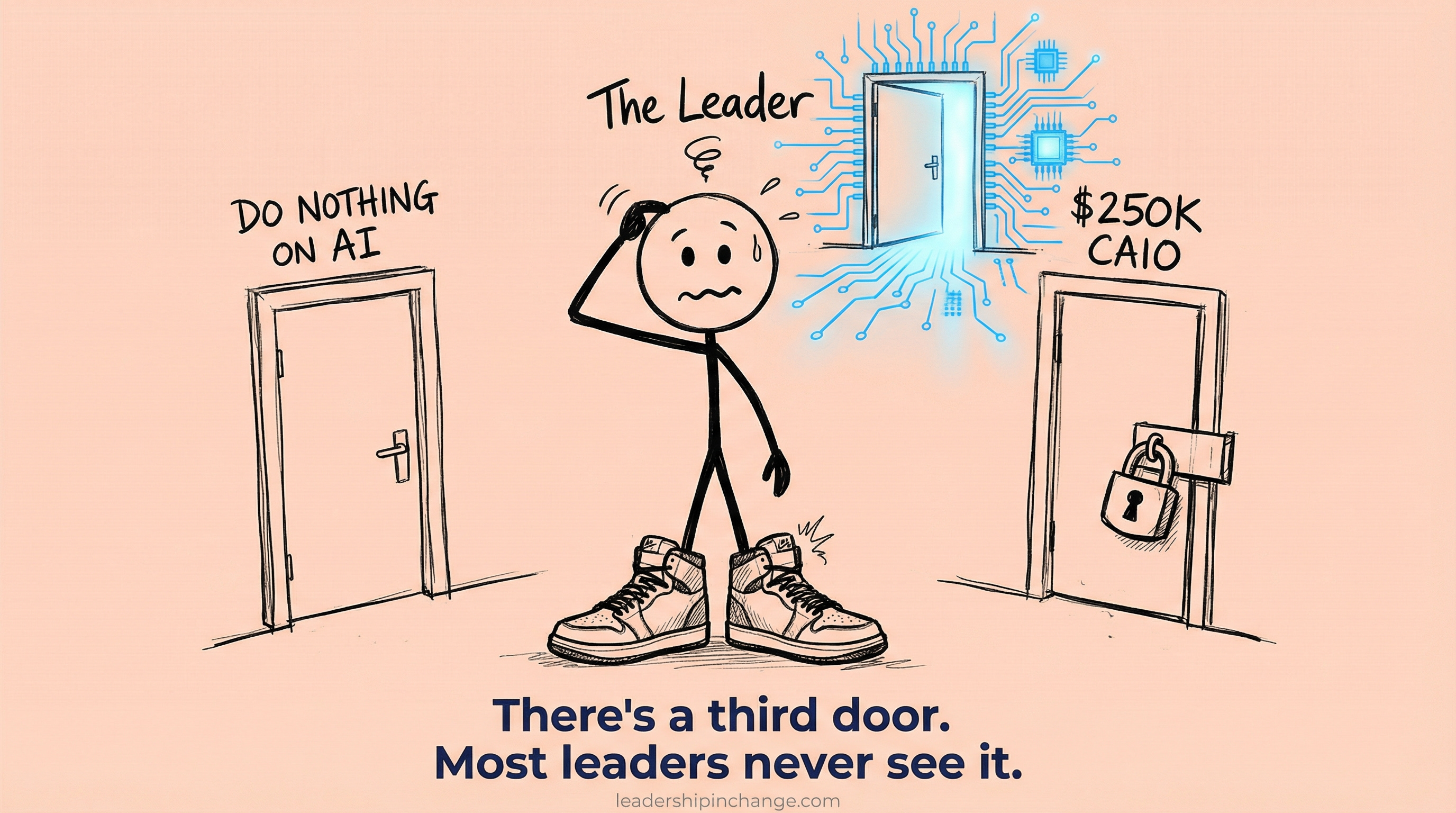
Option two is to do nothing. Not literally nothing, because most organizations are buying AI tools, running small pilots, letting a few employees experiment. But there’s no strategy behind any of it. No governance. No one is accountable for the outcome. No plan for what to do if the tools don’t work or the team resists. I’ve written before about why 92% of AI investments fail to deliver measurable ROI, and the pattern has not improved in 2026. If anything, it’s gotten worse as the tools have gotten more powerful and the stakes have gotten higher. This is the same pattern I’ve described in why most AI implementations fail, and it shows up in every sector where leaders try to skip the strategic work and go straight to deployment.
So leaders get stuck in a hard place: they can’t justify $250,000, they also can’t justify standing still, and while they wait for the perfect answer, their competitors are moving.
Why Organizations Spend $500K on AI Tools and $0 on Strategy
Here’s what I did not expect when I started paying closer attention to this gap.
Organizations are spending massive amounts of money on AI and spending almost nothing on strategy.
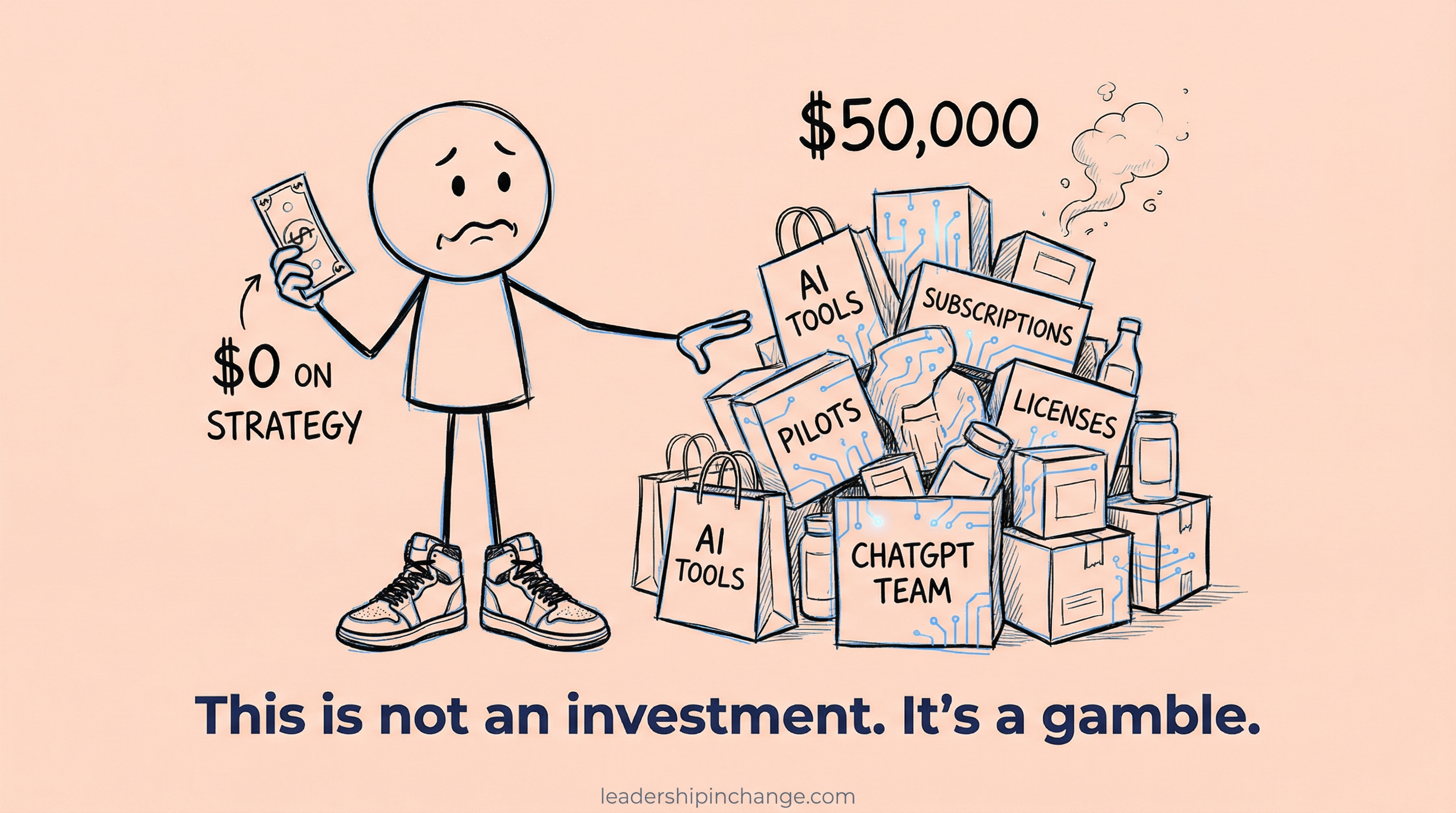
I’ve watched companies purchase $500,000 worth of AI tools, subscriptions, and pilots in a single year, then spend zero on the strategic leadership that would tell them whether any of it is worth keeping (the news is littered with examples).
According to Deloitte’s 2026 State of AI in the Enterprise report, 91% of mid-market firms are using AI in some capacity, but only 34% feel they’ve deeply transformed their business.
RSM’s 2026 Mid-Market AI Mandate found that 70% of mid-market executives report needing outside help to extract measurable value from their AI investments. Seven out of ten.
The honest version of this is that most AI spending right now is a bet on tools that nobody is managing.
A $500,000 AI implementation with no strategy behind it is a gamble, and the cheapest insurance policy against that gamble is the amount per year it takes to have a strategic AI leader in the room for a few hours per month, asking the questions nobody else is asking:
What does success look like?
Which use case do we start with?
What does failure teach us?
Who owns this when I’m not here?
Without that leadership, the tools sit idle, the pilots stall, and the team quietly loses faith in AI as a serious investment. That’s the scenario I’m most trying to help leaders avoid.
If this is resonating, two paths forward: If you want to think through your own AI strategy without any pitch, I offer a free 30-minute intro call where we talk about where you are and what options actually fit your budget. No decks, no pressure, just a conversation.
To get my tools and implement them today ($1500+ in value), become a premium subscriber.
Why Fractional AI Leadership Is the Third Path
Fractional AI leadership operates on a model the full-time hire was never designed for, and it works because the job of a strategic AI leader in most mid-sized organizations does not require 40 hours a week. It requires the right person in the room for the right decisions, supported by async work in between.
Upwork’s 2026 State of AI report found that 77% of business leaders say AI is increasing demand for specialized, fractional talent. That’s a structural shift in how mid-market leadership works, not a passing fad.
The math is hard to argue with. A fractional AI leader at can cost as little as $18,000 to $36,000 per year gives an organization the strategic guidance, governance framework, and experience of someone who has seen this play out across multiple companies, at roughly 10% of the cost of a full-time CAIO. Time-to-first impact drops from six to nine months (the typical full-time executive ramp) to 30 to 45 days. Because fractional leaders work across multiple organizations, they bring pattern recognition that no single in-house hire can match. That pattern recognition is the hidden engine of the three skills that separate leaders who thrive with AI from those who stall out.
What surprised me when I started offering this service is that the mid-market doesn’t want less AI leadership. They want the right amount of it, scoped to their reality. Small businesses that can afford 2 hours a month get an advisor who helps them prioritize their next three moves. Mid-sized organizations that need 4 or more hours a month get someone embedded enough to help them ship their first real use case. Both tiers get the same underlying thing: strategic AI leadership that scales to what the organization can actually absorb.
5 Signs of a Strong Fractional AI Leader
Not every fractional AI leader is going to fit every organization, and the quality varies wildly right now because the category is still forming. The difference between a strong fractional leader and a generic consultant usually comes down to judgment, which is exactly the leadership skill that lets you evaluate AI quality in the first place.
The first thing I watch for is whether they lead with strategy or tools. If the first conversation is about which software to buy, you’re talking to a vendor, not a strategist. A strong fractional leader wants to understand your business, your team, and your priorities before they name a single AI product.
They also have to understand change management, because AI transformations fail because of people, not software. The leader you hire should know that in their bones, not as a talking point but as a lived experience. And they should be able to actually build, because strategy without execution capacity is just a slide deck. Ask whether they’ve shipped something with their own hands recently, and listen carefully to the answer.
Two more signs matter. A fractional leader with 15 clients is not actually fractional, because they’re running a factory, so ask how many clients they work with and whether they cap it. And finally, the organizations that win with AI are the ones whose leaders use it to amplify their people, not replace them. If the pitch you’re hearing is “automate everything,” run.
Why Fractional AI Leadership Works for the Mid-Market
Here’s what I believe, and it’s the reason I finally built this offer: for most small and mid-sized organizations, fractional AI leadership is the future, not a workaround. Not because it’s cheaper, though it is. Because it matches the shape of how these organizations actually make decisions and absorb change.
The cathedral gets built one wall at a time. That’s a philosophy, not a limitation. The organizations I’ve seen succeed with AI are the ones that picked one process, proved the win, and built from there.
If your organization can’t justify a $250,000 full-time hire but knows that doing nothing is quietly costing you more every month, the third path exists, and it’s more accessible than most leaders realize.
If You Only Remember This
Doing nothing on AI strategy is not free. A $500,000 AI implementation without strategic leadership is a gamble, not an investment.
Build the cathedral one wall at a time. The organizations winning at AI in 2026 are the ones that picked one process, proved the win, and built from there, not the ones trying to transform everything at once.
What would it cost your organization if every AI pilot you’ve launched this year quietly failed in the background, and no one was watching?
Questions Leaders Are Asking
How much does fractional AI leadership cost? Most fractional AI leaders charge $1,500 to $5,000 per month for small businesses and $5,000 to $15,000 per month for mid-market organizations. That’s roughly 10% of the cost of a full-time Chief AI Officer, which runs $250,000 to $400,000 per year in total compensation. The model works because most mid-sized organizations don’t need 40 hours of AI executive time per week, they need the right leader in the room for the right decisions.
I personally split it into two tiers.
What’s the difference between a fractional AI leader and an AI consultant? A consultant typically drops in, delivers a report, and leaves. A fractional AI leader is embedded in the organization over time, attending leadership meetings, driving accountability, and owning outcomes rather than deliverables. The distinction matters because AI transformation is a multi-month process, not a one-time engagement, and the leader who starts the work should be the one who sees it through.
Do I really need fractional AI leadership if I’m not a Fortune 500 company? Yes, if your board is asking about AI, your team is experimenting without direction, or you can feel competitors moving faster than you. You don’t need a full-time Chief AI Officer at $250,000 a year. You need the strategic thinking: the prioritization, the governance, the ability to translate business goals into an AI roadmap. A fractional leader delivers exactly that, scoped to your reality.
How fast can a fractional AI leader actually deliver results? Most fractional AI leaders can deliver measurable strategic value within 30 to 45 days. That’s the pattern recognition advantage of working across multiple organizations. A full-time hire typically spends 6 to 9 months on internal discovery before delivering anything meaningful. A fractional leader walks in knowing what the first three moves should be, because they’ve made them elsewhere.
How do I know if my organization is ready for fractional AI leadership? You’re ready if you have leadership buy-in for AI experimentation, some basic data infrastructure, and at least one specific process you want to improve. If you’re still operating purely on paper, start with digital foundations first. If you already have a CTO, a fractional AI leader complements that role rather than replacing it, by owning strategy and governance while your CTO owns technical architecture.
What size company is fractional AI leadership for? Small to mid-sized businesses with 5 to 500 employees typically get the most value from fractional AI leadership. Larger than 500, and the volume of AI decisions may justify moving toward a full-time hire. The mid-market is the sweet spot because the AI decisions matter and the budget for a full-time executive doesn’t exist.
Written by a human, for humans.
Sources Referenced
The AI Hat, Fractional CAIO vs. Full-Time Chief AI Officer, 2026 — https://theaihat.com/fractional-caio-vs-full-time-chief-ai-officer-the-complete-2026-decision-framework/
Deloitte, State of AI in the Enterprise 2026 — https://www2.deloitte.com/
Fractionus, 10 Statistics That Prove Fractional Work Is the Future, 2026 — https://fractionus.com/blog/10-statistics-fractional-work-future
Upwork, State of AI 2026 Report — https://www.upwork.com/resources/state-of-ai
HatchWorks, Fractional Chief AI Officer: Why Mid-Market Companies Are Turning to Them, 2026 — https://hatchworks.com/blog/gen-ai/fractional-chief-ai-officer/
Harvard Business Review, How to Make Fractional Leadership Work, 2025 — https://hbr.org/podcast/2025/08/how-to-make-fractional-leadership-work
Experimenting with fractional support for AI leadership is likely a great way for small and medium organisations to keep up... or catch up.
Couldn't agree more - you're hitting my ICP there!
Over here in Europe I help those firms with platform strategy, AI architecture, and workshops that help them rethink how to do business in the age of AI