



Christopher Chin started out as a coder, one of the jobs you’d think needs the least human communication, and somehow ended up on a TEDx stage teaching people how to speak. This conversation is about how he made that jump, and what he thinks communication actually is once you stop treating it as moving information from one head to another.
The frame that I’m still going over is that communication is music. It has melody, rhythm, and silence, and once you hear it that way you start sounding like a person instead of a content machine. We also got into why authenticity is the thing that survives the age of AI slop, and the dead-simple framework he uses to never ramble again. Watch the full conversation above.
Outline
(00:00) – Meet Christopher Chin
(02:13) – The composer who became a coder
(04:25) – Head down vs. speak up
(06:17) – Communication is music
(08:22) – Mindset over technique
(13:02) – Why silence does the work
(17:37) – Standing out in the age of AI slop
(20:06) – Where AI actually belongs
(28:33) – Bring out your hidden speaker
(32:16) – Three steps for when you freeze
A Few Things That Stuck With Me
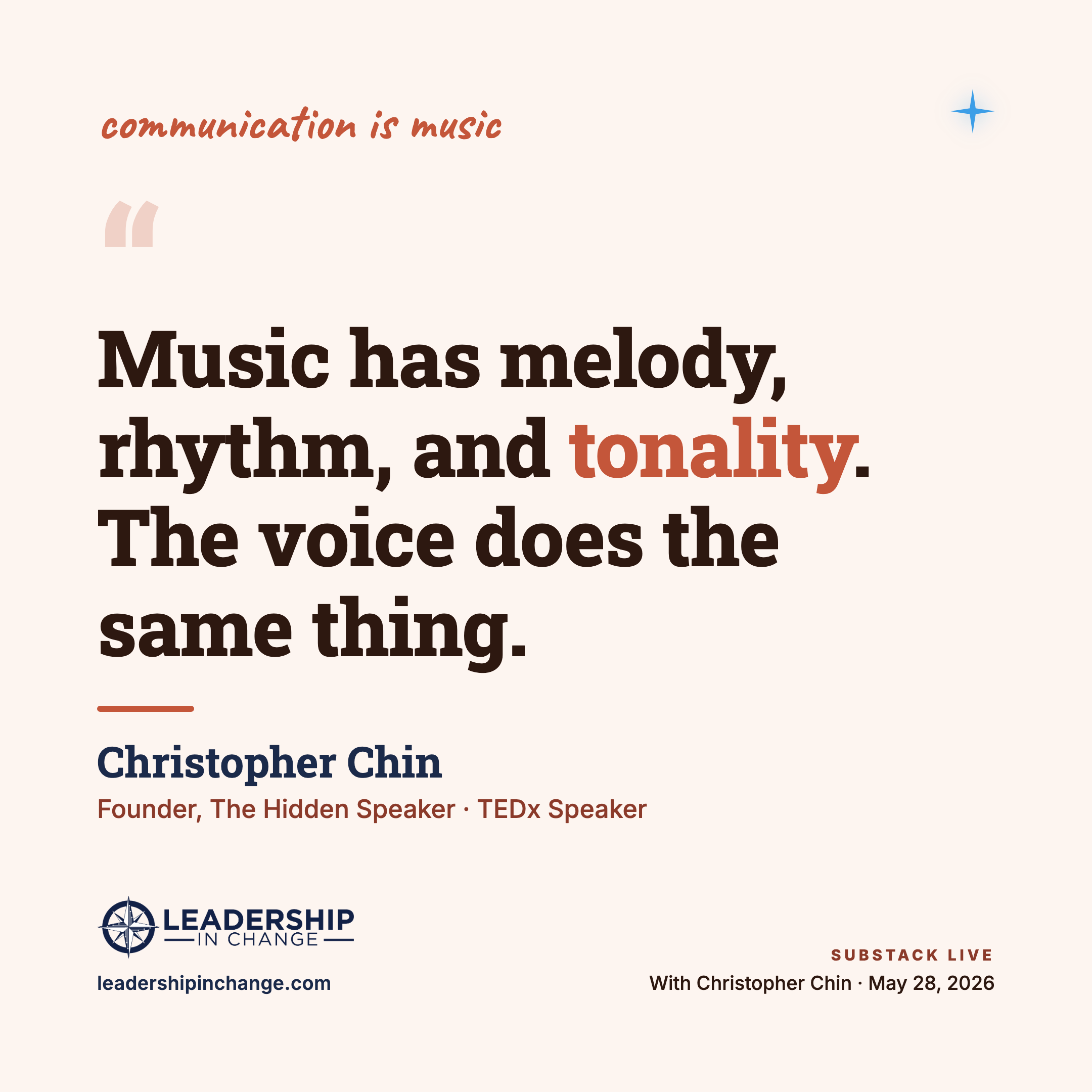
Communication is music. The line I keep coming back to is when Chris stopped describing communication as information and started describing it as something you compose. He grew up wanting to write music for films, and when he finally pulled that side of himself back into how he talks, his whole delivery changed.
“Music has melody and rhythm and tonality, and the voice does the same thing. By not viewing communication as just information, but as an experience you create, that’s how you engage.”
I felt that one personally. I grew up speaking Spanish, my mom’s from Argentina, and there’s so much emotion baked right into the words, and I’d never really clocked that the lilt and the pacing were doing half the work.
Mindset over technique. Here’s the thing most communication advice gets wrong. Chris said you can Google “three steps to executive presence” all day, and if you just copy the hand gestures and the posture, none of it lands.
“The real way to achieve authentic, effortless communication is to work on your mindset and your understanding of why these things work. If I teach you the core of executive presence is coming in with a calm, steady, grounded presence, knowing that no matter what’s thrown your way you can handle it, that changes how you communicate.”
It reframes the whole thing, because you stop trying to perform confidence and start building the kind of steadiness that makes the performance unnecessary.
The fast-food test for AI. We got into AI slop, the wave of generic content flooding every feed, and Chris had the cleanest way of explaining why it bounces right off you. He compared it to McDonald’s fries: the same everywhere, engineered to be fine, forgotten the second you finish.
“It could be saying the most brilliant things in the world, but I want to hear that from an actual person. If I sense there’s no human behind that screen, I don’t want to hear it. I want lived experience.”
Honestly, this is the whole reason I run these as live conversations instead of just publishing a guest article. You’d never get Chris, the actual person, from a block of text.
Nerves are the flip side of excitement. For anyone who freezes the second they have to speak, this was the reframe of the episode. Chris pointed out that the butterflies before a talk and the butterflies before a trip you’ve been dying to take are the same physical thing.
“The physical sensation you experience when you’re nervous, the butterflies in the stomach, is the same exact sensation when you’re excited. The thing that differentiates them is your perception.”
So you don’t actually have to calm down, you just have to decide the feeling means you’re about to do something that matters.
(Quick aside: a lot of my 1:1 coaching work is exactly this, helping leaders close the gap between how good their thinking is and how clearly it lands in the room. If that’s you, here’s where to start.)
One Question to Sit With
Where are you underselling yourself at work, not because your thinking isn’t strong, but because you’ve never put in the reps on saying it out loud where it counts?
Watch the full conversation above, and then go subscribe to The Hidden Speaker.
About Christopher Chen
Christopher Chen is a TEDx and international keynote speaker who coaches leaders and teams on communication, and he writes The Hidden Speaker on Substack. He started out shy, introverted, and behind a screen as a coder before building his practice around helping people speak with confidence. He’s posted around 180 videos on his YouTube channel and releases weekly previews from his upcoming book on communicating in the age of AI. Subscribe to The Hidden Speaker.
About me
Joel Salinas is an Executive AI Coach for leaders at small and mid-sized businesses and nonprofits. 1:1 coaching, team workshops, and AI strategy work built around amplifying what your team is already good at. Creator of the AI Leadership Triad. He writes Leadership in Change. If you want help thinking through your own AI strategy or online presence, start here.
Written by a human, for humans.


