


TL;DR: AI skills are the differentiator in knowledge work, but they sit on top of existing professional experience rather than replacing it. The World Economic Forum projects 170 million jobs created and 92 million displaced by 2030. Displaced workers do not transition one-to-one into the new roles without upskilling.

So, my business and my Substack are built on the topic AI. My consulting business is built on the topic and benefits of AI. AI is the differentiator. You know that.
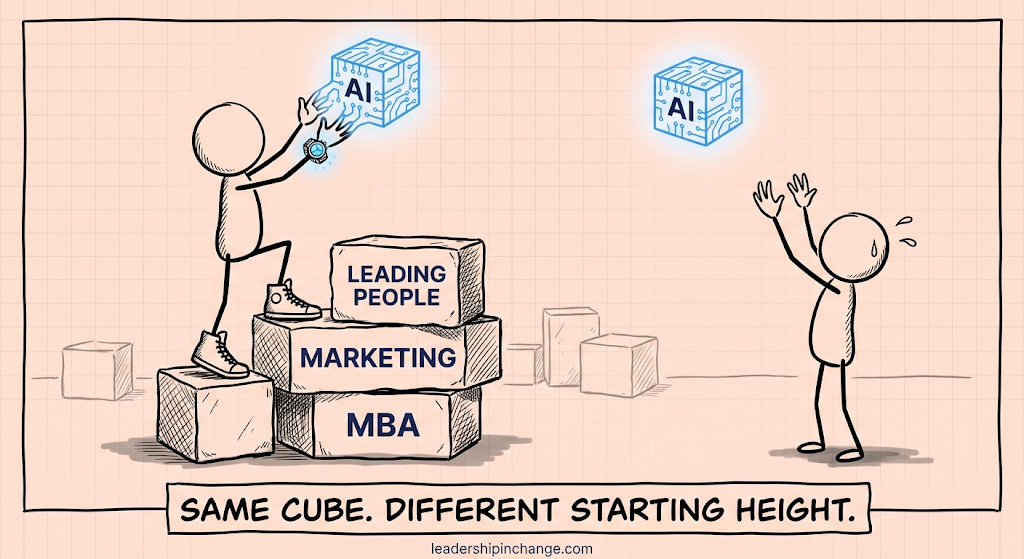
But… the foundation that supports the entire work, the foundation that keeps my consulting business growing, the foundation that brings true depth into each one of my posts, it’s not AI. It’s AI on top of the MBA education that I have, the marketing experience that I have, the finance experience that I have, and leadership experience and training that I have.
Those skills are critical, and they are what support the AI skill. It’s not the other way around, and there is a true need for them.
Below you’ll find the math behind the jobs number everyone quotes, what the factory era charged for its boom, the four questions I use with CEOs, and where I could be wrong.
What You’ll Walk Away With
A straight read on why “78 million net new jobs” tells you nothing about whether your own role is safe
A way to put AI on top of the experience you already have, instead of starting over from zero
That same idea applies to the tools we pick. So many of us are now expected to show up on video, whether it’s a product launch, a quarterly update to the team, or a training walkthrough, and very few of us were ever trained to edit one. You already know the message, the audience, and what the video has to accomplish, because that’s the experience you bring. What you need is help with the production work that eats the afternoon. For me that’s where Fotor comes in.
Thank you, Fotor, for sponsoring this post!
Fotor Agent takes raw footage, or even just a product link, and turns it into a polished video. It pulls in 4K graphics, cuts the pauses and filler, and hands you a timeline to fine-tune, so the call on what stays and what goes is still yours. You bring the judgment about what the video should say, and it takes care of the editing that would otherwise sit on your to-do list until forever.

Why 78 million net new jobs is the wrong number to watch
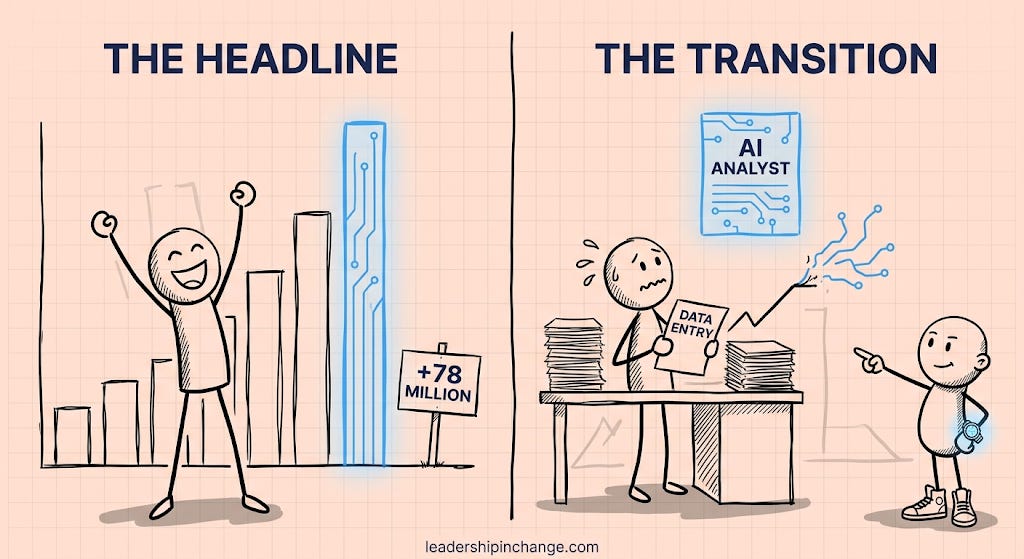
And now the math sounds good. 170 million jobs will be created, 92 million displaced by 2030, a net gain of 78 million. Those are the World Economic Forum’s numbers, from the Future of Jobs Report 2025 (January 2025), built on a survey of more than 1,000 employers, and they cover every force reshaping work, including technology, the green transition and demographics, rather than AI alone.
The problem is the customer service agents or data entry agents that simply answer the phone and update a file, or take a phone call and look for the correct HR policy to report. They are not qualified to all of a sudden transition and take advantage of one of those AI jobs unless they’ve been specifically upskilled. It’s not a one-to-one transition from a job just removed by AI to the jobs opened by AI.
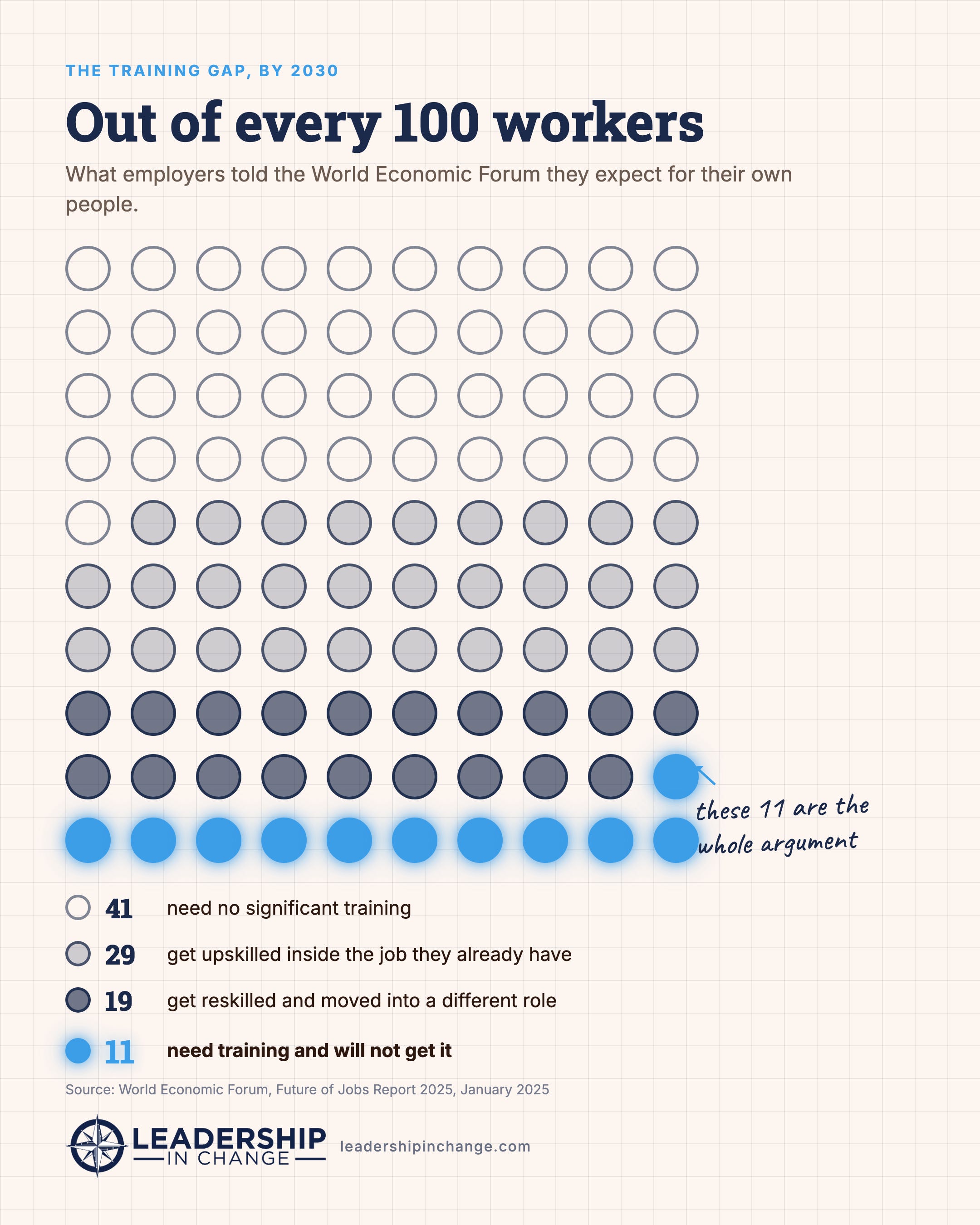
That same report puts data entry clerks among the fastest-declining roles, and its own arithmetic says what happens next: out of every 100 workers, 59 will need training by 2030, and 11 of them will need it and won’t get it. That last group is the whole argument, and I wrote about what it looks like inside a company in The AI Skills Gap Is a Judgment Gap.
What the factory era promised, and what it charged
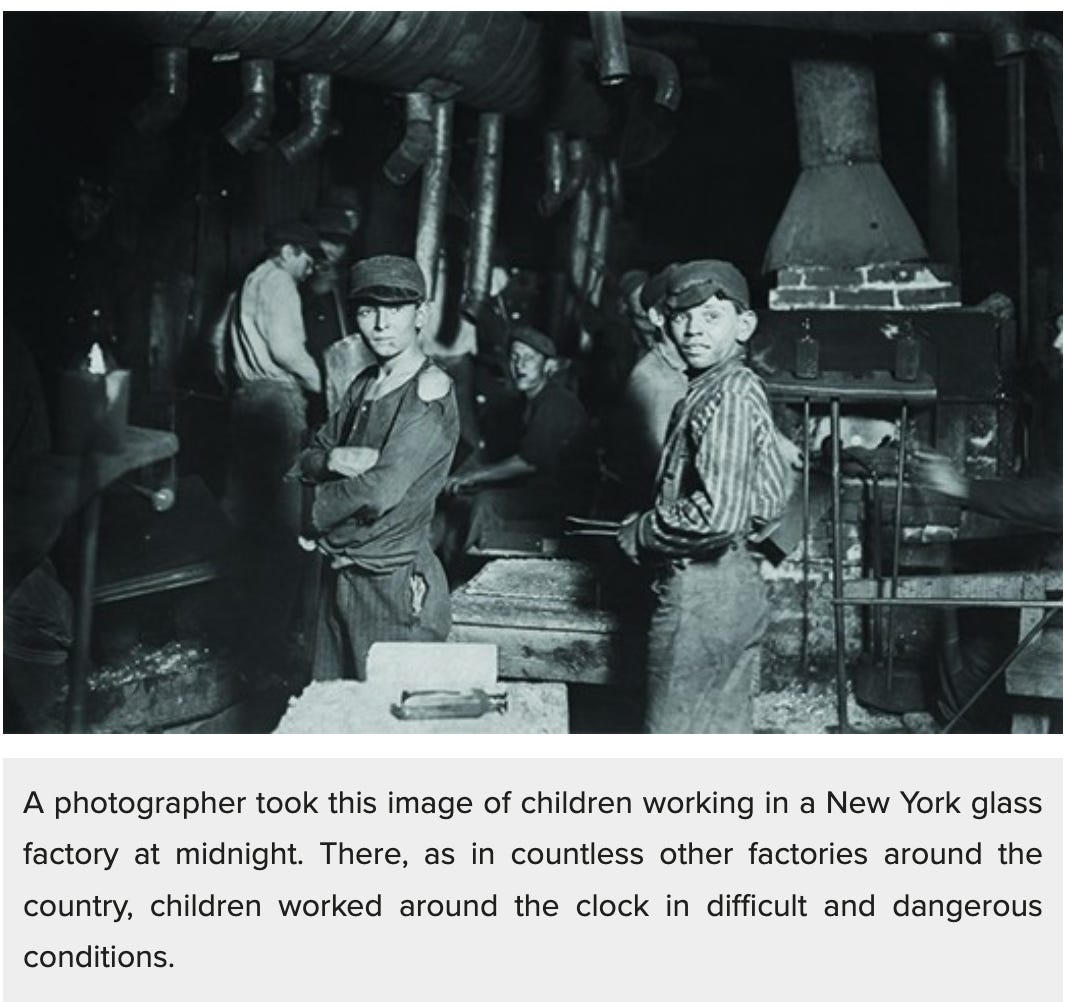
There were a lot of promises that you can find in history books on what factories were going to bring. The factories added a level of productivity never before seen. They allowed for economy to just boom, and it generated more supply, which generated more demand, and the global economy grew as a result. There were also a lot of negatives that came from it, including accidents, including lack of protections in the beginning, and we still even see some of that today. Health issues from people all living in the same place. It is important to understand the positives, and to not ignore the negatives. You can prepare for those negatives.
Britain didn’t send an inspector into a factory until the 1833 Factory Act, decades into the boom.
So who’s the factory worker in this story?
The factory workers are all the people that believe that they understand AI now and believe that AI is just going to save everything, but they’re not understanding, or often not taking into account, the risks and the negatives that come with it. Those risks should not keep you from adopting AI. You just should be going in with open eyes, and working to minimize the risks.
Where should you actually start with AI?
We all got the tools at the same time, the way everyone eventually got electricity. Having it in the building was never what made the difference. What we did with it was.
I take three diagnostic calls a month. It’s 30 minutes, free, and we work out what you’re actually trying to get to, where your biggest hurdles sit, what your low-hanging fruit is, and how that lines up with what I’ve been seeing elsewhere. Then I tell you the first move I’d make.
Afterward I send you an outline of how I’d work on your biggest pain points, so you can decide on your own time.
The skills employers say they are hiring for
That same WEF survey ranks analytical thinking as the most sought-after core skill, with seven out of 10 employers calling it essential, followed by resilience, flexibility and agility at 68%. In TestGorilla’s State of Skills-Based Hiring 2025, 78% of employers said they had hired someone with strong technical skills who failed in the role because of poor soft skills or a lack of cultural or motivational fit. Which is the same shift I wrote about when the résumé started losing its monopoly.
Now the honest complication. The skills growing fastest in that same report are technical: AI and big data first, then networks and cybersecurity. PwC’s 2025 Global AI Jobs Barometer (June 2025) found workers with AI skills earning a 56% wage premium, up from 25% a year earlier.
So, while I do understand that tech skills are important, I am a strong believer that everybody should seek to understand AI. And I feel like there are too many people that have that foundation, but they just have not found a clear way to bolt AI on top of it and have it stand on the shoulders of everything else that they have built. Too many people are just trying to start from zero, but it is their human growth that will set them up for success, as long as AI is used correctly within that.
This is not a lottery
I just see too many people thinking that using AI is going to create success by itself, and it’s just not. They’re going to have to strategically plan for success. This is not a lottery. There is a strategy, and it runs in this order:
Understand what you’re doing wrong
Understand what your strengths are
Understand your weaknesses
Use AI to shore up your weaknesses and uplift your strengths
Stop reading and write those four down for one person on your team.
That’s exactly what I do in my work with orgs. And when we work with small and mid-sized companies, we’re not just focusing on what can be automated in those companies, but we also look at what current employees in those companies are doing and how we can upskill them for them to be even more efficient for those organizations, rather than just be discarded.
The one thing I’d protect
And the one skill that I would protect for myself, I mean, it goes back to the AI Leadership Triad. Adaptability, innovation, and creativity.
If You Only Remember This
A net gain of 78 million jobs says nothing about whether the person losing one can do the one being created.
Employers rank analytical thinking first and still hire for it after they stop asking for degrees, while the fastest-growing skills on the same list are technical.
AI stands on the shoulders of what you already built, so the fastest move is usually to put it under the experience you have rather than starting from zero.
What did you build before AI that you still haven’t put underneath it?
Thanks for reading,
Joel
Worth Your Time
A few pieces from other creators worth your attention this week.
Juan Salas-Romer — What Karpathy’s 143-Million-Job Analysis Actually Means for Your Career. He walks through the job-by-job exposure scoring and argues that once AI absorbs the execution, judgment and accountability are what get repriced upward.
Ethan Mollick — Management as AI Superpower. His MBA students had no AI edge and still outperformed, because scoping a problem and judging the output turned out to be the skill that mattered.
Rob T. Lee — Mythos, entry-level job panic, and my new favorite word: apocalyptimist. He makes the case that the real damage is to the entry-level ladder, and that the fix is the residency model medicine and law already run on.
Questions Leaders Are Asking
Will AI create more jobs than it eliminates? The World Economic Forum’s Future of Jobs Report 2025 projects 170 million jobs created and 92 million displaced by 2030, a net gain of 78 million. That count covers every force reshaping work, not AI alone, and a net gain says nothing about whether a displaced worker can move into a new role without training.
Which skills matter most in the AI era? Employers in the 2025 WEF survey rank analytical thinking first, with seven out of 10 calling it essential, followed by resilience, flexibility and agility at 68%, and curiosity and lifelong learning at 59%. The fastest-growing skills are technical, led by AI and big data.
Which jobs are declining fastest? The same survey names postal service clerks, bank tellers and data entry clerks as the fastest-declining roles. The largest declines in raw numbers fall on clerical and secretarial work, including cashiers, ticket clerks and administrative assistants.
Do I need technical skills to work with AI? You don’t need to code, but you do need to understand what AI does and where it fails. Technical skill opens the door, and PwC measured a 56% wage premium for it in 2025. What decides your value once you’re inside is the judgment and experience you bring to the output.
How do I upskill my team for AI? Start with each person’s strengths and weaknesses rather than with the tool. Ask what they’re getting wrong today, where they’re strongest, and where AI could shore up a weakness. Most companies only ask what can be automated, which skips the people they already employ.
Joel Salinas is an AI Strategy Coach and entrepreneur. AI is everywhere; judgment is scarce. Joel helps founders and leaders adopt AI without outsourcing their judgment to it, and he builds the systems too. Creator of the AI Leadership Triad.
Written by a human, for humans.
Sources Referenced
World Economic Forum, Future of Jobs Report 2025, January 2025 — https://reports.weforum.org/docs/WEF_Future_of_Jobs_Report_2025.pdf
TestGorilla, The State of Skills-Based Hiring 2025, surveyed April 2025 — https://www.testgorilla.com/skills-based-hiring/state-of-skills-based-hiring-2025/
PwC, The Fearless Future: PwC’s 2025 Global AI Jobs Barometer, June 2025 — https://www.pwc.com/gx/en/issues/artificial-intelligence/job-barometer/2025/report.pdf
UK Parliament, The 1833 Factory Act — https://www.parliament.uk/about/living-heritage/transformingsociety/livinglearning/19thcentury/overview/factoryact
Joel, the order is the whole thing. I teach high school chemistry and physics, and your list explains why adults with twenty years of experience can bolt AI on and win. The foundation is already under them.
My students do not have that foundation yet. They get the tool before they get the experience, so there is nothing for the AI to stand on. Your closing question has a hard answer for them. They have not built anything yet to put underneath it.
That is where schools have to be careful. The entry-level ladder Rob Lee writes about starts in a classroom. If students skip the climb, they reach the first rung already outsourced.
Build the person first. Then hand them the tool.