


TL;DR: The AI skills gap is a judgment gap. A 2026 DataCamp and YouGov survey of 517 enterprise leaders found that most organizations already offer AI training, yet every capability gap those leaders named was about interpretation, trust, and decision-making rather than technical skill.

Earlier this year I turned down a client.
A supply chain logistics company came to me the way a lot of organizations do, with a tool already picked and a budget already approved. They wanted help making sure this one worked, because the last one hadn’t. I told them what I tell everybody in that position: before we talk about the tool, we look at what sits underneath it. How their people were being taught about AI, what those people actually believed, and how the change was going to be handled.
They weren’t interested. They wanted the tool.
So I passed on the work. It wasn’t a hard ethical call, but it was an expensive one, because building on a foundation nobody was willing to pour would have produced the same outcome they’d already paid for once.
A few weeks later, a survey of 517 enterprise leaders described their exact problem using almost my exact words.
What to Remember
You’ll see the one number that separates AI investments that pay off from the ones that don’t, and it has nothing to do with which tool got bought.
You’ll get the five questions I ask before I’ll help anyone choose an AI tool, plus a way to answer them for free this week.
The short version, if you read nothing else
What leaders expect. 88% call basic data literacy important for daily work, and 72% say the same about AI literacy.
What they’ve actually built. Only 35% have a mature, organization-wide upskilling program.
What they’re already spending on. 77% already offer some kind of AI training, so access isn’t the gap.
What it’s costing them. 21% report significant returns from AI. Among organizations with a real program, that doubles to 42%.
Source: DataCamp & YouGov, “The State of Data & AI Literacy 2026” (4th Edition), February 2026.
What “we already did training” usually means
When an organization tells me training is handled, it usually means everybody got sent a YouTube video about Claude (Anthropic’s AI assistant, the main rival to ChatGPT) or whatever Copilot license they already had, somebody logged it complete, and that was the program. A lot of them have no AI policy either, so nothing is written down about what data can go into a prompt or who’s accountable when the output is wrong. Then a few months later there’s a purchase order for a tool, sometimes tens of thousands of dollars, that almost nobody uses.
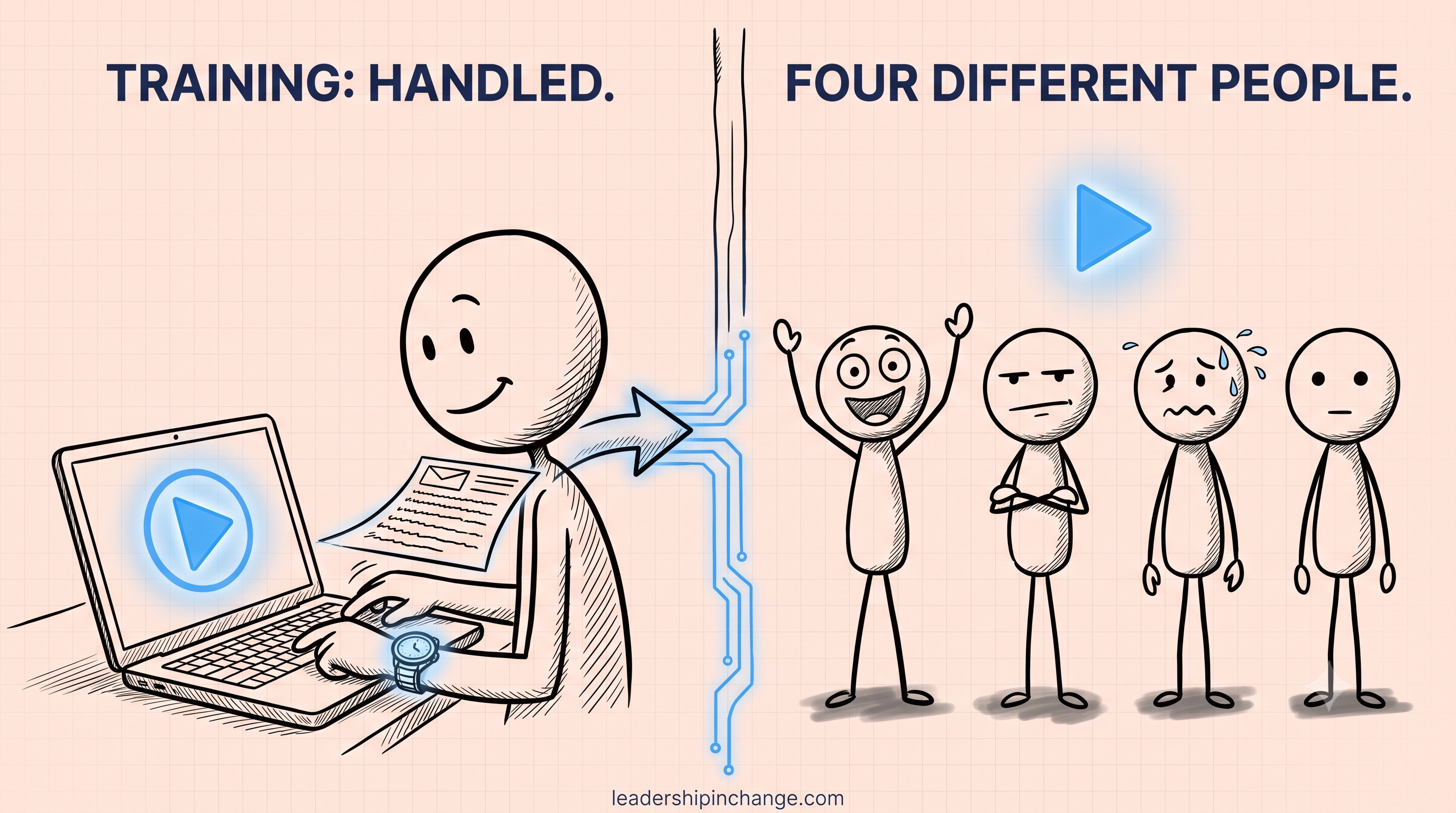
Here’s the thing about that video. You can teach somebody how every piece on a chessboard moves in about ten minutes, and by the end they’ll tell you the bishop goes diagonally and the knight does that odd L-shape. None of it makes them able to play. Knowing which move to make in a real position, against a real opponent, with something at stake, takes years. Training teaches the moves. Judgment is the game. Most of what we’re calling AI literacy is a ten-minute lesson on how the pieces move.
Asked what’s wrong with the training they already run, these leaders didn’t say budget or motivation. They said there aren’t enough hands-on projects (24%), video courses don’t transfer to real work (23%), and there are no role-tailored paths (23%).
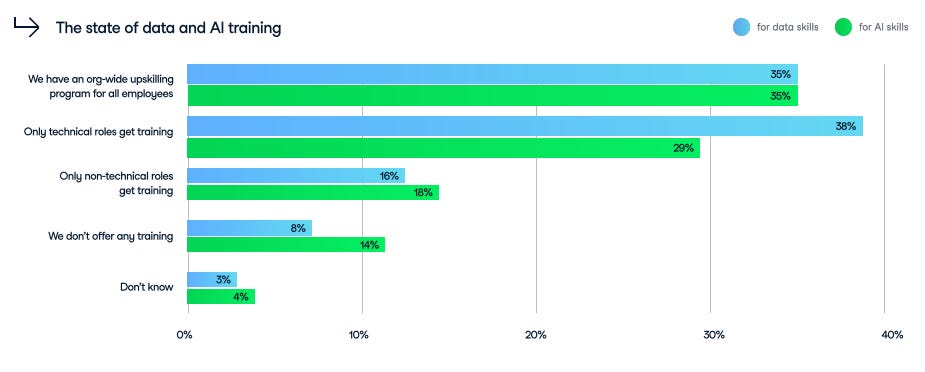
38% train technical roles only on data skills, 29% do the same for AI, and 8% offer no data training at all.
Nothing in this report surprised me, and that’s the problem
What I didn’t expect was how completely it closes off the easiest excuse. These aren’t skeptics: 69% expect an uplift of at least 10% from AI fluency, and only 6% expect nothing at all.
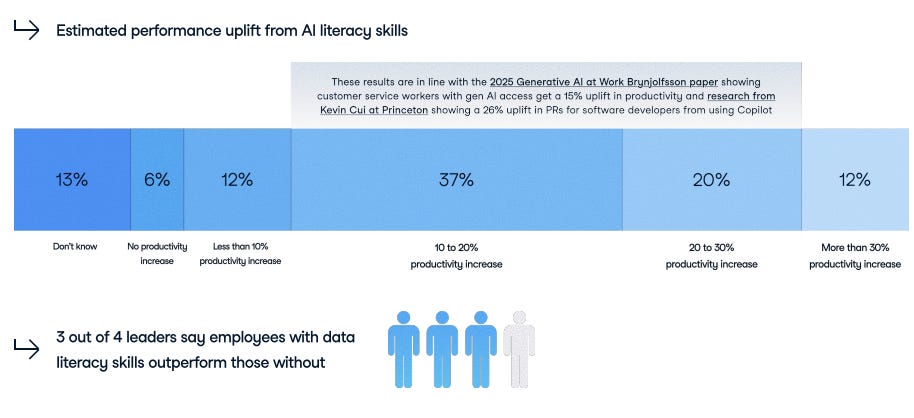
So they believe the return is real, and the comfortable story about why they aren’t getting it is access. This survey takes that away, because 77% already offer AI training. You can’t fix a capability gap by approving another purchase, which is the same mechanism behind why 92% of AI investments fail to produce a return.
Every gap they named is a judgment gap
DataCamp asked leaders to describe, in their own words, where AI and data skills break down. They named four things: turning information into good decisions, communicating and influencing with it, applying it to real work, and knowing what to trust. A fifth was confidence and culture, meaning fear of getting it wrong.
Nobody said their people couldn’t code. Every one of those is a judgment problem wearing a skills label, and the report’s own sentence on it is the most important line in all 37 pages:
“Without strong foundations, advanced tools (from dashboards and BI to AI systems) increase confidence without increasing correctness, which amplifies risk rather than reducing it.”
Certainty is what people act on, which is why the top risk these leaders named was inaccurate decision-making at 35%. It’s also why validating what AI hands you stopped being optional.
Here’s why one video can’t fix it. That video assumes everybody watching is the same person. When I assess how leaders relate to AI, two things matter independently: what somebody believes about it, and how much they actually use it.
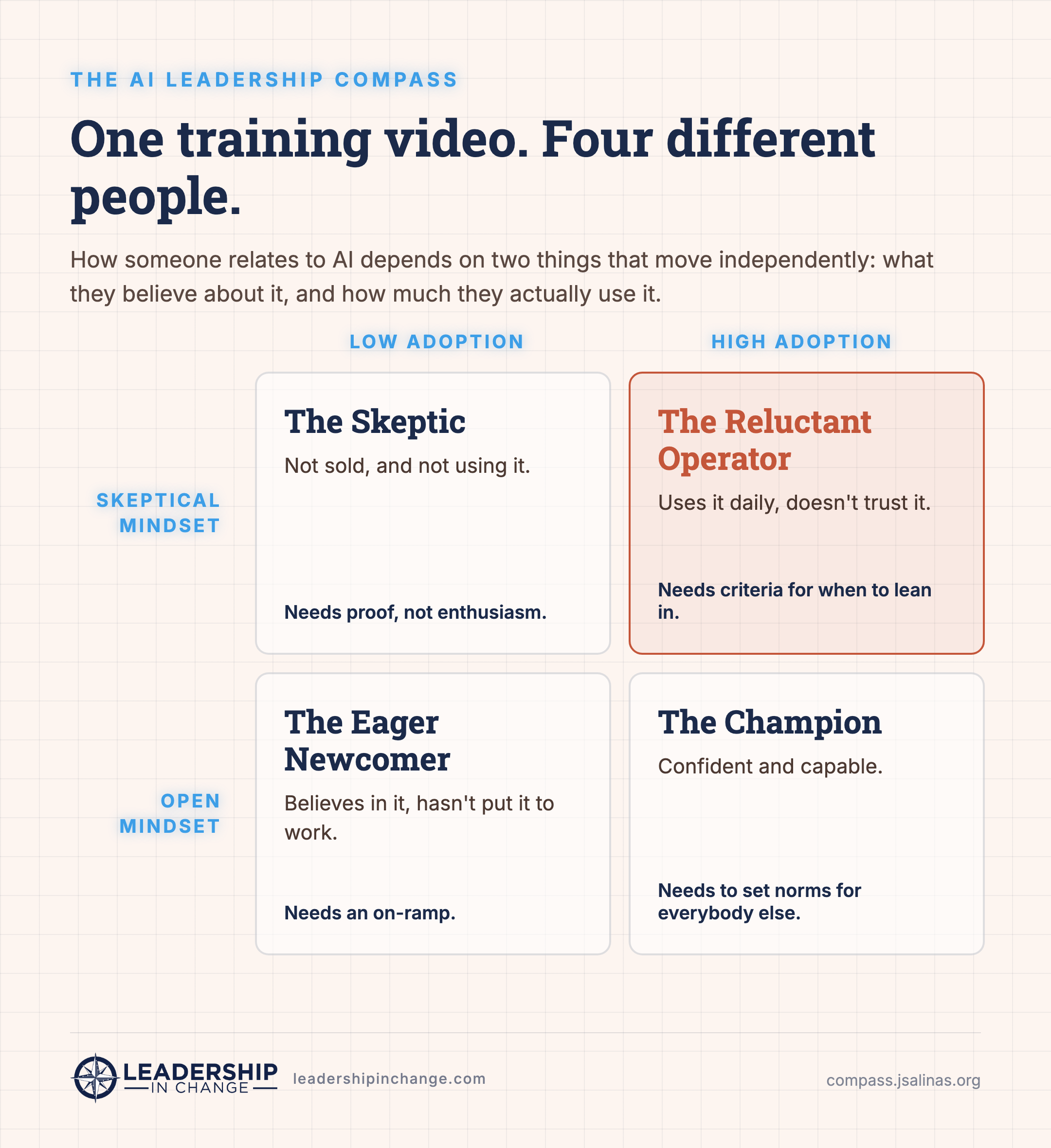
That video is built for exactly one of them, the Eager Newcomer. Send it to a Skeptic and you’ve confirmed their suspicion that this is hype. Send it to a Reluctant Operator, already using AI daily while doubting whether they’re getting it right, and you’ve handed them nothing, because their problem was never access.
That Reluctant Operator is who this whole report describes. When people are unsure how outputs are governed, DataCamp found, they “either over-rely on outputs or avoid using tools altogether.” Both are judgment failures, and both look like adoption on a dashboard.
The five questions I ask before anyone buys anything
None of this requires a vendor, a budget approval, or a consultant.
How are our people actually being taught about AI? Not what got assigned, but what was learned.
What are the real mindsets about AI here? Not the ones people perform in the all-hands. The ones they say to each other afterward.
How is change management being handled? 30% of these leaders named resistance to adoption as a top barrier, which is a change problem showing up as a technology problem.
How is upskilling being handled? If it only reaches technical roles, most of your workforce is on their own.
How is any of this being communicated? Another 30% named unclear guardrails, which is a communication gap before it’s a capability gap.
Stop reading and try to answer number two honestly. Not what you’d put in a board update, what you actually know. If you can’t, that’s not a failure but the most useful thing you’ll learn all week. And it costs nothing: name AI champions on each team, or have your leadership team take the free AI Leadership Compass this week and compare results.
Now let me read this report the way I’m telling you to read your own data
I’d be a hypocrite if I spent this whole piece arguing that leaders can’t evaluate what they’re handed, then handed you a report without evaluating it.
DataCamp sells AI upskilling, so a report concluding that AI training drives returns is also their sales pitch. That doesn’t make it false, but it earns a harder look. The headline is a correlation, not proof, because companies organized enough to run company-wide upskilling are probably organized enough to deploy AI well too. 45% of respondents work in IT, so this is partly technology leaders grading everybody else. And the sample is four industries only, all at 500-plus employees, with no government, education, or nonprofits, so a 40-person mission-driven organization isn’t in it.
Credit where it’s earned: DataCamp refused to make year-over-year comparisons this edition because their methodology changed, and most vendor research compares anyway and hopes nobody checks.
Focus on the people before you focus on the tool
The logistics company wasn’t being reckless. They’d had a tool fail and a reasonable theory that the next one would work better. What they were actually doing was deferring judgment to the tool, asking the software to decide whether the software would be adopted.
That’s the move I’d ask you to catch in yourself, because it’s easier to evaluate a product than to ask your own people what they believe. An organization can outsource its thinking just as easily as a person can.
Judgment is where my work starts, and you’re welcome to start there with me. You’re also welcome to do this yourself, and I mean that. Ask the five questions, find out which quadrant your people sit in, and write an AI policy a normal person can follow. Just don’t skip it and hope the tool is good enough, because that’s the bet the 79% who aren’t seeing real returns already made.
If You Only Remember This
Every capability gap leaders named in this survey was about interpretation, communication, application, or trust, and not one was technical.
Tools raise confidence faster than they raise correctness, so an unprepared team gets more certain and more wrong at the same time.
A company-wide training video is built for one of the four kinds of people in your building, and the other three learn nothing from it.
Which quadrant is most of your team actually sitting in right now, and when was the last time you asked them instead of guessing?
Questions Leaders Are Asking
What is the AI skills gap? The AI skills gap is the distance between what organizations expect their people to do with AI and what those people can actually do. In DataCamp and YouGov’s February 2026 survey of 517 enterprise leaders, 59% reported an AI skills gap and 60% reported a data skills gap, even though most already offered some form of training.
What’s the difference between AI literacy and AI training? AI training teaches someone how a tool works. AI literacy is the ability to understand what AI can and can’t do, judge whether its output is reliable, and apply it to real work. Training covers the mechanics, and literacy covers the judgment, which is where the 2026 survey found every major gap.
Why isn’t our AI investment paying off? The strongest signal in the 2026 data is workforce readiness. Only 21% of leaders reported significant returns from AI overall, but among organizations with a mature, company-wide upskilling program that number rose to 42%. Worth noting this is a correlation, so upskilling may be a marker of organizational discipline as much as a direct cause.
How much does it cost to fix an AI skills gap? Less than most leaders assume, and often nothing to start. Naming AI champions on each team, running an internal survey on how people actually feel about AI, and writing a plain-language AI policy all cost time rather than money. Those three steps address change management, mindset, and guardrails, which is where this survey found the gaps.
Should we train everyone on AI or just technical roles? Everyone. In the 2026 survey, 38% of organizations trained only technical roles on data skills and 29% did the same for AI, yet the capabilities leaders said mattered most were decision-making and interpretation, which every role uses. Organizations with company-wide programs were roughly twice as likely to report significant AI returns.
Worth Your Time
A few pieces from other creators worth your attention this week.
Kamil Banc — Two Years of AI Implementation Advisory: Seven Lessons. He watched two companies run identical AI stacks, one integrating it and the other flatlining by month three, and the difference was never the tool.
Andreas Welsch — Why Your Eight-Week Roadmap Is Already Obsolete. A former SAP VP making the case that an AI roadmap older than eight weeks is already behind, and that light governance beats a longer plan.
Oliver Patel — Banning AI Is Not an Effective AI Policy. A short, direct argument that restricting AI drives it underground instead of reducing risk, which is worth reading if question five was the hard one.
Sources Referenced
DataCamp & YouGov, “The State of Data & AI Literacy 2026” (4th Edition), published February 26, 2026. Survey of 517 US and UK leaders at organizations with 500+ employees, fielded December 2025 to February 2026. Full report · Statistics summary
Erik Brynjolfsson et al., “Generative AI at Work,” 2025, cited within the DataCamp report as the benchmark for a 15% productivity uplift among customer service workers.
Kevin Cui, Princeton, cited within the DataCamp report for a 26% uplift in pull requests among software developers using Copilot.
Joel Salinas is an AI Strategy Coach and entrepreneur. AI is everywhere; judgment is scarce. Joel helps founders and leaders adopt AI without outsourcing their judgment to it, and he builds the systems too. Creator of the AI Leadership Triad.
Written by a human, for humans.
The chess analogy is the best explanation I've seen for why a 10-minute training video does nothing. Knowing the rules and playing a real game against a real opponent aren't remotely the same skill, and most corporate AI training stops at "here's how the bishop moves." Question two is the hard one honestly, since nobody actually wants to ask their team what they say to each other after the all-hands ends.
Thanks for this. The "training without judgment" gap tracks with something similar in hiring, a different domain than your DataCamp citation. A survey of 80 enterprise hiring leaders found over 90% have deployed AI in talent acquisition, but fewer than 5% report transformational outcomes. When asked what's actually holding results back, leaders ranked change management and governance above technology quality, both around 55%, well ahead of the tools themselves.
That's a useful corroboration of your judgment-gap frame: the people running these deployments day to day are naming the human layer as the bottleneck, not the model. It also fits your chess analogy neatly. Teaching the rules produces the 90% deployment rate; developing judgment is what the missing 85% would need to actually win with it.