


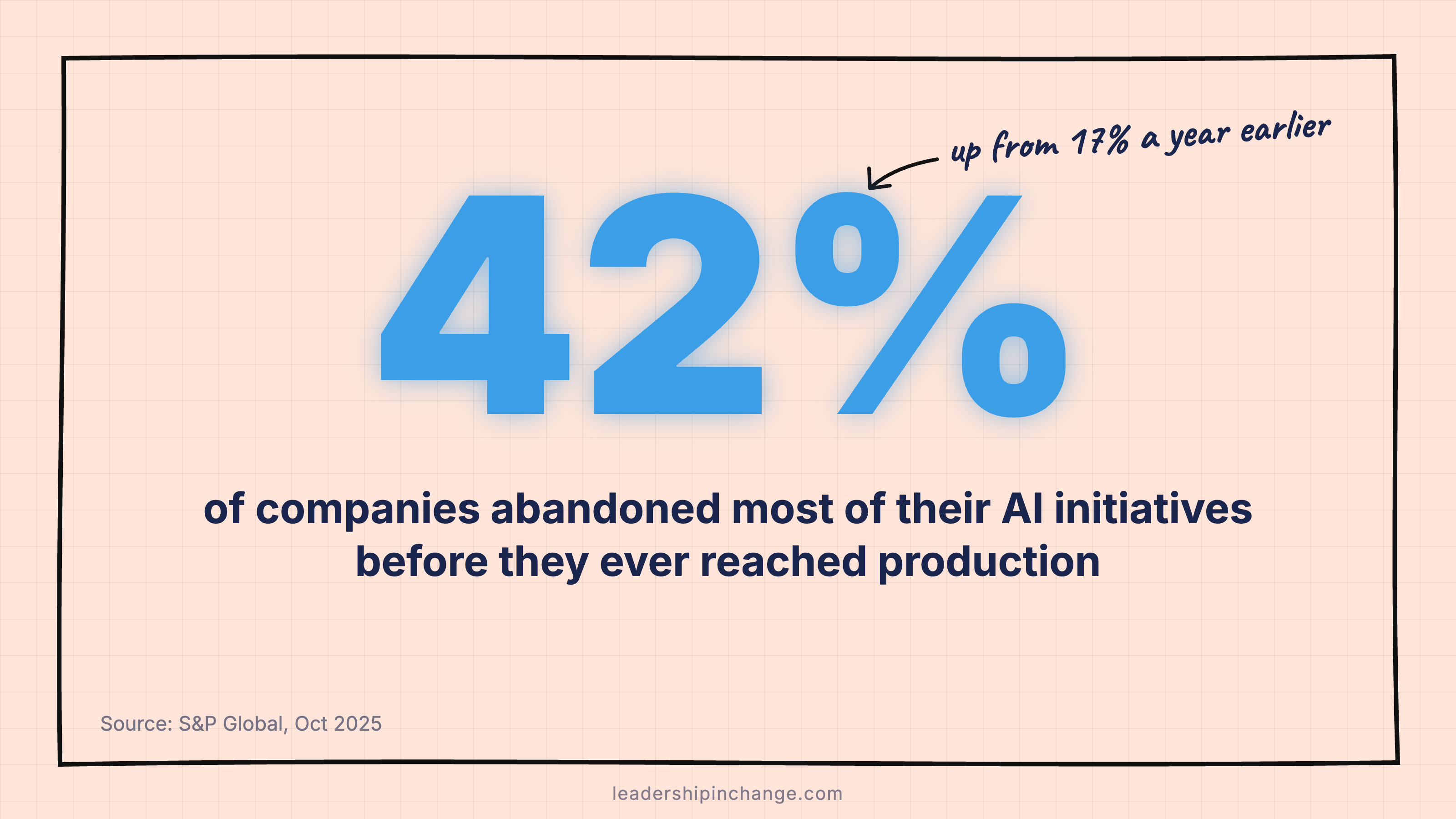
TL;DR: AI pilots usually fail to scale because the workflow underneath them was never fixed. S&P Global found 42% of companies abandoned most of their AI initiatives before production. A 20-minute Claude audit first checks whether the workflow is even needed, then tests five things and ends in one verdict: scale, fix or kill.
I’ve built things for organizations (and for myself) that just never left the pilot stage, that never went from build to savings, simply because the infrastructure was not there.
One example is a content repurposer that I built for a logistics company trying to expand their social media presence. Everything was there: they paid for the tool, they iterated, they tested it. But they just never took that extra step to weave it into their system. So really, it doesn’t matter how good a tool is or how bad a tool is. It’s just not going to work if it doesn’t go there.
So below you’ll find why pilots like that one stall, the one question to ask before any audit, the five audit questions, a copy-paste Claude prompt that runs the whole audit as an interview and hands you a one-page summary, and the test I use to kill my own pilots.
What You’ll Walk Away With
A 20-minute audit that tells you whether to scale, fix or kill one of your AI pilots
A way to spot the broken workflow under a pilot before you spend another dollar on it
Why AI Pilots Fail to Scale
This isn’t a rare problem. In S&P Global’s survey of 1,006 respondents (fielded late 2024, published October 27, 2025), 42% of companies had abandoned most of their AI initiatives before production, up from 17% the year before. The average company scrapped 46% of its proofs of concept (the small trial versions built to test an idea).
You’ve probably also seen the “95% of AI pilots fail” headline. It comes from an MIT NANDA report (July 2025) built on 52 interviews and 153 survey responses, and its own authors call the figures “directionally accurate based on individual interviews rather than official company reporting.” So treat the 95% as a direction, and lean on the S&P number when you need one you can defend.
When I see tools fail, it’s because way too much focus has gone into the tool, way too little focus has gone into the systems, and most importantly, the people that those systems would be plugged into.
Fix the Hole Before You Lay the Rug
Often the conversation before “what AI tool can we build” needs to be: which of our workflows are even necessary? Which are overcomplicated? Which workflows have turned into 25, 30, 40 steps over the course of the years, when only six are needed? We never moved back far enough to see if only six steps are needed, and only then ask which one of those can be automated.
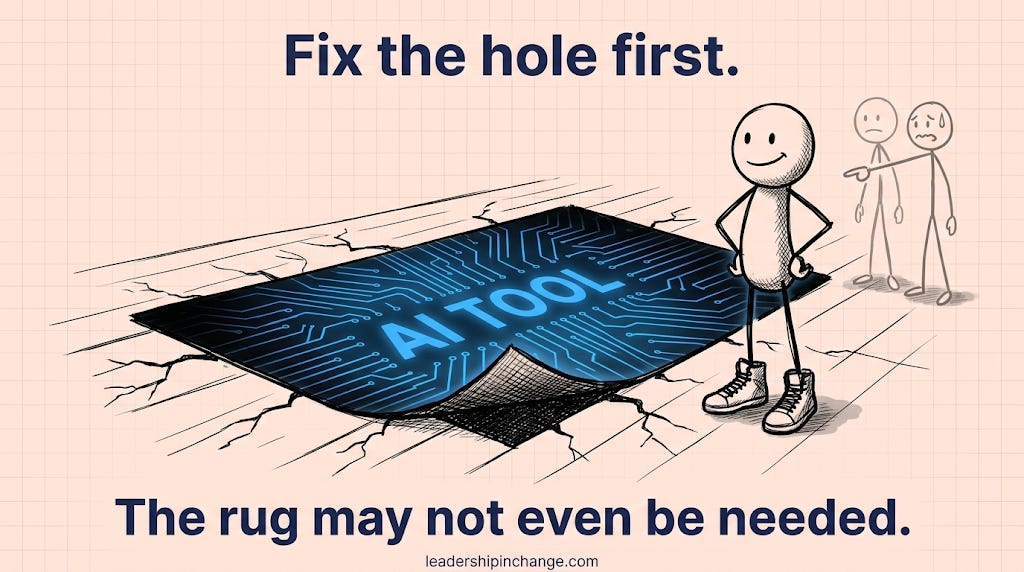
Think of it like a rug placed on top of a soon-to-collapse hole in the ground. The hole first needs to be fixed. And once fixed, the rug may not even be needed.
Quick Win (under 60 seconds) Count the steps in the workflow your AI pilot is supposed to help. If it’s more than ten, write down which ones you’d keep if you were starting from scratch today. That gap is your first fix.
The Five AI Pilot Audit Questions
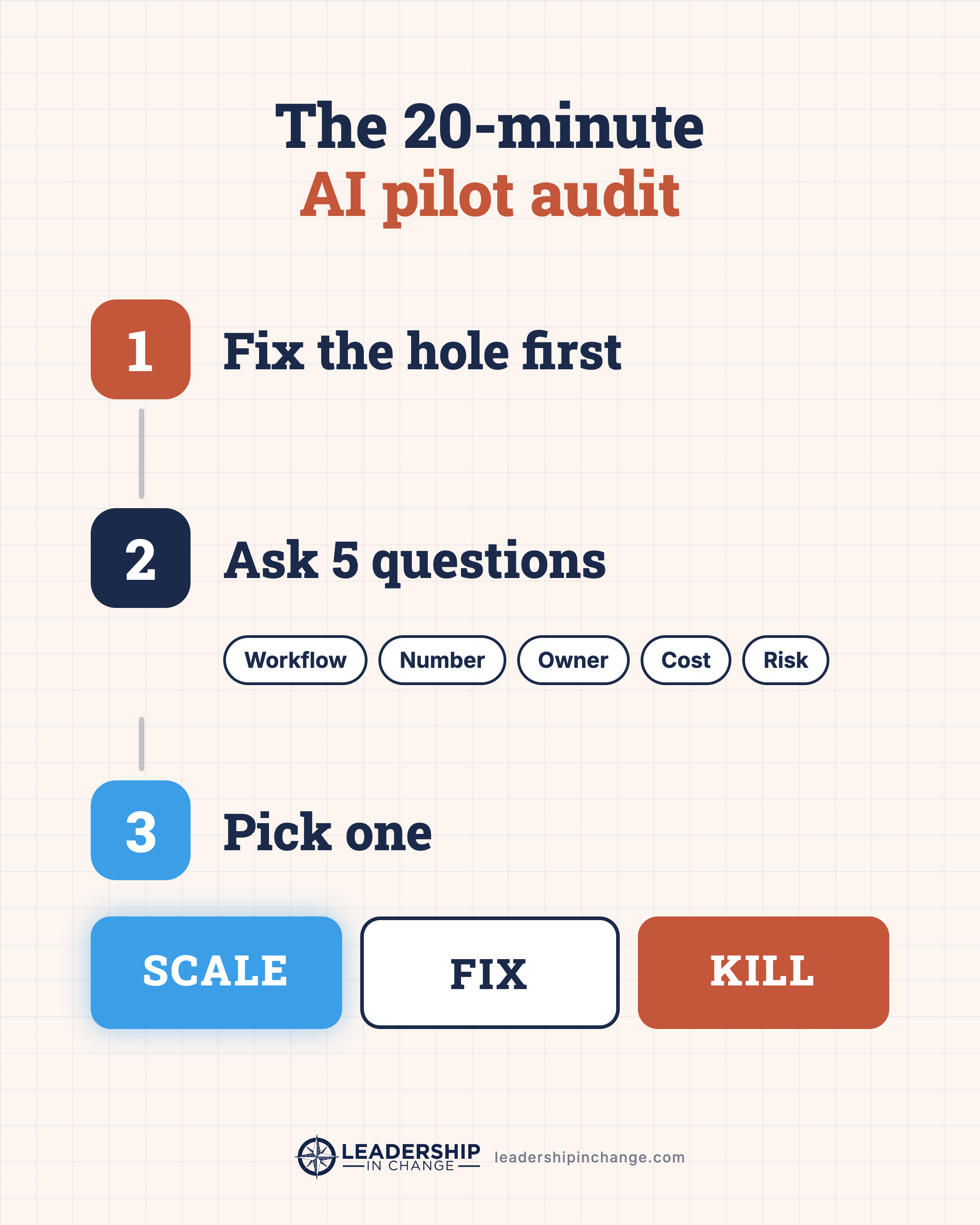
Once the hole is fixed, run every pilot through the same five questions. Most of them come from the reasons research gives for why pilots stall.
Workflow. Which real workflow does this pilot live inside, start to finish? MIT’s researchers found the tools that fail “don’t learn and don’t integrate well into workflows.”
Number. What one business number should it move? Gartner (the research and advisory firm) lists “unclear business value” among the reasons it expects AI projects to be canceled.
Owner. Who is the named person accountable for it once the pilot ends? If it’s “the team,” nobody owns it.
Cost. What will it cost to run once the free trial and the builder’s attention are gone? Gartner names “escalating costs.”
Risk. What could go wrong, and who checks before it does? Gartner names “inadequate risk controls.”
The Gartner reasons come from its June 2025 prediction that over 40% of agentic AI projects (AI that takes actions on its own) will be canceled by the end of 2027. That’s a forecast rather than a count, so the reasons are the useful part here.
💎 Run the Audit in Claude in 20 Minutes
In Claude or ChatGPT, I’d run this as a back-and-forth interview, so the audit isn’t a rug being placed on top of a hole, and then the results come back as a one-page summary.
Here’s how to run it:
Open a new chat in Claude. The free plan works.
Paste the prompt below. Run one pilot at a time.
Answer its questions honestly. It asks about the workflow first, then the five questions.
Read the verdict and the one-page summary.
Stop reading and try it on one pilot.
Claude builds the summary as an Artifact (a page it makes right in the chat), so you can download it or share it with your team. Here’s a sample of what you’d get…
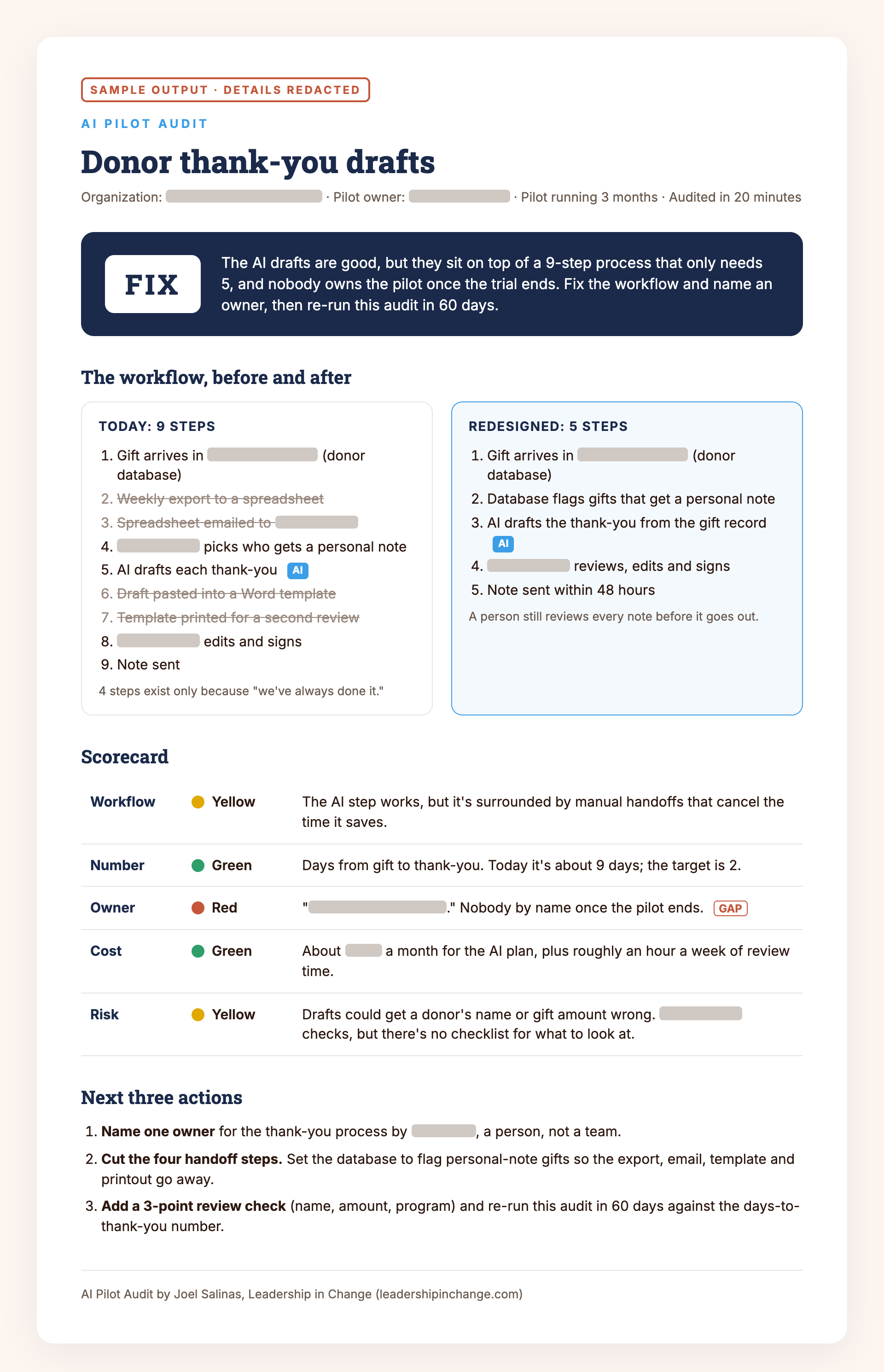
If the audit says FIX, the next question is usually which step to hand over first. I wrote a whole method for that in How to Decide What to Hand AI Next (and Where to Stop), and for marking where AI starts and stops inside the fixed workflow, see Map Where AI Starts and Stops in Your Workflow in 30 Minutes.
Scale or Kill: Two of My Own Pilots
I’ve tried pilots in my personal work. I built a carousel generator that took my Substack posts and generated carousels, and gave me a draft to review before it was posted to LinkedIn. It took a lot of time to build and a lot of time to test. Ultimately, within LinkedIn, it just did not move the needle at all for me.
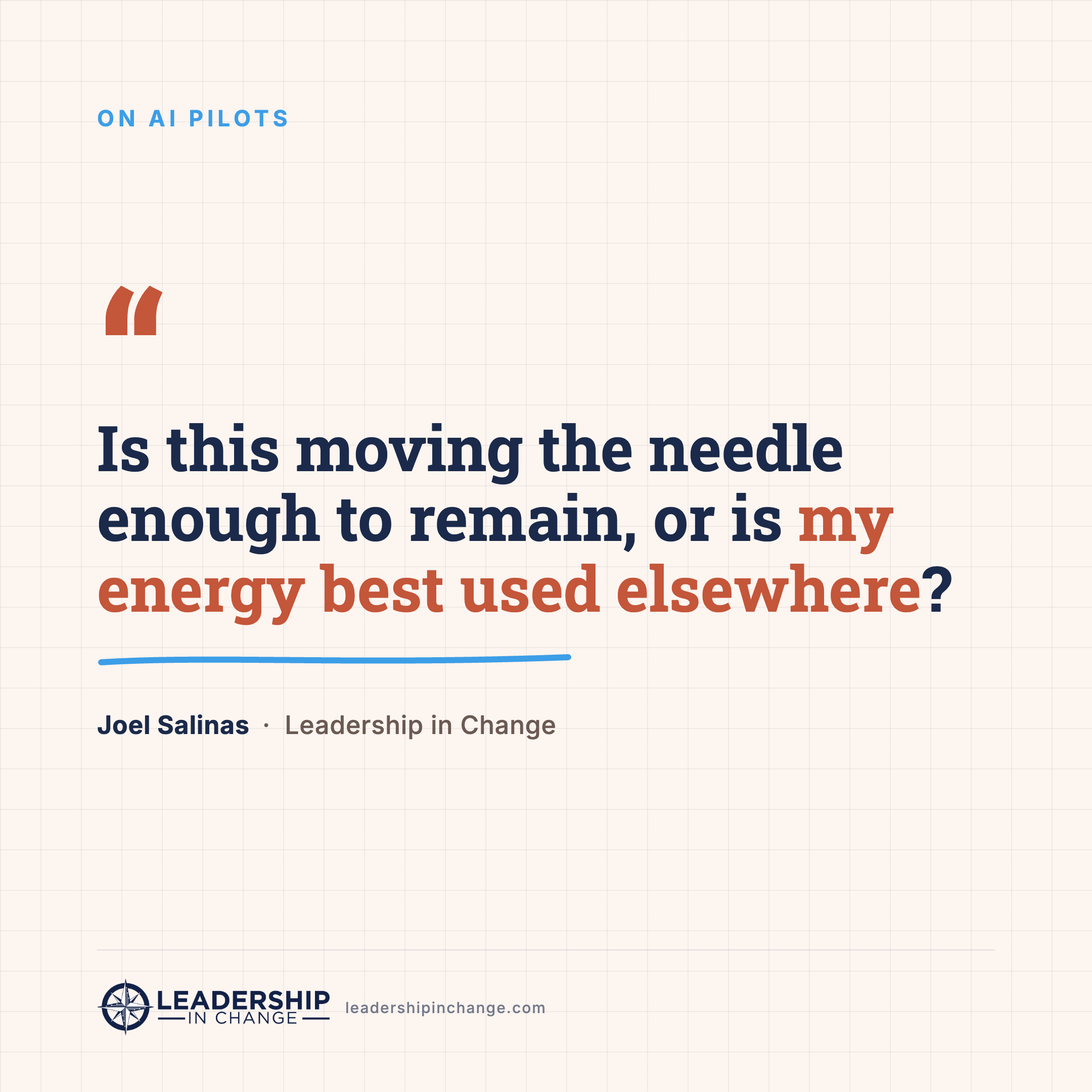
So I did the test that I normally do after a few months of use: is this moving the needle enough to remain, or is my energy best used elsewhere? The answer was better used elsewhere, and I killed it. There are many others that went really well.
One of them is the marketing engine that’s one of the first projects I work on with most of my clients. A human creates a basic draft of the content, and the engine makes it on-brand. It turns it into multiple copies, a drip campaign (a series of scheduled emails), social media. It creates graphics before it goes back to the human for judgment. It made it past the pilot because a human starts every piece and a human judges it before anything goes out.
The Judgment Call: Limit Your Exposure
Claude can recommend scale, fix or kill, but the decision stays with you, and so does the final check on anything that goes out. AI is not deterministic. It’s not A plus B equals C every time. AI reasons, and no matter how many guardrails you have, it could conclude out of different reasoning from time A to time B that A plus B equals D instead of C. That’s where a human in the loop is needed, in the audit and in the pilot itself.
Sometimes you won’t know a pilot failed until you’ve invested some time and money in it, and you have to be ready for that. But if you don’t have a lot of time and resources, then don’t take high-risk pilots. Minimize the exposure you have to those kinds of risks before jumping in, just like you would in finance and investments.
That’s why this matters to me. I focus on working with small businesses and nonprofits, and they can’t afford to waste money, and they also can’t afford to not take advantage of AI.
💎 What Premium includes
This tutorial is free. Premium is where the rest of my work lives:
The Claude Skill Library. Twenty-five paste-ready Claude Skills, sorted by the six jobs a leader actually has. You copy one block, answer a few questions, and it builds itself around your role and your business. No downloads, no setup, and you can’t buy these anywhere at any price.
Both field guides, free. Leading with Claude is the 51-page climb from your first prompt to running real work through it. The NotebookLM Leader’s Playbook is the 36-page grounded-research system. They’re $19.99 for the pair on Gumroad, and you pay nothing for either.
Premium Q&A. Unlimited questions, answered by me in 24 to 48 hours. It’s the benefit members forget they have.
Half off Newsletter Compass and Cozora. Both of them, for as long as you’re a member.
Every artifact I’ve gated. The skills, templates and walkthroughs from every past Monday, yours the moment you join.
Premium is $49 for the year.
If You Only Remember This
Most AI pilots stall because the workflow underneath was never fixed. Fix the hole before you lay the rug.
Every pilot needs a workflow, a number, an owner, a cost and a risk check. A blank answer is a gap, not a pass.
Ask whether it’s moving the needle enough to remain, or whether your energy is best used elsewhere. Killing a pilot is a decision you get to make on purpose.
Pick one pilot this week and run the audit.
Which AI pilot on your team would you put through this first?
Thanks for reading,
Joel
Worth Your Time
A few pieces from other creators on fixing the work before adding AI:
The AI MEMO, AI Transformation Is Not A Technology Project. Andreas Welsch on why process and culture gaps decide payback more than the tool does.
The AI Maker, How My Tiny AI System Saves Me 100 Hours/Year. Omer Feinholtz writes down the steps of one dreaded task before any AI touches it, then starts small.
Build to Launch, How To Reset Your Skill Set In One Day (So AI Can’t Replace You). Jenny Ouyang has you log one real working day and define what done looks like before you hand any step to AI.
Questions Leaders Are Asking
Why do most AI pilots fail to scale? Most AI pilots stall because the workflow they sit inside was never fixed or woven into how the team works. Research names unclear business value, rising costs and weak risk controls. The tool working in a demo doesn’t mean the organization is ready to use it every day.
Is it true that 95% of AI pilots fail? The figure comes from a July 2025 MIT NANDA report built on 52 interviews and 153 survey responses, and its authors call it directionally accurate rather than official. A sturdier number: S&P Global found 42% of companies abandoned most AI initiatives before production.
How do I audit an AI pilot? First check whether the underlying workflow is necessary and how many of its steps you’d keep. Then test five things: the workflow, the business number, the owner, the running cost and the risk. End with one verdict: scale, fix or kill.
When should you kill an AI pilot? After a few months of real use, ask whether it’s moving the needle enough to remain or whether your energy is best used elsewhere. If the number it was meant to move hasn’t moved and nobody owns it, killing it frees time for pilots that work.
How can small businesses and nonprofits reduce AI pilot risk? Limit exposure the way you would with an investment: if time and money are tight, avoid high-risk pilots, start with low-cost workflows that are easy to check, and name an owner before you build.
Joel Salinas is an AI Strategy Coach and entrepreneur. AI is everywhere; judgment is scarce. Joel helps founders and leaders adopt AI without outsourcing their judgment to it, and he builds the systems too. Creator of the AI Leadership Triad.
Written by a human, for humans.
Sources
Generative AI shows rapid growth but yields mixed results, S&P Global Market Intelligence (451 Research), October 27, 2025: https://www.spglobal.com/market-intelligence/en/news-insights/research/2025/10/generative-ai-shows-rapid-growth-but-yields-mixed-results
The GenAI Divide: State of AI in Business 2025, MIT NANDA, July 2025 (mirror; MIT’s original link no longer serves the PDF): https://www.artificialintelligence-news.com/wp-content/uploads/2025/08/ai_report_2025.pdf
Gartner Predicts Over 40% of Agentic AI Projects Will Be Canceled by End of 2027, Gartner, June 25, 2025: https://www.gartner.com/en/newsroom/press-releases/2025-06-25-gartner-predicts-over-40-percent-of-agentic-ai-projects-will-be-canceled-by-end-of-2027
Fixing the broken steps before adding an AI tool means the tool has a real job to do.
On day one, you can write down one plain line. For a LinkedIn carousel tool, it might say: "This should take us from 10 leads a month to 25 by March."
On that date, your "moving the needle" question gets a clear answer. You check the real number against your line. Then the choice to scale, fix or kill is much easier.
Could it be that AI tool development is similar to R&D and product development? Not all ideas that R&D come up with make it into production. Over the years we have learned to balance risk/reward in that department and put up guardrails. Developing AI tools is no different, and we will soon be able to do the same there … Great article!