


A skill that interviews you about your week, ranks what’s ready to hand over, and draws the line on each one.
TL;DR: What you hand AI next matters more than which tool you use. Gallup surveyed 22,573 U.S. workers in Q2 2026 and found that people using AI for one or two kinds of work report a 45% productivity gain, while those using it for seven or more report 90%. Same tools. The difference is how much they let go of.

So there’s a lot of talk right now about automating, and there’s real strength in it. I’m always looking at my own week to see what I can automate. But just because something’s automatable doesn’t mean it needs to be automated, and that’s the part most of us never take the time to think about.
We need to set our own parameters. That sounds obvious until you try it, because the honest question isn’t “can AI do this,” it’s “how much of this am I willing to let go of, and what happens if it gets it wrong?” Most of us never answer the second half, so we stall out at two or three things and assume that’s all AI is worth.
It isn’t. Gallup put real numbers on that in Q2, and the gap between us and the people getting genuine value out of AI has almost nothing to do with skill or with which tool they picked. It comes down to how many different kinds of work they’ve handed over, and they can hand over that much precisely because they’ve decided in advance where each one stops.
So that’s what I want to walk through: why the people handing over the most work are also the ones most explicit about where they stop, and what that means for the next thing you’re deciding whether to let go of.
What You’ll Walk Away With
A one-minute test you can run on any task on your plate, so you can hand over more without losing the decisions that are yours
Your own ranked list of what to hand AI next, with your stopping point written on each one
So let’s start where I did, with the number.
The number that reframed this for me
Gallup ran its Q2 2026 workforce study on 22,573 employed U.S. adults, fielded in May. More than half of us now use AI at work, and 15% use it daily. That part isn’t surprising.
This is the part I had to go back and read twice. Among people using AI for one or two purposes, 45% say it improved their productivity. At three or four purposes, 66%. At five or six, 78%. At seven or more, 90%.
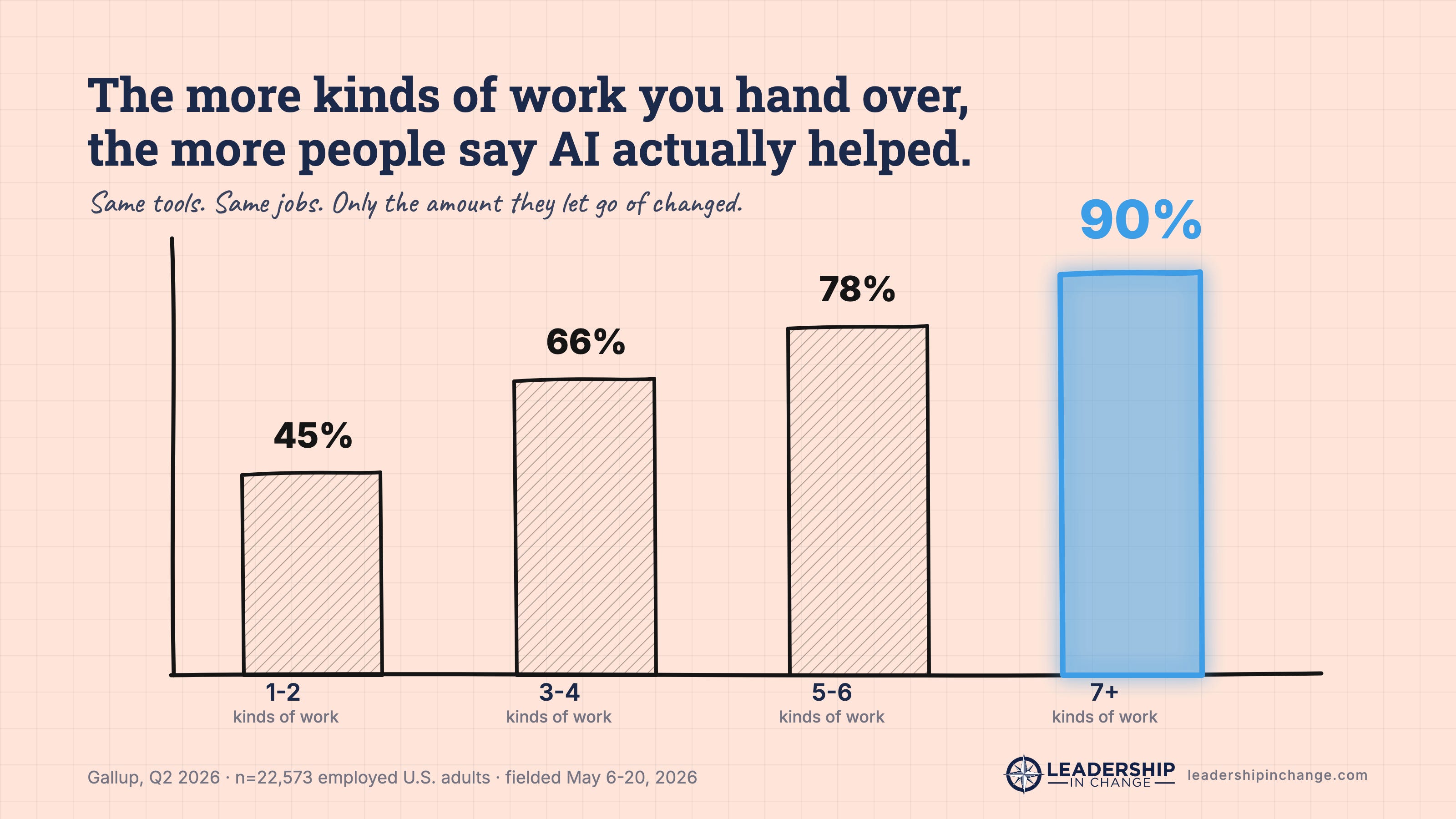
Same tools. Same jobs. The only variable that moved was how many kinds of work people handed over.
And notice it’s a smooth climb, not a cliff. Going from two to four is worth something on its own. That matters more than the headline number, because nobody goes from two to seven in a week, and the data says you don’t have to.
So why do most of us stop at two?
Not because we’re lazy, and not because we haven’t read enough threads about prompting. We stop because somewhere along the way the thing got something wrong, and we pulled back.
That’s a reasonable response. It’s also the wrong lesson. The problem was never that we handed over too much, but that we handed it over without deciding in advance what we’d check. When you can’t say how you’d know an output was wrong, every new task feels like a gamble, so you stop adding them. I’ve written before about not outsourcing your thinking and about what happens when you delegate your brain. This is the other half of that argument, and I don’t think I said it clearly enough the first time.
What my eight-year-old taught me about this
I have two kids, a boy and a girl, and my girl is older. I’ve gotten to know them well enough that I can clearly give one more leeway than the other.
My eight-year-old daughter goes downstairs and makes eggs. She does it for the family about once a week, and she enjoys it. My three-year-old son gets nowhere near the stove.
The guardrails are more ingrained with her, so I trust her with work I wouldn’t give him, but that’s because I’ve taken the time to set those. The trust didn’t arrive with her birthday. I built it, deliberately, one boundary at a time, and now I’m fully confident in it.
That’s the whole thing. She has more freedom because the line is clearer, not in spite of it.
Widening what you hand over and narrowing what you decide are the same move, and if you skip the second one you never get to do the first.
The four lines
Before I hand any kind of work to AI, I pick one of these and I write it down. That’s it. That’s the practice.
Draft, never send — It produces the thing, and nothing leaves without me reading it first.
Analyze, never decide — It brings me the options and the evidence, and the call stays mine.
First ninety percent — It takes the work most of the way, and I finish it and own it.
Side by side — It never runs alone. We work through it together or not at all.
Pick the tightest one that could plausibly work, then loosen it later if the thing keeps earning it. That order is deliberate, because it’s always easier to start too tight and open up than to start too open and suffer the risks.
Stop reading for a second and try this on one thing you already hand over. Which of the four is it? If you can’t tell, that’s your answer about where to spend the next ten minutes.
What I actually hand over
Seven kinds of work, and it took me about two years to get here.
It drafts my emails from content I provide. It drafts summaries of transcripts. It gives me five title and subject-line options against parameters I set, including SEO. It drafts dashboards. It builds my morning brief. It copyedits my work. And it runs routine checks across my sites and emails to make sure a campaign is actually saying one thing.
It never sends my emails. It drafts them. That line has been there since the first day and it has never moved, and it’s the reason I could add the other six without losing sleep.
Try the first question on yourself
Here’s the opening move, free, and it works on paper right now. Don’t list what you use AI for. List what your week actually contains: what happens every Monday, what happens at month end, what happens every quarter, and what you complained about most recently.
You’ll get further than you expect in about four minutes, and the list you end up with is almost never the list you’d have guessed. Here is what you’ll have…
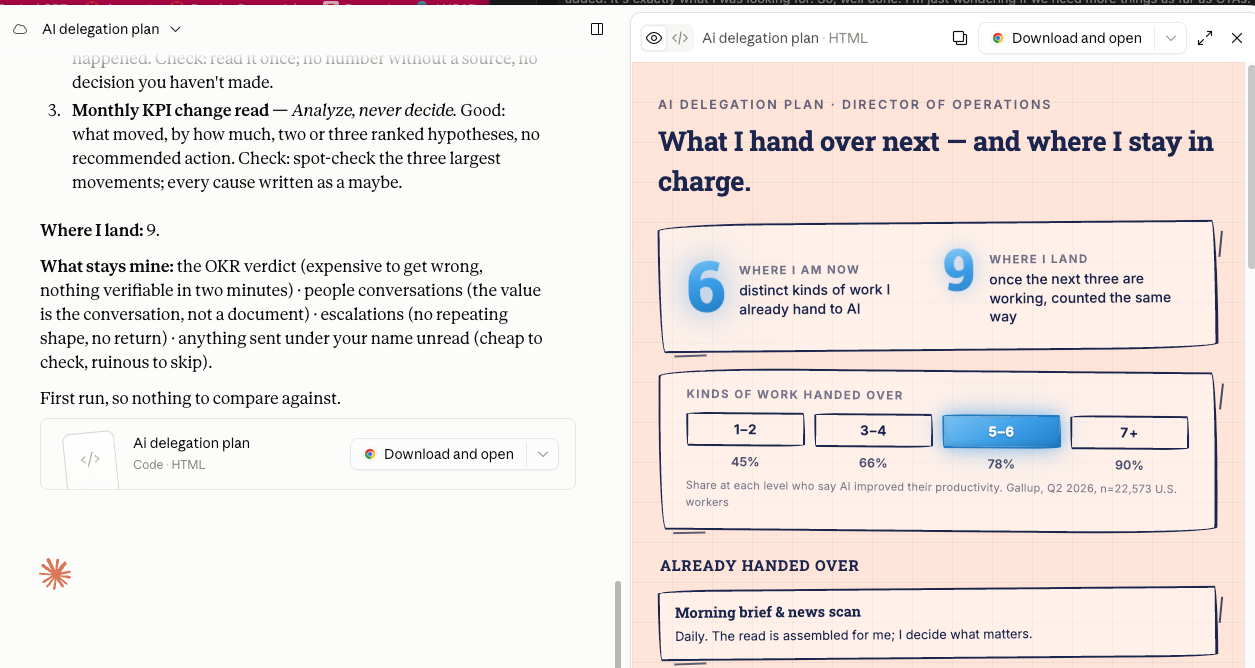
So that’s the map, and you can run it by hand from here. What’s below the line is the skill that runs it for you.
💎 Your AI Delegation Plan
Below is the AI Delegation Plan Skill: you answer three questions, and it builds your plan as a page you can keep, screenshot, and work down over the next month. It comes with everything else your membership includes:
The Claude Skill Library. Twenty-five paste-ready Claude Skills, sorted by the six jobs a leader actually has. You copy one block, answer a few questions, and it builds itself around your role and your business. No downloads, no setup, and you can’t get these anywhere else.
Both field guides, free. Leading with Claude is the 51-page climb from your first prompt to running real work through it, and my own store is the only place it’s sold. The NotebookLM Leaders Playbook is the 43-page grounded-research system. They’re $19.99 for the pair, and you pay nothing for either.
Premium Q&A. Unlimited questions, answered by me in 24 to 48 hours. It’s the benefit members forget they have.
Half off every workshop. Every AI Judgment Workshop is $49 instead of $99, for as long as you’re a member.
Every artifact I’ve gated. The skills, templates and walkthroughs from every past Monday, yours the moment you join.
Premium is $49 for the year, and it pays for itself the first time you come to a workshop.
