


TL;DR - Most leaders run every AI task through one tool and wonder why the results are uneven. Serious AI work runs on two engines: a grounded engine (NotebookLM) that only answers from the sources you give it, and a generative engine (Claude or Gemini) that reasons and creates. Match the engine to the job, ground first, then generate.
You can drive a nail with a wrench. It works, mostly. The nail goes in, the wrench doesn’t break, and you walk away telling yourself you got the job done. Then one day you pick up an actual hammer, drive the same nail in half the swings, and feel how much effort you’d been wasting the whole time. The wrench was never the problem. You were just using it for a job it wasn’t built for.
That’s most of us with AI right now.
We pick one tool, usually whatever we opened first, and we make it do everything. Research, drafting, analysis, summarizing a stack of videos, building a board deck, all of it through the same tab. And it kind of works. We’re hitting the target every so often, the way you hit a target if you shoot enough arrows at it. But there’s a better way to spend the energy, and it starts with a distinction almost nobody makes.
Here’s the thing. We’re past the point where using AI is the advantage.
Everybody’s using it now. Your competitor is using it, your team is using it, the person across the table in your next meeting is using it. The edge moved. Using AI used to set you apart, and now that everyone’s doing it, the thing that sets you apart is using it well. That starts with knowing there are two different kinds of AI sitting on your desk, built for opposite jobs, and knowing which one to reach for.
That’s what this post is: the whole decision, laid out plainly. What the two engines are, how they’re different, and exactly when to use each one. It’s short on purpose, because this is the part your whole team needs to get right, not just you, so send it to them. The step-by-step of actually running the harder engine, I put into a field guide I’ll point you to at the end.
Stay until the end for your copy of my NotebookLM’s Leader Playbook… 📕
In this post, you’ll learn:
The two kinds of AI on your desk, and the one difference that actually matters
A simple rule for knowing
which one to reach for before you type a word
A 30-second checklist you and your team can run on any task
The two engines, and the one difference that matters
Most of us treat AI as one thing you’re either good at or you’re not. That framing is the whole problem, because the tools split into two very different jobs, and once you see the split you can’t unsee it.
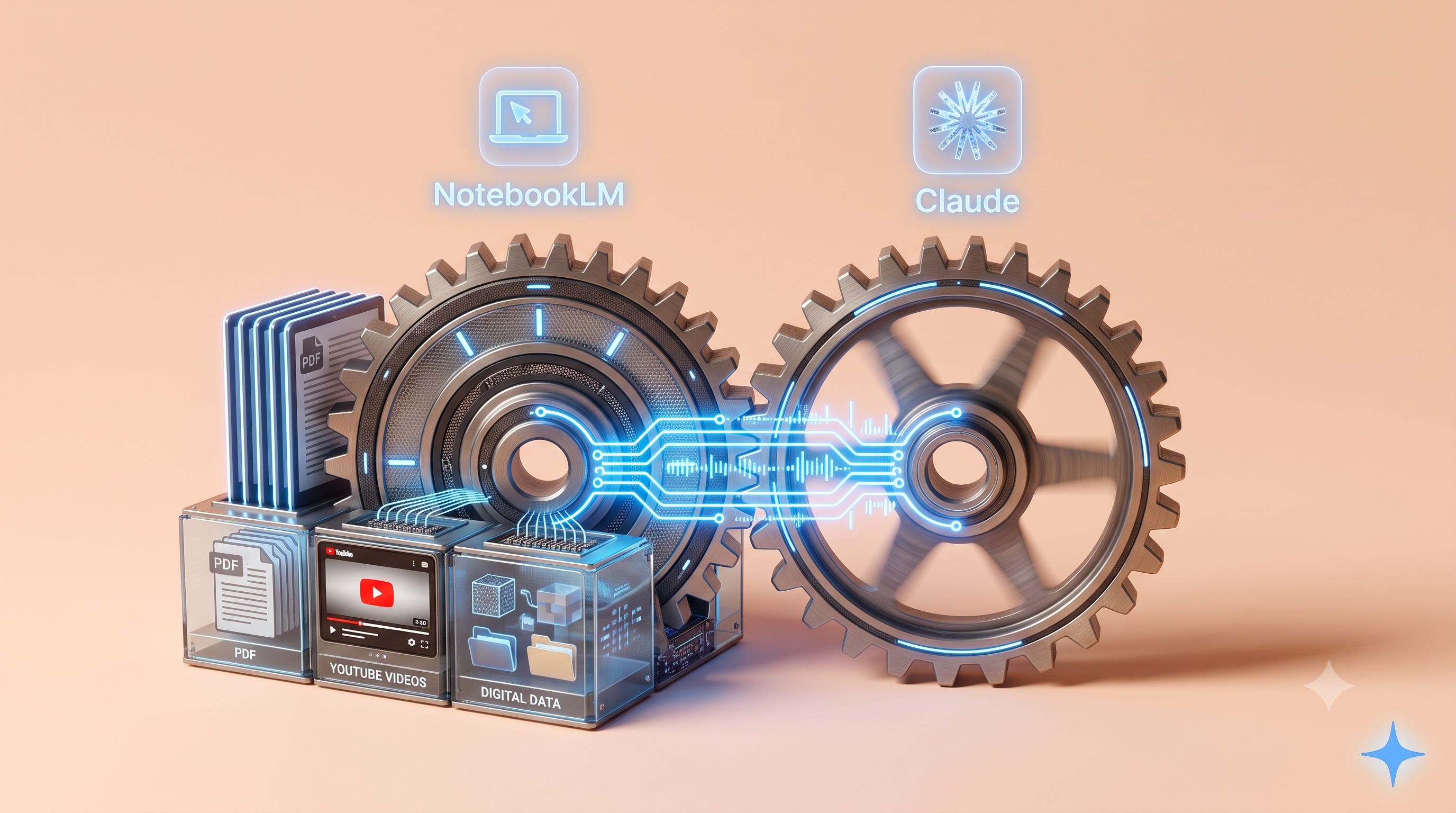
The grounded engine. This is NotebookLM (Google’s AI research tool that only answers from the sources you personally give it). You hand it your documents, your PDFs, your spreadsheets, even a pile of YouTube videos, and it reads only those. It synthesizes, it cites the exact line it pulled from, and it won’t make things up, because it can only see what you handed it. Its whole power is faithfulness to your sources.
The generative engine. This is Claude (Anthropic’s AI assistant, the main rival to ChatGPT) or Gemini (Google’s AI assistant). This engine reasons, argues, drafts, and creates. It roams everything it knows to build something new. That range is its power, and it’s also its risk, because an engine that can invent can also invent a fact you needed to be true.
Here’s the one difference to hold onto, because every decision downstream comes from it. A grounded engine is faithful. A generative engine is creative. Faithful means it stays inside the sources you handed it and never wanders, which is what you want when being wrong is expensive. Creative means it goes past your sources to build something new, which is what you want when the blank page is the problem. One is caged to your truth on purpose. The other roams free on purpose.
Grounding, by the way, just means tying the AI’s answers to specific documents you provide instead of letting it pull from the whole internet. That single idea is the hinge everything here turns on.
Quick Win (under 60 seconds) Take one thing you were about to ask Claude or ChatGPT to summarize from a YouTube video. Instead, drop the actual source into NotebookLM (it’s free) and ask it the same question. Watch it answer only from that document and show you the exact line it used. That gap, between a confident guess and a cited answer, is the entire point of the grounded engine.
When to reach for which
So the decision comes down to one question you ask before you start: is being faithful to specific sources the point, or is thinking and creating the point? Answer that and you’ve picked your engine.
Reach for the grounded engine when you’re working from real material and a made-up detail would cost you. That’s most of the high-stakes research a leader actually does:
Comparing several years of reports to catch a trend nobody flagged
Turning a stack of meeting transcripts into decisions and who-owns-what, anchored to what was actually said
Reading a contract, a policy, or a financial statement and pulling out exactly what it says, with the citation
Making sense of fifteen sources on a market before a board conversation
Reach for the generative engine when you’re starting from a blank page and the point is to think, argue, or build:
Drafting the board narrative once you already know the facts
Pressure-testing a strategy from three different angles
Writing the memo, the email, the plan
Brainstorming names, positioning, or options you haven’t thought of yet
Same leader, same afternoon, two different engines, because the jobs are different. You wouldn’t reach for a hammer to tighten a bolt, and you wouldn’t ask a tool built to invent to be your source of truth.
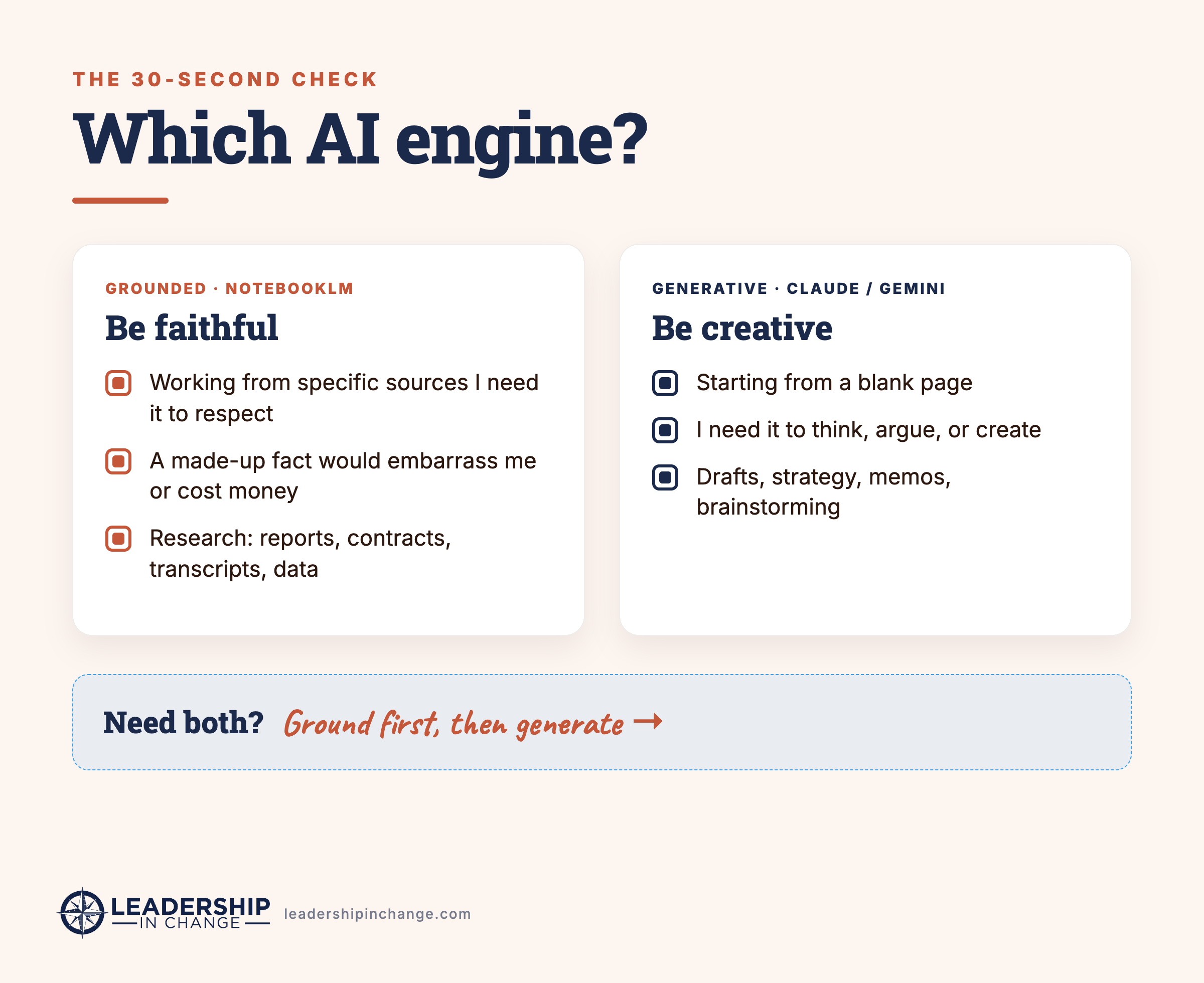
Here’s the 30-second version you can hand your team. Before any AI task, run down this:
Am I working from specific sources I need it to respect? Grounded engine (NotebookLM).
Would a made-up fact here embarrass me or cost money? Grounded engine.
Am I starting from a blank page and need it to think or create? Generative engine (Claude or Gemini).
Do I need it to argue, draft, or brainstorm? Generative engine.
Do I need both? Ground first, then generate. That’s next.
My rule: ground, then generate
Most of the time, the honest answer to that last question is “both,” and the order is everything. Ground first, then generate.
Here’s where most of us go wrong. We take a messy pile of sources and dump it straight into a generative engine, then act surprised when it blends real facts with plausible filler. Flip the order. Put the sources into the grounded engine first, get one report you can trust, then hand that report up to the generative engine to reason and build on.
That’s exactly how I work. Most of my day lives in Claude, four businesses run through it. But when I’m researching something serious, I’ll pull seventeen or eighteen sources into NotebookLM (new to it? here’s a full hands-on walkthrough), including full YouTube videos, and have it build me one synthesized report where every line traces back to a source I chose. No invented statistics. No confident nonsense.
Then I hand that report to Claude, and now the generative engine does what it’s great at, strategy, drafting, turning that research into executive-level analysis, except it’s building on solid ground instead of guessing. The facts come from the grounded side. The thinking happens on the generative side.
The handoff itself is simple. Copy the report out of NotebookLM, paste it into Claude, and you’re done. If you want the cleaner version, you can connect the two directly so Claude reaches into your notebook on its own, but start with copy-paste. It works fine and it teaches you the rhythm.
The full playbook
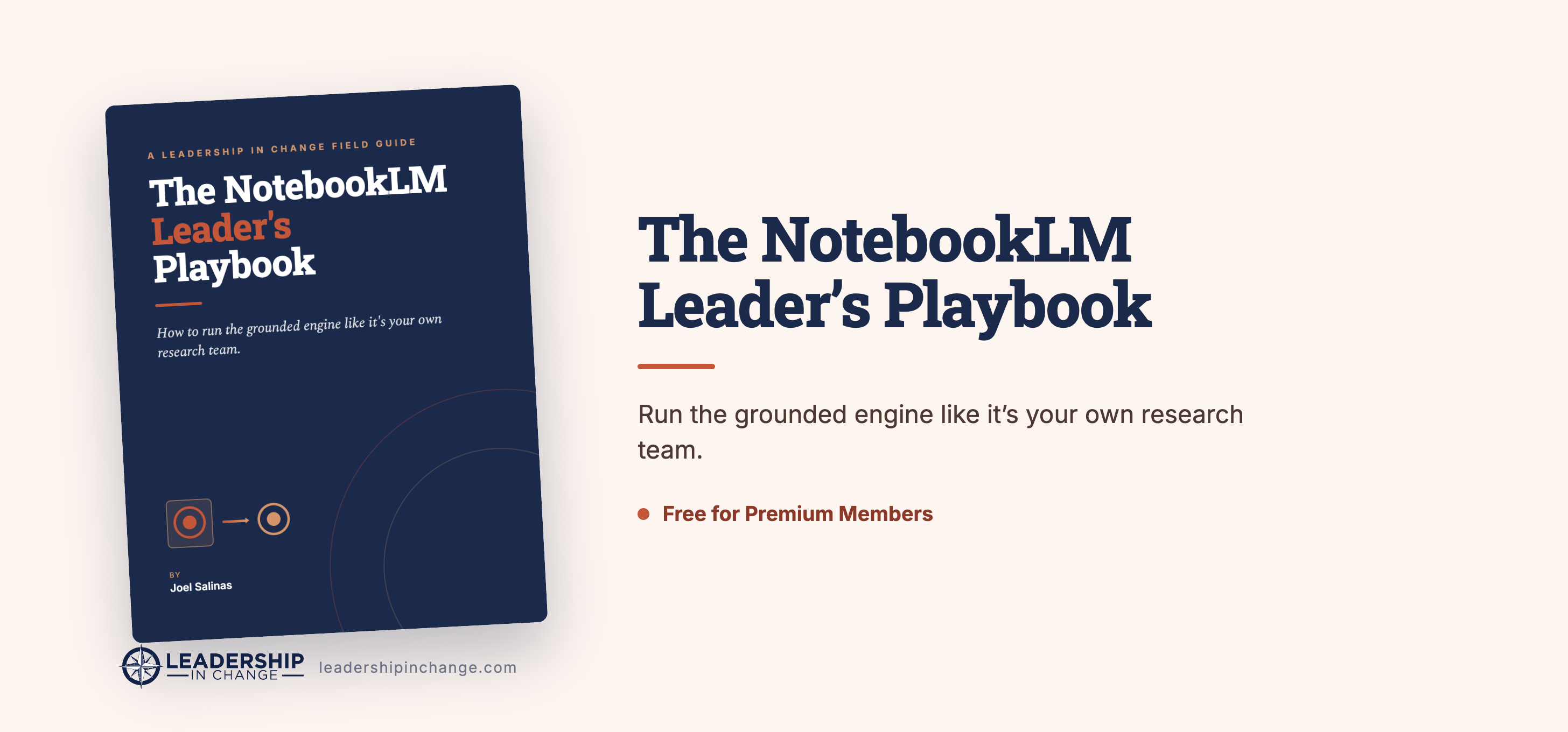
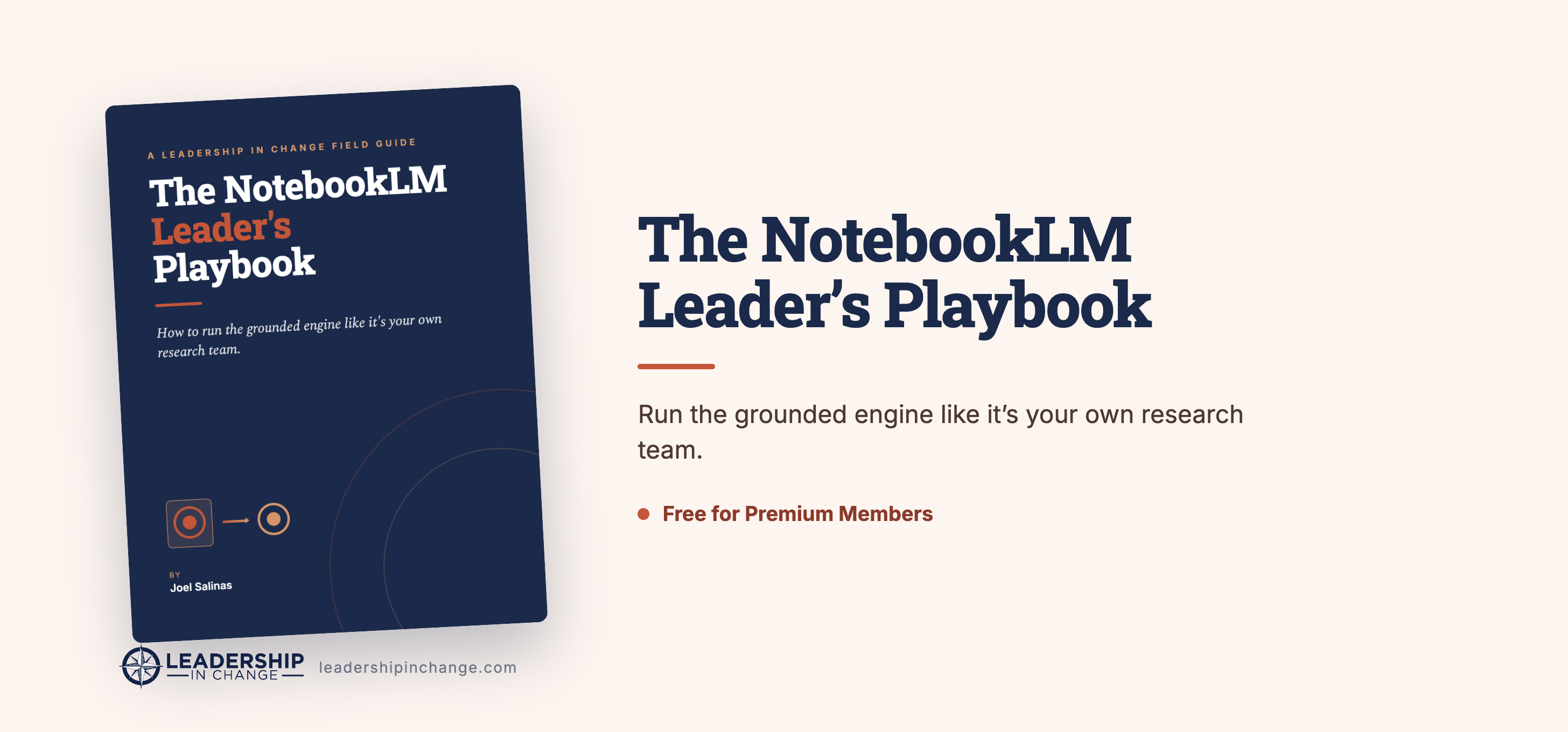
This post is the decision. The full walkthrough of the grounded engine, the part your team will actually execute, is the field guide: The NotebookLM Leader’s Playbook, the do-it-as-you-read version with a screenshot of every step:
Setting up your first notebook and the three-panel workflow
Feeding it the mess: PDFs, living Google Docs, and YouTube videos, plus the one curation rule that decides quality
Pulling grounded, cited answers and building one report you trust
The handoff to Claude, both the copy-paste method and the direct-connection power move
A 3-week plan to wire the two-engine stack into how your team works
You have two options to get the 37-page guide. One, click below to buy it for $5.99. Two, get it for free (plus all future ebooks and guides) by becoming a premium member for $49/year.
You don’t need to rebuild your whole workflow tonight. You need one grounded rep in NotebookLM before you reach for Claude again.
If You Only Remember This
AI splits into two engines: the grounded one (NotebookLM) that stays faithful to your sources, and the generative one (Claude or Gemini) that reasons and creates.
The rule is ground, then generate. Pull your real sources into the grounded engine first, then hand that trustworthy output up to the generative engine to think and build on.
Everybody’s using AI now. That’s not the edge anymore. Using the right engine for the job is.
Which AI are you forcing to do a job it was never built for?
Worth Your Time
A few pieces from other creators I think are worth your attention.
The AI Maker — Before You Try Another AI Tool, Ask These 7 Questions. A 7-question framework for deciding which tool earns a place in your workflow, tested head-to-head across Claude, Gemini, and NotebookLM, the “match the engine to the job” call in practice.
Artificial Corner — NotebookLM: The Complete Guide. The clearest plain-English case for the grounded engine: answers anchored to the sources you upload, with examples like grant writing and customer research.
Grow With AI — My Entire NotebookLM Prompt Library. 60 prompts built around source-grounding and synthesis, a working toolkit for the grounded engine.
Questions Leaders Are Asking
What’s the difference between NotebookLM and Claude? NotebookLM is a grounded engine: it only answers from the specific sources you give it, cites the exact line it used, and won’t invent facts. Claude is a generative engine: it reasons, drafts, and creates from everything it knows. Use NotebookLM when you need faithfulness to your documents, and Claude when you need thinking and creation.
Should I use NotebookLM or Claude for research? Use both, in order. Pull your sources into NotebookLM first so it can synthesize them into a report grounded in real material, then hand that report to Claude to reason, draft, or build on top of it. Grounding first is what keeps the final work from drifting into made-up details.
Is NotebookLM free? Yes. As of July 2026, NotebookLM has a free tier that covers uploading sources (up to 50 per notebook), asking grounded questions, and generating summaries. It’s the easiest no-cost way to try the grounded engine before you build any bigger workflow around it. Higher source limits and the newest features come with a paid Google AI plan.
Why does AI make things up, and how do I stop it? Generative engines like Claude or ChatGPT build answers from everything they know, so they can blend real facts with plausible-sounding filler. The fix is grounding: give the AI a fixed set of sources to work from, which is exactly what NotebookLM does, so every claim traces back to a document you chose.
Do I need to connect my tools to run this workflow? No. Start by copying the report out of NotebookLM and pasting it into Claude. That handoff works fine on its own. Connecting the two directly (through an integration called an MCP) is a convenience you can add later once the two-engine rhythm is second nature.
Can I use this with my whole team? Yes, and that’s the point. The two-engine decision, grounded versus generative, is exactly the thing everyone touching AI needs to get right, not just leadership. Send your team this post for the decision itself, and the NotebookLM Leader’s Playbook walks them through running the grounded engine step by step.
Joel Salinas is an AI Strategy Coach for founders and leaders, from solopreneurs to teams. AI is everywhere; judgment is scarce. Joel helps leaders adopt AI without outsourcing their judgment to it, through the AI Judgment Workshop and the 90-Day Judgment Engagement. Creator of the AI Leadership Triad. He writes Leadership in Change.
Written by a human, for humans.
Most people blame the AI for making things up when they never fed it the right sources.
Separating the factual grounding from the actual drafting saves hours of tedious cleanup down the line. Fits the "right tool for the job" mindset perfectly.