



TL;DR: Judgment at work is built by doing the job, getting feedback and making mistakes. Workplace psychologist Christina Muller argues that AI can remove those chances from people early in their careers, points to a 19% employment gap for 22- to 25-year-olds in AI-exposed jobs, and gives HR leaders three questions to ask the managers running AI rollouts.
I’ve followed Mind Your Workplace™ x Christina Muller a for a while now, and her people-first approach to AI really resonates with me, as well as her focus on charitable giving (she’s President of the Leadership Council at Grateful Giving, a platform that builds charitable giving into everyday business operations).
I’m a huge advocate of learning from my mistakes, and of making the effect of those mistakes small, so I take managed risks and learn from them. That’s been huge for my development, and it’s the thing Christina is worried we lose when AI hands us the answer before we’ve had the chance to get it wrong.
Christina Muller is a licensed clinical social worker and workplace psychology expert whose commentary has appeared in Forbes, Fortune and Fast Company, and she writes Mind Your Workplace™ about the people side of AI.

Below you’ll find her full essay: why judgment only comes from doing the work, what Stanford’s latest data says about the jobs where young people used to get that practice, the three questions she’d have every HR leader ask the managers carrying an AI rollout, and why she thinks this could be the moment younger people get ahead.
What You’ll Walk Away With
Three questions to ask the people running your AI rollout, so you can tell whether someone is getting more efficient or losing a skill
Why some work is worth doing yourself, even when AI could do it faster, whether you lead a team or work solo
Here’s Christina.
Judgment Calls In The Age of AI
“Man, we learned the hard way, didn’t we? I’ve been around for so long, I’ve seen so many things. But the new class of kids? Well, they’re not going to learn anything. They can go to their newfangled AI and get an answer in a second, and there goes judgment. They’re not going to need judgment. It’s going to be given to them.”
What a time to be alive.
We could pass this off as a curmudgeonly statement from somebody who is at the twilight of his career, thinking maybe there’s not much time left for him.
But there is for others coming into this work.
And if you don’t get to practice your judgment, how do you actually grow?
I think that’s a question many of us are asking right now.
Judgment Has to Come From Somewhere
In some ways, AI can be used differently by different people. We see that not every organization has democratized skills in the same way or given the same kind of scaffolding to make sure people are using it as an optimizer, not something that will replace their great work as they know it.
But think about judgment calls.
I find, in my career and having talked to executives, that you only gain judgment by doing and, honestly, making mistakes sometimes.
Getting it wrong.
Or seeing other people get it wrong and learning from their missteps.
And there’s value in that.
That’s something you can’t teach or show in the way we would imagine in a classroom.
You really have to go through it to get to it.
Research on expertise has shown that practice, feedback, and opportunities to adjust how we approach problems are important parts of developing expertise. It’s not just about how many years we’ve been doing something.
And judgment takes years to build.
What Builds Over Time
It’s kind of like compounding interest. It builds on the last experience.
So you may have exposure to one circumstance, and then something else happens. And then something else happens from there.
And two years later, you remember those circumstances and draw on that experience to make a judgment call.
Maybe that judgment call is a minor one.
But maybe it could have real life-or-death consequences.
We know that when information is given to us, and we’re not actually doing something in practice, we don’t necessarily encode it in the same way.
Whereas when we’re engaging our senses, engaging even our body in the experience of learning in the moment, we can process that information more deeply.
And why does that matter?
Well, over time, the more we do something, the more our brain gets signals that this information is important.
Conversely, think about what happens when people have fewer opportunities to learn by doing.
In August 2026, Stanford researchers found that employment among 22- to 25-year-olds in highly AI-exposed jobs, including software development and customer service, was 19% lower than expected compared with trends in less AI-exposed occupations.
It raises a question I don’t think we’re asking enough:
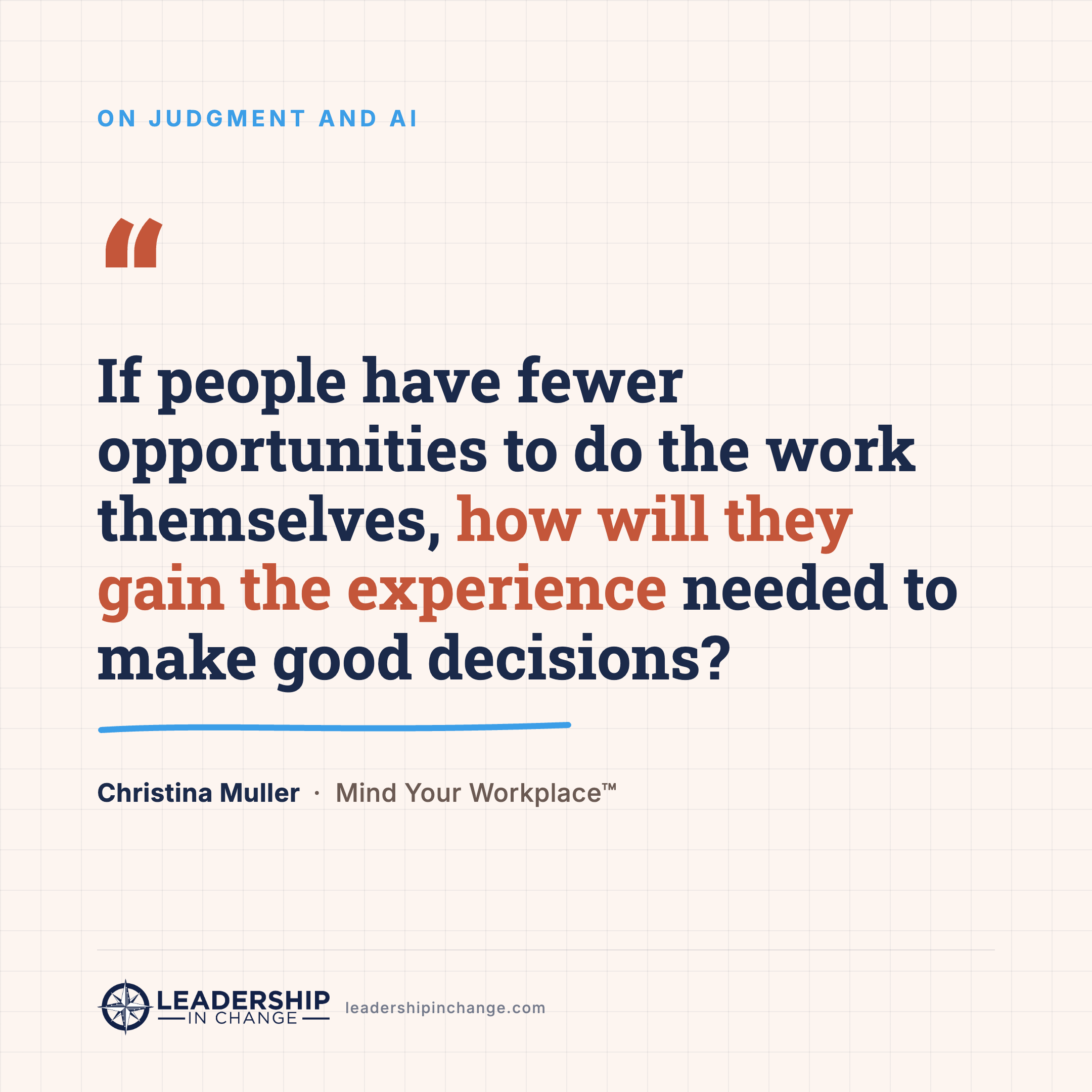
If people have fewer opportunities to do the work themselves, how will they gain the experience needed to make good decisions?
When We Can’t See What’s Ahead
The fewer opportunities we have to talk to one another, to get feedback around a situation, or even to hear something like, “Hey, this just happened to me. I just want to give you a heads-up,” the fewer opportunities we have to build that muscle memory.
Research on cognitive offloading has shown that while relying on external tools can help us perform certain tasks, there can be tradeoffs when that support is no longer available.
Because AI is fed information that we, as people, have essentially given it.
But if we stop learning from doing, what information is AI really going to have for the long term?
And I think there’s a practical question here for CHROs that doesn’t get asked enough.
We spend a lot of time asking about AI adoption. Are people using it? Are they ready? Where are they struggling?
But what about asking the leaders carrying the rollout:
What are you being asked right now that you don’t have the answer to when it comes to the people side of AI adoption?
And then actually giving them the opportunity to answer.
It sounds like, “How do I know when someone is relying on AI too much?”
Or, “What work should we be protecting because people still need to learn how to do it themselves?”
Or even, “How do I know whether someone is becoming more efficient or actually losing a skill?”
These are judgment calls.
Another great example of how CHROs can get this right is the use of working groups.
Having a working group where people can give their feedback in a safe space and say things like:
“Hey, I’m not really sure what the value of this is.”
“I’m not really sure where my expertise is going to play a role in this.”
“I’m not sure where this is heading. Can you give me more clarity?”
Or, “This is something I’m struggling with, especially the people side of it.”
And then doing something actionable as a result of that feedback.
There’s value in having those conversations, hearing how other people are thinking about something, and getting the opportunity to work through it together.
Those are opportunities to build judgment, too.
There is a difference between being efficient and learning something.
Closing Thoughts
I think, more than ever, there is a higher value placed on judgment.
And this can really be a time for younger people especially to shine.
What do I mean by that?
They can take opportunities to do the thing first, exercise actual judgment, get it wrong, and really be at an advantage over some of their peers who may not choose to do it that way.
It’s really a people advantage, more than I’d say we had before AI.
It’s a differentiator.
It’s going back to basics in a way that I think people are yearning for.
AI is incredible. There’s no doubt about it.
We know it’s not going anywhere, and it’s made our lives better in many ways.
But it’s not a replacement for judgment.
And the more we see it that way, the more we can use it for what it’s intended to do.
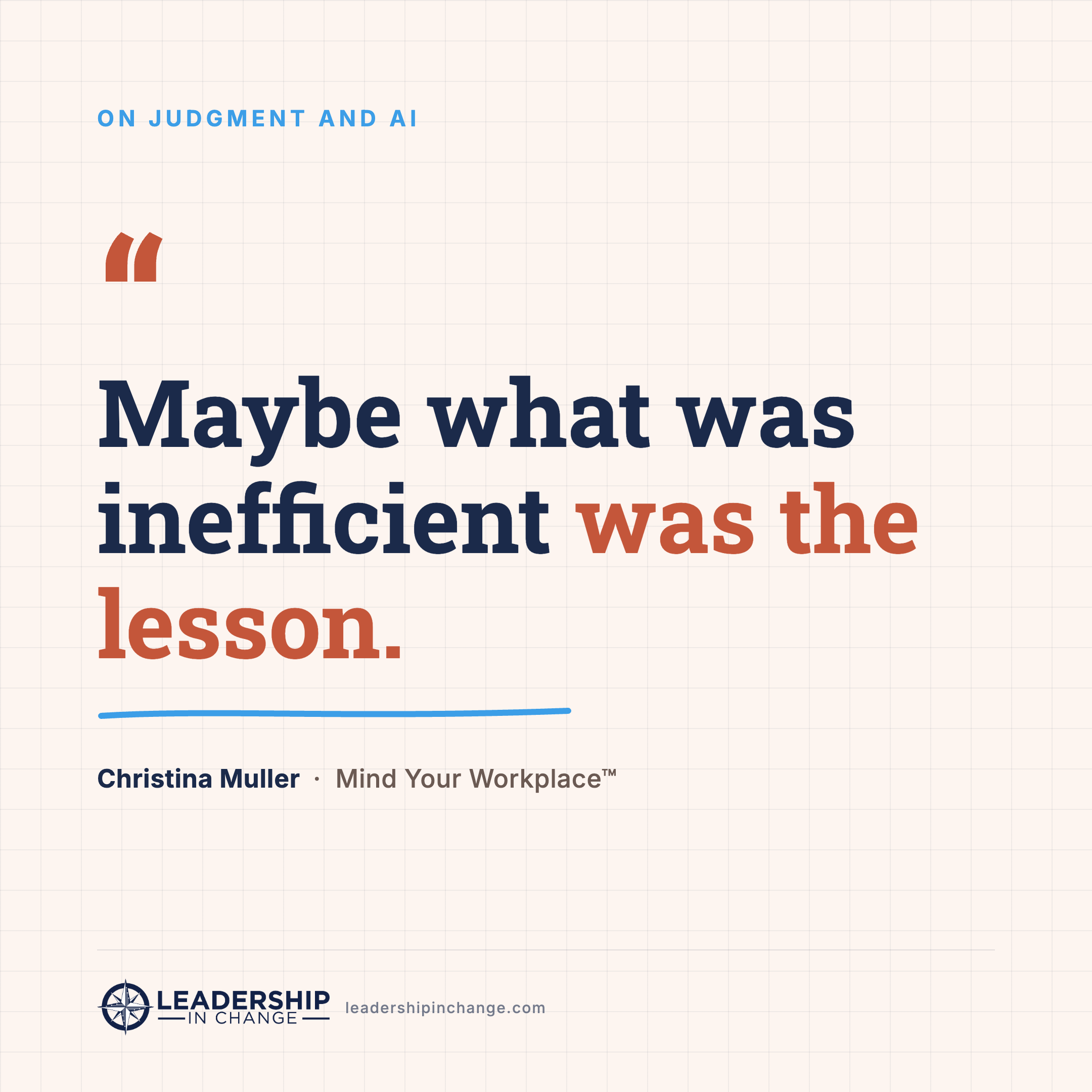
Maybe what was inefficient was the lesson.
You can’t just mind your business.
You need to Mind Your Workplace™.
— Christina
Bring Her Three Questions to Your Next Meeting
So, thank you, Christina.
If I could only ask one of her three questions, it’d be the last one: how do I know whether someone is becoming more efficient or actually losing a skill?
Here’s what I’d do this week: take all three into your next team meeting or one-on-one, and if you work solo, ask them of yourself.
She’s making the same case I made from the data side in The AI Skills Gap Is a Judgment Gap: What 517 Leaders Said, and her question about which work to protect is the one I tried to answer with a practical exercise in Map Where AI Starts and Stops in Your Workflow in 30 Minutes.
Getting it wrong on a small scale is still the cheapest teacher you’ll ever have.
What’s one judgment call you only learned to make by getting it wrong first? Tell me in the comments.
Thanks for reading,
Joel
Questions Leaders Are Asking
Can AI hurt how employees develop judgment? It can if it takes over the work where people used to practice. Workplace psychologist Christina Muller argues that judgment comes from doing a task, getting feedback and sometimes getting it wrong, so when AI hands people the answer every time, they get fewer of those chances.
Is AI reducing entry-level jobs? The August 2026 update of Stanford’s “Canaries in the Coal Mine” study found that employment of 22- to 25-year-olds in AI-exposed jobs stands 19% below where it would have been had it kept pace with less-exposed peers. The authors call it an early, descriptive signal and don’t claim AI caused it.
What is cognitive offloading? Cognitive offloading means relying on an outside tool, like a calculator, a notes app or an AI assistant, to do part of your thinking for you. It can make a task easier in the moment, but research suggests there can be a cost when that support isn’t available.
What should HR leaders ask about AI adoption besides usage? Christina Muller suggests asking the managers running the rollout what they’re being asked that they can’t answer. Three examples: how to tell when someone relies on AI too much, which work to protect so people still learn it, and how to tell efficiency from a lost skill.
How do I decide which work my team should keep doing without AI? Christina Muller frames it as a question for the managers running the rollout: “What work should we be protecting because people still need to learn how to do it themselves?” Her point is that the work where people practice, get feedback and make mistakes is where judgment gets built.
What is the COUNTED at Work Score? It’s a free assessment from Christina Muller that shows where an organization stands with its people and AI adoption. You can take it at counted.scoreapp.com.
About Christina Muller
Christina Muller, LCSW, SHRM-SCP, is a workplace psychology expert and executive advisor for the people side of AI adoption, and the creator of COUNTED at Work™.
Through COUNTED at Work™, she works with CHROs and People leaders to identify where the weight of their rollout sits and help name an owner so it’s not carried alone, before their best talent walks out the door.
Take her COUNTED at Work™ Score to see where your organization stands with your people and AI: counted.scoreapp.com. Her commentary has appeared in Forbes, Fortune and Fast Company. She writes Mind Your Workplace™.
About Joel
Joel Salinas is an AI Strategy Coach and entrepreneur. AI is everywhere; judgment is scarce. Joel helps founders and leaders adopt AI without outsourcing their judgment to it, and he builds the systems too. Creator of the AI Leadership Triad.
Written by a human, for humans.
Sources
Erik Brynjolfsson, Bharat Chandar and Ruyu Chen, “Canaries in the Coal Mine? Six Facts about the Recent Employment Effects of Artificial Intelligence”, Stanford Digital Economy Lab, August 12, 2026 update (PDF).
Christina Muller on Substack and the COUNTED at Work™ Score (bio and credentials).
So fun collaborating with you, Joel!
"Judgment at work is built by doing the job, getting feedback and making mistakes" is the part AI can't shortcut. It's also why experienced professionals underprice themselves: twenty years of reps is the one thing a new hire and a chatbot can't buy.