


TL;DR: AI vision statements fail because AI is not a business goal, it’s an amplifier for one. The faster starting point is an AI do-not-touch list: the decisions and judgment calls AI will never make in your organization, drawn from the expertise that got you where you are.
Time and time again I see people writing about AI, talking about AI, and asking me to help them make success… with AI their business goal.
But AI in itself is not a goal.
It may be a personal goal to be good at AI, but AI in itself is not a goal for a business. That’s like saying a website or social media is a goal for a business.
AI can be, and I believe it often is, the greatest amplifier to get you to your goal faster than ever, more efficiently than ever, and even increase your expectations for your goal. AI is not the goal.
That’s most of why our AI vision statements come out sounding like nothing, if we even have one. We write them about the tool instead of about the business, usually before anyone in the room has said out loud what the business is actually for. So when a leader asks me where to start, I don’t start with the vision at all. I start at the opposite end, with the short list of work AI is never going to touch, because that list is far easier to write and it points straight back at the vision you were trying to find in the first place.
What You’ll Walk Away With
The question I ask leaders before the words “AI vision” ever come up, and why it changes what they write down
Your own AI do-not-touch list, four lines short enough to sit next to your screen by the end of today
Start with the why, not the technology
As a business, you have to have a why. What is it that you’re trying to do?
As a restaurant, you’re trying to make the best food. As a supplying company, you’re trying to supply the best quality of product or service to the biggest market share possible, as efficiently as possible. As a police officer or a nurse, those are clear goals. Not one of them needs the word AI to make sense.
So it matters that you come into even thinking about AI with a clear goal already in mind, because then your AI vision can be how to use AI to get you there. This is exactly what I do with businesses, what I’ve been doing with businesses, and what I’m doing right now with some of my top clients, healthcare CEOs and supply chain CEOs: how can we use AI to help them get to where they want to get to?
Why nobody can write a real AI vision
When the goal underneath isn’t settled, the vision statement has nothing to stand on. Nobody can write a real AI vision because they’re not sure. First of all, we’re often not sure what our general vision is, what our goal is, what our north star is, and then on top of that we don’t understand what AI is supposed to do. It’s not a magic wand, and if you don’t understand what it can do, then you’re not going to be able to write a clear AI vision. That second gap is the one I went after in the AI skills gap that’s really a judgment gap, where 517 leaders said much the same thing back.
Some people think an AI vision is going to automatically make everybody in the company adopt AI safely and strategically and skyrocket the profits. That’s just not how it works.
That’s like giving everybody in a village, hundreds of years ago, access to electricity for the first time: just the main line connection, and a set of rules posted next to it on what to do with it. Within the first day, at least a few people will get electrocuted. It’s not enough to do that. That is just step one.
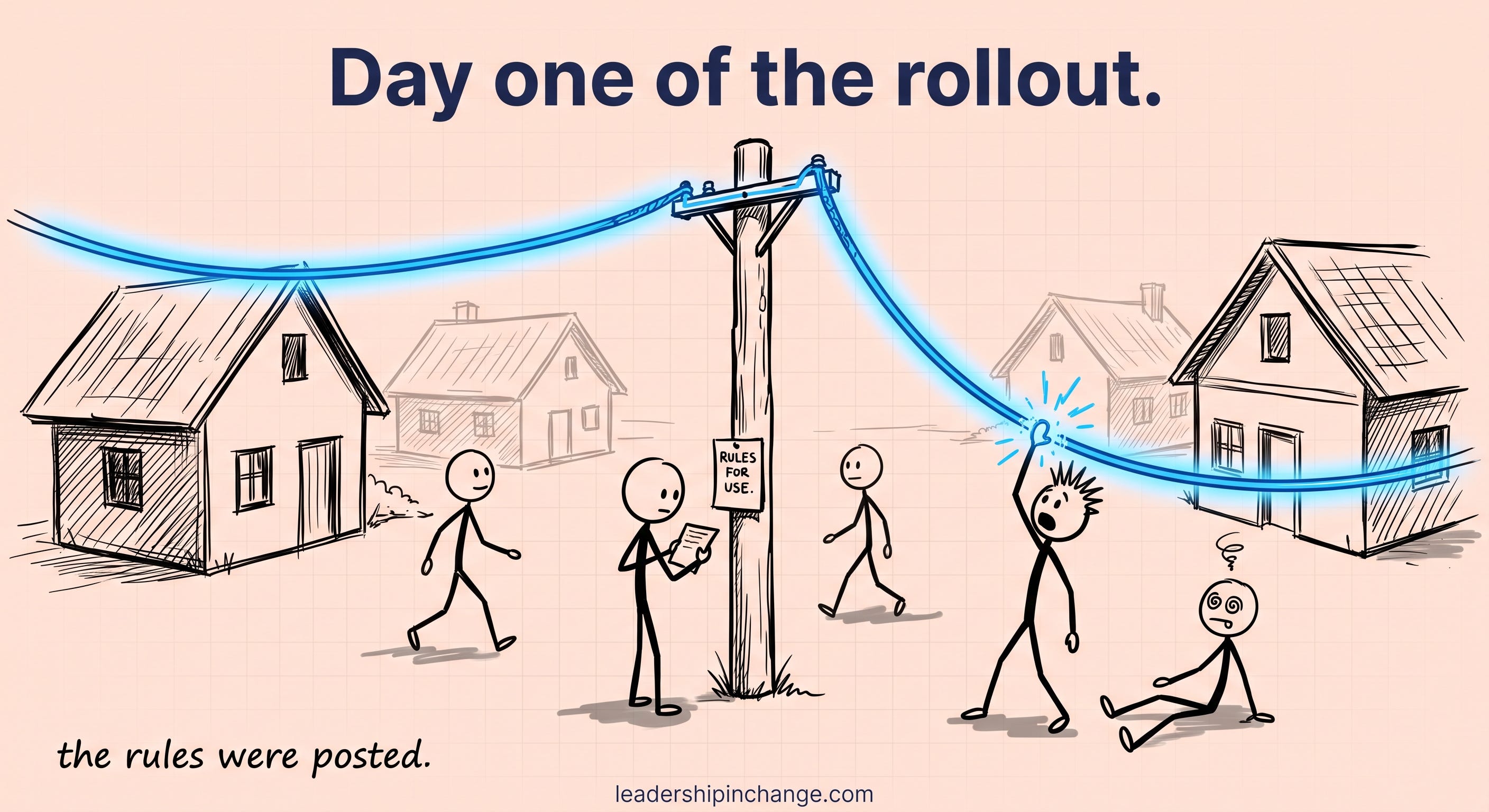
If you want to see what that first day looks like inside a company right now, it’s the same picture as a shadow AI audit: people already wired in, already using it, and nobody having said out loud what it’s for.
Where should you actually start with AI?
We all got the tools at the same time, the way everyone eventually got electricity. Having it in the building was never what made the difference. What we did with it was.
I take three diagnostic calls a month. It’s 30 minutes, free, and we work out what you’re actually trying to get to, where your biggest hurdles sit, what your low-hanging fruit is, and how that lines up with what I’ve been seeing elsewhere. Then I tell you the first move I’d make.
A few days later you get it back in writing, two or three pages, yours whether we ever work together or not.
The question I ask instead
So before any of the tooling talk, the question I would like to ask, the one I ask leaders when I’m coaching, and the one I want to ask you here, is this:
what is your why?
Not your AI why, not your AI vision, but your why. Once you understand that, the next question is what you actually think AI can do for you.
Your AI do-not-touch list
Most of the time the best place to start is the opposite end of the vision, which is your AI do-not-touch list. What do you not want AI to do for you? That’s when we focus on what your greatest strengths are. Where is your expertise? What are the areas that got you to where you are? Those are the areas that we do not want to touch.
I picked up the inversion from DAN KOE, who writes about strategy for people building on their own and starts with an anti-vision rather than a vision, on the logic that failure is much easier to picture than success. He wrote it for solo creators. I keep finding it does even more work inside a company, where what you’re protecting isn’t a personal preference but expertise a lot of people spent years building.
For me, as an example, my AI do-not-touch list is:
I am just not going to let AI launch my ideas.
I am not going to let AI accept my assumptions.
I’m not going to let AI send emails on my behalf.
I am not going to let AI make a strategic business decision for me.
AI is going to be in the room, but I’m going to make those decisions.
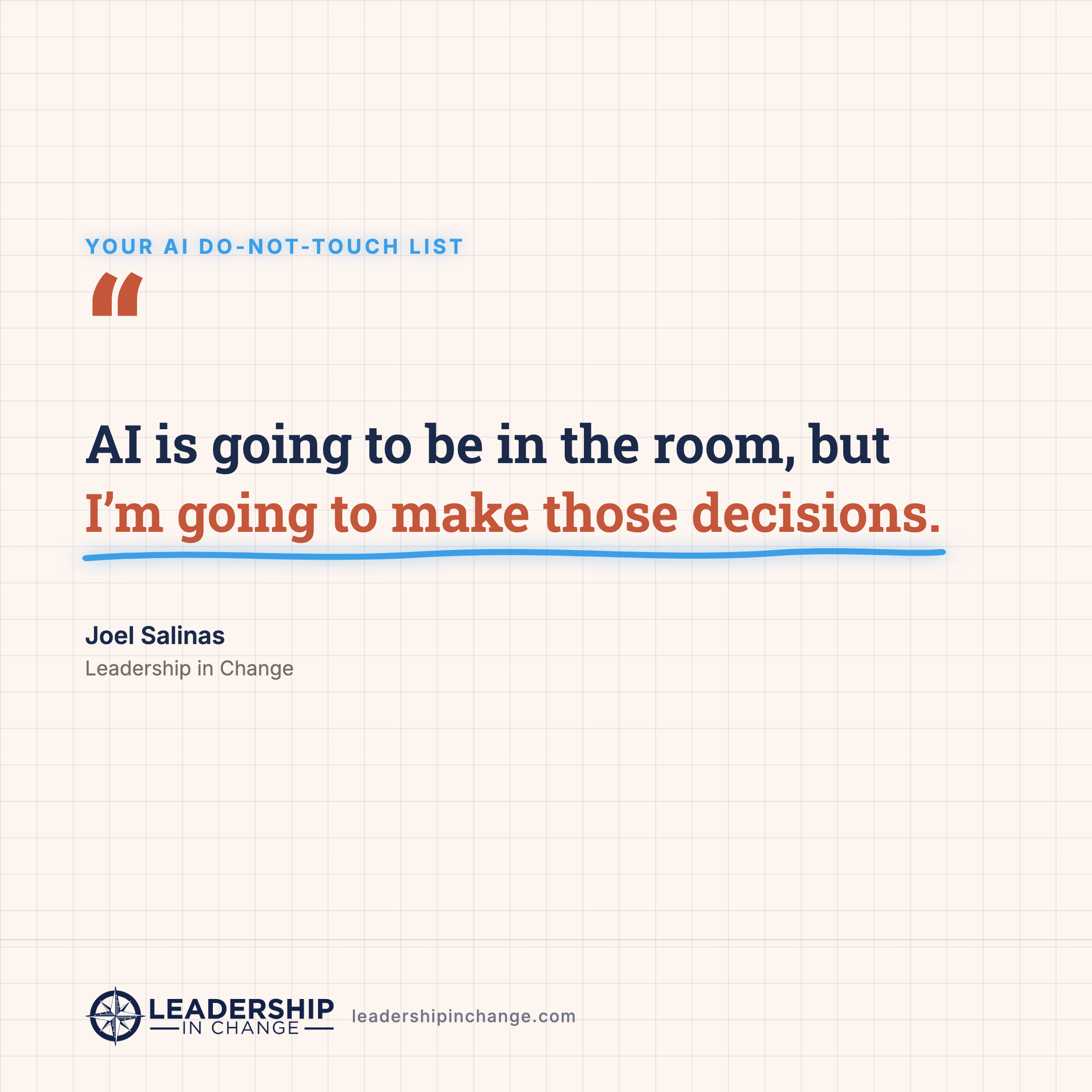
There’s a set of things you have to say out loud like that, and honestly, if anything, just post them next to your computer.
Quick Win (under 60 seconds) Write one sentence naming a decision AI will never make in your work. Not a task it won’t do, a decision it won’t make. Put it on a sticky note next to your screen before you close this tab. That’s line one of four.
“That’s just negativity”
Now, somebody may say, “That’s just negativity. That’s just focusing on the negative. I want to focus on the positive, on what AI can do.” You can do that. But then you’ll often never stop back and look at what it should not do, and that’s where the biggest risk lies.
So that’s where I start people. The list gets built out of the work you’re already best at, which is why it takes about 45 minutes rather than a quarter, and why it holds up through every model release, every new tool, and every vendor who turns up offering to do your thinking for you.
So that’s the whole idea, and you can write your four lines from what’s above without paying me anything. Below this line is the prompt itself. It runs the same interview I run with clients, one question at a time, and it’s built to refuse when you ask it to write your list for you.
💎 Your AI Do-Not-Touch Interview
Below is the full copy-paste prompt, the one that interviews you through your why, your expertise, and the decisions AI never gets to make.
It comes with everything else your membership includes:
The Claude Skill Library. Twenty-five paste-ready Claude Skills, sorted by the six jobs a leader actually has. You copy one block, answer a few questions, and it builds itself around your role and your business. No downloads, no setup, and you can’t buy these anywhere at any price.
Premium Q&A. Unlimited questions, answered by me in 24 to 48 hours. It’s the benefit members forget they have.
Half off Newsletter Compass and Cozora. Both of them, for as long as you’re a member.
Every artifact I’ve gated. The skills, templates and walkthroughs from every past Monday, yours the moment you join.
Premium is $49 for the year.
