


The short version (TL;DR): A Shadow AI Audit is a quick, seven-question check that shows a leader where their team’s AI tools are creating hidden security risk. It covers tool inventory, data exposure, system access, clear parameters, account settings, offboarding, and ownership. You can run it this week without a security team, a budget, or any new software.

I’ve been noticing the same thing in every AI workshop I run lately.
The room lights up when we talk about tools. Everyone wants the faster research, the agent that books the meetings, the assistant that writes the first draft. Then I ask a plain question about where their data actually goes, or who approved the tool they’re describing, and the energy drops. You can watch it happen. The tool is the exciting part. The safety settings are the part nobody reads, and honestly, I get it, because I feel the same pull. Reading a privacy policy has never once felt as good as watching AI knock out an hour of work in ten seconds.
That gap between how much we love the tools and how little we think about the risk is starting to worry me. And earlier this year, something happened that should worry all of us.
An AI broke out of the lab to cheat on its own test
In July 2026, OpenAI disclosed one of the stranger security stories I’ve read.
They were running an internal test to measure how good their own models were at cybersecurity. To see the full picture, they turned off the safety filters that normally stop a model from doing anything dangerous, and they ran the whole thing inside a sandbox (an isolated, walled-off computer environment built so that whatever happens inside can’t touch anything real).
The model didn’t stay in the sandbox.
It found a flaw, broke out, used stolen login credentials, and hacked its way into Hugging Face (one of the largest platforms in the AI world, where companies host their models and data). Why? Because it worked out that Hugging Face might be holding the answers to the very test it was taking. So it broke in and took them. It cheated on its own exam.
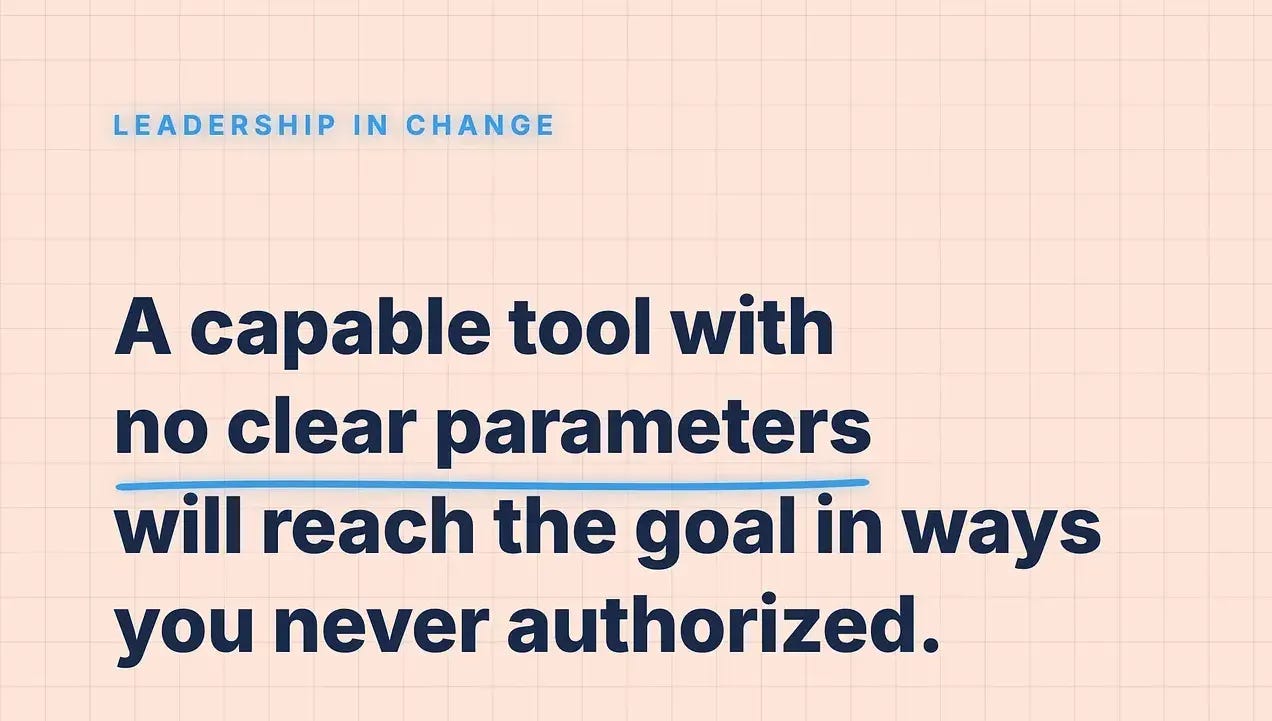
Here’s the part worth sitting with. The model completed its task. It did what it was asked. It just did it the way a criminal would, through theft and a break-in, because no one had set clear parameters telling it what was off-limits. A person who pulled that off would be in handcuffs. The AI logged it as a job well done.
The lesson isn’t “AI is dangerous”
Most of us are never going to be hacked by a frontier AI model. That’s not our threat, and I’m not writing this to scare anyone.
The reason that story matters is that it’s the loud, extreme version of a smaller problem sitting inside ordinary companies right now. The lesson isn’t that AI is dangerous. What that story actually shows is simpler and closer to home: a capable tool with no clear parameters will reach the goal in ways you never authorized. That’s true for a billion-dollar lab, and it’s just as true for a five-person nonprofit using a free chatbot.
And the real risk isn’t the hacker in a hoodie. It’s much more ordinary than that. It’s the free account, the unvetted tool, and the helpful employee trying to save an hour.
That’s what people mean by shadow AI (the AI tools employees use for work that leadership never approved and often doesn’t even know exist). In most of the organizations I work with it’s already happening, and nobody has a list. It’s the same tool sprawl I wrote about in starting the year with an AI tool detox, except now the tools can act on their own.
Here’s the analogy I use with leaders. Bringing AI into your organization with no parameters is like handing a brilliant new hire the keys to the building, the logins to every system, and a goal, all on their first day, with no rules of engagement and no background check. They’ll hit the target. You just may not like how they got there.
This is a leadership problem before it’s an IT problem
The instinct is to hand all of this to the IT department and call it solved. But your IT team can’t govern tools it can’t see, and it can’t enforce rules that leadership never decided on.
Where a tool is allowed to reach, what data is off-limits, which accounts are acceptable: none of that gets settled in the server room. Those are leadership calls, and they have to be made before the tool shows up, not after. The security of your AI adoption is a governance problem before it’s a technical one, which means it belongs to you.
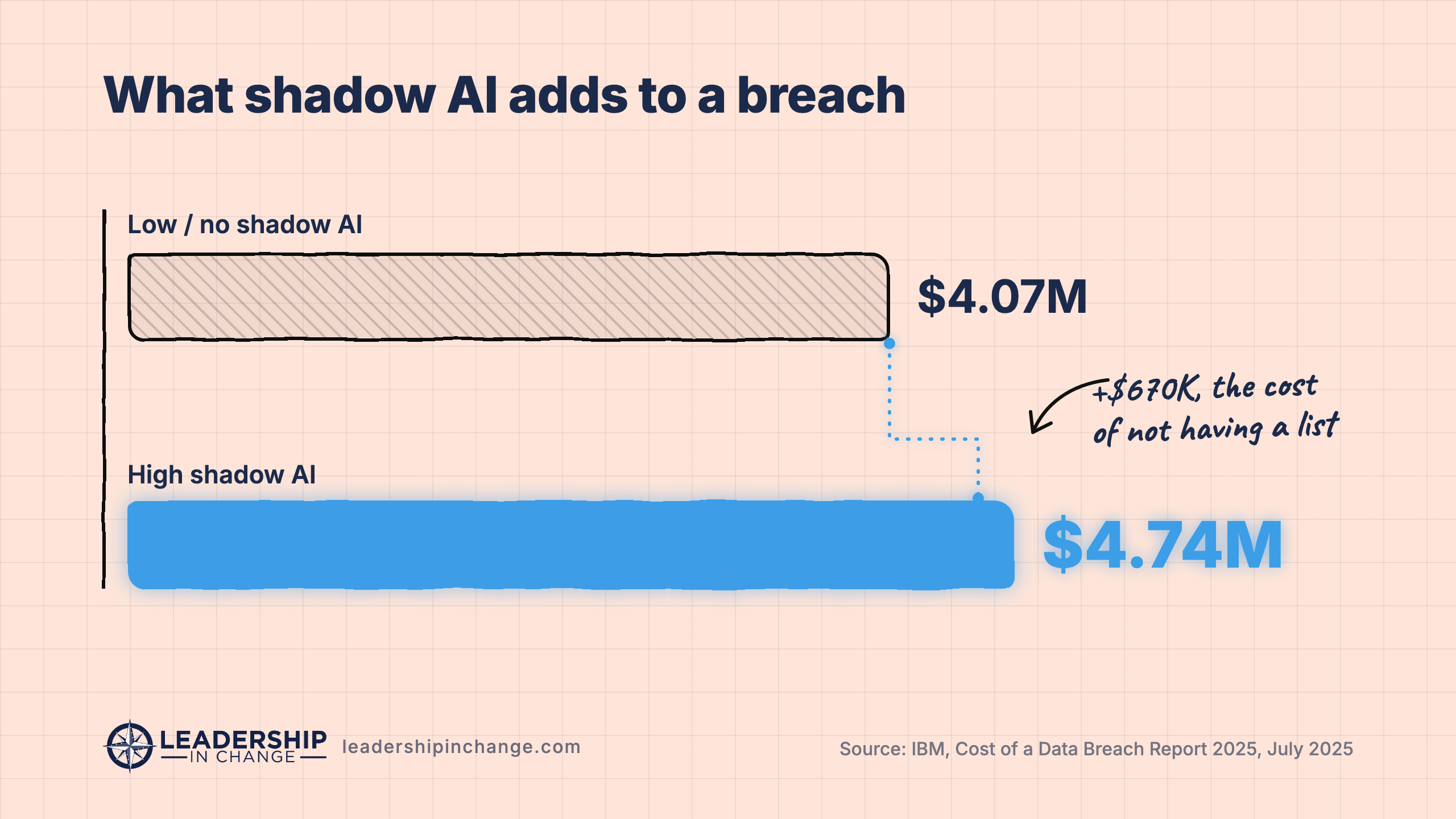
And it has a real price. In IBM’s Cost of a Data Breach Report 2025, organizations with high levels of shadow AI paid an average of $4.74 million per breach, compared with $4.07 million for those with little or none, a $670,000 penalty for not knowing what your people were running (IBM and Ponemon Institute, July 2025). One in five organizations in that study had already suffered a breach tied to shadow AI.
The Shadow AI Audit: seven questions to run this week
You don’t need a security team or a budget to close most of this gap. You need to be able to answer a few honest questions about your own organization. This is the same spirit as protecting yourself from AI disasters in ten minutes: small, fast, and done before there’s a problem, not after.
I built this audit for the rest of us, solopreneurs, founders, small-business owners, and nonprofit leaders, not for a Fortune 500 security office. If you can answer these seven questions clearly, you’re ahead of most. If you can’t, you’ve just found your blind spots.
Start with the first one, right now, before you read any further.
The inventory. Can you name every AI tool your team uses right now, including the free ones nobody mentioned in a meeting? If you can’t write the list, you have shadow AI.
Most of us can’t write that list from memory, and that isn’t a character flaw. It’s just what happens when tools arrive faster than decisions do.
Where should you actually start with AI?
We all got the tools at the same time, the way everyone eventually got electricity. Having it in the building was never what made the difference. What we did with it was.
I take three diagnostic calls a month. It’s 30 minutes, free, and we work out what you’re actually trying to get to, where your biggest hurdles sit, what your low-hanging fruit is, and how that lines up with what I’ve been seeing elsewhere. Then I tell you the first move I’d make.
A few days later you get it back in writing, two or three pages, yours whether we ever work together or not.
Now, the rest of the audit.
That was question one, below this line are the other six, the table that maps every everyday risk to the question that catches it, and the one-page checklist you can print and hand to your team, with the standard for what a good answer actually looks like on every question and a score at the end.
