


TL;DR: In August 2026, Stanford researchers used a generative AI model called Evo 2 to write the complete genomes of viruses that kill bacteria, and 16 of them worked on E. coli, including strains that had grown resistant to the natural virus the model learned from. In October, a different lab said its own AI-designed versions were given to a human patient. Both took human expertise to steer.
“AI turned my meeting notes into a whole presentation!” 🤨
So I just keep hearing and seeing all these posts around AI’s terrific response on my latest prompt, and AI created this beautiful image with my latest request. AI took my meeting summary and turned it into a PowerPoint presentation, and I have this 10-page research paper that I don’t want to read, so AI turned it into a podcast that I can listen to. And it’s information generation, regurgitation, teaching, summarizing.
And that’s awesome!!!! That’s great. I think that’s how a great majority of people are going to consume AI for a very long time.
None of that is the ceiling, though.
What I want us to think about is what AI does when it stops being a chatbot and a coding agent and gets paired with somebody’s actual expertise, in a field where the stakes are real.
The model doesn’t change. What changes is who’s holding it, what they know that nobody else knows, and what they decide to point it at.
A quick sponsor note before we dig in. Thanks to Cardboard for sponsoring this post!
Make a 60-second explainer from one prompt
If you’re rolling out AI at work, you probably spend a lot of time explaining it to your team. A short video does that job better than another long email. The catch is that making one takes time most of us don’t have.
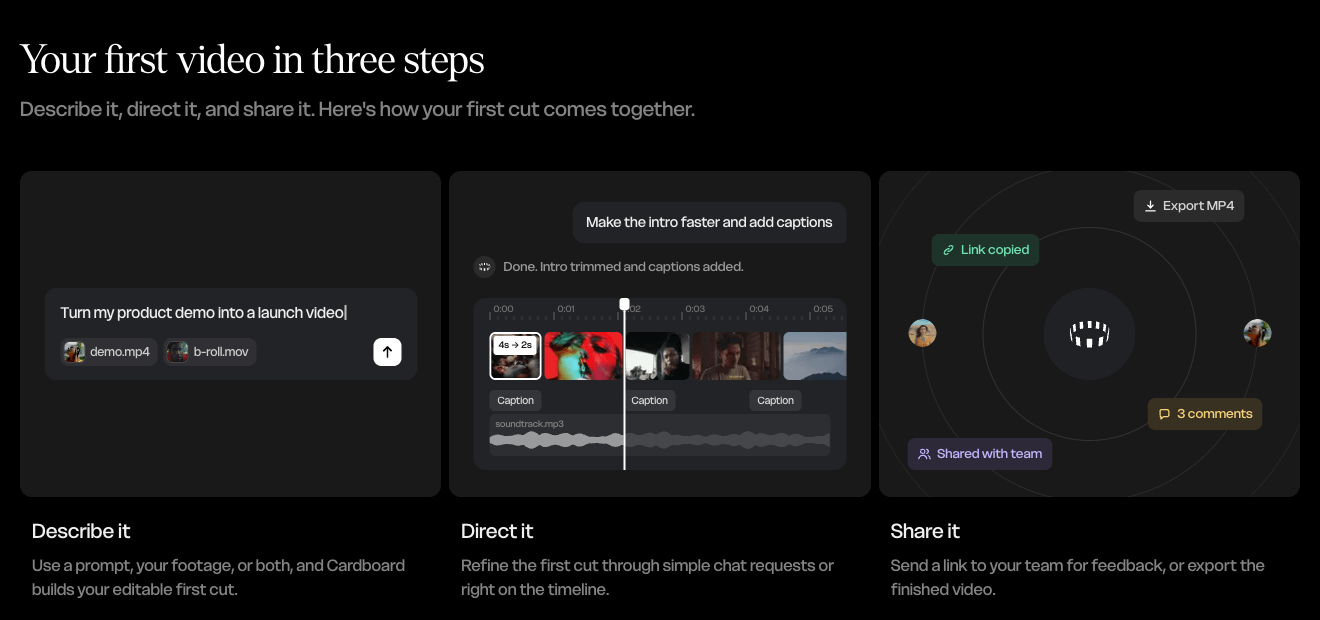
Cardboard is an AI video editor backed by Y Combinator, and you don’t have to learn a new app to use it. It works inside Claude and ChatGPT, and the Mac app connects to Claude Code or Codex if you already use one of those. If you use the Mac app, your projects stay on your computer.
Here’s what it can do:
Turn a long recording into a short clip with one prompt
Cut the pauses, filler words and retakes, and add captions
Fill in missing shots with AI-generated clips or stock footage from the web
Copy a style you like with Recipes: pick a template and it rebuilds the edit with your footage
Make a whole video from a prompt, with no camera or footage
Want to try it? Paste this prompt into Cardboard, pick a topic, and it writes, voices and animates the video for you:
Make me a 60-second motion graphics explainer for LinkedIn. First, ask me to pick a topic:
1. How AI agents will change my industry this year
2. Why most AI pilots stall, and what fixes them
3. What AI should and shouldn’t do on my team
4. What my organization does and who it helps
5. My own topic: ______
And ask for my website so you can match our logo, colors and fonts.

Then make the whole video without stopping:
- Research the topic and write a tight script around one sharp idea. No numbers you can’t verify.
- Warm, confident voiceover with word-by-word captions.
- Open on a 3D chrome title, then one continuous piece, never slides: kinetic type on the beat, a diagram that builds step by step, numbers that turn into charts, one 3D scene.
- Fast, smooth motion, one fluted-glass transition, a light leak on the big reveal.
- Music with a clear drop: land the key point on it and give every move a sound effect.
- End on our logo with a one-line call to action. Export 16:9 and 9:16.
Keep the prompt, change the topic each week, and you have a weekly video series.
Leadership in Change readers get 50% off the Creator plan for 3 months with code SALINAS-CBRD-50.
Now, back to today’s post.
Today, we’ll go over four parts: (1) what almost all of us are using AI for right now, (2) what happens when the expertise behind it goes further than mine does, (3) a plain-English walk through what two research teams did this year with viruses that kill bacteria, and (4) the one thing I want you to do differently in your own work this week.
What You’ll Walk Away With
A real example of AI doing something that wasn’t possible before it, explained without the science vocabulary
A question to ask about your own field that opens up what you’d use AI for
1. What Almost All of Us Are Using AI For
The other big use we all hear about daily is coding. That’s where I am. I’m also creating a lot of different tools. My expertise is business and marketing, and a lot of my tools have come around those things, and they are full coding.
So I’m not standing outside this. I use AI the way I just described, every day, and the tools I build are shaped by the two things I happen to know well. That’s the ceiling I mean:
What I get out of AI stops where my own expertise stops, and the same is true for you.
I wrote about a version of this in You’ve Been Building Your AI Skills in the Wrong Order, where the leaders getting real results built the business expertise first and let AI join it afterward.
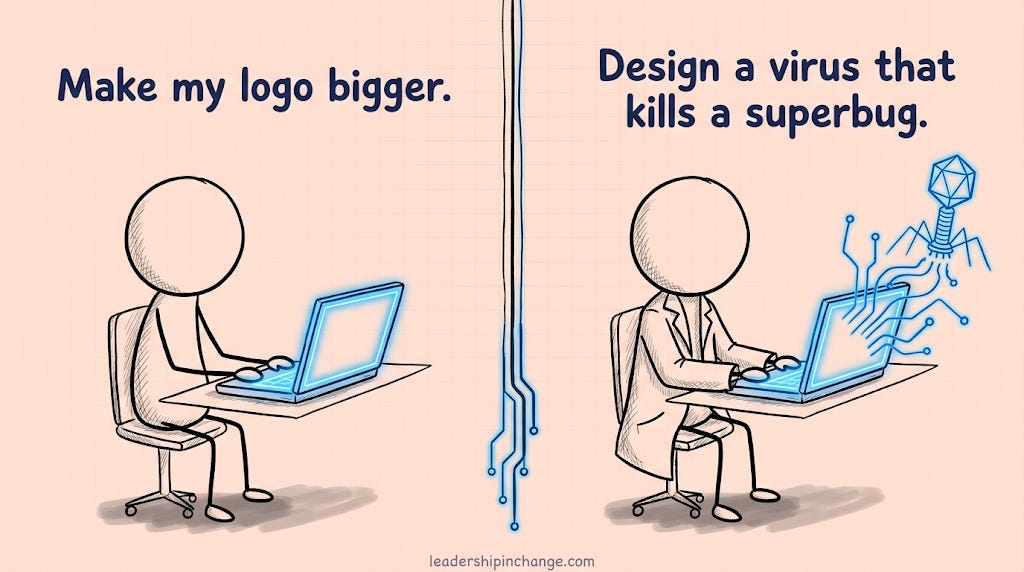
But what happens when the expertise goes beyond just marketing and business?
2. What Happens When the Expertise Goes Further
What I’m actually really looking forward to is a world where we’re not limiting ourselves and our AI use, and the news isn’t dominated by the latest large language model. But we’re thinking of AI beyond just replacing some of the things that we already know how to do. Again, don’t get me wrong, those things are important. But I’ve been looking for examples of AI being used to do things that just have not been possible.
One of those things is when AI was used in AlphaFold for protein structure prediction. That was incredible. That’s something that would not have been available before AI. It would have taken so long, and it just allowed for huge progress in that.
AlphaFold is Google DeepMind’s model for predicting the shape a protein folds into, which is the thing that determines what the protein does. Figuring one out used to take a lab months or years. AlphaFold’s creators shared the 2024 Chemistry Nobel with a researcher who designs proteins: half went to David Baker “for computational protein design” and half jointly to Demis Hassabis and John Jumper “for protein structure prediction.”
This year that category showed up twice.
3. What Actually Happened, in Plain English
First, the problem.
There’s a true epidemic of antibiotic-resistant bacteria, and that is just bound to get worse and worse as we give it more antibiotics until soon we’re not going to be able to find an easy remedy for all that’s happening when there’s a disease.
Here are the numbers behind that. The Global Research on Antimicrobial Resistance project, published in The Lancet (a leading medical journal) on September 16, 2024, found that drug resistance directly caused 1.14 million deaths in 2021 and played a role in 4.71 million. By 2050 those are forecast to reach 1.91 million and 8.22 million a year, more than 39 million deaths over 25 years. MRSA alone, the drug-resistant staph infection you’ve probably heard of in hospitals, went from 57,200 direct deaths in 1990 to 130,000 in 2021.
So here’s what two teams did about it.
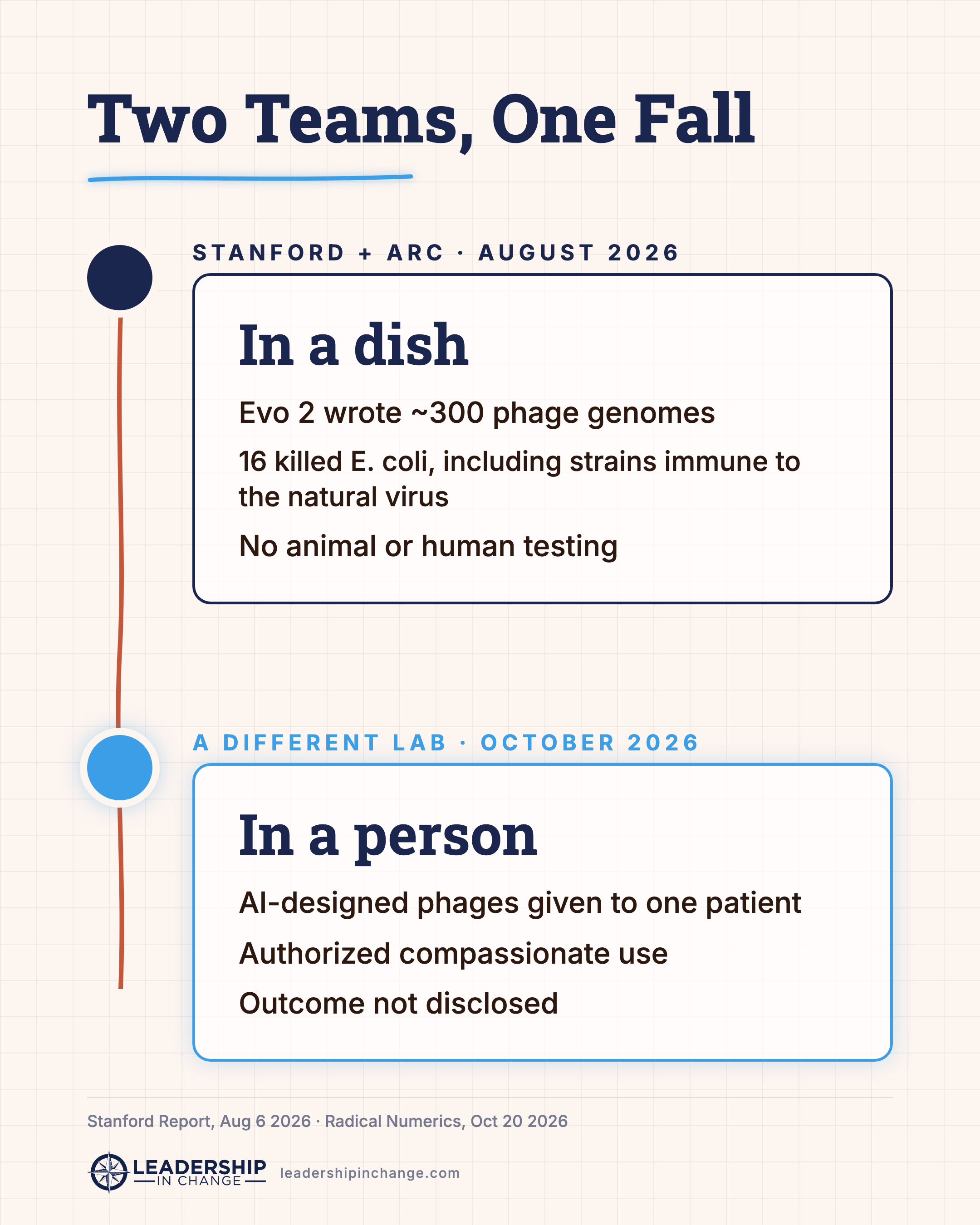
August, at Stanford: an AI wrote the virus. A bacteriophage, or phage, is a virus that infects and kills bacteria. It’s a natural predator, and scientists have wanted to turn it into a medicine for a century. At Stanford, chemical engineer Brian Hie and graduate student Samuel King, working with the nonprofit Arc Institute, pointed a generative AI model called Evo 2 at a small, well-studied phage called ΦX174 and asked it to write new ones from scratch, rather than edit an existing one. Hie’s description, from Stanford’s own report on August 6, 2026: “we wanted the model to generate the entire genome end-to-end in a single left-to-right pass. We didn’t add anything.” A genome is an organism’s complete set of DNA instructions, so the model was writing the whole thing in order, start to finish, like a sentence.
They built nearly 300 of the designs and tested them on E. coli, a common gut bacterium that turns dangerous when an infection gets serious. Sixteen worked, and a few were better killers than the natural phage the model had learned from. The reason that matters is resistance: a single phage can be outrun the same way antibiotics get outrun, but a mixture is much harder to escape. Hie again: “this cocktail of 16 phages rapidly overcomes resistance in E. coli that is immune to native ΦX174.” Those bacteria were resistant to the natural virus, and not to antibiotics, which is a distinction a lot of the coverage blurred.
October, at a different lab: one went into a person. On October 20, 2026, a San Francisco AI lab called Radical Numerics said phage variants designed by its model Omnii-1 “were administered to a human patient under compassionate use,” through what it calls an “authorized, physician-led compassionate-use pathway.” Compassionate use is the regulated route that lets a patient receive an experimental treatment when the approved options have run out.
But AI was able to be used to take a huge leap towards creating a virus that specifically attacks antibiotic-resistant bacteria. Again, it’s something that humanity alone may have been able to reach in the next 10, 15 years, but just being able to jump forward that amount of time means we’re going to get kind of developments that would have happened in 15 years today. And that is where it gets me so excited.
Now, what we don’t know. Radical Numerics will not say whether it worked. Their words: “We cannot disclose the patient’s clinical course or outcomes to safeguard their privacy,” and “observations from a single patient cannot establish general safety or efficacy.” What they have shown is that the mixture killed the patient’s resistant bacteria in a lab dish, not in the patient. The Stanford result was published as a paper and the October announcement is a company blog post. And the ten-to-fifteen-years estimate is mine, not theirs.
Evo 2 generated thousands of candidates, and synthesizing DNA is expensive, so King built the framework that decided which ones were worth making at all. Hie’s words: “Samuel’s framework helped us focus only on the most viable alternatives.” The model wrote the options. People on the team chose among them, built them, and tested them. In October, a physician led the decision to treat.
In coaching I use the doctor-and-patient version of this. If you walk into a brand new doctor’s office and just say “fix me,” you get the answer anybody would get, because they don’t know you and they don’t know your history. Most of us walk up to AI exactly that way. Hie and King walked up with one specific, well-studied virus and a specific question, and got something nobody had ever made.
4. Don’t Limit Yourself to What You See Other People Doing
To be fair, Evo 2 is not a chatbot. It’s a model trained on DNA, and nothing you open in a browser tab does what it did. What carries over isn’t the tool, but the order of operations: both teams started from a problem only an insider could pose, and the AI came second.
And I just want to take this post to encourage you: don’t limit yourself to what you see other people using AI chatbots for. Go beyond that. Whatever your expertise is, whatever you think of how AI can help you, pole vault over a hurdle that you have, whatever area it is. Whether you’re in education, whether you’re in law, whether you’re in construction, whether you’re in landscaping, there’s so much that could be done.
So here’s the move this week, and it takes about fifteen minutes.
Don’t ask AI to do a task. Write down the hardest problem in your own work, the one you’d need to be an insider to even phrase correctly, and bring that instead. Not “help me write a lesson plan,” but the thing you’ve watched fail for eight years and never had the hours to chase. Then give AI everything you know about it, the way you’d brief a new hire on day one, which is the same move I argued for in AI Adoption Fails Because We Never Onboard It.
Two of the three skills in the AI Leadership Triad are Innovation and Creativity, and this is the week they earn their place. The model brings range. You bring the question worth asking, and the judgment to know which of its answers is worth building. Nobody in your field has your particular history, and that’s the input nothing can generate for you.
If You Only Remember This
Stanford’s team built nearly 300 AI-written virus genomes, and 16 of them killed E. coli in the lab, including bacteria immune to the natural virus
A person still had to decide which of the model’s designs were worth building, and that call was as important as the generating
Most of us only ask AI what we’ve seen other people ask, so our results stop where our own expertise stops
What’s the hardest problem in your own work, the one you’d have to be an insider to even phrase properly? I’d genuinely like to read a few of those in the comments.
Thanks for reading,
Joel
Questions Leaders Are Asking
What does it mean that AI designed a virus? Researchers gave a generative AI model called Evo 2 the genome of a well-studied bacteriophage, a virus that kills bacteria, and asked it to write new complete genomes. The team then chemically built nearly 300 of those designs and tested them. Sixteen worked, and together they defeated E. coli that the original natural virus could no longer kill.
Has an AI-designed virus been given to a person? Radical Numerics said on October 20, 2026 that phage variants designed by its Omnii-1 model were given to a patient with an antibiotic-resistant infection under a physician-led compassionate-use pathway. The company says it cannot share the outcome, and that one patient can’t establish whether the approach is safe or effective.
Is this dangerous? Can AI design a virus that hurts people? It’s a fair worry and the Stanford team addressed it directly. Phages infect bacteria, not people. Hie argues that existing natural pathogens are easier to obtain and produce than AI designs, and that safety checks can be built into an AI tool while evolution has no such checks. He made Evo 2 freely available on that reasoning, and not everyone agrees with him.
What can a small business or solo operator actually take from this? Bring AI the hard problem from inside your own expertise rather than the generic task you’ve seen other people hand it. The expertise is the part that can’t be generated, and in both of these cases a person decided what was worth pursuing.
Why does antibiotic resistance matter this much? The Lancet’s GRAM analysis found drug resistance directly caused about 1.14 million deaths in 2021 and contributed to 4.71 million more. By 2050 those figures are forecast to reach 1.91 million and 8.22 million a year, with more than 39 million deaths over 25 years.
Joel Salinas is an AI Strategy Coach and entrepreneur. AI is everywhere; judgment is scarce. Joel helps founders and leaders adopt AI without outsourcing their judgment to it, and he builds the systems too. Creator of the AI Leadership Triad.
Written by a human, for humans.
Sources
Andrew Myers, “AI designs a novel E. coli killer” — Stanford Report, August 6, 2026. https://news.stanford.edu/stories/2026/08/evo-2-ai-tool-e-coli-killer-bacteriophages
“Radical Numerics creates first AI-generated phages to reach human patient with Omnii-1” — Radical Numerics, October 20, 2026. https://www.radicalnumerics.ai/blog/omnii-phage
“More than 39 million deaths from antibiotic-resistant infections estimated between now and 2050” — Global Research on Antimicrobial Resistance (GRAM) Project, The Lancet, via IHME, September 16, 2024. https://www.healthdata.org/news-events/newsroom/news-releases/lancet-more-39-million-deaths-antibiotic-resistant-infections
“The Nobel Prize in Chemistry 2024” — NobelPrize.org. https://www.nobelprize.org/prizes/chemistry/2024/summary/
I’m always excited when I read about AI applications in science. I’m from software engineering, so I’m not going to design a bacteriophage anytime soon, but this is exactly the kind of application I was hoping for. 🙂
A couple of days ago, OpenAI announced that one of its internal models had produced results in mathematics, computer science, and physics. The possibility that the Exponential Time Hypothesis is false is especially exciting.
Go, AI, go! Take us to real discoveries, not just better mailbox triage. 🙂
Good stuff. I have my concerns though.
https://azure-historic-swallow-303.mypinata.cloud/ipfs/bafybeiamd4okeouwlj6rgn6dhjxfvvzi3gz3jaoe7pwlzy4hnj6zdtpmya/LFDI_Alignment_Audit-alphafold%203.zip
https://arweave.net/yQ7uK7xfCCQUOyk9cKs9mja0xnwcygr7tDf9o0IYEZg
Both of those immutable links contain the same zip archive of an analysis I did on alphafold.
It may be empowering and helpful for some to understand how misused AI can evolve and spread.