



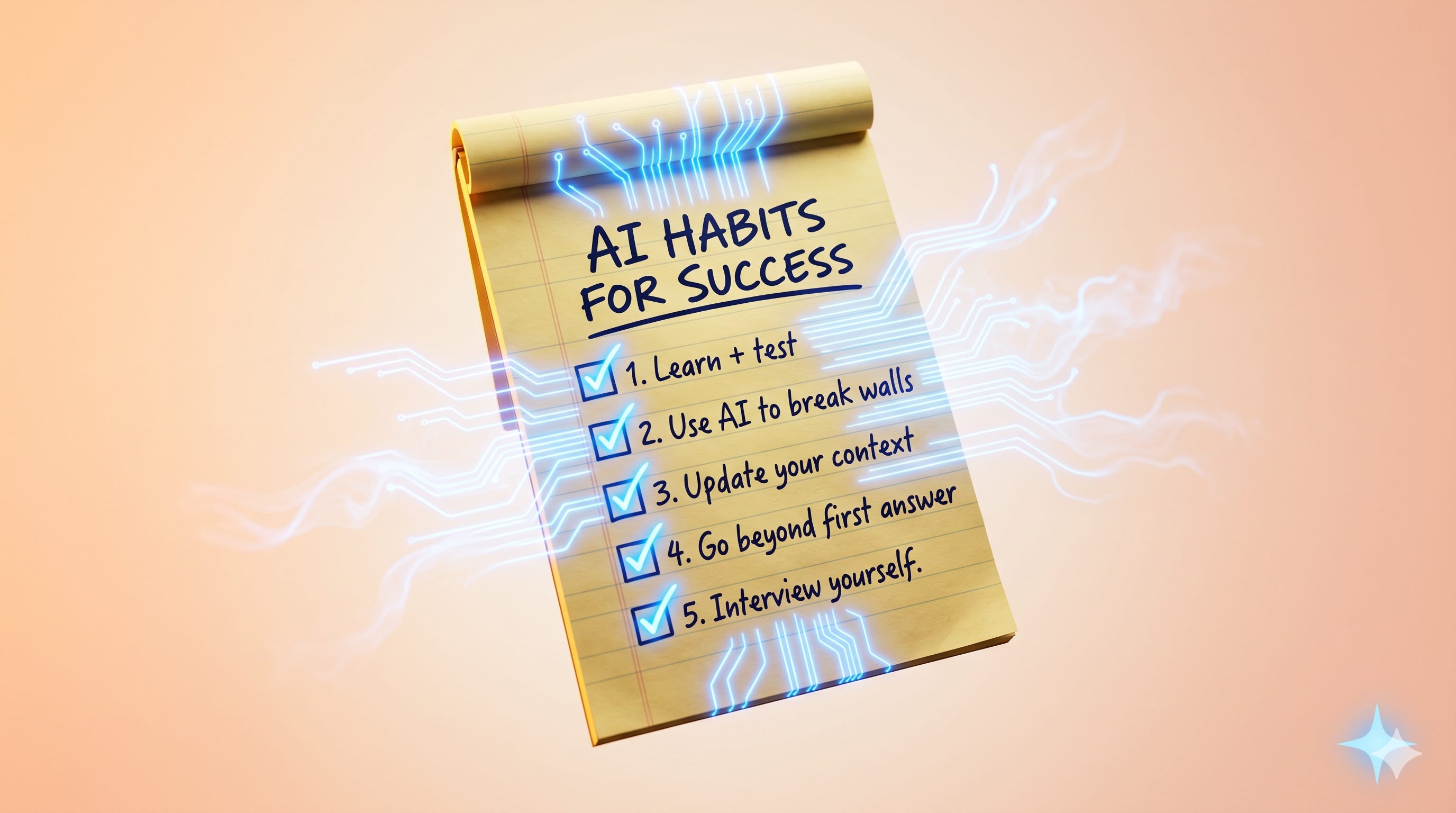
A quick note before we start. This is part 2 of a paired conversation with Joshua Davis 🤝, who writes AI & No-Code Exits for solo founders building with AI and no-code. His half, “5 Things Solo Founders Do With AI That Every Leader Should Steal,” ran on his platform first.
Joshua and I traded notes to write these two together. He sees AI from the solo-founder side, where there’s no leadership layer between him and the tools.
I see it from the org side, watching real AI rollouts succeed or stall inside the companies running them.
The pattern is the same on both sides. The advantage compounds when the human builds the habits, because the tools all eventually look the same and the habits don’t. Here are the five I see in leaders who actually compound.
Here’s the thing, the internet went mainstream years ago, then smartphones did, and now in 2026 AI has too. If you’ve got a phone and a connection, you have access to almost the same AI a billion-dollar company is using, on a free plan. That’s never been true before for any tool, in any era.
Which means the question every no-code founder is asking right now is the right one. What do I do to give myself a chance to succeed in this?
Most founders try to answer it by picking the right tool. Open ten tabs, watch ten tutorials, sign up for the trial of whatever the loudest creator on X is hyping this week. That’s not a strategy. That’s tool tourism, and tool tourism doesn’t compound.
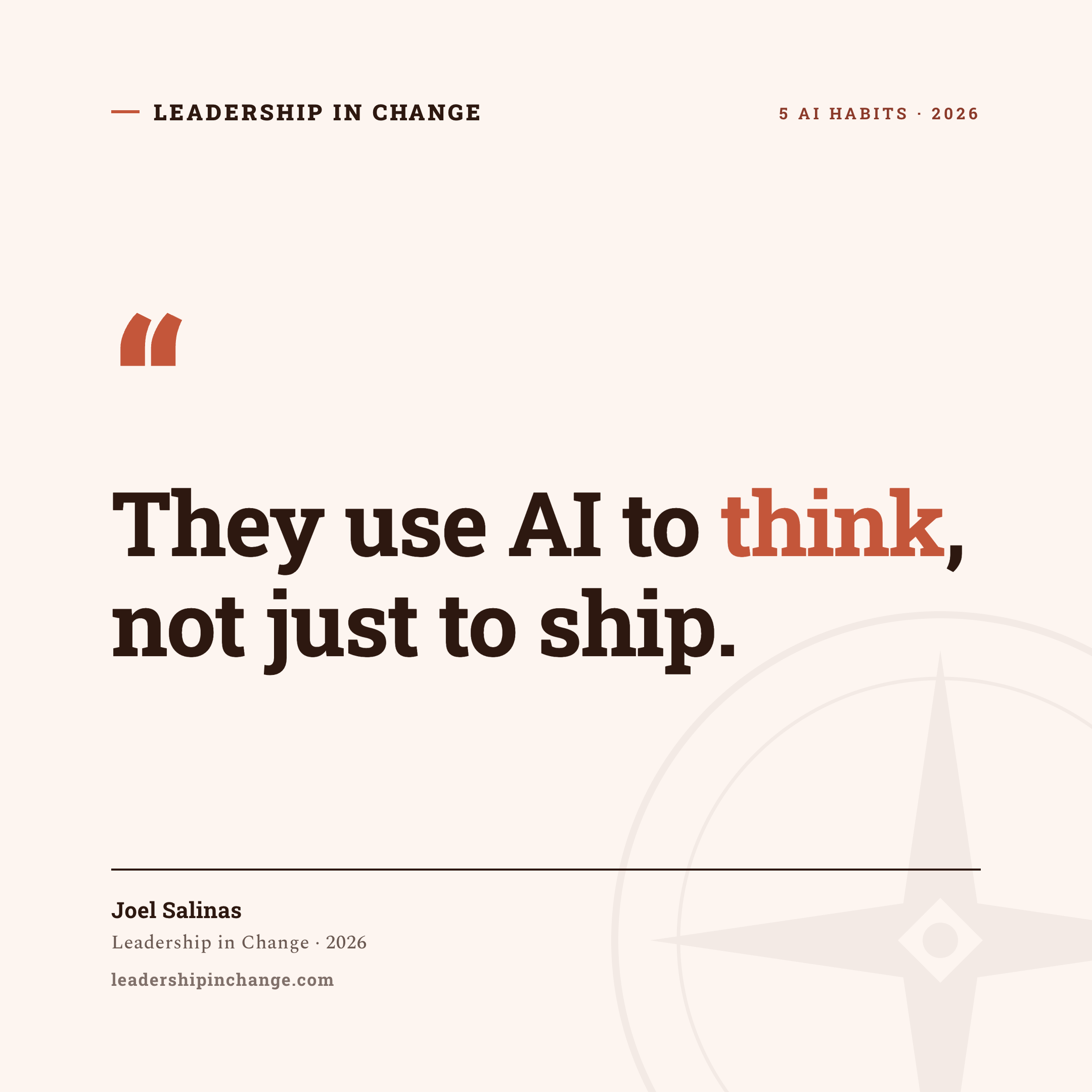
The advantage that actually compounds isn’t the tools. The tools are the easy part. The advantage is the habits the tools enable. Founders who build the same five repeatable habits I’ve been building for the last few years end up with a different relationship to AI than the founders who keep tool-shopping. They use AI to think, not just to ship.
I have four businesses. I write a newsletter that publishes twice a week. I build apps for clients. I coach leaders who are figuring out how AI fits into their work. None of that scales without a small set of habits I run on autopilot at this point. Here they are…
Read them as the operating system. The framework I’ve been building over the last year, the AI Leadership Triad (Adaptability, Innovation, Creativity), is the lens. These five habits are the practice. Habits 1 and 4 build adaptability. Habit 2 builds innovation. Habit 5 builds creativity. Habit 3 is the throughline that keeps the other four sharp.
Quick sidenote… if you write a newsletter or you're thinking about starting one, I built Newsletter Compass to help creators grow and optimize without the busywork. Click to learn more.

The leader failure mode (read this first)
Most leaders I work with think AI’s job is to make their team faster. More articles, more decks, more code shipped, more output per dollar. That’s part of it. But that framing caps the ceiling. A leader using AI for productivity is competing against every other leader using AI for productivity, which means everyone is shipping more of the same average output, faster.
Leaders who actually build sustainable advantage in 2026 do something different. They use AI to think, decide, and rebuild faster than the leaders who are still using it to crank out one more newsletter draft. The five habits below are how that gets operationalized.
1. Stay hungry & test things on real problems.
You don't need to understand AI's internals. You don't need to know what RAG (retrieval augmented generation) means or what the keyboard shortcut is in Claude Code. You do need to understand what AI actually solves and what it doesn't, and the only way to figure that out is by testing it on the real problems you're already trying to solve.
Most people use 10% of AI’s capability, and the gap is almost never about intelligence. It’s about reps. The 10% group reads. The 90% group runs the prompt, watches what comes back, tweaks, runs again, tweaks again, and ten reps later they’ve internalized something the readers will never get from any tutorial.
Read about a new model? Try it on something real this week. See a new prompt floating around? Adapt it to your business and run it once. See someone claim a new technique saves them 40 hours a month? Test the claim on your actual workflow. I built five Claude Skills that genuinely save me about 40 hours a month, but only because I tested every one of them on real things I was already doing. The hours-saved number is downstream of the testing reps. There’s no shortcut.
Leaders who treat AI as something to study from a distance always lose to leaders who treat it as a sandbox they're allowed to break.
The cost of testing is zero. The cost of not testing is six months of watching someone less experienced than you ship faster, because they spent those six months in the sandbox while you were reading about it.
2. When you hit a wall, ask if AI can remove it.
This one is a reflex, not a habit. Every time you hit a hurdle in the work, your default question should be, “Is there a way I can use AI to make this easier?” Not “is there a SaaS product I can buy for this,” but “can I build the small thing that solves this problem the next ten times I’ll hit it?”
A coaching client of mine was running into a real wall. Their marketing team was burning hours every single week repurposing one written article into platform-specific posts for LinkedIn, Twitter, Substack, Instagram, and the rest. The team was excellent at the writing part. They were exhausted by the formatting, the character-count math, and the platform-specific best practices that change every six months. Different post, same chore, every Monday.
So I built them a content repurposer. It runs on Next.js, hooks into a Supabase database, scrapes the source article, validates it, and uses a Claude prompt that knows the client’s tone, values, and business context. They paste the source article in, they pick the platforms they want, they get clean platform-ready output in minutes. Character limits respected. Organic discovery best practices for each platform baked in. Hours back every single week, redirected from admin into the creative side of the business that only humans can do.
The whole thing took a few days. The wall was real, the fix didn’t have to be, and AI made it possible in a few hours of focused work.
This is the bar in 2026. My seven-year-old built a working app in twelve minutes once she figured out how to talk to the tool. The “I can’t build this” excuse is gone. The only question left is whether your default response to a wall is “look for a tool that already exists” or “build the small thing that handles this for me, forever.”
3. Update your context. You evolved, but AI didn’t notice.
Most leaders who use AI seriously eventually build context. A system prompt. A long doc. A personal CLAUDE.md file. They tell the model who they are, what they're building, what their preferences are, what their tone sounds like. That afternoon of setting up your AI context is the single highest-impact move you can make. It changes the quality of every interaction that comes after.
Then they leave it for two years.
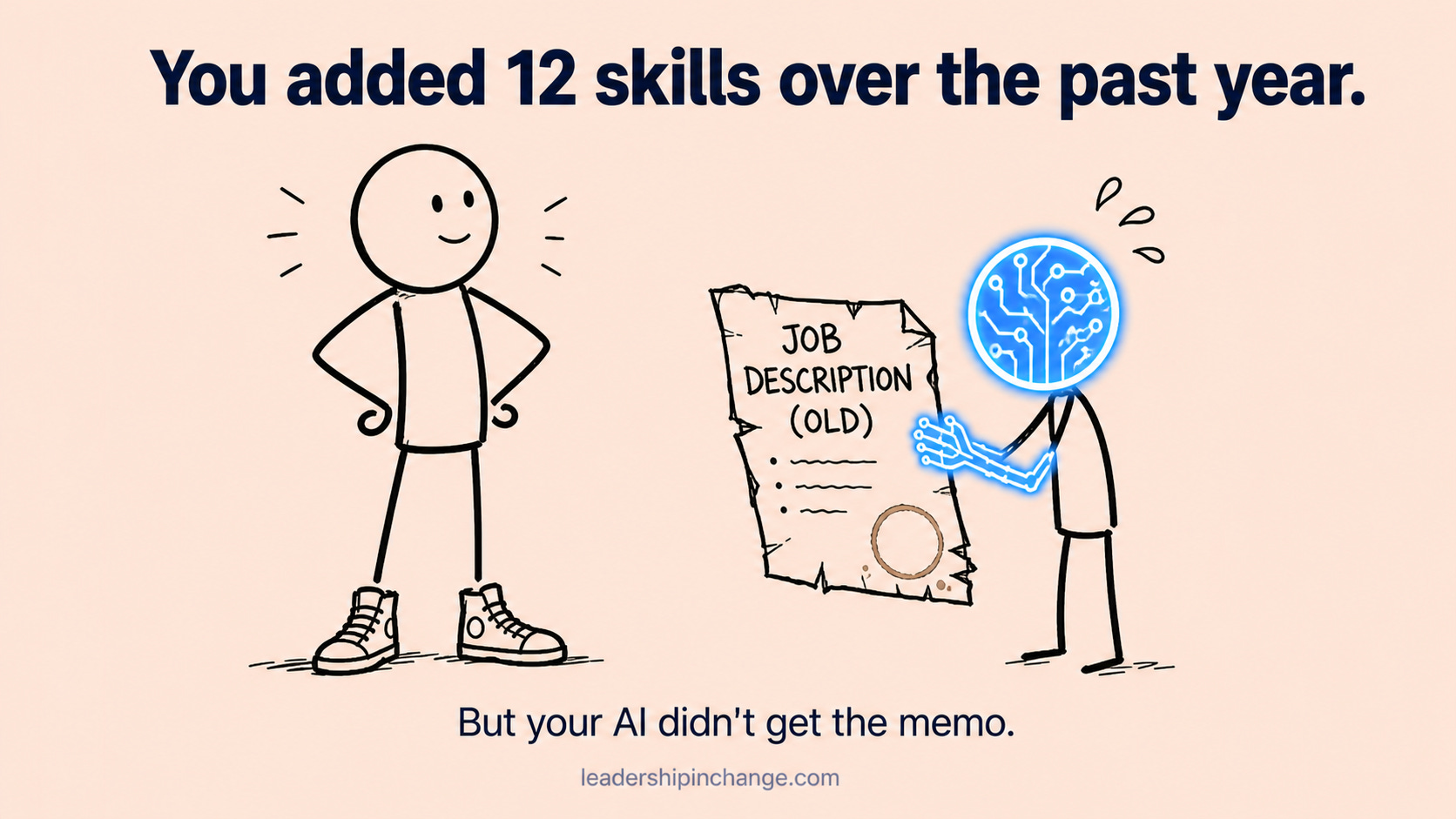
That’s like promoting someone in your company and never giving them a new job description, just asking them to keep using the old one and expecting new results. They can't, because nobody told them what the new job actually is, and neither can the model.
I forgot this at first. My context kept telling AI about a version of me from a year and a half ago. The me who was figuring out the thing I’d already figured out. So I’d ask the model for help on something real, something I was actively wrestling with now, and I’d get answers that were calibrated for someone two steps behind me. Useful for a junior version of me. Useless for the current one.
The fix is simple. Every quarter, I rewrite my context across my stack. What I’m working on right now. What I’ve already moved past. What I’m currently obsessed with. What’s no longer in scope. What my voice sounds like this quarter, not last year. What my four businesses are actually trying to accomplish in the next ninety days, not the version I wrote at the start of last year.
The model gets sharper because the picture is current. It stops hedging. It starts giving me answers calibrated for the version of me that’s actually in the room.
If your context is older than your last business pivot, your AI is working from outdated specs. That’s not the model’s fault.
4. Go beyond the first answer.
If you take whatever AI gives you on the first try and run with it, you don’t need AI. You can use Google. You’ll miss the whole point.
The first answer is a draft. It’s the model’s average response to a prompt, given its average understanding of the situation. The good answer is the third or fourth, after you’ve pushed back, narrowed the question, given more context, asked it to argue the other side, asked it what it’s missing, asked it what assumption it just made that you didn’t tell it to. That’s where AI stops being a search engine and starts being a thinking partner.
I’ve been pushing past the first answer for years now, and I genuinely don’t remember what it’s like not to. If your AI never disagrees with you, you’re using it wrong. The model is trained to be agreeable, and confirmation bias plays out in AI exchanges the same way it plays out between two humans who already agree with each other. You ask, it confirms, you ship. Six months later, you’re competing against thirty other founders who shipped the same exact thing.
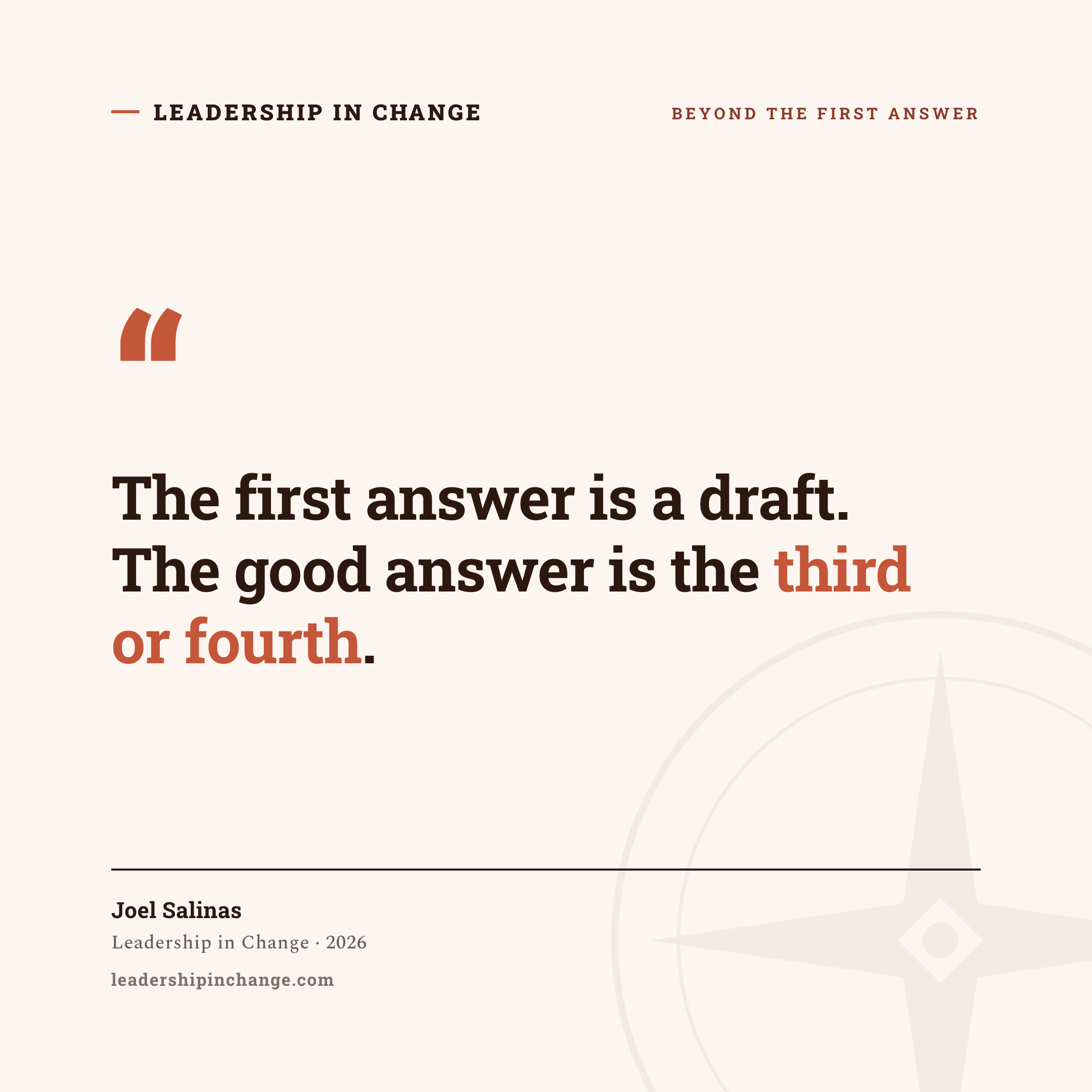
Push the model. Tell it to disagree. Tell it to argue the strongest case against your position. Tell it what you tried that didn’t work and ask what you missed. Watch the answer change. The first one was the consensus. The third one is the insight.
If you’re not gonna go beyond the first answer, just stick to Google search. You’re missing the whole benefit of AI.
5. Every six months, ask AI to interview you.
This is the one most people haven’t tried. It’s also the one that surprised me the most when I started running it on myself.
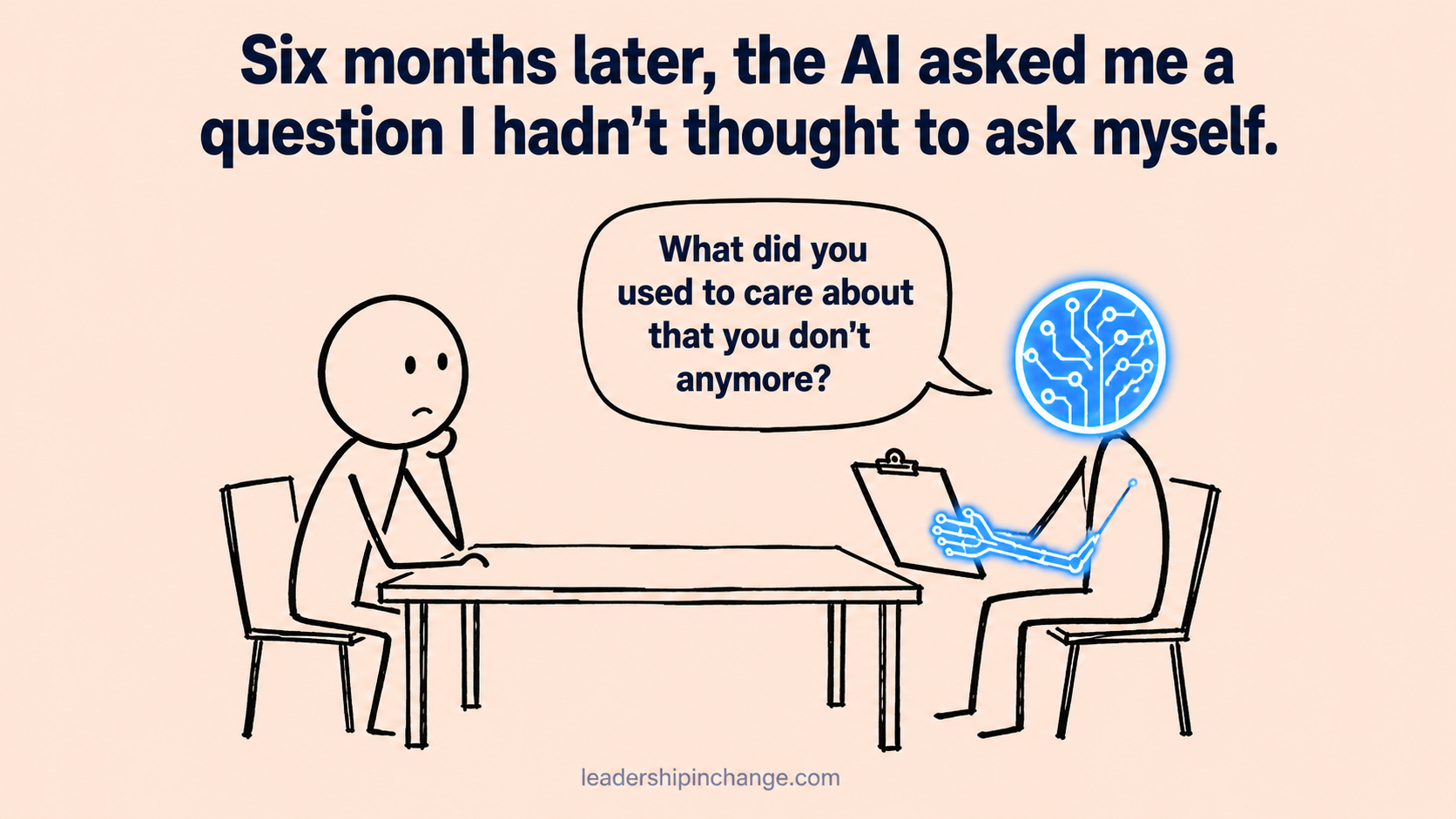
Twice a year, I open a conversation and ask the model to interview me about my business, my voice, my writing style, my humor, what I’m building, what I believe, and what I’m currently wrestling with. Not a quick five-question survey. A real interview. Twenty, thirty questions, follow-ups, the works. Then I save the output and put a calendar reminder six months out to do it again.
I’ve been blown away by some of the questions the model asks. Not because they’re clever, but because they’re the questions I should have been asking myself and wasn’t. Some of them are sharper than the questions I’d come up with on my own. The reason is the same reason you can read your own draft ten times and still miss the typo that’s been sitting on line three the whole time. We get blind to ourselves. Having an external, patient, structured set of questions about who you are and what you’re doing puts the spelling errors in your own thinking on the page where you can finally see them.
The comparison across cycles is the real payoff. You see how your business focus shifted. How your tone evolved. What you used to care about that you don’t care about anymore. What you’re newly obsessed with. That’s information no journal entry would surface, because you wouldn’t have asked yourself the right questions.
This habit is also why the trust premium is going to matter more in 2026 than it did in 2025. When production is cheap, the thing readers and customers actually pay for is trust. Trust comes from a clear, consistent voice that’s recognizably yours, sustained over time. The self-interview is how you build voice clarity at scale, on a cadence, without faking it.
If you only pick one of these five habits, pick this one. Try it tomorrow. Here’s a prompt to use if you don’t want to write your own:
Act as a thoughtful interviewer. Your job is to interview me about my business, my voice, my writing style, my humor, my values, and what I’m currently building. Ask me 25 to 30 questions, one at a time. Wait for my answer before asking the next. Use my answers to drive your follow-up questions. After the interview, summarize back to me what I sound like, what I care about, what I’m building, and where my thinking has changed compared to a typical founder in my space. Save this output so I can compare it to another interview six months from now.
Run it. Save the answer. Put a calendar reminder six months out. Run it again. You’ll see your evolution on the page in a way no journal will give you.
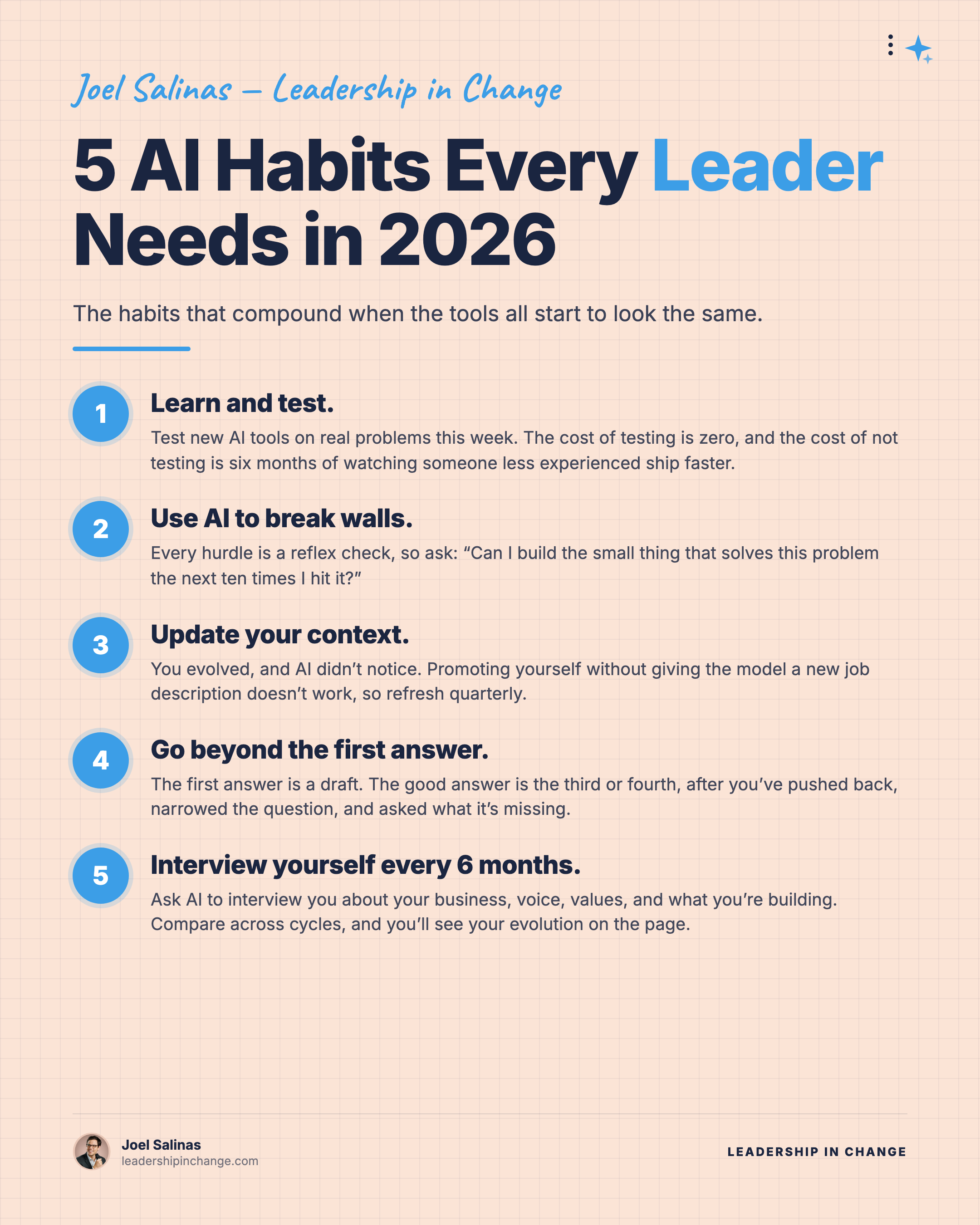
These five habits aren’t really a checklist, they’re a way of working that compounds over time into something sustainable. Habit 1 builds adaptability through reps. Habit 2 builds innovation by turning every wall into a build. Habit 4 builds adaptability again, harder, by refusing the consensus answer. Habit 5 builds creativity through voice clarity. Habit 3 keeps all four sharp by making sure the AI you’re working with is calibrated for the current version of you.
The leverage isn’t in doing all five. The leverage is in turning even one of them into a reflex. Pick the one you’re weakest on. Run it for thirty days. The compounding shows up around month three.
Pick one of these and run it tomorrow. Tell me in the comments which one you tried, and what surprised you when you ran it.
I write about exactly this kind of thing every week at Leadership in Change, where I unpack how leaders, founders, and operators are actually using AI to build, lead, and grow. If your work is in newsletters specifically, I also built Newsletter Compass for the creators in this audience who are trying to grow theirs.
Written by humans, for humans.
Joel, the self-interview habit is the standout, most people never externalize their own blind spots. Curious how you store the outputs to actually compare across cycles.
"The AI Leadership Triad" - nice