




TL;DR: Five AI books recommended specifically for non-technical leaders navigating organizational change: "The AI-Driven Leader" by Geoff Woods (using AI as a strategic thought partner), "Co-Intelligence" by Ethan Mollick (foundational framework for working with AI), "AI and the Octopus Organization" by Brill and Wunker (distributed intelligence structures), "AI First" by Brotman and Sack (implementation playbook), and "Reshuffle" by Choudary (how AI rewires competitive positioning).
I hate wasting time on bad books.
If you ask my wife, she’ll tell you I’m usually juggling two non-fiction books and one fiction at any given moment. Reading fuels how I think, lead, and show up daily. But here’s the thing about AI books specifically: they’re either outdated before the ink dries or so technically dense that only software engineers can get through them.
A book written in 2022 about AI feels like it’s from another decade. And most new releases? Either shallow hype or incomprehensible jargon, I believe you’ve seen this as well.
This is the problem I kept running into:
What AI books should leaders actually read today?
Not developers. Not data scientists. Leaders navigating real organizational change in a world being reshaped by AI.
So I reached out to someone who’s made this his entire focus.
Meet Paul Morrison.

Paul has spent decades at the intersection of business transformation and emerging technology, first as a programmer, then working with companies like Accenture, WNS, Hewlett-Packard, and The Hackett Group.
Now? He runs AI Book Review on Substack, where he cuts through the noise to find the AI books that actually matter for business leaders. Not the hype, or technical manuals, but the books he believes are built to last.
I asked Paul to share his top recommendations for leaders who need practical, strategic insight, not another surface-level listicle or technical deep-dive meant for engineers.
What follows is his curated list of 5 AI books that stand out, each one tested against the unique challenges mission-driven leaders face when navigating AI implementation, strategy, and organizational change.
Let’s dive in!

Key Reads for Leaders
How to succeed with AI - It’s the big question for all business leaders. There’s no shortage of advice - in fact, there is a deluge of opinion. So where do you focus?
We all love the up-to-the-minute insights at our fingertips on Substack and beyond. But the printed word provides something extra: a unique, considered perspective on business strategy. Books stand several paces back from the hype-prone social media cycle. The ideas in books are built to last.
AI Book Review is on a mission to help leaders benefit from this stream of knowledge by finding the books and ideas that matter. There are hundreds of AI books to read out there - and based on my personal experience, here are 5 reads that stand out for business leaders.
As ever, it’s great to hear what you are reading, what has inspired you, and what is next on your list!
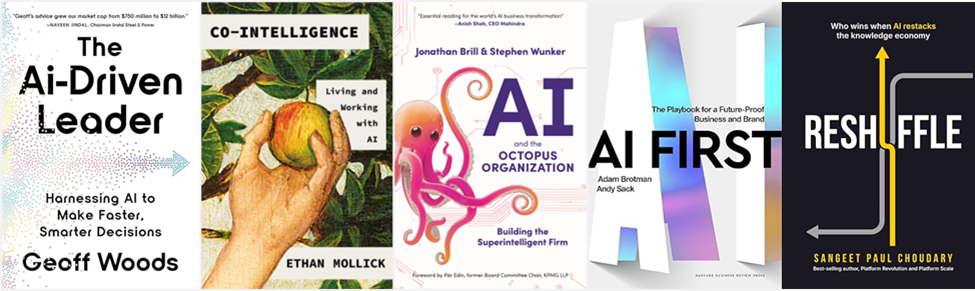
THE AI-DRIVEN LEADER:
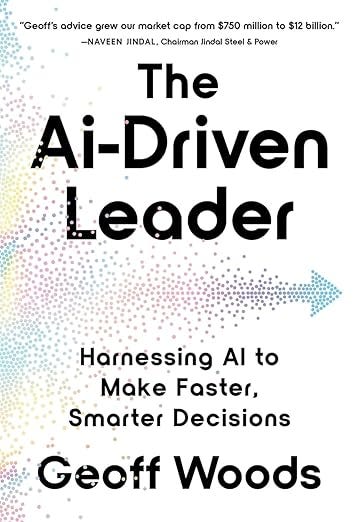
Harnessing AI to Make Faster, Smarter Decisions
By Geoff Woods
Why this book: A practical plan for making AI work for you and for your team
Key quotes:
‘Getting educated is your job... By harnessing AI as your strategic thought partner, you can build a competitive advantage. IF you do not, you risk your competitors beating you to it.
Geoff Woods is an adviser, former industrial exec and perhaps best known as presenter of ‘The One Thing’ podcast. His recent book is for stressed and time-poor business leaders, offering a plan for getting the most out of AI: ‘Rather than seeing AI a threat… recognise that it is a powerful ally in making faster, smarter decisions, one that shifts you from operational overwhelm to strategic clarity.’
It’s all about using LLMs as thought partners. Steering clear of advice on specific tools, he explains why successful leaders must become expert ‘communicators with AI’ - through clear thinking and smart prompting. ‘Instead of asking how can I do this, start asking how AI can help.’
A leader should never give final control of thought leadership to AI. But LLMs can partner, challenge and accelerate their work across many key tasks:
Strategic thinking
Decision making
Content creation
Idea generation
Analysis and research
Then comes the team - why not 10x the impact of every employee? ‘You can create a world where the majority of your people’s time is invested in high-impact priorities… super-charged with AI.’ The leader needs to understand the different needs of the team, and shape a plan for everyone: the innovators, champions, early adopters, early majority, late majority, and laggards.
For the leader ‘this is less about doing, and more about becoming a composer of strategy and a conductor of teams and technology.’
CO-INTELLIGENCE:
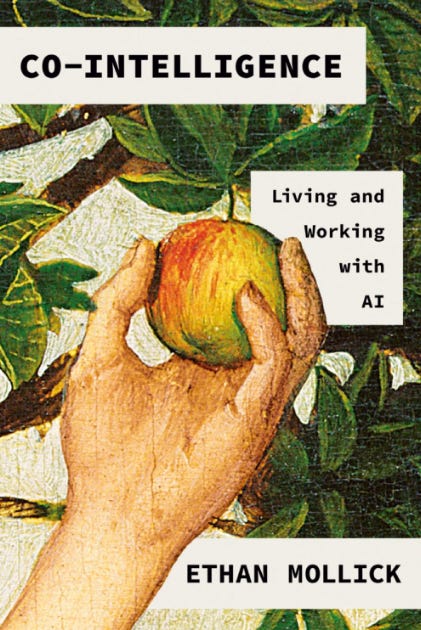
Living and Working with AI
Why this book: A primer on LLMs and how to think about them as co-workers
Key quotes:
‘Almost all of our jobs will overlap with the capabilities of AI’ / Get equipped for ‘A future that demands the seamless integration of human and artificial intelligence.’
Ethan Mollick, Associate Professor of Management at The Wharton School, is one of the world’s leading communicators on AI, not least through his newsletter ‘One Useful Thing’. His book ‘Co-Intelligence’ has been on the bestseller lists for over 18 months now (decades in AI terms) - but it stands the test of time, as a great jumping-off point for leaders thinking through the implications of AI.
As suggested by the title, the thrust of Mollick’s book is about learning to work with AI. It’s all about experimentation, delegation, unbundling and reblending tasks. Two frames of reference stand out. Firstly, the ‘4 Rules for Co-Intelligence’
Always invite AI to the table. ‘Using AI in our everyday tasks serves to enhance our understanding of its capabilities and limitations.’
Be the human in the loop: ‘By actively participating in the AI process, you maintain control over the technology and its implications.’
Treat AI like a person: ‘Working with AI is easiest if you think of it like an alien person rather than a human-built machine.’
Assume this is the worst AI you will ever use. Just one of the widely-held concepts that Mollick coined and popularised.
Secondly, he introduces the idea of a ‘jagged frontier’, in which AI’s impact is unevenly distributed across jobs and industries. AI is not equally applicable everywhere. An important truth that means leaders must map and explore this frontier in their own domain.
AI AND THE OCTOPUS ORGANIZATION:
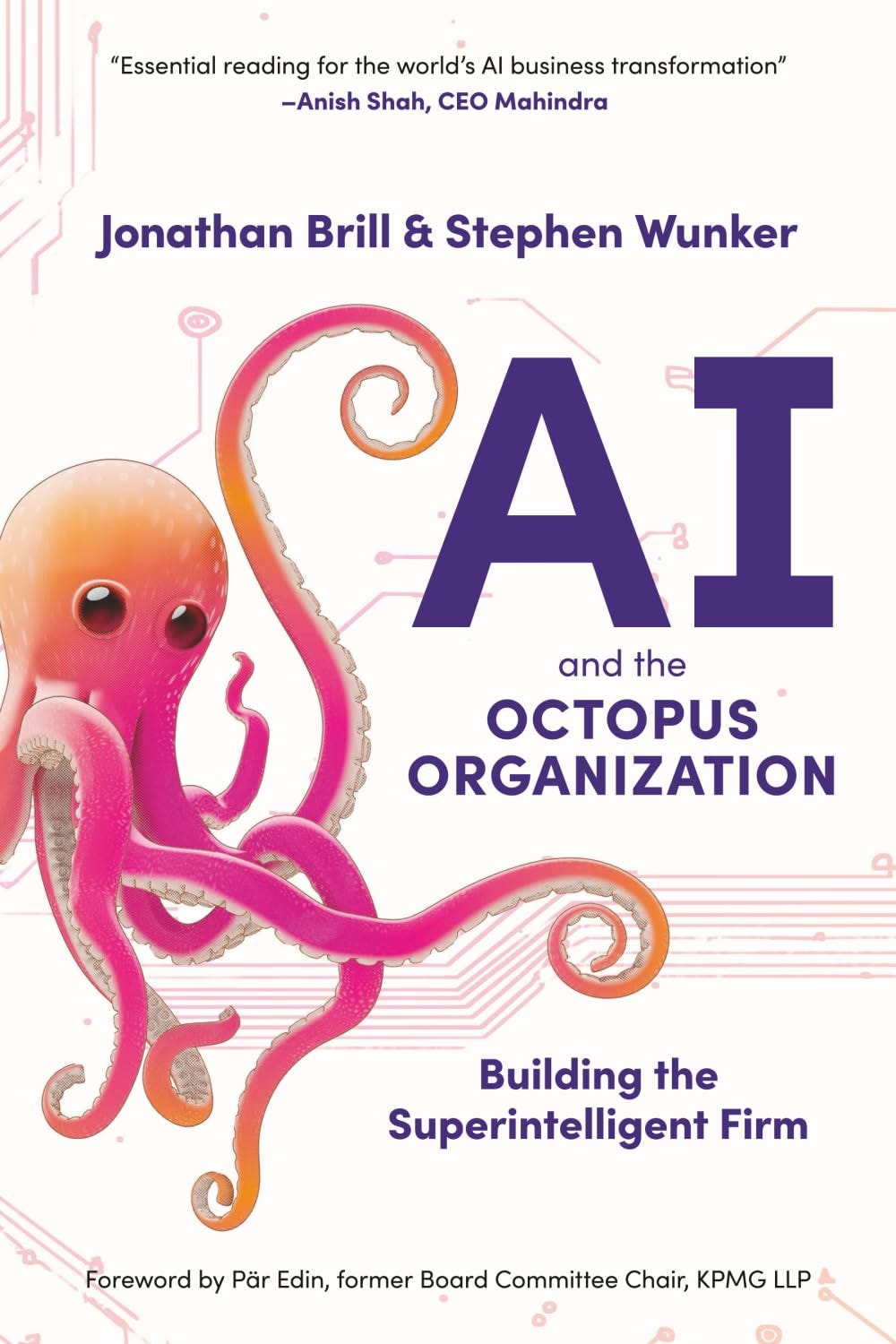
Building the Superintelligent Firm
Jonathan Brill and Stephen Wunker
Why this book: An alternative take on how AI could overturn old ‘command and control’ ways of working
Key quotes:
‘AI gives all nodes in an organization the ability to monitor what is happening across it, enabling new methods of decision-making and coordination.’
Brill (Futurist-in-Residence at Amazon) and Wunker (MD at New Markets Advisors) are seasoned innovation practitioners. They have cooked up a plan with a distinctive aquatic motif. The Octopus Organization shows how businesses need to become hyper-flexible in the age of AI. ‘Rigid, unyielding business structures are destined for extinction’. But the shift requires a break with old ways of thinking. ‘Even several years after ChatGPT… clients are struggling to turn localized AI pilots into broader organizational transformations.’
Above all, businesses need to plan for ‘distributed intelligence’ (reflecting the ‘9 brains’ of an octopus) - as opposed to the command and control model that is the default today. This means the delegation of sensing and thinking across the enterprise.
This leads to the empowerment of middle managers and the front line to make more decisions. Rote tasks are steadily automated away, leaving more time and tools for decisions about operations, tailored to each client. ‘AI can provide unprecedented contextual awareness, fine-grained decision support, and clear networks of communication at scale. LLMs allow even junior managers to see the wider chessboard.’
AI FIRST:
The Playbook for a Future-Proof Business and Brand
By Adam Brotman, Andy Sack
Why this book: A practical work plan for leaders looking to accelerate AI adoption across a business
Key quote:
‘Lean in and embrace the new technology with curiosity and vision… this may be a once-in-a-lifetime opportunity’
Most organizations are like the proverbial deer in the headlights. ‘Everyone has a sense of what AI is evolving into. And yet there’s an eerie silence as business leaders look around and wonder what it will mean.’ Authors Brotman and Sack, executives and advisers with the likes of Starbucks, J.Crew and Microsoft, want to change this.
AI First is all about tempo - get on with it! The book dives into a number of case studies and interviews with key names from the AI revolution, with their conclusions crystalised into two priorities:
Have an AI first mindset - Leaders and the wider organisation need to change their ways of thinking. They need to mashup a ‘growth mindset’ (as popularised by Carol Dweck), lean thinking, and customer-centricity. Business leaders need to be constantly monitoring and acting on opportunities to make a difference with AI, always learning, testing and evolving.
Adopt an AI first playbook - With the right mindset, the business can then put in place an ongoing programme of activities to drive AI across the business:
AI education and proficiency - Actively and comprehensively improve AI literacy and proficiency across the organization
An AI council - Set up a cross-functional group with the passion, sponsorship and range of insight needed to make AI successful. Not just tech, but business leaders too
AI policy and governance - Specify guidelines, governance and compliance requirements - without snuffing out experimentation and progress
AI opportunity assessment and road-mapping - Understand in detail which new AI use cases can really make a contribution to efficiency, revenue and growth.
RESHUFFLE:
Who wins when AI restacks the knowledge economy
Why this book: Understand how AI is rewiring business, so you can reposition your company or career for the future
Key quote:
‘Firms chasing automation may unlock short term gains but those using AI to orchestrate complex systems will unlock entirely new forms of value.’
This book rethinks how the business landscape is being withdrawn. Historically the energies of businesses are wasted in meetings, mails, politics. But AI is bridging this ‘coordination gap’, changing the flow of information, knowledge and control. As a result industries are being reconfigured, and work is being rebundled: ‘The real impact of AI comes not from how it performs a task, but from how it restructures the system around that task.’ This is changing what roles, organisations and industries will look like.
In this new world, businesses fight to succeed or survive by exploiting ‘control points’ such as particular relationships, workflows and insights. AI is creating totally new opportunities every day. ‘Whoever owns the control point gets to shape the ecosystem… Defining how partners, users or suppliers coordinate, becomes the new competitive moat.’
What happens to the workforce? AI means that the cost of producing knowledge work through machines is plummeting. ‘Tasks that once required meetings or intermediaries can now be coordinated instantly using AI…Decisions that relied on human judgement could now be coded as logic into information systems.’ So many roles will become obsolete, but others will be created where coordination gaps remain, or where new control points have emerged.
Knowledge workers need to be aware of the dynamics of AI: In this highly dynamic business landscape leaders and employees alike need to be extremely alert. ‘The real opportunity for workers is to track where value is added and position themselves in its path.’

Feed your brain with AI Book Review! Subscribe for concise insights on the best new AI writing and media - such as:
Thank you, Paul!
Paul’s done the hard work here, filtering hundreds of AI books down to five that actually deliver for leaders navigating real organizational change.
What strikes me about this list is the range: from practical implementation guides (Brotman and Sack) to strategic reframing (Choudary) to understanding AI as a thought partner (Woods and Mollick). Each book solves a different piece of the AI leadership puzzle.
If you’re wondering where to start:
New to AI strategy? Start with Mollick’s Co-Intelligence for the foundational mental models
Ready to implement now? Go straight to Brotman and Sack’s AI First for the playbook
Rethinking organizational structure? Dive into Brill and Wunker’s Octopus Organization
Want to lead with AI as your thought partner? Grab Woods’ The AI-Driven Leader
Thinking long-term competitive positioning? Read Choudary’s Reshuffle
One more thing: What AI book changed how you think recently?
Drop your answer in the comments. I’m always looking for my next read, and I know others are too.
P.S. I’ve already added three of these to my Audible cart. If you’re looking for last-minute gift ideas or using those holiday book credits, this list is a solid starting point.
Brought to you by COZORA👇, learn AI live!
During December, All Subscribers get 10% with code CHRISTMAS25.
Premium subscribers get $360 off (50% per year) through the coupon in the Premium Hub.

PS: Many subscribers get their Premium membership reimbursed through their company’s professional development $. Use this template to request yours.
Partner and Connect
I love connecting with people. Please use the following connect, collaborate, if you have an idea, or just want to engage further:
LinkedIn / Community Chat / Email / Medium
I hate wasting time on bad books too. Thanks for putting this together.
By the way, I might need to set up a “Buy me a book” instead of “Buy me a coffee” if I keep reading Paul’s newsletter, haha.
Added AI and the Octopus :)