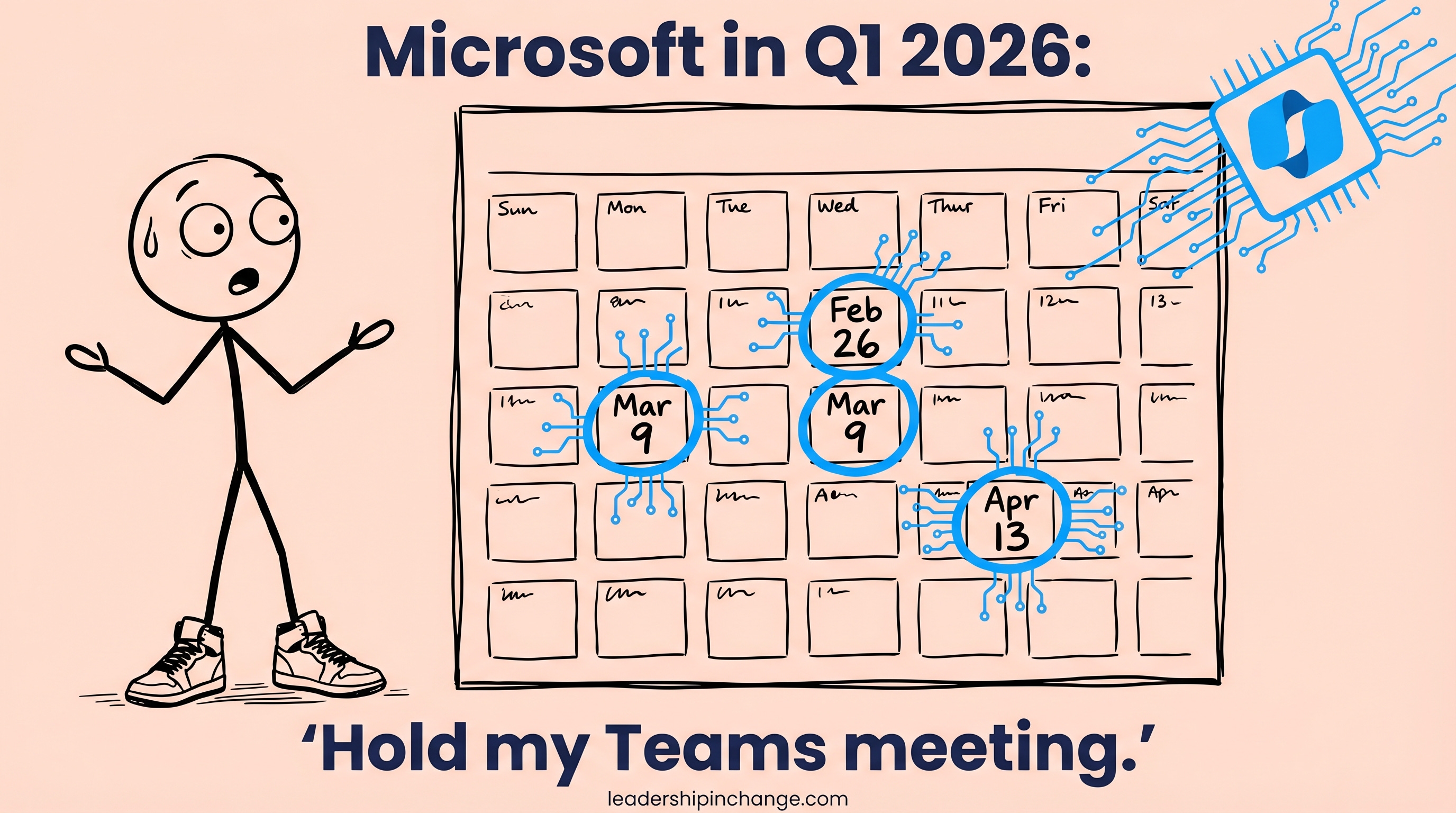
TL;DR: Microsoft Copilot agents saw four new releases between February 26 and April 13, 2026: Copilot Tasks, Copilot Cowork powered by Claude, the Frontier Transformation agent suite, and a local OpenClaw-style agent previewing at Microsoft Build 2026. Copilot still lags Claude and ChatGPT on model quality, but Microsoft’s 400 million Microsoft 365 users make this rollout unavoidable for enterprise leaders.
I use Claude almost exclusively when I build. Claude Code sits on my desktop pretty much at all times now. But almost every leader I coach, whether nonprofit executive or Fortune 500, works inside Microsoft 365. Copilot is already in their email, documents, and Teams. Switching to Claude isn’t a button click for them. It’s a vendor negotiation, a training rollout, and a security review.
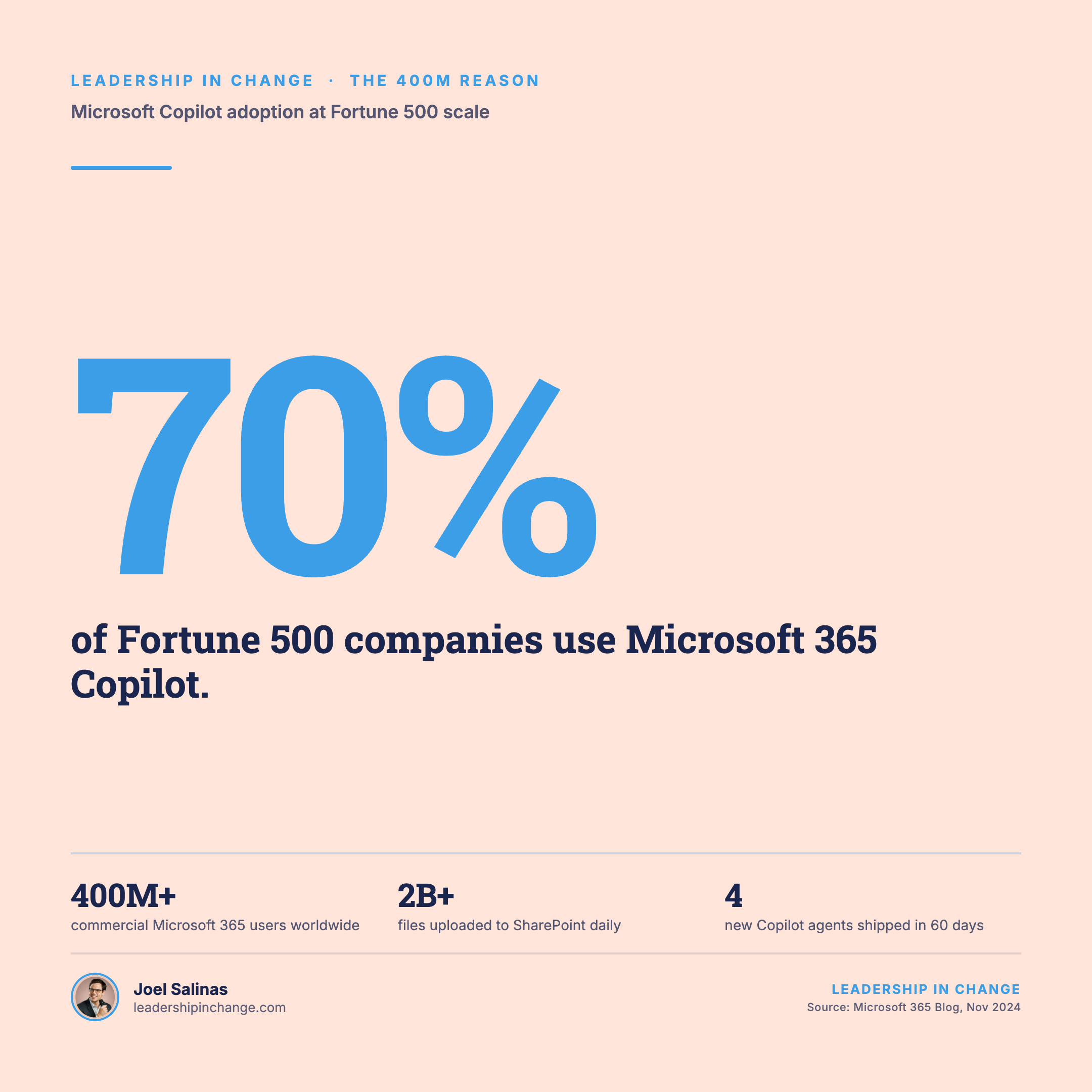
Copilot lost the model race. Run the same prompt in Claude, ChatGPT, and Copilot side by side and that’s obvious. But Microsoft isn’t trying to catch up on models anymore. Between February 26, 2026 and April 13, 2026, they shipped or previewed four AI releases, aimed at the 400 million people working inside Microsoft 365 every day. 70% of Fortune 500 companies already use Copilot. If your team is one of them, this matters more than which model won the benchmark this quarter.
In this post, you’ll learn:
What each of the four new Copilot agents does, with honest pros and cons
Why Microsoft’s 400 million-user footprint changes the agent rollout equation, even with Copilot still lagging Claude and ChatGPT on model quality
What to do about Microsoft’s agent rollout this week, before Build 2026 in June
Agent 1: Copilot Tasks (February 26, 2026)
Copilot Tasks is Microsoft’s first real move from chat-and-search to action. Released in preview on February 26, 2026, Tasks takes multi-step actions on behalf of the user (organizing email, booking travel, prepping for recurring meetings) on a schedule you define. It runs in the cloud, not on your device.
Promising:
First Copilot release that crosses from answering questions to completing actions.
“Set and forget” automation model is closer to how most leaders actually want AI to work.
Limited:
Covers tasks already handled by ChatGPT Agent and Claude’s computer use, tools most analysts still consider more capable.
Still in preview as of April 2026, with no final release date confirmed.
Why it matters: If your team’s mental model of Copilot is “the thing in the sidebar that writes email drafts,” that model is already out of date.
How to apply this Monday: Pick one recurring weekly task your team handles manually (Monday status recap, weekly customer sync prep, end-of-week priority digest). Have whoever owns Copilot admin in your tenant enable the Tasks preview and configure one Task for that workflow. Try this starter prompt inside Copilot Chat:
“Create a Copilot Task that summarizes my last week of customer emails every Monday at 8am and drafts three priority follow-ups.”
Review output quality for two weeks before scaling to a second Task.
Agent 2: Copilot Cowork, Powered by Claude (March 9, 2026)
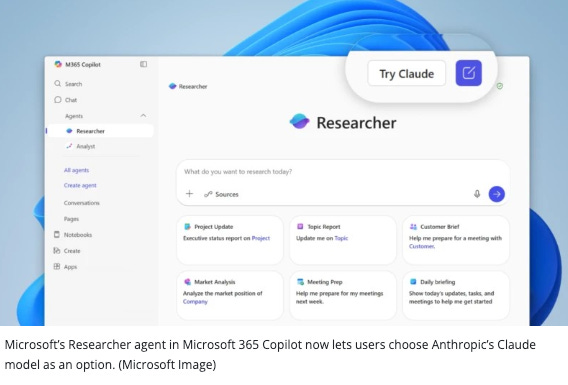
Copilot Cowork is the most significant Copilot release of the year so far (and runs on Anthropic’s Claude!!!). It runs across Microsoft 365 apps (Word, Excel, Outlook, Teams) and takes cross-app actions autonomously: gather data from SharePoint, draft a memo in Word, format numbers in Excel, queue it for review in Teams. It’s powered by Microsoft’s “Work IQ” layer and grounded in the tenant’s actual data.
Microsoft’s Researcher agent inside Microsoft 365 Copilot now offers “Try Claude” as a model option. This is what “distribution layer for the models that won” looks like in production UI. (Image: Microsoft)
Promising:
Runs on Anthropic’s Claude, not just GPT. Microsoft partnered with Anthropic late last year and now lets enterprise customers pick the model.
Grounded tenant access (SharePoint, Graph, Dataverse) gives Cowork context standalone Claude and ChatGPT can’t match.
Limited:
Cloud-only. Data-residency-sensitive organizations (government, defense, some healthcare) still can’t use it.
Till Freitag’s April 2026 Copilot assessment called Excel integration “significantly weaker” and PowerPoint generation “generic.” The surrounding scaffolding limits what Claude can do inside it.
Why it matters: Cowork lets you run Claude against your own Microsoft data without leaving the stack you already pay for. For most leaders I coach, that matters more than any standalone AI tool launched this year. Adding Cowork with Claude underneath should raise the ceiling further for well-configured tenants.
How to apply this Monday: Identify one cross-app workflow your team currently does manually, something like “pull vendor performance data from SharePoint, summarize it in Excel, draft a board memo in Word.” Ask your IT admin whether Cowork with Claude model selection is available on your license tier.
If yes, pilot it on that workflow for two weeks. If no, get on the wait list and block time to revisit in Q3.
A word from our partners — tools I use daily
Here’s the thing about Cowork. Even if your IT team approves it next quarter, most of you won’t touch it until Q3. But the describe-it-and-it’s-built pattern that makes Cowork interesting is already shipping in simpler tools.
Jotform is a Leadership in Change partner, and it’s the cleanest example I use. You describe the form you need (”a 3-question lead capture form with name, email, and biggest AI challenge”) and Jotform AI builds the fields, sets the logic, and makes it production-ready in seconds.
Agent 3: The Frontier Transformation Agents (March 9, 2026)
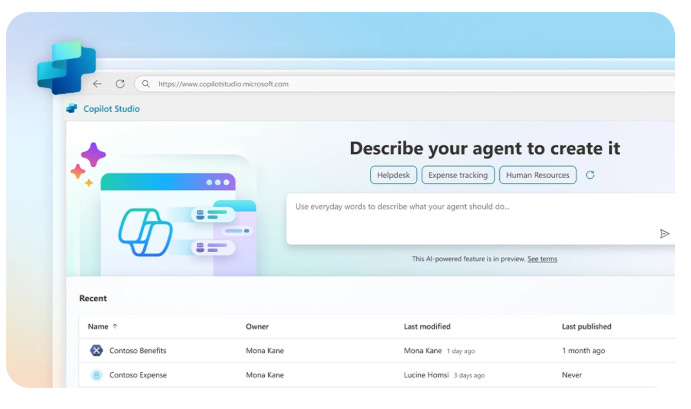
On the same day as Cowork, Microsoft announced a broader Frontier Transformation agent suite on Copilot Studio. These are autonomous agents for specific business functions: a Sales Qualification Agent that prioritizes leads, a Supplier Communications Agent that tracks vendor performance and delays, and role-specific agents for HR, finance, and operations. The suite extends the ten autonomous agents Microsoft first announced in October 2024.
Copilot Studio’s natural-language agent builder lets non-developers spin up role-specific agents by describing what they need. (Image: Microsoft)
Promising:
SharePoint hosts over 2 million sites and absorbs 2 billion file uploads daily. That knowledge base is what these agents now sit inside.
Limited:
Futurum Group analysts call the training process “toilsome,” “labor-intensive,” and “time-consuming.” Expect heavy human supervision in the early phases.
The 300-seat minimum on Enterprise Agreements means small and mid-size organizations pay for licenses that often go unused.
Why it matters: If your organization has clean SharePoint data and the patience to train these agents, they represent the highest ROI path on the Microsoft roadmap. If you don’t, they become expensive shelfware.
How to apply this Monday: Audit your SharePoint for one “clean-data zone,” a site or document library that is well-organized, current, and has consistent metadata. That zone becomes your pilot ground. Start with Supplier Communications (if you have a vendor management function) or Sales Qualification (if you run outbound).
Set a clear two-week success metric before you start: hours saved, leads processed, response time, something measurable. Without that, the Futurum warning about “labor-intensive training” becomes a budget line with no payoff.
Agent 4: The Local OpenClaw-Style Agent (Previewed April 13, 2026)
TechCrunch reported on April 13, 2026 that Microsoft is testing an OpenClaw-like agent that runs locally on the user’s machine, not in the cloud. The working description: a Copilot that is always on, takes actions over long periods, and completes multi-step tasks in the background. Microsoft confirmed the feature to The Information and will reveal it at Microsoft Build 2026 in June.
Promising:
Local agents can run offline, access local files without upload friction, and maintain long-horizon context that cloud agents can’t.
Not a product yet. Preview only, with practical limits unclear until Microsoft shows a working demo at Build 2026.
XDA Developers warns that customers already committed to OpenClaw or Claude Cowork may not switch just because Microsoft ships a version inside the tenant.
Why it matters: If this ships as advertised, it’s the first Copilot release that competes on agent autonomy, not just distribution. The timeline to pay attention is June, not next year. If you lead a Microsoft-stack organization, put Build 2026 on your leadership team’s calendar this week.
How to apply this Monday: Nothing to implement today. Three things to schedule: (1) block the Microsoft Build 2026 keynote on your leadership team’s calendar, (2) brief your IT lead that a local Copilot agent is coming and ask what approval path would be needed, (3) set a 48-hour review window post-keynote to translate what Microsoft ships into a go or no-go for your organization.
The 400 Million-User Reason You Should Care
Microsoft 365 has over 400 million commercial users, and 70% of Fortune 500 companies use Copilot. That is not a model-quality advantage. It’s a distribution advantage, and in enterprise software, distribution usually wins.
Claude is the clear agent leader right now. Claude Code makes that obvious. But most leaders I coach won’t spin up Claude Code at their nonprofit or Fortune 500 employer this quarter. They will see Cowork appear in their Word ribbon in Q3. Their IT team will get briefed on the Copilot Control System governance layer. Their board will watch a demo of the local OpenClaw-style agent at Build 2026.
Stop thinking of Copilot as a chatbot. It’s the agent distribution layer your team will meet first.
Even If You Use Claude or ChatGPT, This Still Matters
If you read this far and thought, “I use Claude, so Microsoft’s moves don’t apply to me,” here’s why they do. Most of the people you work with use Copilot. Your colleagues, your vendors, your clients, the board you report to. When 70% of Fortune 500 companies are standardized on Microsoft 365 and Microsoft is wrapping the best models (Claude, GPT) in front of that footprint, ignoring Microsoft’s agent moves in 2026 is the AI-era equivalent of ignoring what Salesforce did to CRM in 2010. You don't have to switch your personal stack to care about this. What you do need is an accurate read on the ground your organization is already standing on, because that's what your team, your vendors, and your board will be navigating in Q3 whether you're in the room for the decision or not.
Regardless of whether your preferred AI is Claude or ChatGPT, if you are an AI user, it is foolish to ignore what is happening with Microsoft in 2026.
Microsoft is not trying to beat Claude on model quality. They don’t have to. They are becoming the distribution layer for the models that won, and Cowork already ships with Claude as an option. Satya Nadella’s own framing tells you where Microsoft’s head is at: “Just like I can build a spreadsheet, I will build thousands and hundreds of agents that will streamline my own work” (Outlook Business, January 2025).
Nadella's framing is platform-layer. Thousands of agents, built like spreadsheets, running inside the 400 million-seat footprint Microsoft already owns.
This is the adaptability test for leaders, not vendors. The AI Leadership Triad (Adaptability, Innovation, and Creativity) says the leaders who thrive update their mental model fast when the ground shifts. If your working assumption is still “Copilot is a chatbot, and Claude is the real tool,” you are two quarters behind where your IT team is already heading.
If You Only Remember This
Copilot lost the model race. Microsoft is not trying to win it. They’re shipping agents on top of 400 million enterprise seats, which is a different and arguably smarter play.
Cowork already runs on Claude. Microsoft’s agent strategy is becoming a distribution layer for the winning models, not a competitor to them.
If you use Claude or ChatGPT and ignore Microsoft’s 2026 agent moves, you’re making the same mistake leaders made ignoring Salesforce’s CRM pivot in 2010. You don’t have to switch. You have to know.
If Microsoft showed you a working local Copilot agent at Build 2026 that ran on your machine, integrated with your files, and used Claude as the underlying model, would your IT team approve it in 2026, or would it take another year of policy revisions?
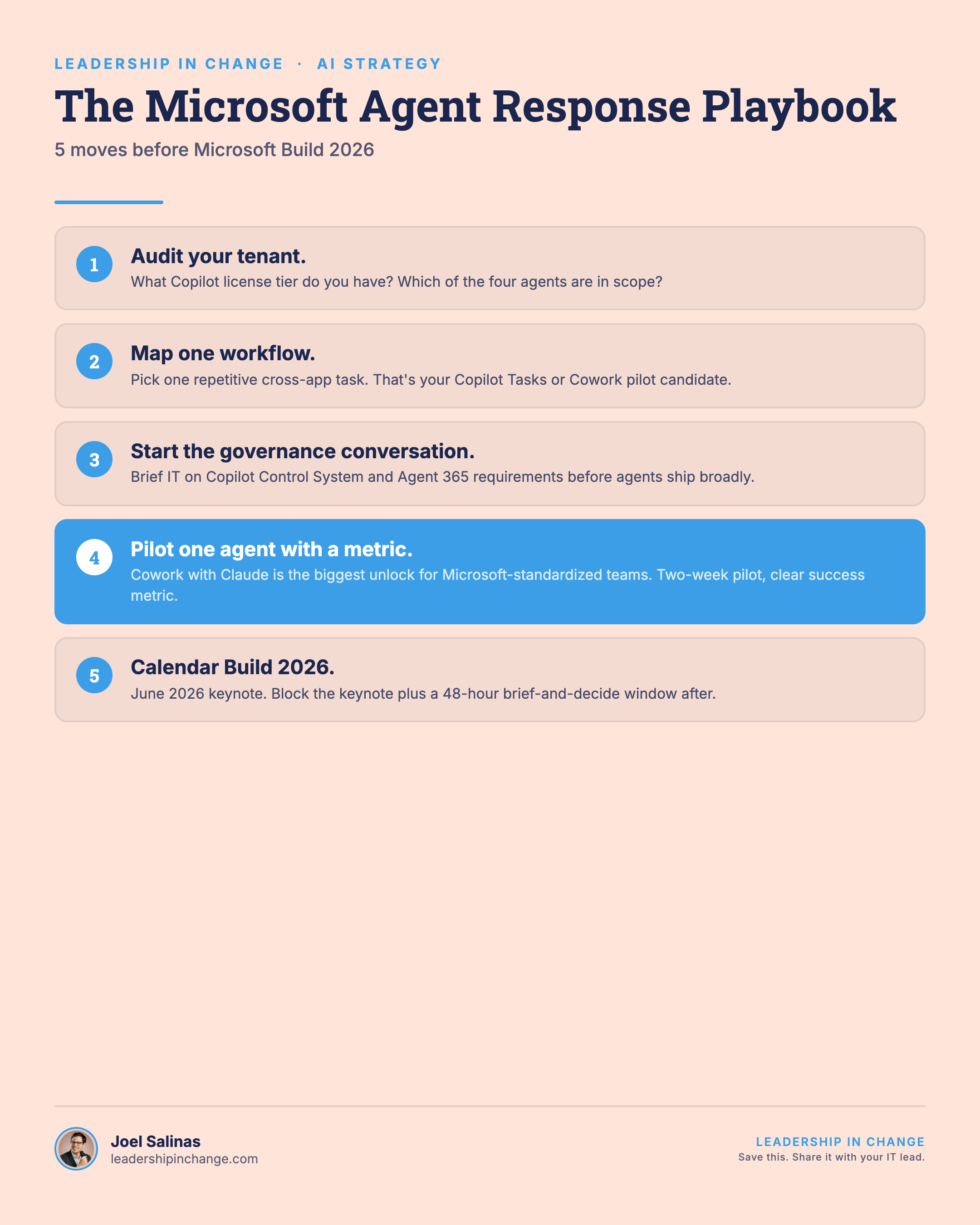
The 5-Step Microsoft Agent Response Playbook
Every agent section above has a Monday action. Here is the consolidated version, ordered by what to do first. (This is also available as the branded checklist below — save it, share it with your IT lead, make it the spine of your next leadership team meeting on AI.)
Questions Leaders Are Asking
What is Microsoft Copilot Cowork and how is it different from regular Copilot? Copilot Cowork, launched March 9, 2026, takes autonomous cross-app actions across Microsoft 365 (drafting in Word, formatting in Excel, posting to Teams) without the user switching apps. Regular Copilot answers questions. Cowork completes multi-step work, and it can run on Anthropic’s Claude as the underlying model, not only GPT.
Can I use Claude inside Microsoft Copilot? Yes, as of March 2026. Microsoft partnered with Anthropic to let enterprise customers select Claude as the model powering Copilot Cowork. Features like “Critique” use Claude to refine GPT output, and “Council” lets users compare both side by side. Standalone Claude still outperforms Copilot on pure reasoning, but Claude-inside-Cowork gives you Claude with your Microsoft 365 data grounded automatically.
Is Copilot worth it in 2026 if Claude and ChatGPT are better models? It depends on your stack. If your organization lives in Microsoft 365, Copilot’s agent layer reaches workflows Claude and ChatGPT cannot touch without significant integration work. Till Freitag’s April 2026 assessment notes Copilot still has quality gaps in Excel and PowerPoint, but Microsoft’s tenant-grounded data access is a real advantage for enterprise teams.
What is Agent 365 and why does it matter for IT leaders? Agent 365 is Microsoft’s governance layer for observing, securing, and managing every agent running inside a Microsoft 365 tenant, whether built in Copilot Studio, shipped by Microsoft, or sourced from third parties. For regulated industries, it is the control plane that makes agent adoption approvable in the first place.
When will Microsoft reveal the new local OpenClaw-style Copilot agent? Microsoft is expected to preview the local, always-on Copilot agent at Microsoft Build 2026 in June. The April 13, 2026 TechCrunch report confirmed Microsoft is testing the capability, with a focus on tighter enterprise security controls than the open-source OpenClaw project.
What is Copilot Tasks used for? Copilot Tasks, released in preview February 26, 2026, runs multi-step actions on behalf of the user on a schedule you define, including organizing email, booking travel, and prepping for recurring meetings. Unlike regular Copilot, which answers questions, Tasks completes actions in the background.
How does Microsoft Copilot compare to Claude and ChatGPT in 2026? Claude and ChatGPT still lead on pure model quality in 2026. Copilot’s advantage is not the model, it is the integration with Microsoft 365 data (SharePoint, Graph, Teams, Outlook) and the ability to run Anthropic’s Claude inside Cowork. For teams standardized on Microsoft, Copilot’s tenant-grounded agent layer reaches workflows that standalone Claude and ChatGPT cannot without significant integration work.
Can small businesses use Microsoft Copilot agents in 2026? Yes, but with caveats. The Frontier Transformation agent suite carries a 300-seat minimum on Enterprise Agreements, which makes it expensive for small and mid-size organizations. Copilot Tasks and Cowork are available at lower license tiers. Smaller teams should focus on Cowork with Claude and Tasks before investing in the larger autonomous agent suite.




Cowork running on Claude inside Microsoft 365 data is the most underreported story in enterprise AI right now.
A 5-step playbook for Copilot agents is exactly the kind of practical content people need right now.