



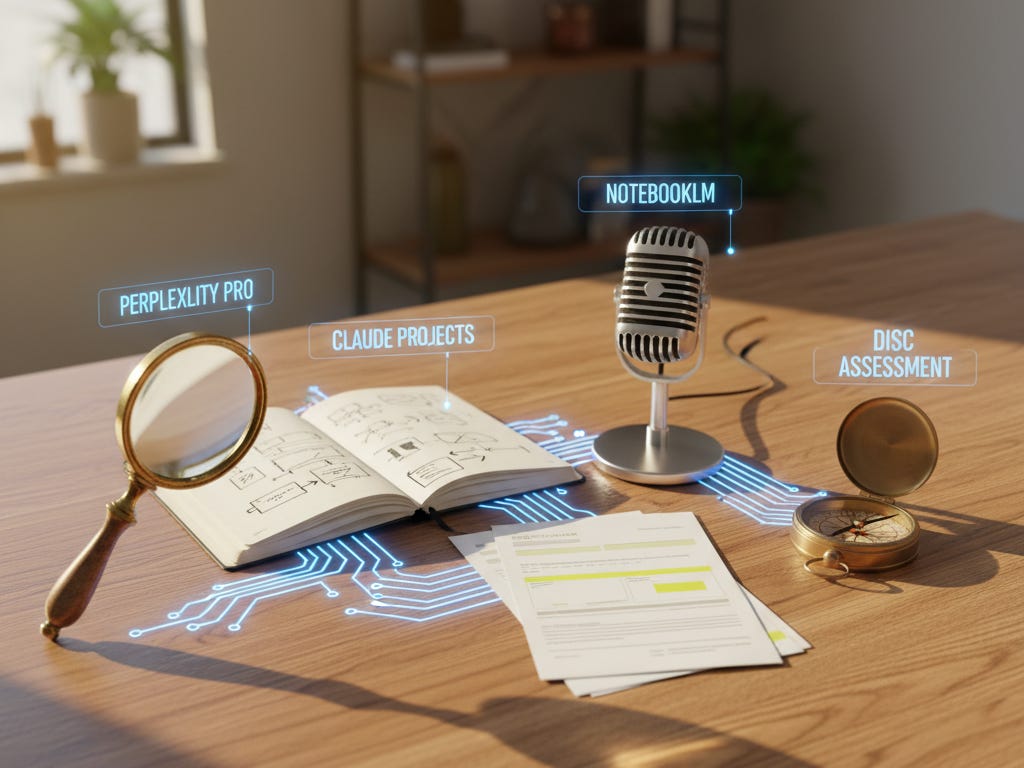
TL;DR: Five AI tools solve specific recurring leadership challenges for product managers transitioning to leadership roles: Perplexity Pro for competitive intelligence research (saving 4-6 hours weekly), Claude Projects for strategic scenario planning, NotebookLM for synthesizing multiple documents into actionable insights, Granola for automated meeting notes that allow full conversational presence, and DISC assessment for identifying communication blind spots. Together they compress a 12-hour strategic analysis into approximately 3 hours.
Before we start, a quick question: Does switching between 100 tabs, note-taking apps, and ChatGPT sound like you?
I was there, 47 tabs open, three PDFs to read, two YouTube videos about a new AI feature, and no time to synthesize it all.
Otio changed that. It’s an AI workspace where you can upload documents, videos, and links, then chat with all of them simultaneously.
Over 200,000 researchers at tier-1 institutions use it as their go-to research AI tool. See why… Try it free here, because, why not?…
There’s a difference between being promoted to leadership and actually knowing how to lead.
I’ve watched it happen dozens of times. A talented individual contributor gets the tap on the shoulder. Suddenly, they are managing a team, and without the right support, within six months, they’re drowning.
The problem isn’t a lack of intelligence or capability. The problem is that nobody tells you the skills that got you promoted are often the wrong skills for the job.
Elena Calvillo understand this well. As a product manager who made the leap to leadership, she discovered something I’ve been teaching mission-driven leaders in every conversation:
AI used well doesn’t replace leadership. It reveals what leadership actually requires.
Elena Calvillo writes Product Release Notes, where she helps product leaders navigate the messy reality of building products in the age of AI. She’s not a leadership guru. She’s someone who made the transition from shipping features to leading teams, made every mistake along the way, and figured out what actually works.
What I appreciate most about Elena’s approach is that she’s not selling AI magic. She’s showing you the tactical implementation and the exact tools, so I asked her to share with all of you in this guest post.

In this post, you’ll learn:
The five AI tools Elena uses daily to handle execution while focusing on leadership
How to research competitive intelligence in minutes instead of hours
A framework for preparing difficult conversations using AI as your thinking partner
Why understanding your communication style matters more than any AI tool
Here is Elena…
There’s a moment every product manager faces when they realize the skills that got them promoted are suddenly the wrong skills for the job.
You were great at execution. You shipped features. You wrote specs. You could crank out a PRD in your sleep.
Then you become a leader, and suddenly none of that matters.
Now you need to think strategically. Delegate effectively. Make decisions with incomplete information. Have difficult conversations you can’t prepare for. And somehow, you’re supposed to do all of this while supporting a team, managing up to executives, and still understanding what’s happening on the ground.
Research shows that 60% of new managers fail within the first 24 months. The transition from individual contributor to leader is one of the hardest career shifts you’ll make.
I know because I’ve been there. And here’s what nobody tells you:
The problem isn’t that you lack leadership skills. The problem is you’re still trying to operate like an IC while doing a leader’s job.
That’s where AI changed everything for me.
Not because AI makes you a better leader (it doesn’t). But because AI handles the execution layer, freeing you to actually lead. Let me show you the five tools that made this possible.
The 5 AI Tools That Transformed My Leadership
1. Perplexity Pro: Your Competitive Intelligence Partner
What it does: Research and competitive analysis in minutes instead of hours.
Why leaders need it: You don’t have time to spend three hours researching a competitor’s strategy before a Monday morning exec meeting. But you also can’t show up uninformed.
Perplexity Pro is like having a research analyst on demand. AI can detect patterns with up to 82% accuracy by analyzing multiple sources simultaneously.
Real example I use:
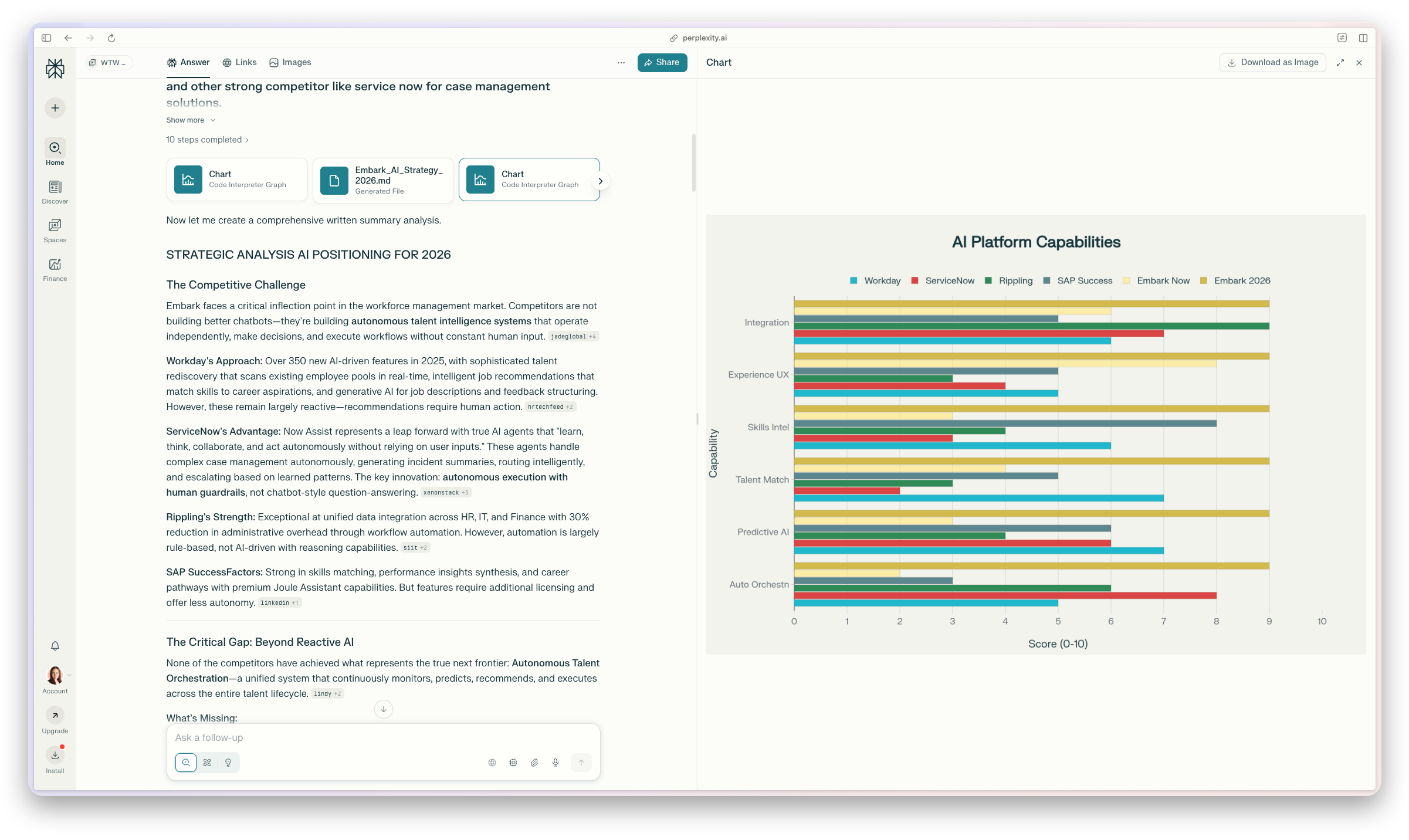
When I needed to understand how competitors were positioning their AI features, I didn’t spend hours clicking through websites and reading blog posts.
I asked Perplexity: “Competitive analysis: How are the top 5 project management tools positioning AI features in 2025? Focus on messaging, pricing strategy, and target audience.”
In 3 minutes, I had:
A clear comparison table
Links to original sources
Pattern recognition I wouldn’t have caught manually
Specific messaging frameworks they’re using
Why this matters for new leaders: You need to make informed decisions quickly. Perplexity gives you the research layer without the time investment. This is critical when you’re learning to delegate because you can’t deep-dive into everything anymore.
Price: $20/month Time saved per week: 4-6 hours of research
2. Claude Projects: Your Strategic Thinking Partner
What it does: Long-form strategic thinking, scenario planning, and decision-making support.
Why leaders need it: The hardest part of leadership isn’t making decisions. It’s thinking through all the scenarios before you decide.
Claude Projects lets you maintain context across multiple conversations. You can build a “strategy project” where all your thinking lives, and Claude remembers everything you’ve discussed.
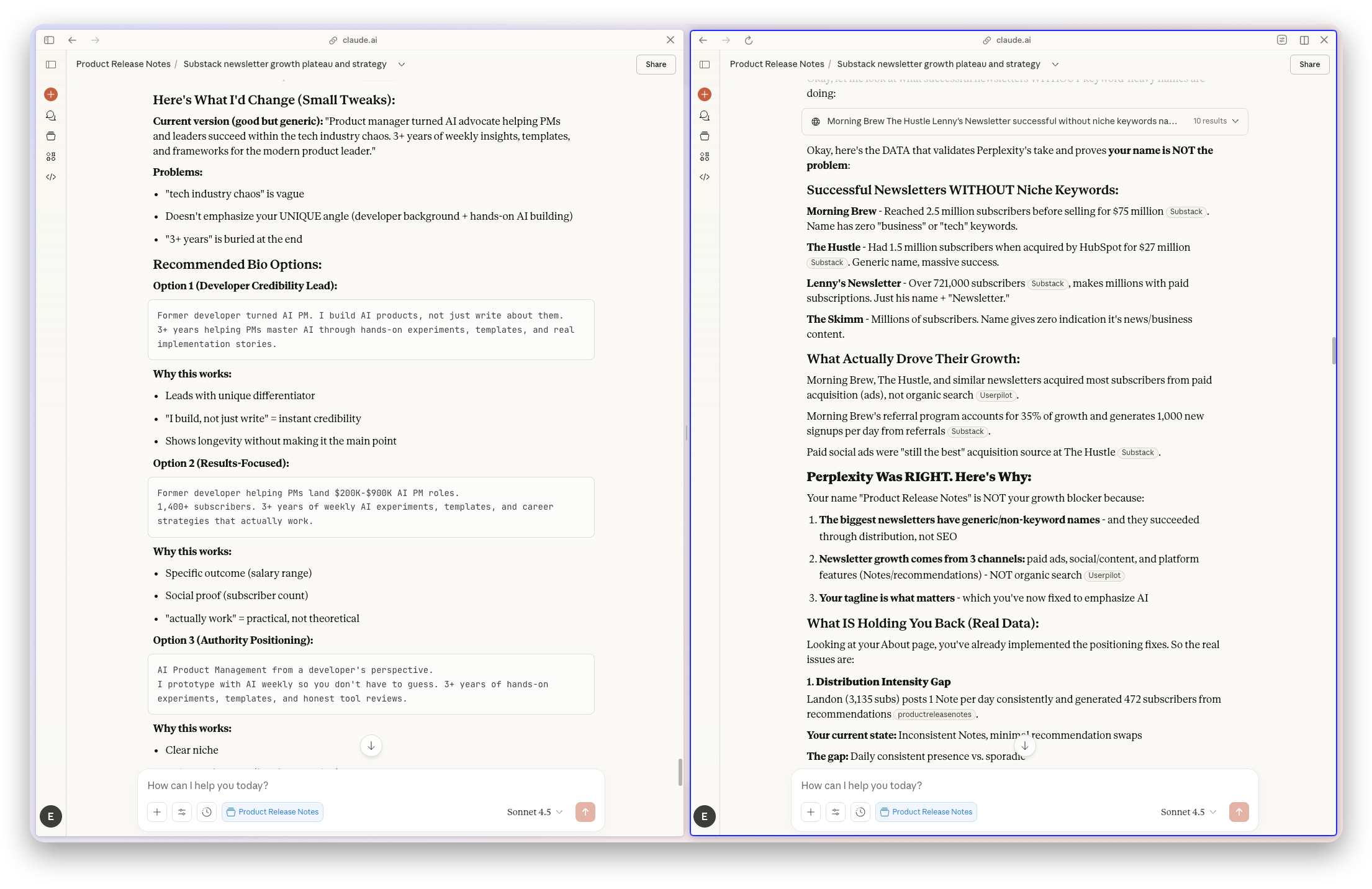
Real example I use:
I created a Claude Project called “Q1 2026 Team Strategy” where I work through:
Team structure decisions
Difficult conversations before I have them
Strategic trade-offs between competing priorities
Communication frameworks for different stakeholders
Here’s a prompt that I used when I switched to managing a new product team:
“I’m transitioning from Product Manager to a leadership role. Help me prepare for my first team all-hands. Context: 8-person product team, main challenge is that we’ve been reactive to sales requests instead of following our roadmap. I need to set a clear direction without demoralizing the team or blaming sales.”
Claude helped me structure:
Opening that acknowledges the problem without blame
Framework for how we’ll evaluate requests going forward
Clear priorities for Q1
How to position this as an opportunity, not a restriction
Why this matters for new leaders: You’re expected to have answers, but you don’t always have time to think them through. Claude Projects gives you a thinking partner who remembers context and helps you work through complexity.
Price: $20/month (Claude Pro) Time saved per week: 3-5 hours of strategic thinking preparation
3. NotebookLM: Your Document Intelligence System
What it does: Processes long documents, reports, and strategic plans into actionable insights.
Why leaders need it: As a leader, you’re drowning in documents. Strategy docs. Market research. Team retrospectives. Board presentations. You can’t read everything deeply, but you need to understand it all.
NotebookLM lets you upload multiple documents and ask questions across all of them. It’s like having a research assistant who’s read everything and can connect dots you’d miss.
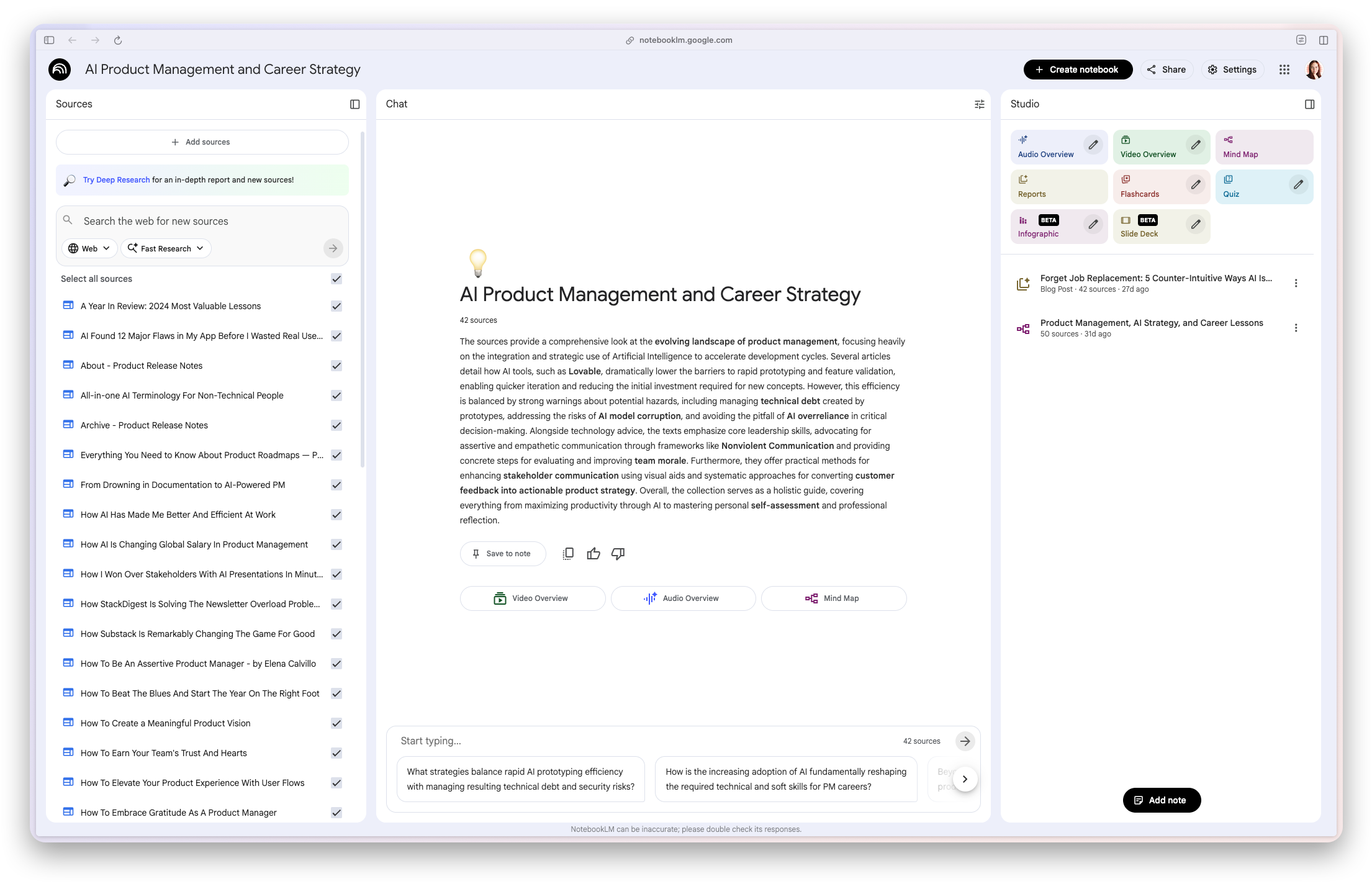
Real example I use:
Before a strategy meeting, I uploaded:
Our annual strategic plan (42 pages)
Competitor analysis reports (3 documents)
Last quarter’s team retrospective
Customer feedback summary
Then I asked: “What are the key strategic priorities mentioned across these documents? Where do they conflict? What patterns emerge in customer feedback that align or contradict our strategy?”
NotebookLM gave me:
Three clear strategic themes
Two areas where team feedback contradicted leadership direction
Specific customer quotes that supported a strategy pivot
Connections between competitor moves and our planned features
Why this matters for new leaders: You need to synthesize information from multiple sources quickly. NotebookLM helps you see patterns and connections that would take hours to identify manually.
Price: Free Time saved per week: 4-6 hours of document review
4. Granola: Your Meeting Intelligence Tool
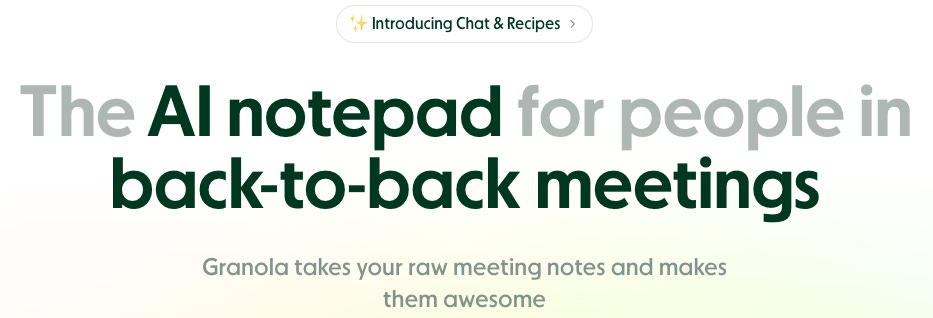
What it does: Automatically captures meeting notes, action items, and decisions without you having to take notes.
Why leaders need it: As a leader, you’re in meetings constantly. 1:1s. Team syncs. Stakeholder updates. Strategy sessions. And you’re expected to remember everything while also being present in the conversation.
Granola runs quietly in the background and generates structured notes after every meeting. But here’s what makes it different from other transcription tools: it understands context and captures decisions, not just words.
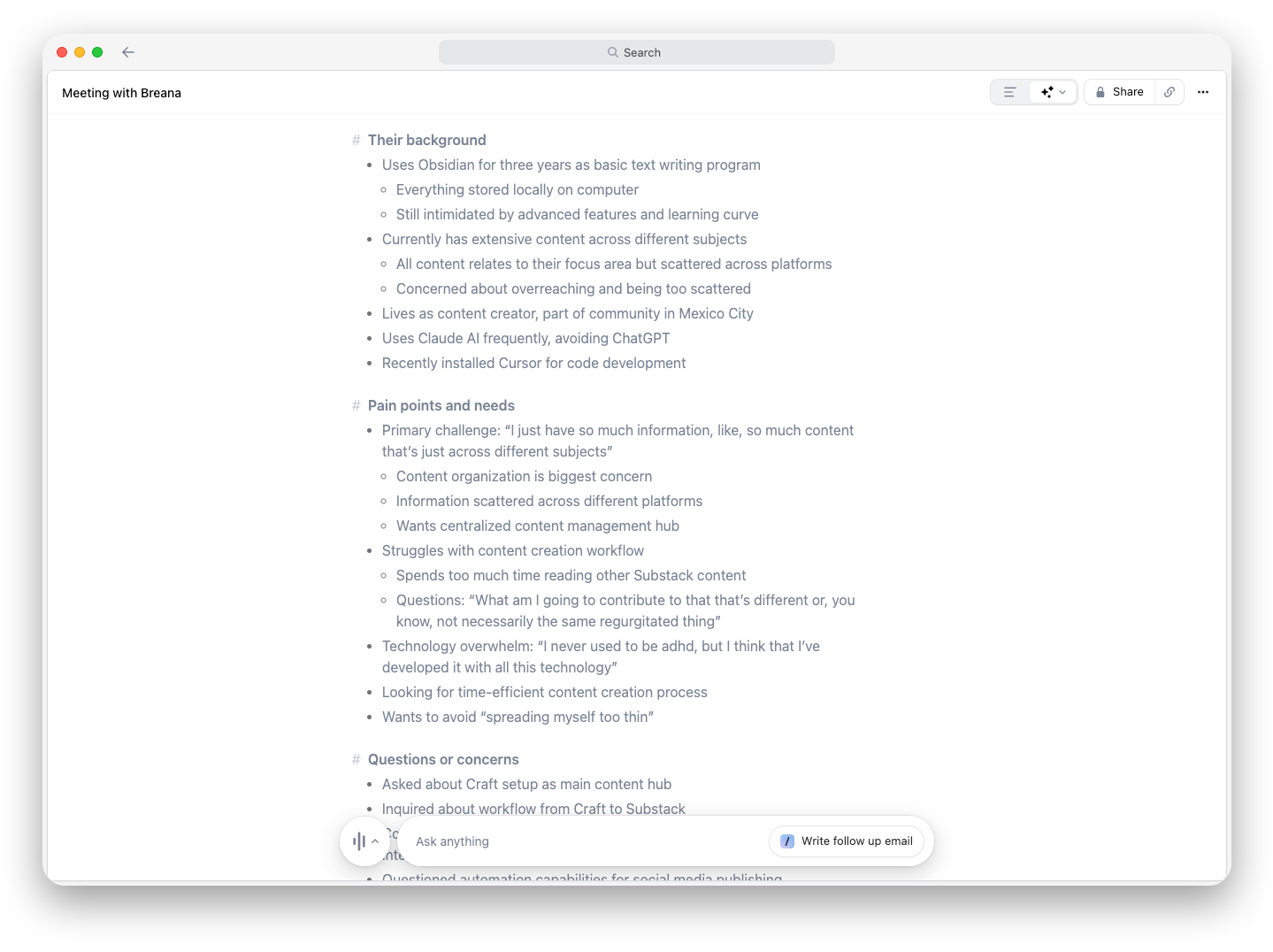
Real example I use:
I use Granola for:
Weekly 1:1s with direct reports (captures their concerns and my commitments)
Mentorship sessions (tracks advice given and follow-up items)
Process walkthroughs with team members
Strategy discussions with other leaders
The game-changer: I can be fully present in conversations instead of frantically taking notes. And after the meeting, I have a structured summary with:
Key decisions made
Action items with owners
Important context that came up
Follow-up questions to address
Why this matters for new leaders: You need to show up present in conversations. When team members feel heard, they trust you. Granola lets you focus on listening instead of documenting.
Price: Free tier available, Pro at $15/month. Time saved per week: 2-3 hours of note-taking and follow-up organization
5. Your DISC Assessment Tool: Fix Your Leadership Blind Spots
Disclaimer: I developed this assessment tool specifically for product leaders. It’s based on the established DISC framework but tailored to address the communication and delegation challenges common in product management roles.
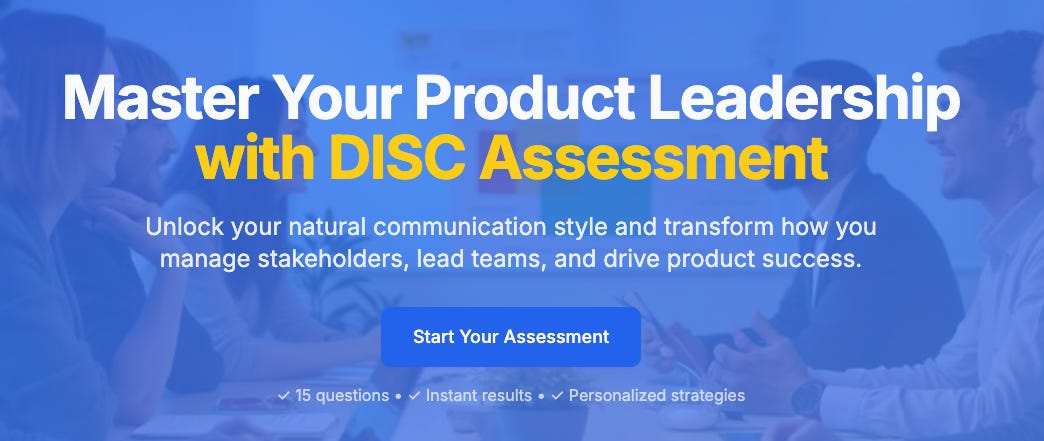
What it does: Identifies your communication style and leadership gaps specific to product management.
Why leaders need it: Here’s a truth nobody talks about: 49% of workplace conflict happens as a result of personality clashes and egos, not strategy disagreements.
As a new leader, you’re trying to figure out why you can’t seem to connect with certain team members, why some stakeholders always push back, and why delegation feels impossible.
The answer isn’t that you’re bad at leadership. It’s that you don’t understand your default communication style and how it clashes with others.
The transition trap:
When you were a PM, you could power through personality differences because you were executing. But as a leader, your job is to communicate, influence, and coach. If you don’t understand your style, you’ll keep hitting the same walls.
How I use it:
I built an AI-powered DISC assessment specifically for product leaders because traditional assessments are generic and useless. Here’s what mine does differently:
Identifies your primary leadership style (Dominance, Influence, Steadiness, Conscientiousness)
Shows your specific blind spots in delegation and communication
Gives you concrete scenarios for how your style handles difficult conversations
Provides adaptation strategies for working with each personality type
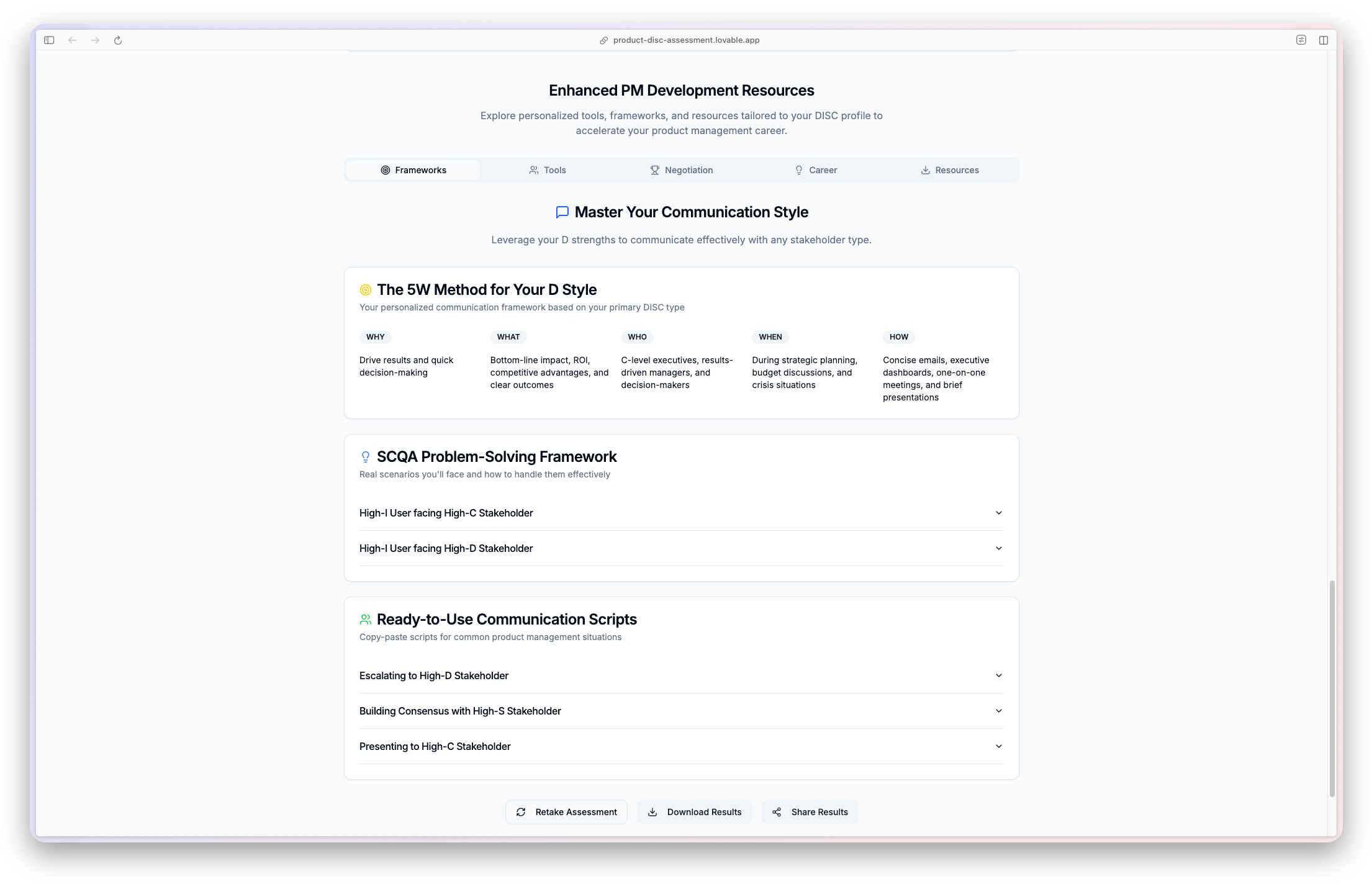
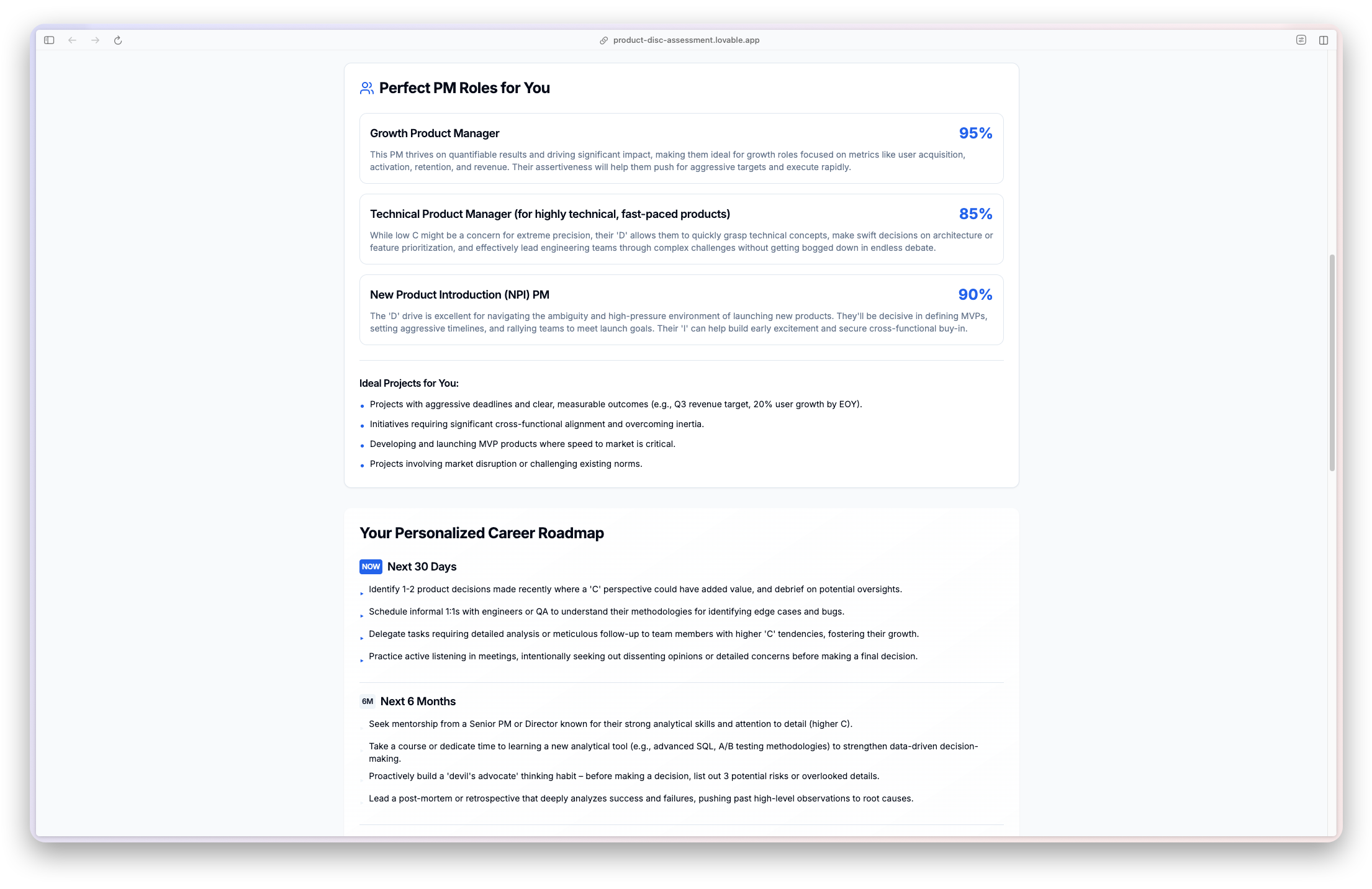
Real example:
I thought I was a strong D-type (decisive, results-driven). Turns out, I’m balanced between D and I (also enthusiastic, idea-driven). This explained why I sometimes struggled between wanting to decide quickly and wanting everyone on board.
Understanding this helped me:
Recognize when I’m avoiding hard decisions by seeking more input
Know when to stop brainstorming and commit
Adapt my communication style based on who I’m talking to
Delegate more effectively by matching tasks to people’s styles
Why this matters for new leaders: You can’t lead effectively if you don’t understand yourself. This tool gives you self-awareness and a playbook for adapting to different people.
Bonus integration with NotebookLM:
Here’s something powerful I discovered: I upload my DISC assessment results into NotebookLM along with notes about my team members’ working styles.
Then before difficult conversations, I ask: “Based on my DISC profile and this team member’s working style, what’s the best way to approach this feedback conversation?”
NotebookLM gives me personalized communication strategies that account for both personalities. This is the kind of coaching you’d normally pay thousands for.
Price: Freemium assessment available at product-disc-assessment.lovable.app Time saved: Prevents countless hours of miscommunication and conflict
How These Tools Work Together: A Real Scenario
Let me show you how I used all five tools for a single leadership challenge: deciding whether to pivot our product strategy mid-quarter.
The situation: A competitor launched a feature that some stakeholders wanted us to copy immediately. My team was already stretched. I had 48 hours to make a recommendation to the executive team.
How I used the stack:
Perplexity Pro (30 minutes): Researched the competitor’s feature, their positioning, early customer reactions, and market analysis of similar features.
Claude Projects (45 minutes): Created a decision framework examining:
Strategic alignment with our roadmap
Resource requirements and opportunity cost
Risks of responding vs. ignoring
Communication strategy for each option
NotebookLM (20 minutes): Uploaded our product strategy, team capacity analysis, and competitor research. Asked: “What does our strategy say about responding to competitor features? How does this align with our stated priorities?”
Granola (during meetings): Captured a quick sync with my lead engineer and a stakeholder conversation without needing to take notes.
DISC Assessment (preparation): Reviewed how to communicate the decision to different stakeholder types (my D-type boss who wants the answer, my S-type team who needs reassurance, my I-type marketing lead who wants the story).
The result: I walked into the exec meeting with:
Clear recommendation backed by data
Three scenario options with trade-offs
Team capacity analysis
Communication plan for all stakeholders
Confidence in my decision-making process
Total time: 3 hours instead of the 12+ hours this would have taken without AI.
Thank you, Elena Calvillo!
Here’s what strikes me about Elena’s approach: she’s not collecting AI tools. She’s solving specific leadership problems.
Perplexity for research. Claude for strategic thinking. NotebookLM for synthesis. Granola for presence. DISC for self-awareness.
Each tool serves one purpose. Each tool solves one recurring problem. This is what I mean when I say productive leaders organize by outcome, not by capability.
The question isn’t “How many AI tools should I use?” The question is “What recurring leadership challenges am I facing, and which tool actually solves that specific problem?”
If You Only Remember This:
AI handles the execution layer (research, documentation, synthesis) so you can focus on what actually requires leadership (strategy, relationships, decisions)
Five focused tools beat twenty scattered subscriptions when each tool solves one specific recurring problem
“You can’t lead effectively if you don’t understand yourself first. Tools make your approach stronger, they don’t fix your blind spots.”
One question for you: What’s the one leadership task you’re still doing manually that’s preventing you from actually leading?
Drop your answer in the comments. I read every response, and your challenge might become the next article.
Ready to discover your leadership blind spots? Take the DISC assessment here: product-disc-assessment.lovable.app
PS: Many subscribers get their Premium membership reimbursed through their company’s professional development $. Use this template to request yours.
Partner and Connect
I love connecting with people. Please use the following connect, collaborate, if you have an idea, or just want to engage further:
LinkedIn / Community Chat / Email / Medium
thank you Otio for sponsoring LiC.
Great list and +1 on Notebook LM! Granola is perhaps the most elegantly designed meeting tool I’ve seen so far, but I’m a renegade when it comes to recorded meetings. I find that transcripts = more information that needs to be managed and curated. Plus, I tend pay much closer attention in meetings when I know that I can’t “find it in the transcript” later. 😆
Thank you for this clear overview of the tool!
I have a question about Granola: when it’s used in a corporate context, how do you handle data confidentiality and sensitive information?