




Thanks for reading! To access our community, full prompt library, coaching, and AI tools saving leaders 5-10 hours per week, check out our Premium Hub.
I’ve read dozens of AI-generated vision statements in the last year.
Every single one was grammatically perfect. Structurally sound. Professionally polished… and every single one could have been written by anyone, about anything, for any organization. GENERIC!
The words were right, but it seemed soulless.
This is the hidden cost of AI efficiency that most leaders miss. You can generate a vision statement in thirty seconds. But you can’t generate the voice that makes people believe it.
Greg Wolford gets this because he’s spent decades teaching fiction writers something mission-driven leaders are just discovering: authentic voice can’t be outsourced.
Authormedia.com surveyed over 1,200 authors trying to cut through the noise and they found that 45% of authors are using some form of generative AI. It’s already here.
But the ones who maintain their audience? They’re not letting AI write for them, they’re using it strategically while keeping their voice intact.
I invited Greg Wolford to write this because he sits at that intersection. He’s a fiction writer who runs Writing in the Age of AI: A Craft-First Approach. Fiction writers have been obsessing over voice for generations. They know the hardest part of writing isn’t grammar or structure. It’s sounding like yourself when the stakes are highest.
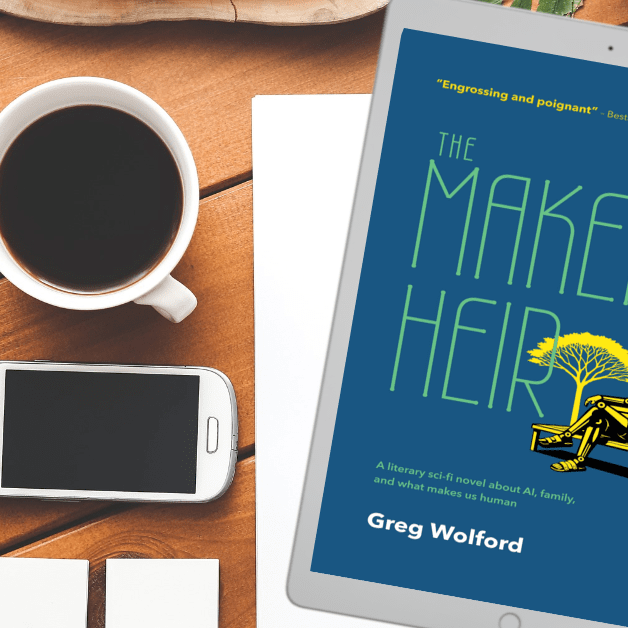
Here’s what strikes me about Greg’s approach. He’s not anti-AI. He uses it. But he’s figured out something critical: AI can be your editor, your assistant, your amplifier. But only you can tell the story.
In this post, you’ll learn:
Why fiction writers develop voice through thousands of pages of practice and what that means for your leadership communication
The Reader Question Framework that transforms generic messages into human connection
When to use AI as a thinking partner and when to write it yourself
If you’ve ever read an AI-generated message and thought “this is good, but it doesn’t sound like us,” Greg will show you why that matters.
Before You Let AI Write Your Vision Statement: What Fiction Writers Know About Authentic Leadership Voice
Your organization’s most important documents—vision statements, values, strategic plans—are increasingly being drafted by AI. But fiction writers have spent decades mastering something leaders are just discovering: authentic voice can’t be outsourced. The question isn’t whether AI can write for you—it’s whether your people will still recognize you when it does.
By Greg Wolford
The Illusion of Efficiency
I’m frequently asked to review vision statements, marketing pitches, and other AI-assisted content. The writing is usually well-structured, has polished grammar, and hits all of the social media taglines.
But they’re all generic.
When I read them aloud, they could belong to any organization doing vaguely good work in a vaguely defined space. The words are correct, but there’s no connection.
This is our paradox: AI makes writing easier and communication harder.
Fiction writers have lived this tension for generations. We know that the most challenging part of writing isn’t grammar, structure, or clarity—it’s voice.
Voice is what transforms information into identity. It’s how the reader knows who’s speaking, what they value, and why it matters. When you lose that voice, no amount of editing can bring it back.
So before you let an algorithm draft your organization’s next vision statement, it’s worth learning what storytellers already know about voice—and how to protect it.

What Fiction Writers Understand About Voice
In fiction workshops, we talk about “voice” the way musicians talk about tone. It’s the difference between a note played perfectly and one played with passion and connection.
A writer’s voice isn’t word choice or syntax. It’s a blend of experience, conviction, and rhythm—what you choose to emphasize and what you leave unsaid. It’s how you sound when you stop performing and say what you mean.
The same is true of leadership. Every organization has a voice shaped by its origin story: the problem it set out to solve, the communities it serves, and the beliefs that drive its people.
That voice is the heartbeat of culture. It’s how stakeholders recognize you in a noisy world.
When you hand that over to an AI system trained on billions of generic documents, you risk replacing identity with averages.
The model’s job is to predict the next likely word. It isn’t trying to sound like you. It’s trying to sound like everyone.
And “everyone” doesn’t build trust, inspire action, or hold a community together through uncertainty.
Leaders, like novelists, earn their voice through their experiences. Why would you want it any other way? The challenges you overcome are what create your value. What value were you adding if a prompt can print out your message?
Your message should be grounded in the trenches of solving problems and helping customers.
Why Mission-Driven Leaders Need Voice More Than Efficiency
Our culture values productivity. It’s a major economic indicator. But what good is productivity without direction? You can make good time, but if you’re driving in the wrong direction, it doesn’t matter.
People want purpose. They want to know that their work matters.
When a CEO or executive director speaks in copy-and-paste corporate language, employees and donors hear the subtext: We’ve lost our way.
A vision statement written entirely by AI might be clear, concise, and even inspiring on paper—but it often lacks what readers instinctively search for: human fingerprints.
That absence triggers a credibility gap. The message may be logical, but it’s hollow. Just as readers can tell when a novel’s narrator rings false, teams can sense when a leader’s words are manufactured.
Authenticity isn’t a luxury brand; it’s a leadership currency. Lose it; you’ll spend months rebuilding trust one conversation at a time.
The Reader Question Framework—for Leaders
As a writer, I rely on the Reader Question to anchor everything I write.
At any moment in a story, the reader is asking, “What happens next—and why should I care?”
The author’s job is to answer that question clearly enough to sustain curiosity, but not so completely that the tension disappears.
The same principle applies to organizational communication. Every audience—employees, customers, board members—is silently asking:
What are you really trying to tell me?
Why are you telling me now?
What does this mean for me?
When your communication doesn’t answer those questions, people tune out.
AI is brilliant at rearranging words. It’s terrible at empathy. It can’t sense what your readers feel or what reassurance they need.
Before using any tool, ask yourself:
What question is my audience asking me right now—and how can I answer it in a way that only we could?
That mindset transforms communication from templated to human.
A Tale of Two Vision Statements
Consider these two versions of the same message from a hypothetical health-care nonprofit.
Version A (AI-Generated):
“We strive to deliver innovative, patient-centered solutions that enhance wellness outcomes, advance equity, and empower communities through accessible, data-driven health initiatives.”
I’m sorry, what?
Version B (Craft-First Revision):
“We believe health begins with trust. Our mission is simple: listen first, act compassionately, and bring care within reach for every neighbor who needs it.”
The second version isn’t perfect, but it sounds like a person. You can picture somebody looking at a neighborhood and wondering where the gaps are.
Let your audience see you in their world. That’s voice. That’s leadership.
AI can assist in polishing the phrasing—but the core message has to come from you.
Using AI as a Thinking Partner—Not a Ghostwriter
Writers who collaborate with AI effectively follow a rule that leaders can borrow: draft first, delegate later.
Use AI to refine, not to originate.
Here’s a simple workflow that keeps the human voice at the center:
Free-write your intent. Don’t edit. Say what you mean, however messy.
Clarify your audience’s question. What are they worried about? Hopeful for? Skeptical of?
Ask AI to organize, not to invent.
Example prompt:Restructure this draft for clarity and flow, but keep my tone and phrasing wherever possible. Highlight any jargon or clichés that weaken authenticity.Reclaim the emotional beats. Re-insert your phrasing, idioms, or stories that sound like you.
Read it aloud. If you can’t imagine saying it in a meeting, rewrite until you can.
This process turns AI into an intelligent mirror. It reflects your thinking, stripped of clutter, without erasing personality.
The difference between a collaborator and a ghostwriter is simple: a collaborator helps you think; a ghostwriter replaces you.
Leaders can’t afford to be replaced in their own voice.
Brought to you by COZORA👇, learn AI live!
During December, all Subscribers get 30% with code HOLIDAY30 ($210 off!!)

The Craft-First Communication Process
Here’s a step-by-step framework drawn from fiction technique and adapted for mission-driven organizations.
1. Begin with the “Why.”
Before any prompt, articulate your reason for communicating. Why now? Why this message? Why you?
Simon Sinek was right: people don’t buy what you do—they buy why you do it. AI can’t supply the why.
2. Identify the emotional core.
In storytelling, this is called the controlling idea—the feeling or truth the story proves. In leadership writing, it’s the emotion you want your audience to carry away: hope, urgency, belonging, resolve.
Ask AI to strengthen logic and flow later, but guard that emotion.
3. Draft as if you’re speaking to one person.
Every good novelist writes to a single reader. Choose yours—a skeptical board chair, a burned-out frontline worker, a hopeful donor—and write directly to them.
AI drafts tend toward pluralization: “our stakeholders,” “our customers,” “our partners.” Your goal is personalization: “you,” “we,” “together.”
4. Invite AI in for the edit.
Once you have a human draft, use prompts like:
“Help me tighten this message without losing warmth.”
“Highlight any phrases that sound corporate rather than personal.”
“Suggest ways to make this read like a conversation instead of a press release.”
You’ll get mechanical suggestions—some useful, some tone-deaf. Keep the ones that make your voice clearer, not cleaner.
5. Validate with real humans.
In fiction, beta readers catch what the author can’t see. In leadership, that’s your trusted circle.
Ask them:
“Does this sound like us?”
“Would you believe this if you didn’t know who wrote it?”
Authenticity is a team sport.
Why Voice Is a Leadership Discipline
Fiction writers develop voice through repetition—thousands of pages written and discarded until what’s left sounds undeniably theirs.
Leaders can cultivate their voice the same way: through reflection, writing, and iteration.
Try this small practice:
Write your organization’s purpose in 100 words.
Now cut it to 50 words without losing meaning.
Then explain it in a single sentence you’d be proud to say out loud.
You’ll notice that clarity isn’t the same as compression. The fewer words you use, the more every word must sound like you.
That’s the paradox of leadership writing: constraints reveal authenticity.
AI can accelerate drafts, but it can’t accelerate self-knowledge.
When to Use AI—and When to Leave It Alone
Use AI for:
Research and synthesis. Gathering background information, data, or examples.
Formatting and consistency. Style sheets, tone checks, proofreading.
Brainstorming contrasts. Ask for “five alternative metaphors” or “three ways to frame this challenge.”
Avoid AI for:
Vision, values, or ethics statements. These define identity; they must originate with humans.
Crisis communication. AI can’t gauge tone or timing under pressure.
Promises. Never let a model draft commitments you’ll have to keep.
A good rule of thumb: if a message will outlast a fiscal quarter, write it yourself.
Reclaiming the Human Advantage
C.S. Lewis wrote, “We read to know we are not alone.”
Leadership communication works the same way.
People don’t remember mission statements; they remember moments when a leader’s words made them feel seen, safe, or inspired.
AI can manage the structure, but it fakes sincerity.
The more technology mediates our interactions, the more people crave the unpolished sound of a human being thinking out loud.
The Story Beneath the Strategy
At the end of every great novel, the reader feels that they’ve met a person, not read a script.
Your employees, donors, and stakeholders deserve the same.
When they read your vision statement, they should feel like they’ve met you personally.
The goal of leadership writing isn’t to impress; it’s to connect. And connection—like craft—requires intention, patience, and humanity.
AI can be your editor, your assistant, and your amplifier.
But only you can tell the story.
In a world where machines can mimic our words, the real craft is learning how to sound unmistakably human. That’s what I write about each week at Writing in the Age of AI: A Craft-First Approach—a newsletter about storytelling, leadership, and the tools that shape our voice.
You can find it at gregwolford.substack.com.
Here’s what Greg Wolford shows, the problem isn’t the tool. The problem is who’s holding it.
When you hand AI a blank page and say “write my vision statement,” you’re not using a tool. You’re giving up responsibility.
But when you draft your message first, messy and human and true, then ask AI to help you clarify it without erasing you? That’s leadership.
Draft first. Delegate later.
If You Only Remember This:
AI makes writing easier and communication harder because it replaces identity with averages
People don’t remember mission statements, they remember moments when a leader’s words made them feel seen
Use AI to refine, not to originate. Draft your intent first, then use AI to organize and clarify
One question for you: When was the last time you read your organization’s vision statement out loud and felt like it actually sounded like you?
PS: Many subscribers get their Premium membership reimbursed through their company’s professional development $. Use this template to request yours.
Partner and Connect
I love connecting with people. Please use the following connect, collaborate, if you have an idea, or just want to engage further:
LinkedIn / Community Chat / Email / Medium
Leaders connect more when their words carry the fingerprints of their own story.
This is the right rule: AI is a copilot.
Use it for research, structure, and consistency, and for pressure-testing your draft.
Do not outsource vision, values, or commitments.