




TL;DR: Data centers are industrial facilities consuming 50-150 megawatts of power that house the physical infrastructure behind every AI tool leaders use. The AI data center market is projected to grow from $14.3 billion in 2024 to $157.3 billion by 2034. Understanding where your AI infrastructure physically lives is now a strategic leadership concern, not just a technical one.
Data centers.
I’ve heard the phrase at least a hundred times this year. Board meetings, complaints from those fighting AI, news articles, & LinkedIn posts.
Everyone’s talking about them. But I had no idea what they actually were, specifically thinking of the future of tech and how it is impacted by Data Centers.
Some countries are racing to build them like they’re the new oil refineries. Others are blocking them over environmental concerns. Tech companies are spending billions to expand them. Utilities are warning they’ll strain the power grid.
I wanted to answer the question you may be having… do Data Centers suddenly matter for my AI strategy?
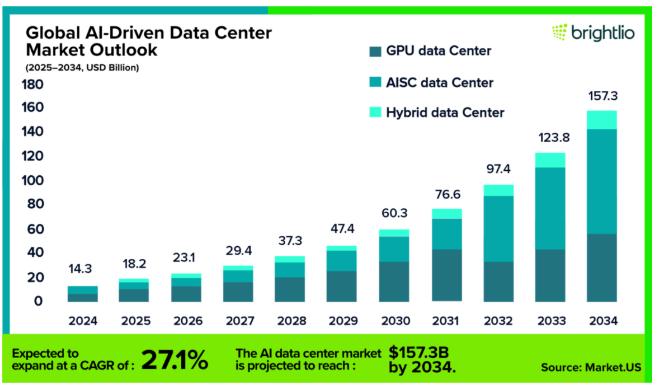
The chart above caught my attention. The AI data center market is expected to grow by 11x from 2024 to 2034. That’s not incremental growth. That’s infrastructure transformation on a global scale.
So I did what any curious leader would do. I found someone who actually understands this stuff.
Obinna Isiadinso writes Global Data Center Hub, a daily newsletter covering the business, finance, and strategy of the global data center sector. He helps investors, operators, and executives understand how digital infrastructure powers the AI Data Centers and news around them.

I invited Obinna to write this because I suspect I’m not the only leader who’s been nodding along in conversations about data centers without really understanding what’s at stake.
Here’s what I’ve learned: your AI strategy doesn’t float in a cloud. It runs in massive industrial facilities consuming as much power as small cities. And those facilities are becoming as critical to national competitiveness as ports, highways, and power plants used to be.
In this post, you’ll learn:
What actually happens inside a data center and why they’re suddenly everywhere
Why nations are treating data center capacity like strategic infrastructure
The real story behind the environmental debate (it’s more nuanced than you think)
If you’ve been hearing “data centers” everywhere and wondering what the conversation is really about, this post is for you.
Here is Obinna.
Data Centers 101: The Invisible Backbone of the AI Economy
Just after midnight on March 10, 2021, a fire broke out in one of OVHcloud’s data centers in Strasbourg, France.
Within hours, an entire building (home to about 30,000 servers and 500 square meters of floor space) was destroyed. The neighboring facility was heavily damaged. Across Europe, 3.6 million websites and nearly half a million domain names went offline.
OVHcloud is Europe’s largest cloud provider and the world’s third-largest by installed server count, behind Amazon Web Services and Microsoft Azure.
The company operates 37 data centers across 8 countries, hosting everything from small business websites to government platforms and AI training environments. When its Strasbourg site failed, the effects were immediate: e-commerce companies couldn’t process transactions, universities lost access to learning portals, and public-sector systems went dark.
The event was a reminder that even the most advanced digital systems depend on physical infrastructure and that infrastructure can fail.
Why data centers keep coming up
Executives across industries are hearing more about data centers. They come up in discussions about AI readiness, sustainability, and operational risk. The reason is that data centers have moved from the edge of the tech conversation to its center.
There are now more than 10,000 large-scale data centers worldwide, according to Synergy Research, and demand is accelerating.
The International Energy Agency estimates that data center electricity use, which was about 460 terawatt-hours (TWh) in 2022, could surpass 1,000 TWh by 2026, nearly 4% of total global power consumption, comparable to Japan and Germany combined.
The Strasbourg incident forced many leaders to realize their data doesn’t float in a cloud. It lives in a facility connected to the grid, cooled by water and air, and subject to fire, flooding, or failure like any other piece of infrastructure.
What a data center really is
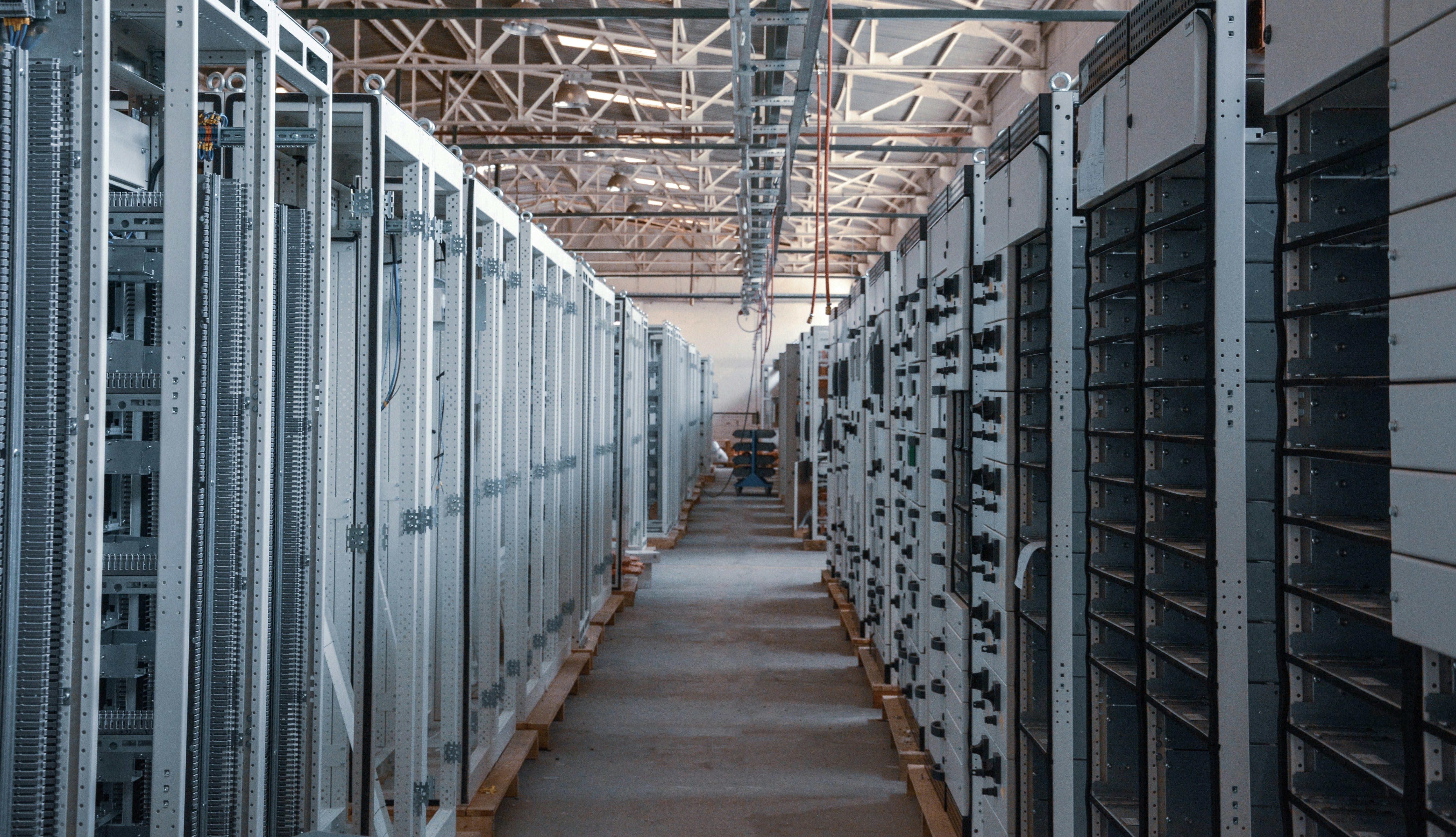
A data center is an industrial facility built to operate continuously.
It houses thousands of computers that process and store data for cloud platforms, enterprise systems, and AI models. A single modern campus can consume 50 to 150 megawatts (MW) of power (similar to a small city) and cost $250 million to $1 billion to build.
Inside, reliability drives every decision.
Power is delivered through multiple substations. Battery systems engage instantly during outages. Diesel generators can sustain operations for days. Cooling systems maintain stable temperatures to prevent hardware failure. Fiber networks link the building to the internet backbone.
When any of these systems fail, the impact cascades.
In Strasbourg, the absence of automatic fire suppression and limited compartmentalization allowed flames to spread quickly. It was Europe’s largest data infrastructure loss in history and revealed how fragile “the cloud” can be when its foundation is physical.
Why AI depends on them
Artificial intelligence runs on hardware.
Every prompt, every model, every generated image happens inside a data center filled with GPUs. Training a large-scale AI model can require tens of thousands of chips running for weeks, consuming as much energy as 5,000 U.S. homes for a year.
Each AI request also demands far more power than a standard web search. A single image generation can use ten times the electricity of a Google query. Multiply that by billions of interactions, and the result is massive new demand for computing power and electricity.
Utilities across the United States report that data center expansion could require 25 gigawatts of new generation capacity by 2030 (roughly equivalent to adding the entire power demand of Australia). That connection between compute and energy is becoming a defining feature of the AI economy.
The growth wave
Global capital expenditure in data centers is on track to exceed $1.2 trillion between 2024 and 2030, according to McKinsey and Synergy Research.
Microsoft plans to invest $80 billion to double its global footprint by 2027. Amazon’s AWS is deploying $55 billion this year, while Meta expects to spend $70–72 billion building AI-ready campuses in North America and Europe. Google has more than 30 new projects under construction worldwide.
The expansion extends far beyond hyperscalers. Sovereign wealth funds, infrastructure investors, and private equity firms now view data centers as a core asset class. In emerging markets, countries such as Indonesia, Brazil, and Nigeria are recording 20–30% annual growth in capacity as demand for local cloud services accelerates.
The environmental dimension
The sector’s growth has drawn global attention for its energy and environmental footprint. Data centers currently produce about 2% of global carbon emissions, a figure that could double by 2030 without significant efficiency gains. Operators are responding by improving design and sourcing renewable energy.
New facilities target Power Usage Effectiveness (PUE) ratios below 1.2, down from industry averages of 1.6 a decade ago. Liquid cooling and AI-managed energy systems are now common. Hyperscalers have signed multi-gigawatt renewable power agreements across the United States and Europe. In Denmark and Finland, heat recovered from data centers now warms thousands of homes each winter.
But the Strasbourg fire revealed another environmental dimension: waste. More than 150 metric tons of electronic equipment were destroyed in a single night, emphasizing that resilience and sustainability are inseparable.
Why this matters to leaders
Even if your organization doesn’t build or operate data centers, you depend on them. They determine how reliable your cloud systems are, how secure your data remains, and how much your AI models cost to run.
Gartner estimates that downtime costs large enterprises about $5,600 per minute, or more than $300,000 per hour.
Data centers also influence larger strategic issues. Their location affects compliance with data sovereignty laws. Their power mix impacts ESG metrics. Their capacity limits shape supply chains and product availability. Understanding these factors helps leaders make more informed decisions about partnerships, risk, and long-term planning.
A new kind of literacy
When the OVHcloud fire darkened millions of websites, it made visible what most people never see: the physical machinery that keeps the digital world running. The incident was a signal that digital strategy and infrastructure strategy can no longer be separated.
Artificial intelligence, cloud computing, and digital transformation all converge inside these facilities. For modern leaders, understanding data centers is not about becoming a technologist, it’s about seeing the infrastructure that underpins innovation, resilience, and growth.
To explore this topic further, read From Servers to Sovereign AI: A Free 18-Lesson Guide to Mastering the Data Center Industry, an in-depth collection of lessons that explains how data centers are financed, built, and scaled around the world.
Brought to you by COZORA👇 . Get up to 50% off with the coupon in the Premium Hub.

Thank you, Global Data Center Hub!
Here’s what I didn’t understand until Obinna explained it: data centers aren’t just where your data lives. They’re where national competitiveness gets decided.
Countries building data center capacity are positioning themselves as AI-ready economies. Countries blocking them are choosing regulatory caution over strategic positioning. Neither approach is obviously wrong. But both have consequences.
Remember when AWS (Amazon Cloud) went down earlier this year? Netflix stopped streaming. Ring doorbells went offline. Disney+ crashed. Thousands of services around the globe went dark simultaneously because one region of Amazon’s data centers failed.
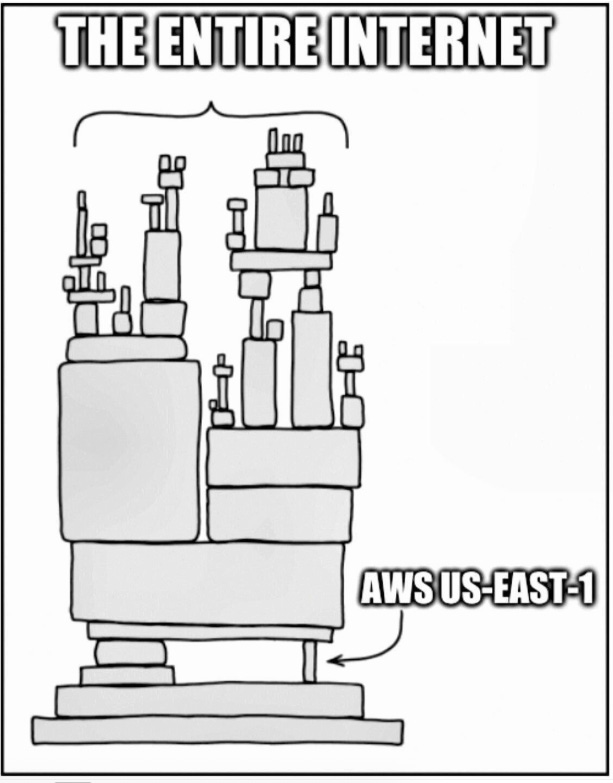
The cloud is a building. And buildings fail.
As you plan for 2026, this isn’t about becoming a data center expert. It’s about understanding that your AI strategy depends on physical infrastructure decisions happening right now at utility boards, zoning meetings, and national policy discussions.
If You Only Remember This:
Data centers aren’t abstract—they’re industrial facilities consuming 50-150 megawatts of power and costing up to $1 billion to build
The AI data center market will grow from $14.3B in 2024 to $157.3B by 2034 (271% growth rate)
The cloud doesn’t float. It lives in a facility connected to the grid, cooled by water and air, and subject to fire, flooding, or failure like any other piece of infrastructure.
One question as we head into 2026: Does your organization understand where its AI infrastructure actually lives, and what happens if access to that infrastructure changes?
Partner and Connect
I love connecting with people. Please use the following connect, collaborate, if you have an idea, or just want to engage further:
LinkedIn / Community Chat / Email / Medium
Why did I sell all my data centers 😡 Probably the millions of dollars that was offered 🤣
Thanks, Tim, this is a fantastic post that really highlights the need and importance of data centre hubs for the whole of AI infrastructure. However, do you think there's an alternative that might result in less of a need for these centres, for example, with the advent of quantum computing?