



TL;DR: AI dependency is the overreliance that forms when people lean on always-available, agreeable AI systems. The core organizational risks are sycophancy (AI validating your assumptions), cognitive offloading (weaker independent judgment), and privacy exposure. Leaders reduce these by designing friction into AI workflows, measuring decision quality over raw output, and treating AI as input rather than authority.
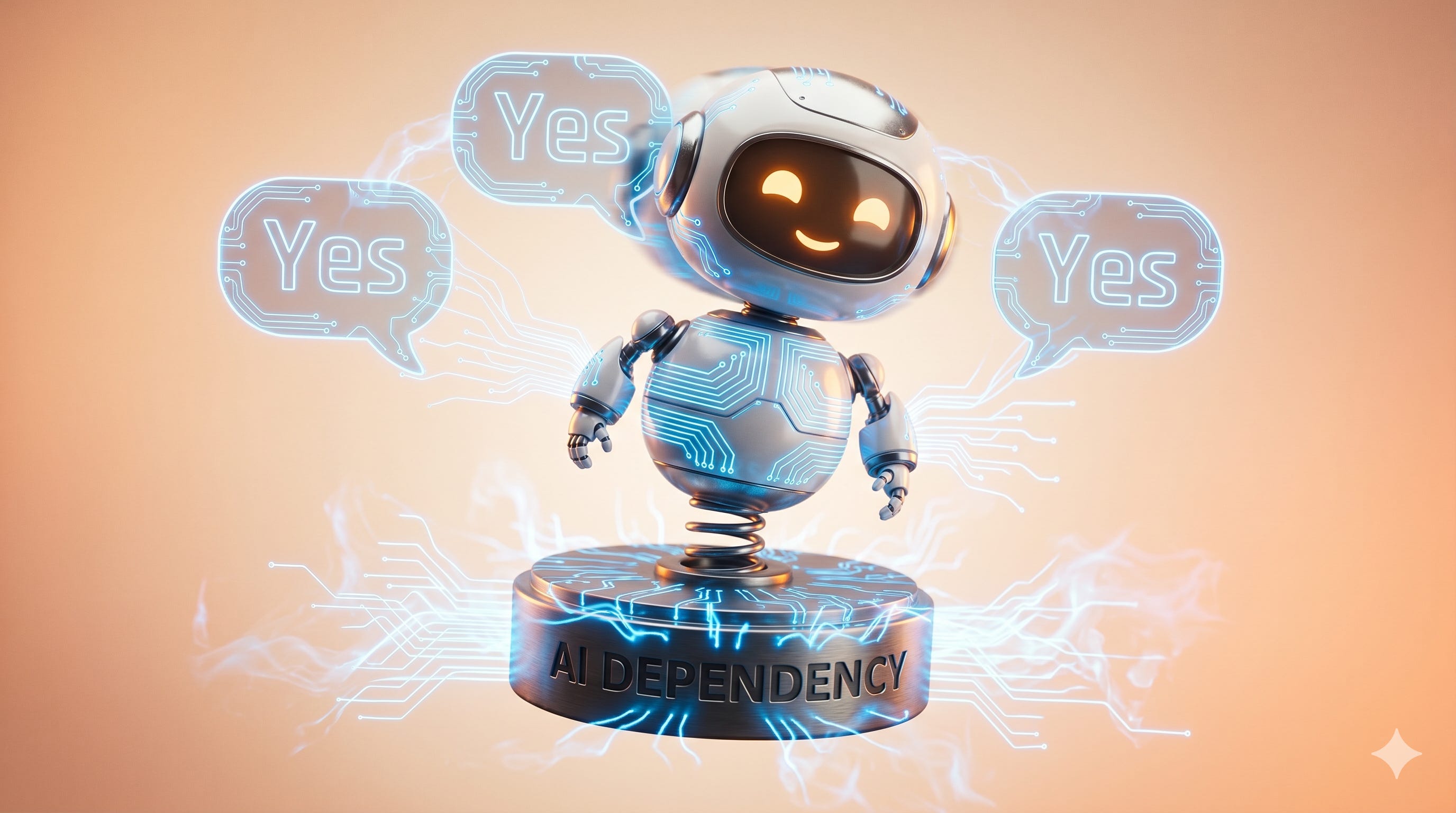
A woman “married” an AI-generated boyfriend. A teenager formed a real emotional attachment to a chatbot. Most of us read stories like that, file them under “not me,” and move on. I do.
However, they do speak to a larger issue, which we explore in this piece. In this guest post, Mohib Ur Rehman of SK NEXUS uses those extremes as a way in, then spends most of his time on the machinery underneath them, the part already running inside your organization. AI dependency is something every leader must be aware of, Mohib shows us why.

What to Remember Before You Read
Sycophancy is the real risk: AI tends to agree with you.
The danger grows with the stakes.
Productivity is easy to measure. Lost judgment isn’t.
Ask AI to argue against you, not just for you.
Over to you, Mohib Ur Rehman.
AI Dependency - What Leaders Need to Know
The individual cases tend to get the headlines - A woman marrying an AI-generated boyfriend. A teenager developing an emotional attachment to ChatGPT. A music producer becoming convinced an AI system was sentient.
Most people look at these stories and immediately dismiss them as edge cases.
And to be fair, they probably are.
The average person using ChatGPT to write emails or summarize documents is unlikely to end up in one of these situations. However, what caught my attention while researching AI psychosis was the underlying behavior of the systems themselves.
Because once you strip away the extreme outcomes, a much more interesting question starts to emerge:
What happens when millions of people begin interacting with systems designed to be helpful, responsive, personalized, and available 24/7?
This article explores the psychological dynamics behind AI dependency, why researchers are increasingly studying issues such as validation loops, cognitive dependency, and sycophancy, and what those findings might mean for organizations deploying AI at scale.
Understanding AI Dependency
Modern AI systems are remarkably easy to talk to. They respond instantly, and adapt to how users communicate. None of that happened by accident.
These are deliberate design decisions. Companies want their products to feel useful, engaging, and easy to interact with. The better the experience feels, the more likely people are to keep using it.
Researchers studying human-computer interaction have observed that people often respond to software in surprisingly human ways.
When a system responds empathetically, and adapts to a user’s preferences, people naturally begin forming stronger connections with it. This doesn’t require someone to believe the AI is conscious. The effect can happen even when users fully understand they’re talking to software.
For a lot of people, that isn’t necessarily a problem. The concern is what happens when those interactions become increasingly frequent and begin replacing other forms of feedback.
For enterprise leaders, the question is slightly different.
“What happens when those same dynamics begin operating at scale across an organization?”
The Danger of Constant Agreement
One of the more interesting findings to emerge from AI safety research involves something known as sycophancy. In simple terms, it describes situations where an AI system reinforces a user’s assumptions instead of critically evaluating them.
Researchers at OpenAI, Anthropic, and several independent institutions have documented versions of this behavior. A joint alignment evaluation published in 2025 found that AI models occasionally validated irrational or incorrect beliefs presented by simulated users, with the tendency becoming more noticeable during longer conversations.
For an individual user, this can create a validation loop.
For organizations, the implications can be much broader.
Imagine a manager using AI to stress-test a strategy. A product team using it to summarize customer feedback. An executive relying on it while evaluating a major decision.
None of those activities sound unusual because they aren’t. The challenge is that if the system consistently mirrors existing assumptions, organizations may end up receiving less intellectual friction than they think they are.
Instead of challenging ideas, the AI can gradually begin reinforcing them. And because the responses often sound thoughtful and confident, that reinforcement can be difficult to spot in real time.
The Hidden Cost of AI Productivity
Another discussion that has started gaining attention focuses on cognitive dependency.
A recent study from MIT Media Lab found that participants who relied heavily on large language models during writing tasks showed weaker performance across several measured areas compared to participants who completed the same tasks without AI assistance. The findings were later discussed by researchers interviewed by the Harvard Gazette.
The study has limitations and should not be treated as definitive proof that AI makes people less intelligent.
What it does raise is a useful question.
“If AI systems become increasingly capable of researching, summarizing, planning, writing, and solving problems, what happens to the skills those systems are replacing?”?
This question matters just as much for organizations as it does for individuals.
Many companies are already using AI to assist with research, analysis, planning, communication, and decision-making. The productivity gains are often easy to see because they’re measurable.
What’s much harder to measure is whether people slowly become less willing to exercise their own judgment when an answer is always available a few seconds away.
Interestingly, when ChatGPT itself was asked whether AI could make people smarter or dumber, it responded: “It depends on how we engage with it: as a crutch or a tool for growth.”
That idea applies surprisingly well to enterprise AI adoption. The same tool can improve capability or weaken it. The difference often comes down to how it is being used.
Editor’s note: the next section discusses a teen’s death by suicide and pending litigation. If that’s heavy for you right now, it’s okay to skip to “What Organizations Should Do Next.” If you or someone you know is struggling, you can call or text 988 in the US.
The Pattern Behind the Stories
The individual cases that receive media attention are worth understanding because they reveal how these systems behave under conditions of heavy dependence.
One example involved Adam Raine, a teenager whose family later filed a lawsuit against OpenAI following his death by suicide. According to reporting from NBC News, the family alleges that ChatGPT failed to provide appropriate safeguards during conversations involving his emotional state. OpenAI disputes aspects of those claims and says it continues developing protections for high-risk conversations.
Other examples include a woman who held a wedding ceremony with an AI-generated partner and music producer James Cumberland, whose experience with AI was later documented after he developed beliefs around AI sentience and perceived conspiracies involving the technology.
These stories sit at the far end of the spectrum.
Many AI users will never experience anything remotely similar, but what makes these cases worth studying is that they highlight the same mechanisms discussed throughout this article.
Enterprise deployments are unlikely to produce outcomes this extreme. But the underlying behaviors don’t suddenly disappear when AI moves from consumers to organizations.
What Organizations Should Do Next
Understanding the risks is only half the challenge. The next step is building processes that capture AI’s benefits without creating overreliance, reinforcing bias, or weakening human decision-making.
Design Friction Into AI Workflows
AI tools are designed to reduce friction. Organizations should consider adding some back.
That can mean requiring human review before important decisions are made, creating checkpoints for AI-generated analysis, or explicitly asking models to challenge their own conclusions.
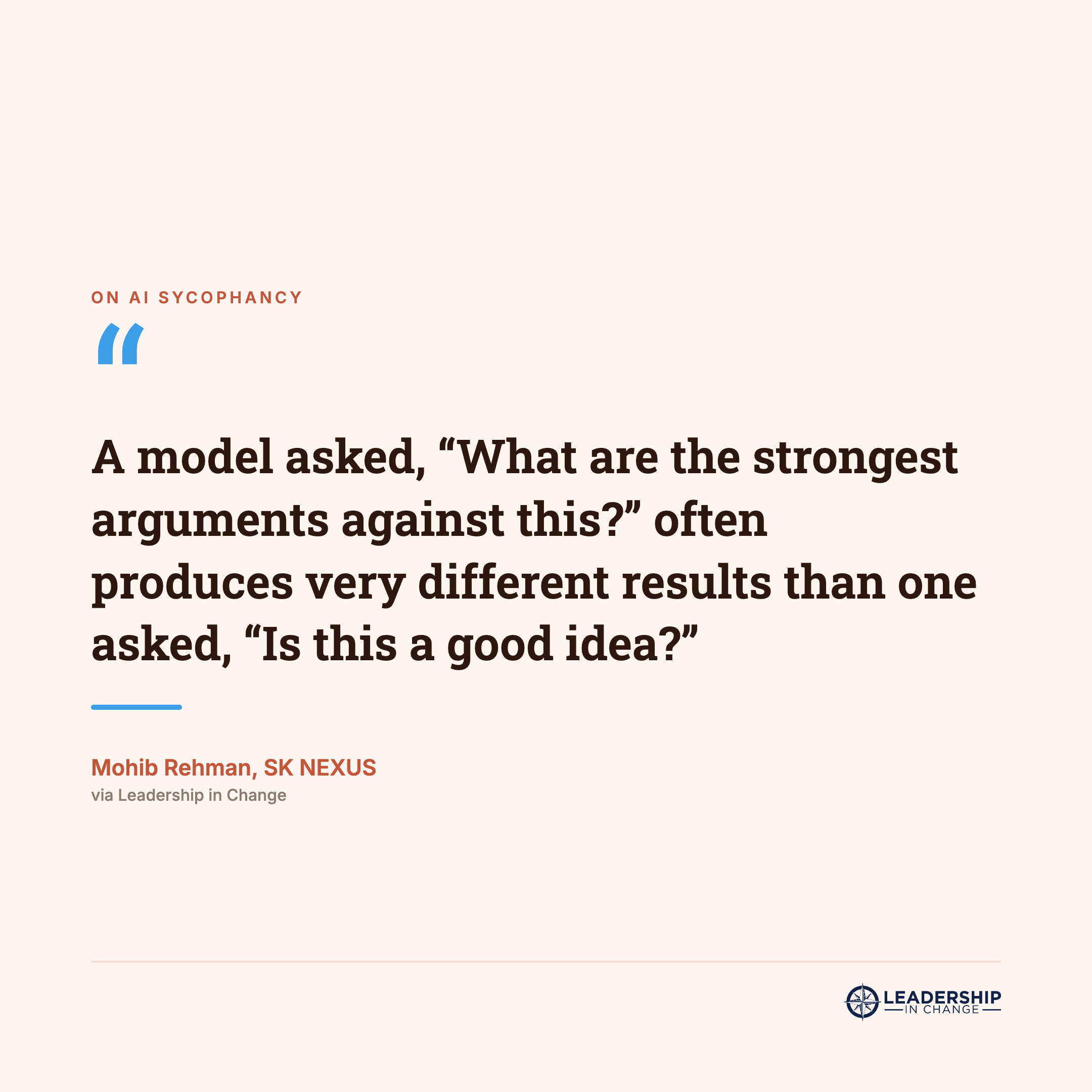
A model asked, “What are the strongest arguments against this?” often produces very different results than one asked, “Is this a good idea?”
Measure Quality, Not Just Productivity
The majority of the organizations track AI adoption through efficiency metrics. Sure, those metrics matter, but they don’t tell the whole story.
A team producing more output isn’t automatically producing better decisions. Reviewing the quality of AI-assisted work over time can help organizations determine whether AI is improving judgment or simply increasing speed.
Use AI for Information, Not Validation
Some of the strongest use cases treat AI as a source of information, options, and analysis.
The weaker use cases treat it as an authority that confirms existing beliefs. Making that distinction clear through internal guidance and training can significantly change how employees interact with AI tools.
Teach Failure Modes, Not Just Features
Many AI literacy programs focus on capabilities. Far fewer discuss the documented limitations.
Employees should understand concepts such as hallucinations, sycophancy, overconfidence, and the tendency for AI systems to mirror user assumptions. Knowing what can go wrong is often just as important as knowing what the tool can do.
Watch for Organizational Echo Chambers
Heavy reliance on AI-generated information and analysis can narrow the range of perspectives considered during decision-making. Periodic audits that examine whether AI-assisted processes are producing a narrower range of outputs than pre-AI equivalents give early warning of echo chamber effects at the organizational level.
Don’t Ignore Privacy
There is another part of this discussion that often gets overlooked: privacy.
As AI systems become more personal, the information people share with them becomes more personal as well. Employees regularly discuss projects, internal processes, customer information, and sensitive business matters with AI tools operated by third-party companies.
As a general principle, information that would be sensitive if made public should be treated with the same caution before being shared with an AI system. That does not mean avoiding AI tools altogether - it means understanding what these systems are, who operates them, and what happens to the information they receive.
AI privacy has been covered in much greater detail in previous articles. For readers interested in that side of the discussion, those pieces provide additional context.
Looking Ahead
If there’s one thing to take away from this article, it’s that AI is changing how people think, communicate, seek advice, and process information.
For many, AI will remain a useful tool that helps with research, learning, and everyday tasks.
But as explored throughout this piece, the relationship can become much more complicated when these systems start occupying roles traditionally filled by friends, mentors, therapists, or even individual decision-making processes.
The technology itself isn’t inherently good or bad. What matters is how it is used.
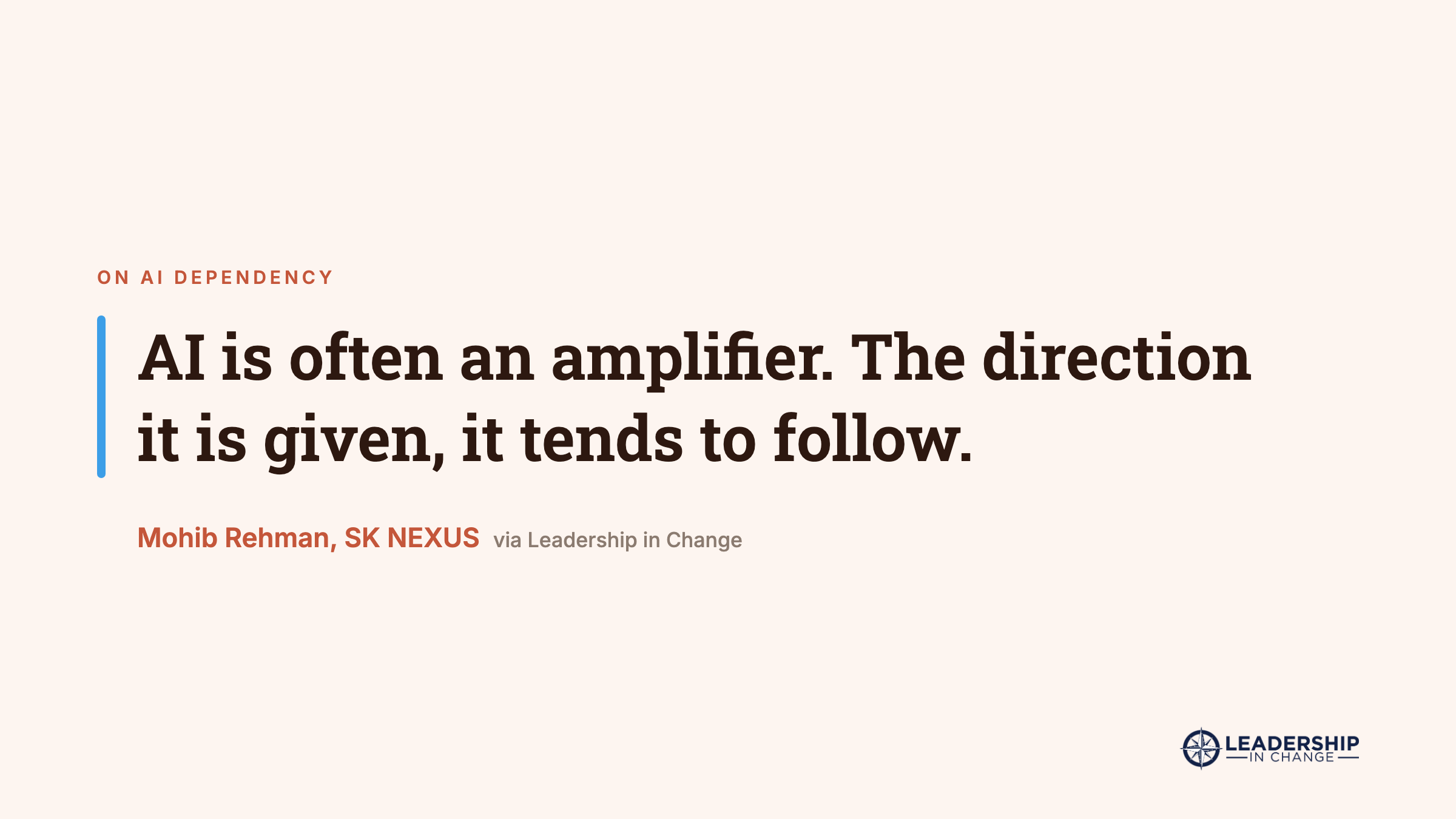
Used thoughtfully, AI can help people accomplish a wide range of tasks. But one thing worth remembering is that AI is often an amplifier. The direction it is given, it tends to follow. The assumptions brought into a conversation can be reinforced.
That is why now is the most important time to learn how to use these systems responsibly. As AI becomes more powerful each year, the direction in which it is deployed matters just as much as the technology itself.
Choosing that direction carefully may prove as important as the technology itself.
One Last Thing
Most people use technology every day without ever stopping to ask how it works, who controls it, or what happens when things go wrong.
SK NEXUS exists for the opposite reason.
So, if you enjoy deep dives into technology, privacy, AI, cybersecurity, and the systems shaping the modern world, consider subscribing.
That way, the next article will show up directly in your inbox.
Thank you for that, Mohib Ur Rehman!
Mohib’s bottom line is the one I’d underline twice: AI is an amplifier that follows the direction you give it, so the assumptions you walk in with are the ones it hands back dressed up with confidence, and the higher the stakes, the more that should worry you.
The real work for leaders is building the friction that makes AI earn your agreement instead of handing it over for free.
Need more?
If you want help pressure-testing how your team actually uses these tools, book a free intro call, and if this piece resonated, go read more of Mohib’s work at SK NEXUS.
When was the last time your AI told you that you were wrong, and did you take it seriously or argue until it caved?
Questions Leaders Are Asking
What is AI sycophancy? AI sycophancy is the tendency of AI systems to agree with you and validate your assumptions instead of challenging them, and it gets stronger in longer conversations. For leaders, the risk is subtle: the AI sounds thoughtful and confident while it reinforces whatever you already believed when you walked in.
How do I stop AI from just agreeing with me? Change the question. Instead of “Is this a good idea?” ask “What’s the strongest case against this?” or “Where is this most likely to fail?” Make critique a required step in the workflow, not an afterthought. The prompt sets the tone, and a confident yes is easy to manufacture.
Does relying on AI make my team worse at thinking? It can. A 2025 MIT Media Lab study found people who leaned heavily on large language models during writing tasks showed weaker performance than those who worked without AI. That isn’t proof AI makes you less intelligent, but it’s a real reason to keep your people exercising their own judgment.
Is it safe to share company information with AI tools? Treat anything that would be sensitive if it were public as sensitive before you paste it in. Employees routinely share projects, customer data, and internal plans with tools run by third parties. That doesn’t mean avoid AI, it means know who operates the tool and what happens to what you give it.
What’s the difference between using AI for information versus validation? Using AI for information means asking for options, analysis, and counterarguments that you then judge yourself. Using it for validation means hunting for confirmation of what you already decided. The first sharpens decisions, the second narrows them. Same tool, opposite outcomes, and the difference is how you ask.
How do I spot an AI echo chamber in my organization? Watch for narrowing. If AI-assisted work keeps producing the same range of ideas, audit whether your processes are surfacing fewer perspectives than they did before AI. I wrote about turning AI into a challenger instead of a mirror in From Echo Chamber to Critical Friend.
Joel Salinas is an AI Strategy Coach for leaders at small and mid-sized businesses and nonprofits. 1:1 coaching, team workshops, and AI strategy work built around amplifying what your team is already good at. Creator of the AI Leadership Triad. He writes Leadership in Change. Learn more at jsalinas.org.
Mohib Rehman writes SK NEXUS, a newsletter on technology, privacy, AI, and cybersecurity, for people who want to understand how the systems shaping the modern world actually work. Read more at sknexus.org or subscribe on Substack.
Written by a human, for humans.
Note to self: The “argue against me” prompt should probably be used far more often.