


TL;DR: AI is not a race. A race has a start, a finish line, and one path to run, and AI adoption has none of the three. Trying to win it wastes time, which is part of why 95% of organizations see zero return on generative AI. The better goal is finding the lane where AI serves your actual work.

So here’s a question I’ve been thinking about based on a The Economist article I recently read:
Would you run your entire company on electricity you rented from a single supplier in another country, with no way to generate your own and no say in the price?
Arthur Mensch, the CEO of the French AI company Mistral, put almost exactly that question to The Economist in July (worth 20 minutes if you want to judge it yourself, below). No serious country would accept it, he said. Energy fragments because it has to, so every country imports some, exports some, and makes its own. He thinks AI ends up the same way, less a winner-take-all sprint and more like the power grid.
That framing is the one I want to start with, because he's describing AI as infrastructure, closer to electricity, and once you see it that way you notice how badly most of us have mislabeled the thing.
We don’t talk about AI like power. We talk about it like a race. That’s the mistake.
A race has a starting gun, a finish line, and one lane you’re supposed to stay in. AI has none of those. Treating it like a competition you can win is a category error, and chasing that win is a fool’s errand that costs you time, money, and a fair amount of your sanity.
In this piece I want to walk through why the race framing falls apart, and what to do instead:
Why “winning at AI” is a target that keeps moving
Why there is no single path, and why that’s good news
How the race is driven by fear, not strategy
How to find the one lane where AI actually serves your goals
A race answers three questions, AI answers none.
When you enter a real race, three things are settled before the gun:
Where the line is, where it ends, and which course everyone runs.
Take those away and the word stops meaning anything.
That’s AI. I play a fair amount of chess, and the fastest way to lose is to match a stronger opponent move for move. You get taken apart every time. You win by playing your own game on the squares you control. The leaders getting somewhere aren’t copying every move OpenAI or Google makes. They picked their squares.
There’s no finish line, just a target that keeps moving
Ask ten leaders what “winning at AI” looks like and you’ll get ten different answers, measured on ten different sticks. There’s no shared scoreboard, and the target moves every few weeks when the next model drops. So a lot of us pour money into chasing a line that isn’t there, and the results show it.
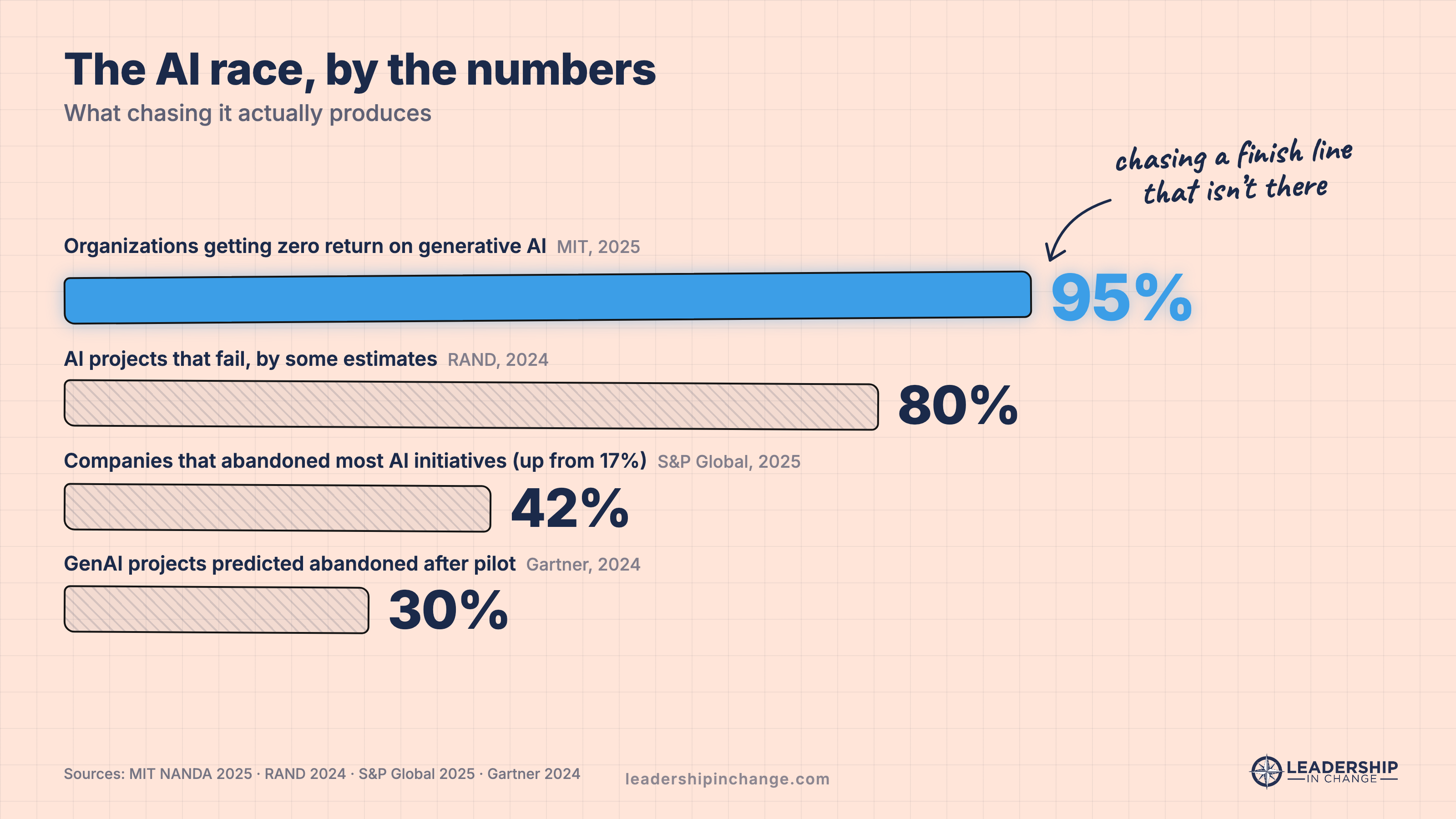
In August 2025, MIT's Project NANDA found 95% of organizations getting zero return on their generative AI (AI that creates text, images, or code) investment. S&P Global reported in March 2025 that the share of companies walking away from most of their AI initiatives jumped to 42% in one year, up from 17%.
I’ve written before about why most AI investments fail, and it’s the same pattern every time: the money chases “doing AI,” not a goal AI was meant to serve.
There isn’t one path. There are thousands.
A race has one course. AI has more than 51,000 tools, as of July 2026 by one widely used directory. Fifty-one thousand. There’s no single path, there are thousands of them, and nobody alive has run them all.
This is the real reason I keep bringing other experts into Leadership in Change instead of pretending I cover everything.
My lane is leadership, and the tools I go deep on are Claude (Anthropic’s AI assistant) and Google’s tools like NotebookLM (Google’s AI research tool). That’s it. I understand AI video, Perplexity and ChatGPT, and the Chinese and open-source models well enough to hold a conversation, but none of them are my specialty and I don’t plan to make them my specialty. When my readers need those, I hand the mic to someone who lives in that lane (recent experts include Ilia Karelin, Dheeraj Sharma, Justin Taylor, Julia | Taking you global, Global Data Center Hub, Mohib Ur Rehman, Judy Ossello (AI Mechanic), Jurgen Appelo, ToxSec, and others). Handing off those lanes isn’t a dodge. No single person can run 51,000 paths at once, and pretending otherwise is how you end up spread thin across all of them and deep in none.
That’s also why I keep pushing an AI tool detox over tool-hoarding. Picking one path and walking it beats collecting fifty.
The race is fear, not strategy
Here’s the part that bothers me most. A lot of the racing comes down to fear. Not strategy, not a plan, just the fear of being the one left behind.
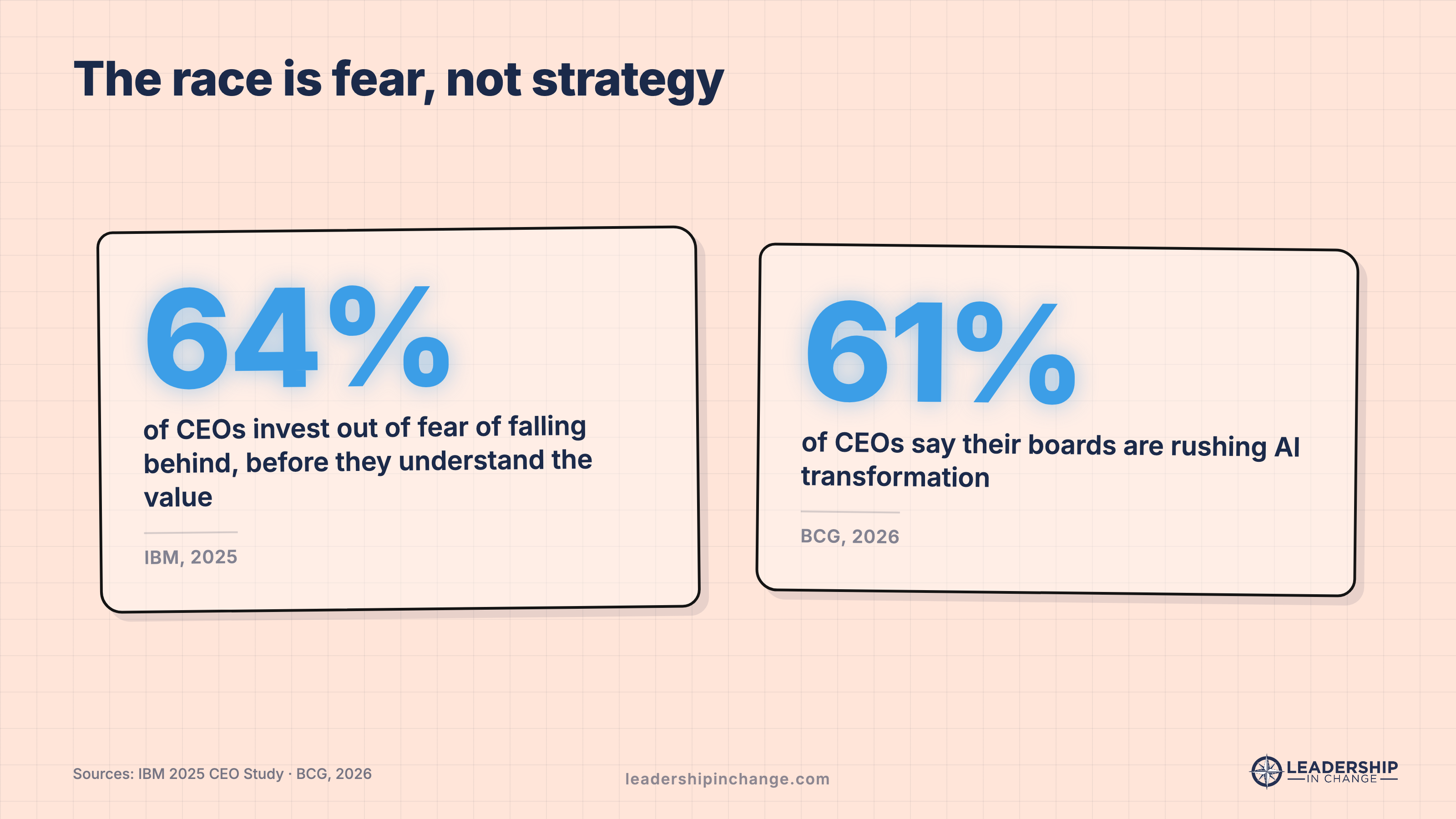
IBM surveyed 2,000 CEOs in 2025, and 64% admitted they invest in technology out of fear of falling behind, before they understand the value it brings. So we get leaders sprinting down a track they can’t see the end of, in a direction they didn’t choose, because everyone around them is running too. And anyone who says they’ve “got AI figured out” is keeping score on a scoreboard that has nothing to do with your goals.
So if it isn’t a race, what is it?
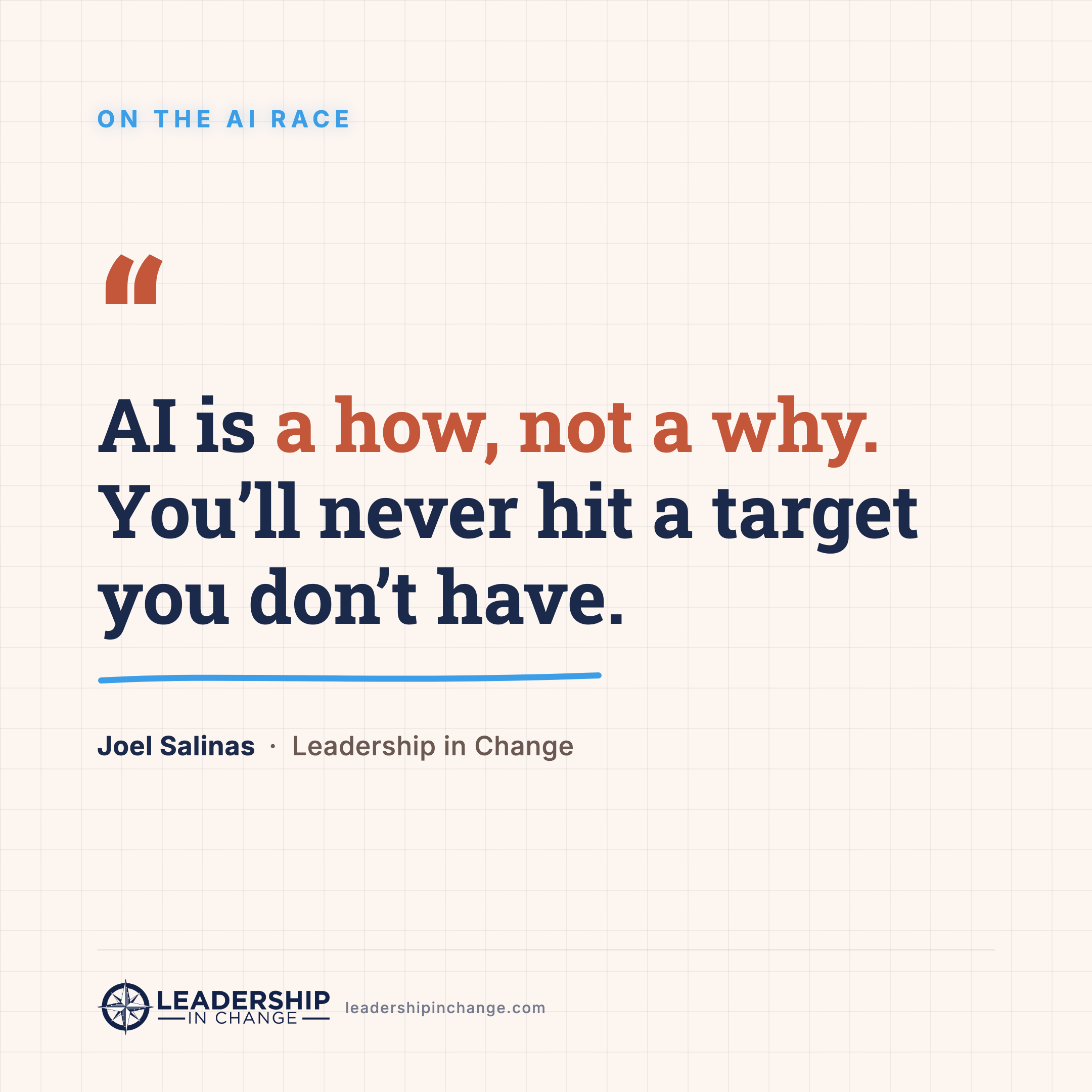
The best answer I’ve found is that AI is a how, never a why. It’s electricity, not the destination. Electricity doesn’t tell you where to drive, it just powers the car once you know.
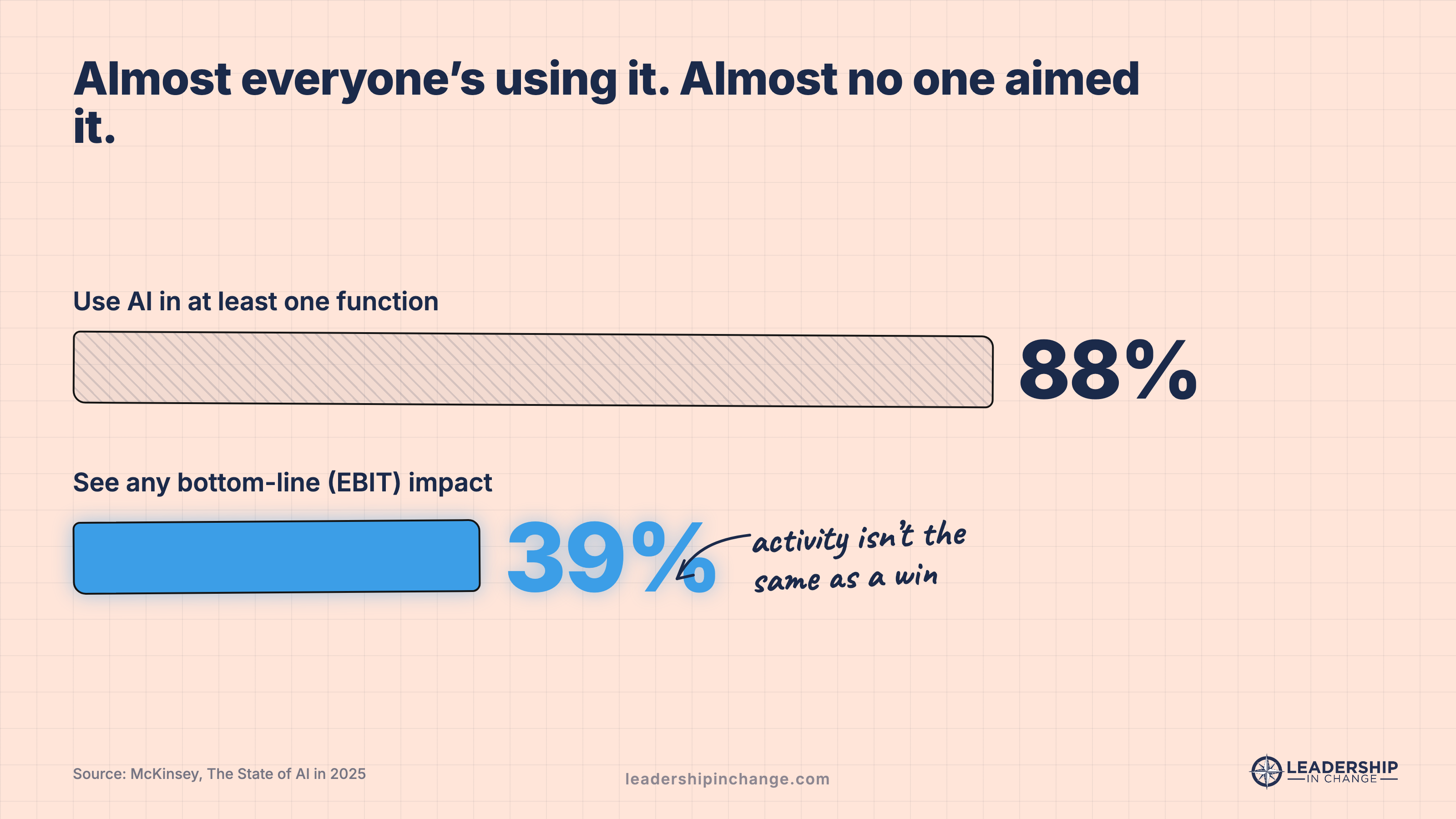
You will never hit a target you don’t have. That sounds obvious until you see how many of us adopt AI with no target at all, just a vague pressure to be “doing AI.” McKinsey’s 2025 research found 88% of companies now use AI in at least one function, but only 39% see any bottom-line impact. Almost everyone is using it. Almost no one aimed it first.
Where should you actually start with AI?
We all got the tools at the same time, the way everyone eventually got electricity. Having it in the building was never what made the difference. What we did with it was.
I take three diagnostic calls a month. It’s 30 minutes, free, and we work out what you’re actually trying to get to, where your biggest hurdles sit, what your low-hanging fruit is, and how that lines up with what I’ve been seeing elsewhere. Then I tell you the first move I’d make.
A few days later you get it back in writing, two or three pages, yours whether we ever work together or not.
This is where the AI Leadership Triad, adaptability, innovation, and creativity, matters more than raw speed. Adaptability means knowing your lane well enough to adjust inside it, not abandoning it every time a faster runner passes, and protecting your own judgment instead of handing it to whatever tool is trending this week.
To be fair to the other side of this, “find your lane” can become an excuse to stop learning, and ignoring a tool that ends up mattering carries a real cost. I’m still working out when to widen a lane and when to hold it. The one thing I’m sure of is that the answer was never to chase all 51,000 at once.
Stop racing. Start aiming.
I’m not against speed. If AI genuinely serves your why, move fast in your lane. What I’m against is the made-up race, the one with no start, no finish, and no path, the one that leaves capable people exhausted and frustrated with nothing to show for the sprint.
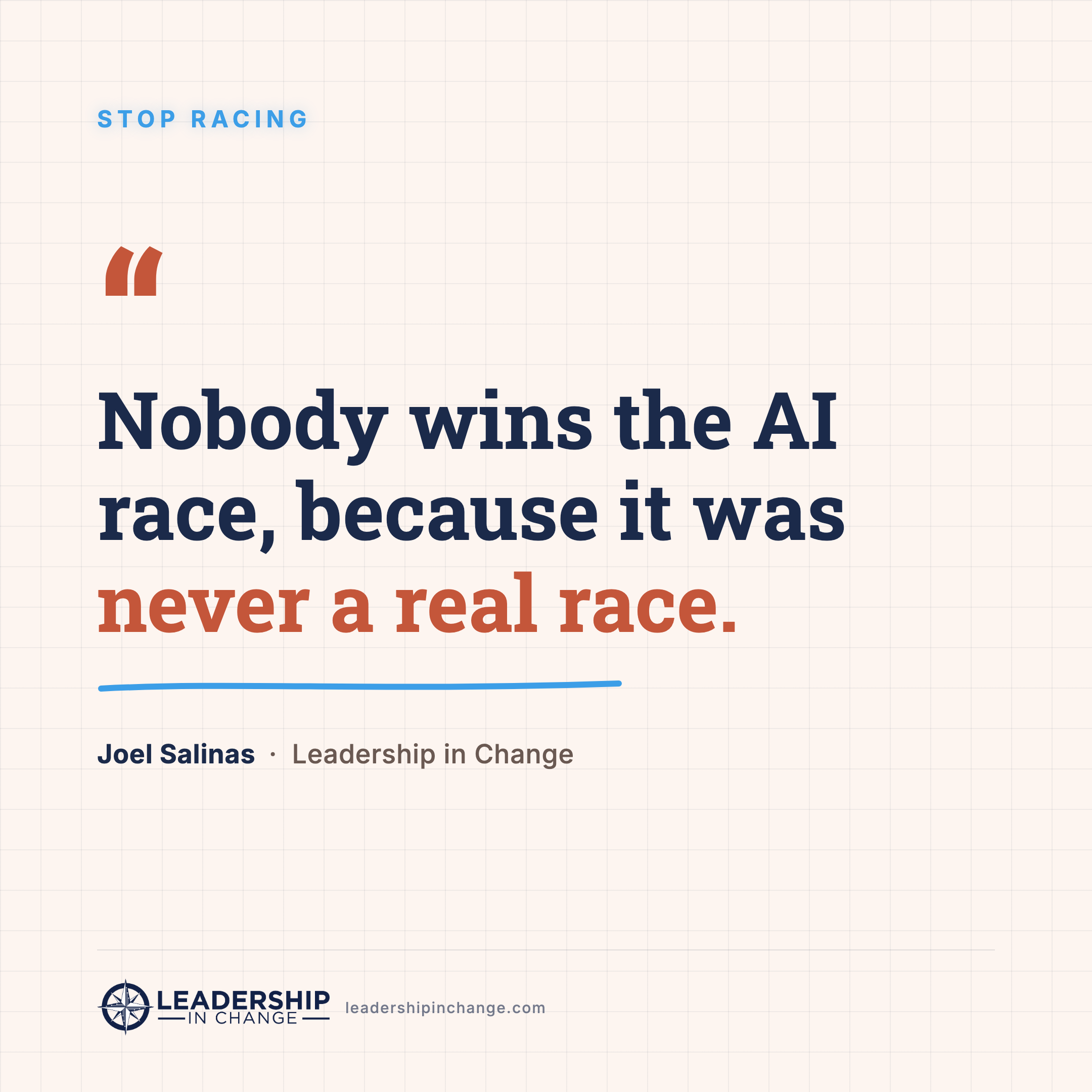
Nobody wins the AI race, because it was never a real race. Find your lane, point AI at what you actually care about, and let everyone else run themselves ragged chasing a line that isn’t there.
Use AI. Don’t chase it.
If You Only Remember This
AI is not a race. A race has a start, a finish, and one path, and AI has none of the three, so “winning” is a target that keeps moving.
There are more than 51,000 AI tools and no single path. Trying to run all of them is how organizations end up in the 95% getting zero return.
AI is a how, not a why. You will never hit a target you don’t have, so aim it at your real goal before you touch a single tool.
Your turn: What’s the one lane where you’d back your own judgment against any model on earth? That’s the lane to point your AI at first. Tell me in the comments.
Worth Your Time
A few pieces from other creators I think are worth your attention.
This Week in AI Club — Why “AI 2040” Gets the AI Race Wrong. The strongest case against my argument, made at the level where a race actually does exist, which is nations deciding whether to build their own AI or rent someone else’s.
Frank Andrade — How to Use AI to Get Smarter (Not Just Work Faster). Five habits for pointing AI at your thinking instead of your output speed, including asking it to argue against you before a decision.
Compound with AI — I don’t let AI pick stocks. Here’s what I use it for instead. A clean example of naming the one job AI does well for you and refusing to hand it the rest.
Questions Leaders Are Asking
Is AI a race? No. A race needs a fixed start, a finish line, and one path, and AI adoption has none of them. Treating it as a competition to win pushes most organizations to chase a moving target, which is part of why 95% see zero return on generative AI as of 2025. The better frame is infrastructure you aim at a specific goal.
Can you “win” at AI? There’s no shared scoreboard to win on. Every organization defines success differently, so “winning” means something different for each one. The useful question is whether AI is moving you toward the goals you already have, not whether you’re ahead of everyone else.
Why do so many AI projects fail? Often because the goal was “adopt AI” rather than a specific business outcome. McKinsey found 88% of companies use AI but only 39% see any bottom-line impact. Tools without a target produce activity, not results, and activity is easy to mistake for progress.
How should leaders choose which AI tools to focus on? Start with your goal, not the tool. Pick the lane where you have real expertise and where AI directly serves what you’re trying to do, then bring in specialists for everything outside it. With more than 51,000 tools available, no single person can master them all, and trying to is the trap.
Should I be worried about falling behind on AI? Falling behind assumes a shared finish line that doesn’t exist. IBM found 64% of CEOs invest out of fear of falling behind, often before they understand the value. Fear is a poor strategy. Aiming AI at a clear goal beats chasing whatever everyone else is running toward.
Joel Salinas is an AI Strategy Coach and entrepreneur. AI is everywhere; judgment is scarce. Joel helps founders and leaders adopt AI without outsourcing their judgment to it, and he builds the systems too. Creator of the AI Leadership Triad.
Written by a human, for humans.