



TL;DR - AI investing in 2026 does not mean letting software pick your stocks. In one real-money, AI-native portfolio, AI reads every SEC filing, screens thousands of companies, and monitors positions daily, while a human still sets every price and places every order. The boundary moves only as the system earns it.
I’ve been investing for fifteen years. Not casually, and not with money I could afford to shrug at, because a large part of my income has gone into the market that whole time. That’s a long enough run to have made most of the mistakes at least once, and I have made many.
When I came across Jing Xie’s work, what got my attention wasn’t the AI angle, but that his investing ethos is almost exactly mine, and he happens to be an actual expert in a field where most of what gets written is either hype or fear. He runs a real-money portfolio, he publishes every position and every mistake in public, and he’s blunt about what AI can and can’t do with your savings.
I’ve written before about why you shouldn’t outsource your thinking, even to AI, and about what it means when your AI never disagrees with you. Jing is doing that same work with his own capital on the line, which is a harder test than any of us run on a Claude prompt, and it’s why I wanted the leaders I serve to read him.
One thing to set up front. Jing wrote this in July 2026, so the market numbers in it are a snapshot of that week. Neither of us is publishing a call on where stocks go next. Read it for the process, which holds up whether the market runs or breaks.
Here’s his piece. I’ll meet you at the end.
Before you read:
Nothing here is investment advice. It’s one person’s process, described in public, so you can build your own.
If you don’t invest, read it as a delegation case study. The tickers are the vehicle; the boundary is the lesson.
The question isn’t what to buy today, but what you’ll do when everything goes on sale.
AI made research nearly free. It did not make judgment optional.
Investing Advice for the Age of AI
Hint: it starts with cash and a list
Everyone who finds out I run an AI-powered investment portfolio asks me the same question: “What should I buy?”
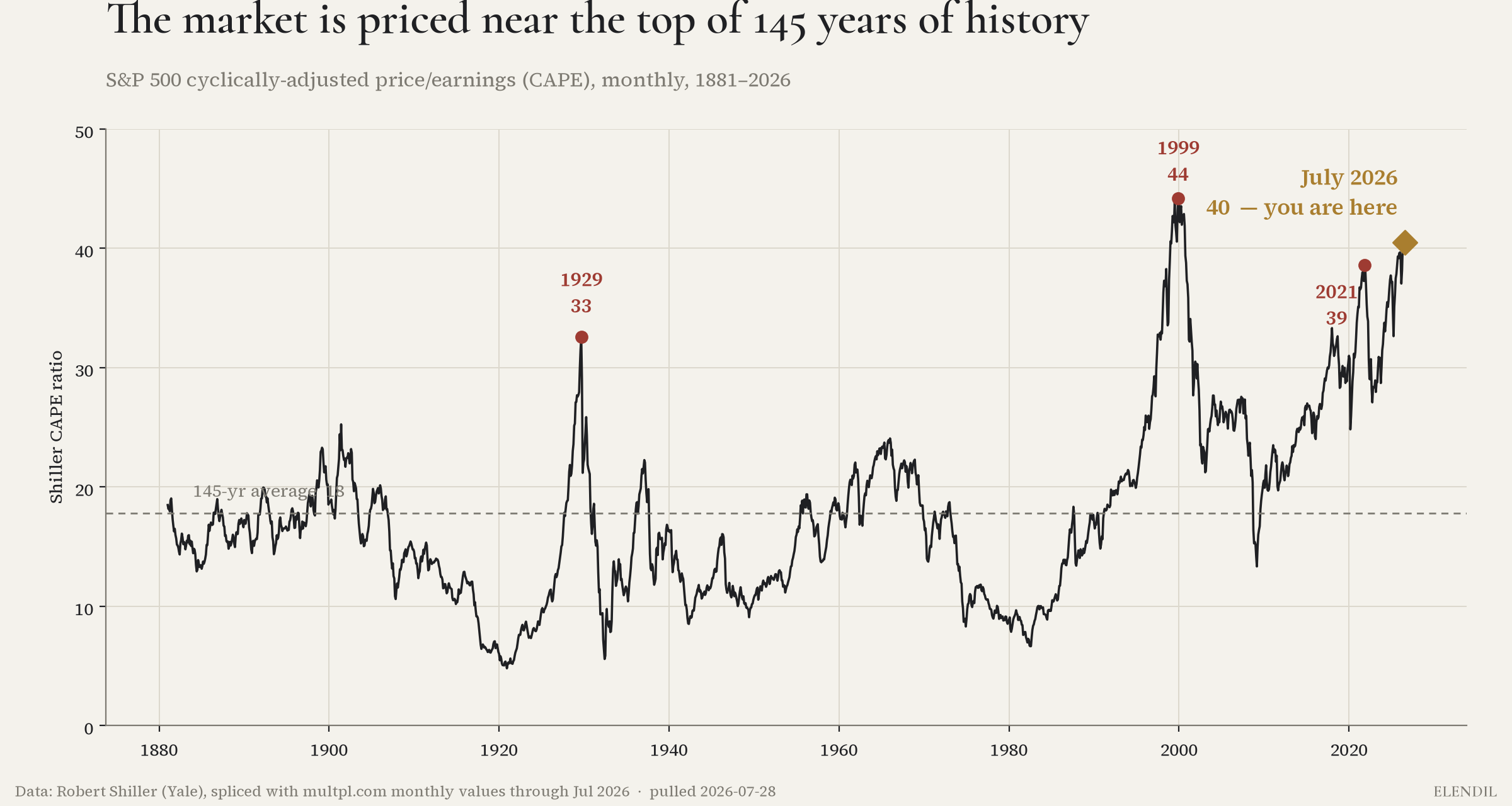
It’s the wrong question, and it’s wrong in a specific way. Today the S&P 500 trades at a CAPE ratio just above 40 — a mouthful of a metric that just means stocks are more expensive, relative to a decade of earnings, than at almost any point in market history. In 145 years of data, only one stretch was pricier: the dot-com peak of 1999–2000. Even 1929 and 2021 sat below today’s level. You may remember how the years that followed those peaks felt.
I’m not predicting a crash — and I say that as someone who once tried to. After the market sold off in December 2018 and then V-shaped straight back up, I was convinced the recovery couldn’t hold. So I shorted the S&P 500, and I stayed short for essentially all of 2019 while the market ground higher against me. That bet cost my portfolio about 15% while I waited to be proven right. The crash did eventually come — in March 2020, more than a year later, triggered by a pandemic nobody could have named in advance. I covered the short and spent the following weeks buying stocks at historically cheap multiples, so the story ends well on paper. But I’m honest with myself about what actually happened: I had the direction right, my timing was wrong by over a year, and luck bailed out the difference. That trade taught me the lesson this entire essay is built on. Knowing the market is expensive tells you nothing about when it breaks. Betting on when is how you lose money being right. Preparing for eventually is how you make it.
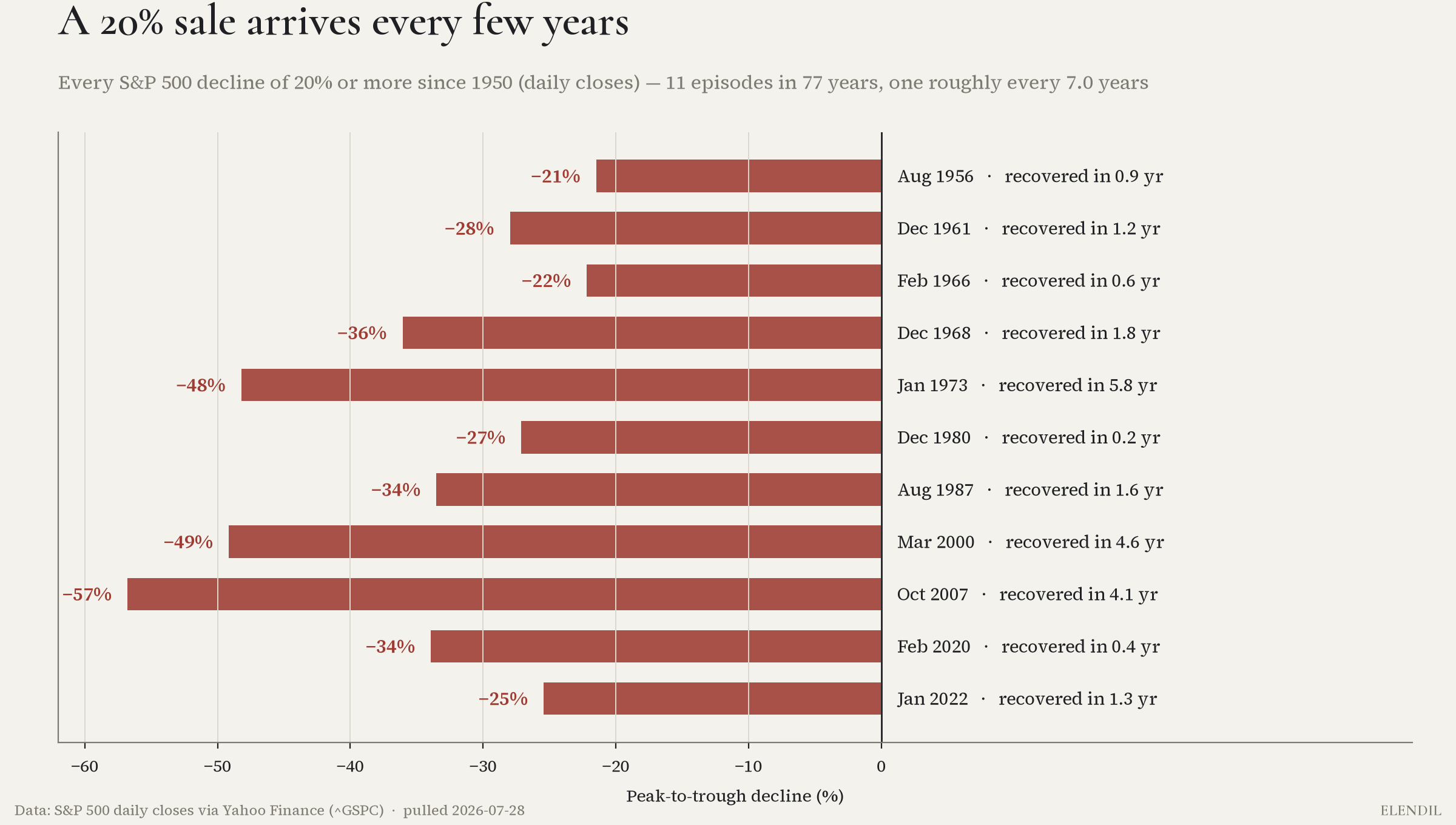
You don’t need to take the extreme route I did. History says it plainly: since 1950, the S&P 500 has fallen 20% or more from its high eleven separate times — roughly once every seven years, through wars, recessions, panics, and pandemics. It will do it again. The date is unknowable. The event is close to certain.
Honesty also requires acknowledging the other side of this market. The AI trade has made some people genuinely rich — the ones who were early in Nvidia below a split-adjusted $100, or in memory stocks like Micron when it traded under $100 a share. And after the brutal correction of the past few weeks — Micron cut from a high around $1,200 in late June to the low $800s, SanDisk from over $2,300 to near $1,100 — these names can absolutely still run further. But be clear-eyed about what this is: a trader’s market. The early birds have largely cashed out or sit on a cost basis that’s a fraction of today’s price; if you’re buying now, you’re accepting real upside potential and equally real downside risk, without their margin of safety. There’s nothing wrong with taking that bet — just know that at these levels it’s a trade, not necessarily a long-term investment, and don’t confuse it with the strategy in this essay.
So the right question isn’t “what should I buy today?” It’s: “what will I do when everything goes on sale?”
For the average person — no Bloomberg terminal, no research team, a day job — the honest answer has two parts. Neither requires genius. Both require doing something now, while the market is calm and expensive.
Part one: build the cash pile
When stocks are expensive, the best-performing move available to most people is boring: accumulate cash.
Not cash under a mattress — cash in Treasury bills, currently yielding about 3.75%, or a money-market fund, where the big-name funds pay in the 3.3–3.6% range. That’s your baseline. Every stock you buy has to beat it to be worth the risk. At today’s valuations, a lot of stocks won’t.
Cash gets a bad reputation because it “does nothing.” I’d put it differently: cash is an option on every future bargain, and right now that option pays you roughly 3.5% a year to hold it. In our portfolio, roughly half the book sits in cash and T-bills — deliberately, and we’ve said so publicly every quarter. In an expensive market, patience is a position.
Here’s the line I’d ask you to remember: when the correction comes, cash is the difference between being a buyer and being a seller. The people who got wealthy buying in March 2009 or March 2020 weren’t smarter that month. They just arrived with cash while everyone else arrived with margin calls.
And AI can help you build the pile, not just deploy it. Nothing fancy — three practical moves: export a few months of bank and card statements and ask an AI assistant to categorize your spending and flag every recurring charge you forgot about (subscriptions are where cash piles go to die). Tell it your income and fixed costs and have it propose a monthly auto-transfer into T-bills you’ll actually stick to. Then once a quarter, have it recompute your savings rate and project the date your war chest hits its target. Budgeting fails on tedium, and tedium is exactly what AI is good at absorbing. The saving still has to be automatic — AI just makes the plan honest and keeps it current.
Part two: build the shopping list — stocks you want when they go on sale
Cash alone isn’t preparedness. Plenty of people held cash through 2020’s crash and never bought anything, because when prices finally broke, fear made every stock look broken too. At the bottom, every headline is a reason to wait.
The antidote is a shopping list written before the panic: five to fifteen businesses you understand, would be proud to own for a decade, and have researched enough to name a price you’d pay. Not tickers your cousin mentioned. Businesses whose products you can explain, whose filings you’ve at least skimmed, whose risks you can say out loud.
If you’re not sure how to build that list, you have two good options. The lightweight one: ask any AI assistant to help you build a simple screen — say, consistently profitable businesses with low debt and high returns on capital — and use it to generate candidates you then research one by one. The deeper one: I’ve open-sourced the entire system I use to run our own portfolio. It’s called Clarion Intelligence System, it’s free, and it’s built for anyone willing to roll up their sleeves. A similar version of the same system manages our own internal capital at Elendil Labs — you can inspect the live Elendil portfolio, every position and thesis included, to see exactly what it produces. It runs on Zo Computer, a managed personal AI server — an always-on assistant with its own computer, so the research keeps running when your laptop is closed. Setup is a sentence: install the skills and tell the agent to “set up Clarion.” From there, “evaluate Costco” pulls the SEC filings, scores the business on quality and value, and drafts the research file — including the two numbers this essay keeps insisting on: the price you’d pay, and the facts that would prove you wrong.
Then — and this is the step that separates preparation from daydreaming — write the price down and stage the order.
A story from our own book. In May, we decided Meta was worth owning below $580 and Microsoft below $400. Prices were higher, so we placed standing limit orders and went back to work. Weeks later, in a June pullback, both orders filled — at exactly the prices we’d chosen when we were calm. On the day it happened, no decision was required. The decision had been made weeks earlier, by a version of us that wasn’t watching a red screen.
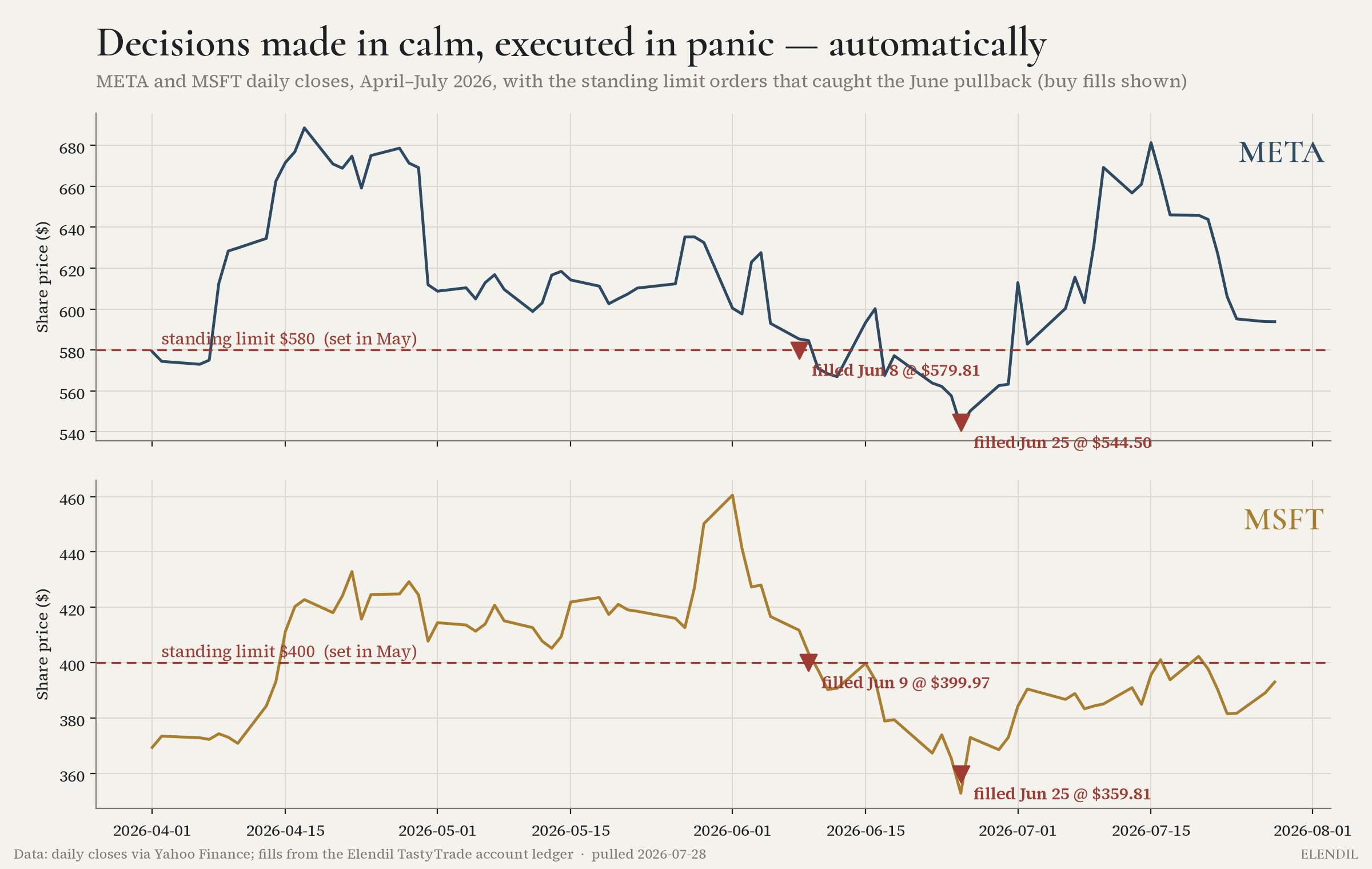
Note what those fills were not: a signal to go all-in. We still hold roughly half the book in cash and Treasuries, because the market as a whole is still expensive and we want dry powder for better opportunities ahead. But that pullback in two of the largest companies on Earth makes the point — even in an expensive market, individual businesses go on sale for days at a time, and the only people who catch those windows are the ones who wrote down an entry price and a view of fair value in advance.
That’s the whole trick. Decisions made in calm, executed in panic — automatically. Your future panicking self is not the person you want picking entry points. Your current, unhurried self is.
Where AI actually fits in
Now the part everyone expects me to say, since I build AI systems for a living: no, AI will not pick winning stocks for you. If someone sells you that, keep your hand on your wallet.
What AI genuinely changed is the cost of doing the homework. The research that used to require a team — reading hundreds of pages of SEC filings, screening thousands of companies, checking whether insiders are buying, monitoring every position for the specific facts that would break your thesis — is now available to one person with a laptop. I run our entire book this way. AI agents index the filings, screen for quality and value, track a market-regime signal, and re-check every position’s health on a schedule. What took my former research colleagues a week takes the system an afternoon.
Three examples of what that looks like in practice:
AI reads what screeners miss. Last spring, a stock screener scored IBM near the bottom of our list — its decades of share buybacks had distorted a standard debt metric so badly the screen read it as drowning in leverage. The actual 10-K told a different story. The system flagged the discrepancy because it reads filings, not just ratios. A number can lie; a filing lies less.
AI finds the needle. The Trade Desk’s founder-CEO bought $148 million of his own stock at $24.71 — disclosed in a Form 4 filing most people will never open. Our pipeline surfaces insider buying like that automatically. We later bought at $20.33, seventeen percent below where the CEO put his own money at risk. That’s not forecasting. That’s reading — at machine speed.
AI never gets tired of checking. Every thesis we hold has written “kill conditions” — specific, testable facts that would mean we’re wrong. The system checks them continuously against live data. Humans get attached to positions; a checklist doesn’t.
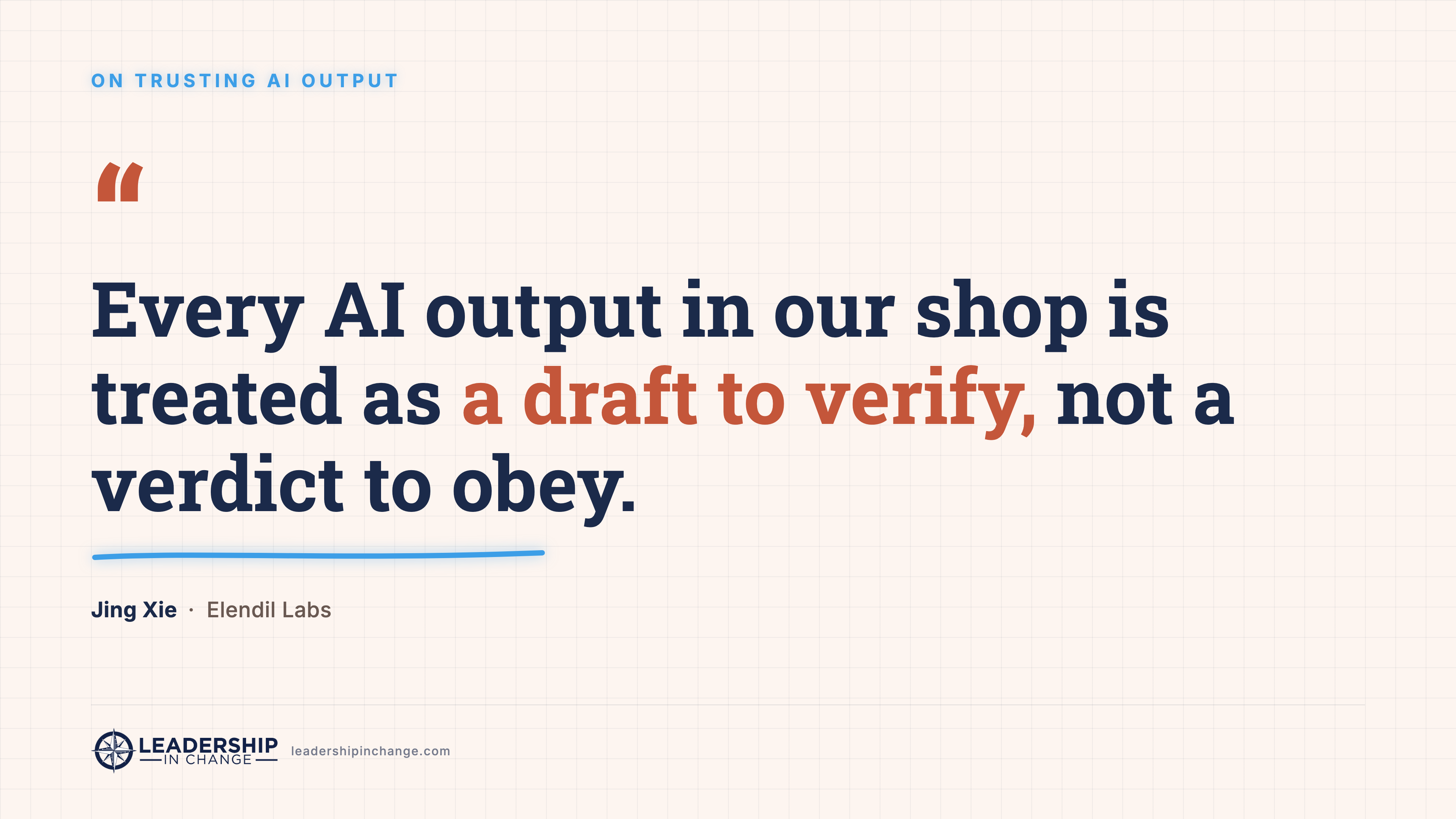
And one example of the opposite, because honesty matters more than marketing: our monitoring system once flagged five positions as urgent sells. Every one was a false alarm — the underlying data fields were empty, and the system had averaged zeros into failing scores. We caught it because every AI output in our shop is treated as a draft to verify, not a verdict to obey.
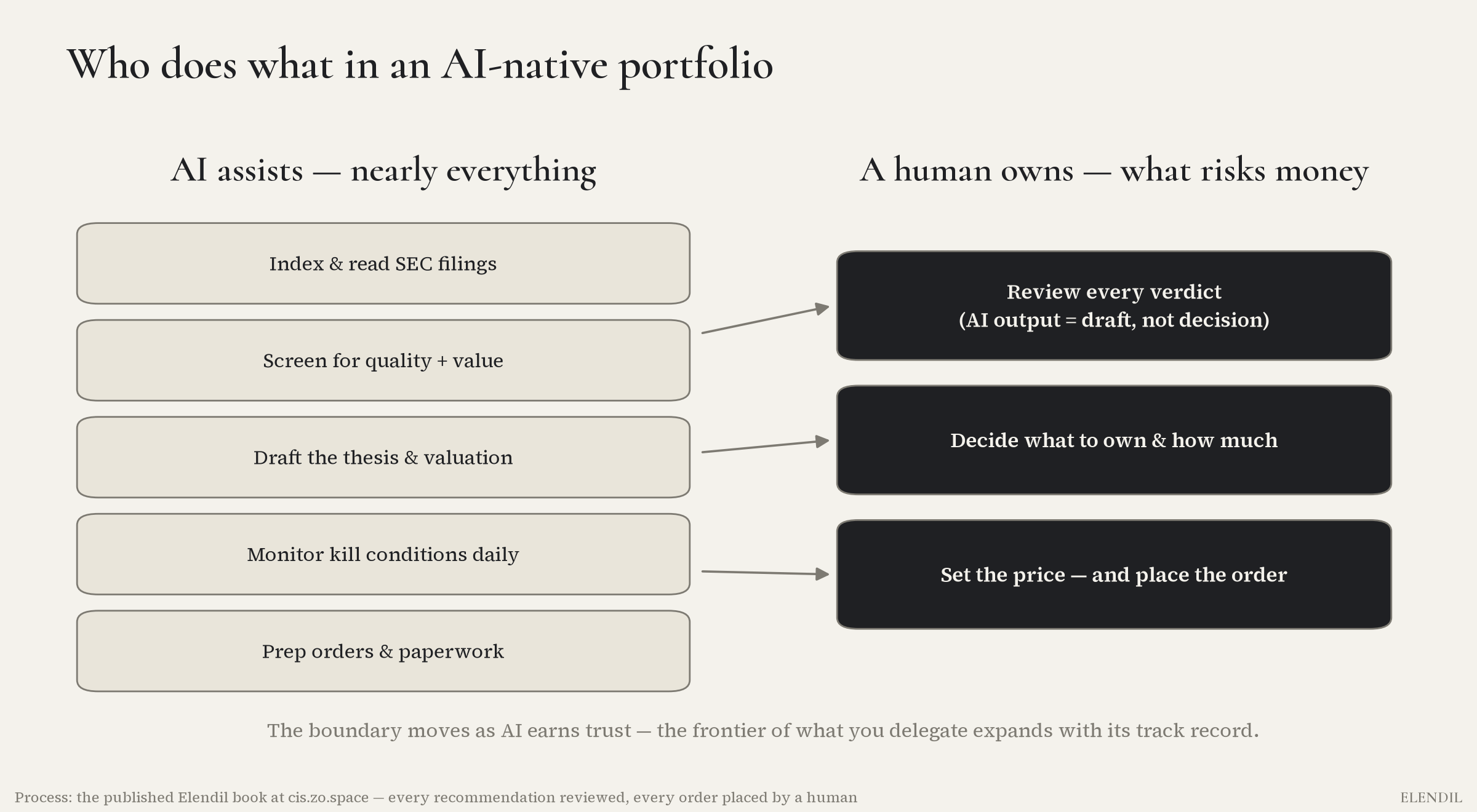
So here’s the honest version of the human-versus-AI question, without a slogan. In our process, AI’s role is enormous and still growing: it does nearly all the reading, the screening, the monitoring, the trade research, and the operational prep. But in the portfolio we publish, a human reviews every recommendation and a human places every trade and limit order. That’s not a permanent ceiling on what AI can do — agentic systems earn more autonomy every quarter, ours included. It’s how trust is supposed to work: let AI assist everything, and let it own only what it has repeatedly proven it gets right. The frontier of what you delegate should expand with its track record — the same standard you’d hold a new analyst to. For most people starting out, that means AI dramatically accelerates the research, the checking, and the ops, while the decisions that put your savings at risk — what to own, how much, at what price — stay with you. In our shop that boundary is written down, along with a deployment checklist every trade must pass. The checklist took fifteen minutes to write. The mistakes it prevents are measured in thousands.
The advice, in one place
If you’re starting out, in this market, here’s what I’d actually do:
1. Automate saving into a T-bill or money-market fund. This is your war chest. ETFs like SGOV make it easy: they’re liquid, the share price barely moves, and they currently yield about 3.6% while you wait — so the money is stable and ready the day you need it. Stop feeling guilty about holding cash.
2. Build a list of 5–15 businesses you understand and would hold for ten years. Use AI to help you read the filings and earnings calls — that’s the legitimate shortcut.
3. Borrow a system instead of building one from scratch. The Clarion Intelligence System is open source, and on Zo Computer it runs in plain English: “set up Clarion,” then “evaluate [company],” then “monitor my theses.” The filings get read, the scores get computed, and the checking happens on a schedule — whether or not you’re at your desk.
4. Write down the price you’d pay for each. If you can’t name a price, you haven’t finished the research. AI can help you get there.
5. Write down what would make you wrong. One sentence per stock. If you can’t write it, you don’t understand the business yet. AI is genuinely good at this one — feed it a company’s last few 10-K and 10-Q filings and ask what facts would break the investment case.
6. Stage standing limit orders where your broker allows. Let calm-you make the decision and panic-day markets fill it.
7. Stop trying to time the top. You only need to be ready for the bottom, and readiness is a checklist, not a feeling.
The uncomfortable truth about investing in the AI age is that the machines have made research nearly free, but they haven’t changed the thing that actually determines results: whether you show up to the correction with cash, a list, and prices you chose in advance — or with regret.
And if you’d rather see all of this in practice than take my word for it, everything we do is public: the live Elendil portfolio and every thesis page at cis.zo.space, and the running investor letter — wins, mistakes, and lessons included — at cis.zo.space/letter. Copy whatever is useful.
And if you work — or want to work — at the intersection of capital markets and AI, that’s exactly what we write about. Subscribe to the Elendil Labs Substack at elendillabs.substack.com for ongoing investment research and posts like this one.
Markets don’t reward the people who predicted the storm. They reward the people who were packed for it.
Thank you, Jing!

AI isn’t a binary where you’re either all in or all out, but a set of choices about what you hand over and what you keep, and the leaders getting real value out of it are the ones making those choices deliberately instead of by default. Adaptability, one of the three skills in the AI Leadership Triad, is mostly this in practice: knowing what to move and what to hold.
Whichever way you draw the line, you’re 100% responsible for the decision, whether you pulled the trigger or your AI did.
Where have you drawn your line, and did you decide it on purpose or just end up there?
Want help drawing that line for your own work?
Deciding what to hand to AI and what to keep is most of what we do in the AI Judgment Workshop. Ninety minutes, live, and you leave with your AI archetype, a map of where your team really sits, and a 90-day plan you wrote in the room.
$99. Premium subscribers $49. Executive members free. Twenty seats, replay included, and the $99 credits toward the engagement if you go further. The next cohort date is on the page.
Jing writes at Elendil Labs. If capital markets and AI is your intersection, subscribe to him there.
Questions Leaders Are Asking
Can AI pick stocks for me? No, and Jing is direct about it. AI in a real-money portfolio does the reading, the screening, and the monitoring. A human still decides what to own, how much, and at what price. Any tool sold as a stock picker is selling you certainty that doesn’t exist.
How do I decide what to let AI do and what to keep? Write the boundary down before you need it. Let AI assist with everything, and let it own only the tasks it has repeatedly proven it gets right. Expand that list as the track record grows, the same way you’d expand what a new hire handles.
Do I need to be technical to use AI for research? No. Jing’s system runs on plain-English instructions like “evaluate Costco.” The harder skill isn’t technical, but knowing what question to ask and how to check the answer. If you can read a summary skeptically, you can do this.
What’s the most common way this goes wrong? Treating AI output as a verdict instead of a draft. Jing’s monitoring system once flagged five positions as urgent sells and every one was a false alarm caused by empty data fields. They caught it because verification was already part of the process, not an afterthought.
Does this apply outside investing? Directly. Any decision with real consequences has the same structure: research that AI can accelerate, and a judgment call that stays yours. Hiring, budgets, vendor selection, and strategy all follow the same pattern of automating the reading and keeping the deciding.
What AI tool should I start with for this? Start with whichever assistant you already use, because the discipline matters more than the tool. Ask it to summarize a document, then verify one claim against the source yourself. That single habit of checking is the whole method, and it transfers to every tool you’ll use later.
About the Authors
Jing Xie runs a real-money, AI-native investment portfolio and publishes every position, trade, and mistake at cis.zo.space. He writes about capital markets and AI at Elendil Labs. Nothing here is investment advice, but a description of a process, offered so you can build your own.
Joel Salinas is an AI Strategy Coach for founders and leaders, from solopreneurs to teams. AI is everywhere; judgment is scarce. Joel helps leaders adopt AI without outsourcing their judgment to it, through the AI Judgment Workshop and the 90-Day Judgment Engagement. Creator of the AI Leadership Triad. He writes Leadership in Change.
Disclaimer: Nothing in this essay is investment advice, an offer, or a recommendation to buy or sell any security. It describes one process for educational purposes. Investing involves risk, including the possible loss of principal. Past performance does not guarantee future results. Do your own research and consult a licensed financial professional before making investment decisions.
Written by a human, for humans.
Hope this is helpful to everyone. Please send me any questions and would love to read comments from subscribers.
This is deep work, bringing AI to bear in next-level investing.
The only thing I'd be interested in knowing is getting other information sources outside of SEC filings. The most telling conditions that impact long-term performance often come through other channels.