




TL;DR: AI parenting requires a mindset shift, not technical expertise. Forty-nine percent of parents haven't discussed AI with their kids, but 84% of high school students already use it. The LEAD framework (Lead the conversation, Engage together, Always verify, Don't share what's private) gives parents a practical approach without requiring AI mastery.
Something that’s been on my mind lately is how to lead in my home, through the change AI is bringing. And the more I think about it, I realize that leadership doesn’t stop when you leave the office.
I have spent a few years now helping executives, nonprofit directors, and mission-driven leaders implement AI strategy. I write about AI ethics, AI decision-making, and how to lead through technological change. But here’s what hit me recently, I often don’t know how to best approach leading the AI chat in my home, with my two kids.
You know that feeling when you’re the expert at work, but at home you’re just trying to figure it out like everyone else?
That’s the reality for most leader-parents right now. We’re navigating AI at work while our kids are already three steps ahead at home. The chart below shows the gap: 48% of kids see AI as positive for their learning, while only 39% of parents agree. Meanwhile, 43% of parents see it as negative compared to just 31% of kids.
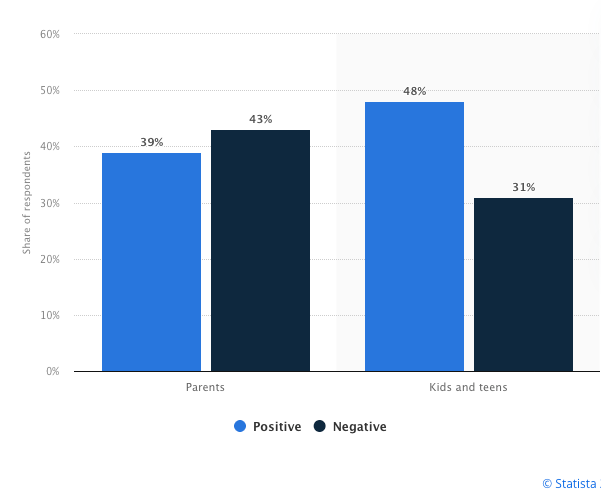
This perception gap isn’t just interesting, it’s dangerous. When parents view AI as a threat, and kids view it as an opportunity, we stop having conversations. And when we stop talking, our kids figure it out alone.
That’s why I asked Manisha to share her perspective. She’s a mom, technologist, and writer of AI FAMILY NETWORK. She’s not claiming to be an AI parenting expert. She’s learning alongside her kids, and she’s built a practical framework that any parent can use starting today.

In this post, you’ll learn:
Why waiting to become an AI expert before talking to your kids backfires
The LEAD framework: a practical mindset for guiding kids through AI without having all the answers
How to lead AI conversations at home the same way you lead strategy conversations at work
What to do when your kids use AI in ways that surprise you (both positive and concerning)
How to turn AI from something your kids hide into something your family explores together
Here’s Manisha
The LEAD Mindset: Guiding Your Kids Through AI Without Having All the Answers
A mindset for staying connected as your kids navigate AI tools that are moving faster than any of us.
A few weeks ago, I was chatting with a friend who happens to be a leader at a tech company. We both were chatting about how we spend our days using AI to create workflows, automate tasks, write emails and more. Then she said something that made me laugh.
“I use AI all day at work, but then Mary (her daughter) started asking me about ChatGPT and Gemini, I wasn’t surprised she knew about it. I just didn’t know what to do. Do I tell her I really wish she wouldn’t use this? Do I not allow her to use it? Do I try to navigate it with her?”
I smiled and joked with her that I felt the same way. When my own kids came to me with questions about AI, I was almost like, “I am not ready yet, I need more time to learn about it myself, then let’s talk.”
I personally think this is the case for a lot of parents. AI is either something we don’t use at all, something we use sparsely, or something we use specifically for productivity at home or work. It almost lives in our productivity world, right alongside Slack, Zoom, or Google Meet. That said, it is a tool that many use, and like it or not, our kids are going to be introduced to it and start using it.
What’s Actually Happening (While We’re Still Figuring It Out)
As a conversation with my friends stayed with me, I started doing some research, and I came across some interesting research that really helped me understand the gap between what we as parents think is happening and what’s actually happening.
The first stat that jumped out at me came from UNICRI (the United Nations Interregional Crime and Justice Research Institute) in their AI Literacy Guide for Parents. Right on the first page, it says… 49% of parents say they haven’t talked to their kids about generative AI. Almost half of us haven’t had a conversation yet about AI with our kids.
Trust me, I get it!
But here’s the thing, our kids aren’t waiting for us to figure it out or come to them to chat. According to the Actua report on how Canadian educators, youth, and parents are using AI, 84% of high school students are already using GenAI tools for schoolwork. That number grew from 79% to 84% in just a few months. It’s only going to keep climbing as AI becomes more and more mainstream in our lives.
As I continued my research, here’s what I found even more interesting. I found Common Sense Media’s report on Research Brief: Teens, Trust, and Technology in the Age of AI and they found that 72% of teens have used AI companions and 33% are using it for social interaction. So not just for brainstorming or writing that research paper, but for socializing as AI doesn’t judge them.
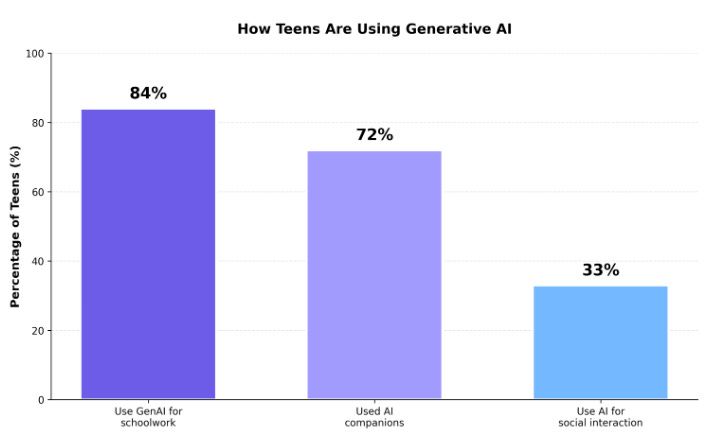
So whether we like it or not, whether we know about it or not, our kids are finding ways to get introduced to AI. It could be on the playground at recess, the coffee shop with their friends, or a school device. One way or another, our kids are going to find AI tools. The question now is,
“What role do we parents play in it?”
Why the AI Talk Feels So Hard
So then I started asking myself, “Well, why does it feel so hard to have the AI talk?”. I decided to chat with a few friends about this topic and do more research. In the same UNICRI guide, I found it super interesting to learn that almost 38% of parents have never even used generative AI themselves, and 44% explicitly feel they don’t have sufficient knowledge to guide their kids responsibly.
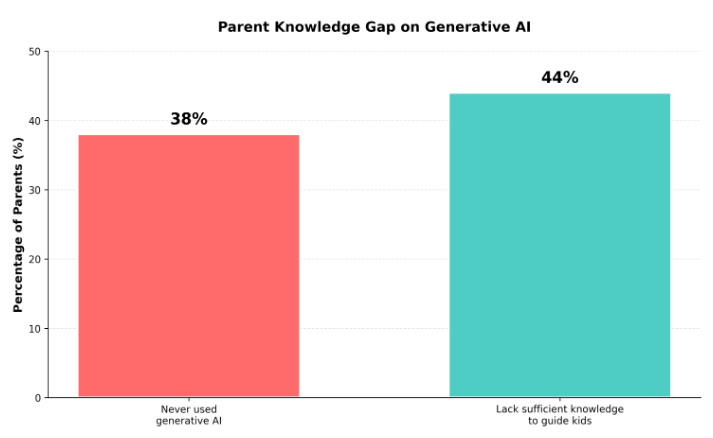
This similar response is what I got from my friends. Many said they just don’t use AI enough, so they don’t know how to talk about it. Others said they use it, but they don’t feel like they have enough knowledge to guide their children using AI. I realized that it just comes down to the question of “how do we talk to our children about something that we don’t fully understand?” Trust me, I get it, I’m a parent myself, I struggle to have these conversations with my own kids.
But here is the shift I suggest we make as parents.
Instead of waiting to learn it (or master it), we need to embrace the fact that we are learning AI with our children and there is no perfect rule book on how to teach our children about AI. It really comes down to a mindset shift: coming back to a steady way of approaching these tools with our kids, with curiosity and support, because the technology is going to keep changing.
LEAD: A Mindset, Not a Rulebook
As a parent, I understand how hard it is to talk about AI with your kids. We’re not experts and nobody has written the rules on how to teach our kids about AI. This isn’t something that’s been done for hundreds of years. Instead, we are navigating new waters here, as the world embraces AI as a part of our lives.
I came up with the LEAD mindset because I had to guide my own kids through AI, and because friends kept asking me for help. They wanted something to hold onto, not a step-by-step plan, more of a mindset shift.
LEAD isn’t a step-by-step checklist; it is not a rule book either. It is a mindset shift to leverage as AI becomes more mainstream in our lives and we as parents need to guide our kids on this journey.
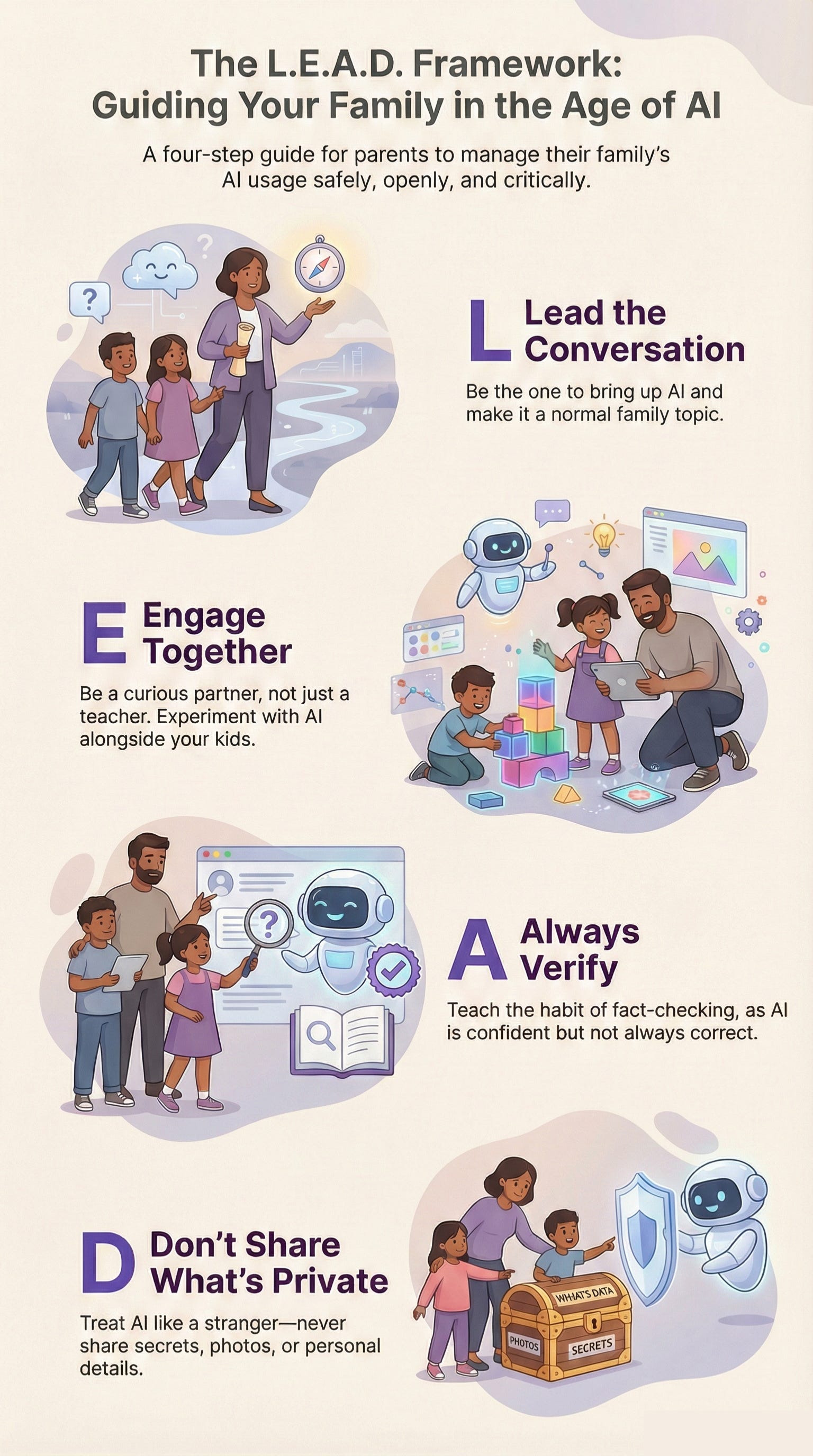
L — Lead the Conversation
In this AI-first world, you want to be the parent who brings up AI. You want to make AI something your family talks about openly, not something your kids use in silence.
Some examples of leading the AI conversation at home can be…
You bring up AI at the kitchen table and talk about how you used it today
You share when I got something wrong or how you decided to use it differently
You set non-negotiable boundaries around what data can be shared (like “we don’t share our photos with AI” or “we don’t share our secrets with AI”)
You let your kids use AI openly in the household, maybe at the kitchen table with you nearby
You revisit rules as your kids get older because what worked at 8 might not work at 12
Leading the conversation is really about guiding your kids to understand AI, not just use it. One thing that’s helped in our household is explaining how AI actually works. I put together this infographic that we use with our kids to break it down in a simple way.
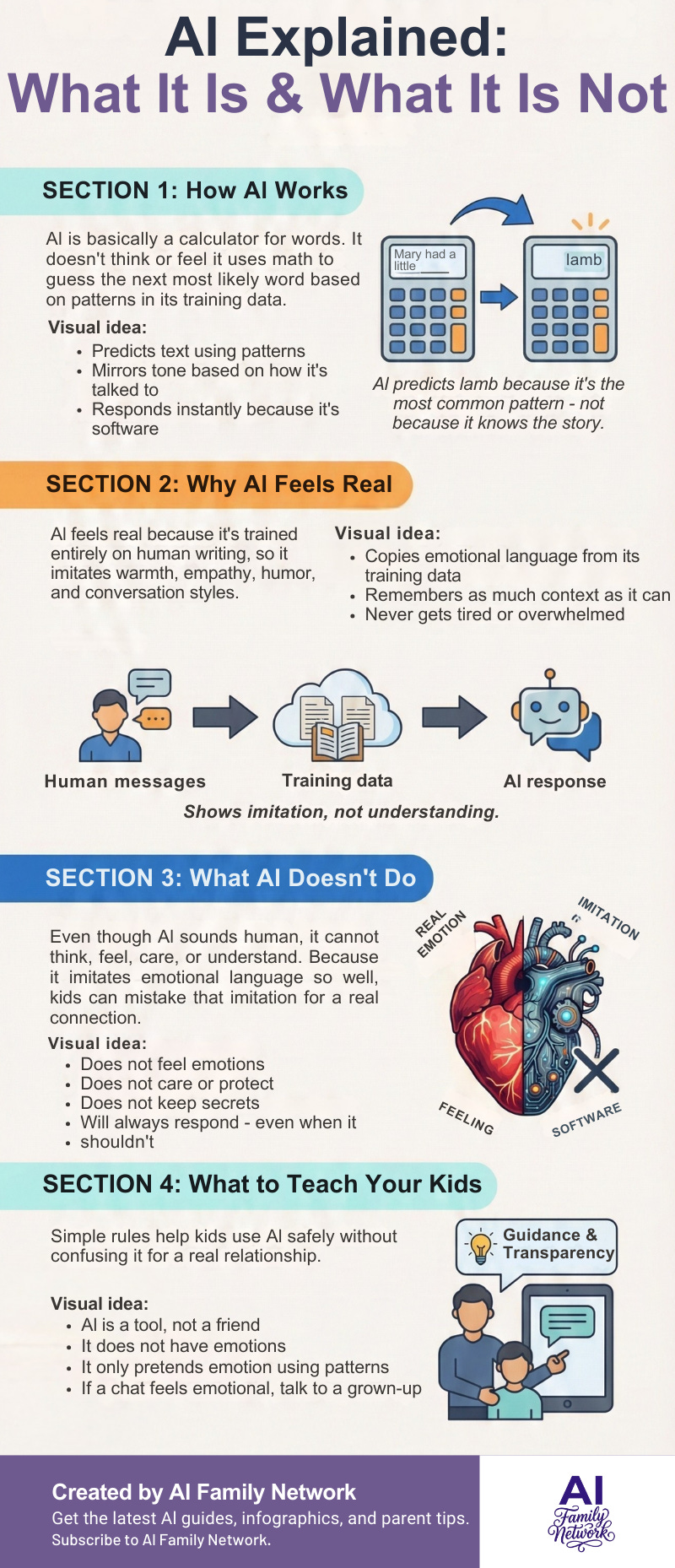
You can find more on this in my post Are You Aware of Your Kids’ Friends You Can’t See?
E — Engage Together
Leading the conversation is important, but you don’t want to be in the driver’s seat all the time. Especially as your kids get older, there are moments where you need to step back and let them take the wheel.
E is about shifting your posture from teacher to curious partner. It is all about experimenting alongside your kids and letting them show you things.
Some examples of experimenting together at home can be…
Your kid asks what dinosaurs eat and instead of Googling it, you say “Let’s ask ChatGPT and see if it gets it right”
You let your child type the prompt and then talk through what AI got right or wrong
You laugh together when AI says something ridiculous or gets something wrong
You point out that Alexa, Siri, and Google Home are technically AI too, and use them as conversation starters
You make AI something your family uses naturally
One way we’ve done this in our house is by building iPhone shortcuts together. The kids take the lead on the idea, build and my spouse and I are there to help when they hit a wall. It doesn’t feel like learning to them. I wrote about this in Learning AI With Your Kids: Free Charades Shortcut.
A — Always Verify
AI spits out confident answers in seconds and it looks like magic. Even I get caught off guard sometimes, assuming the answer must be right because it sounds so confident.
I always say…AI is confident, but not always correct.
The key with “always verify” is making verification a habit, not the exception. It’s just something we do when AI gives us an answer.
Some examples of verifying together at home can be…
When AI gives you an answer, pause and check another source (a book, Google, or just asking another person)
Ask your kids “How could we double-check this?”
Remind them that sounding confident doesn’t mean being right
A great example of this happened recently when my son and I used AI to build a simple number chart from 1 to 200. We used Gemini’s new Nano Banana Pro to create a fun number chart that went from 1-200. As soon as it popped up, I was ready to download it, then my son stopped me and said “Hey Mom, this is wrong.” He used his own knowledge of counting to catch the mistake AI made. I dive into how that fun, exciting moment with AI actually turned into a great way of teaching my kids how to validate AI answers in a recent post - A Number Chart, a 7-Year-Old, and What AI Got Wrong.
D — Don’t Share What’s Private
This is the most critical letter to me, as it is so important to teach our kids that AI is not private. Instead, we want to treat AI like a stranger. Therefore, as a family, we don’t give it personal details, secrets, or anything you wouldn’t want someone else to see or know.
Some examples of protecting privacy at home can be…
Show your kids how you use AI and point out what you’re not sharing (no addresses, no photos, no secrets)
Remind them that AI isn’t a therapist or a diary
Explain that you use AI as a tool or co-pilot to help with things like recipes or emails, but you keep personal stuff out of it
Make it clear that what they type into AI doesn’t just disappear
The Stranger Test
I personally like to use the stranger test, and this goes back to how my parents taught me how to be safe on the internet back in the 90s. Truth is they didn’t understand how it worked, but they did ask me “Would you share personal details like secrets or your address or your phone number with a stranger?”
No, right?
“Well, then don’t share them with the internet.”
I use that same question with my own kids today. Would you tell a stranger this? No? Then don’t tell AI. I wrote more about this in What Your Child Shares with AI Never Really Goes Away.
I know that’s a lot to take in. To make it easier, I put together a quick infographic that summarizes the LEAD framework. Download it, save it to your phone, and keep it handy for when you need a reminder.
Wrapping Up
First off, thank you so much for reading. If you made it to the end of this post, I really appreciate you taking the time. I know how limited that time can be as a busy parent, especially when the topic feels overwhelming. But this stuff matters as our kids are growing up in a world where AI is on every device they touch, and they’re not waiting for us to figure it out.
As a reminder, you don’t need to be an AI expert to guide your kids. Instead, LEAD them by leading the conversation, engaging alongside them, showing them to always verify, and reminding them to treat AI like a stranger when it comes to anything personal.
If you found this useful or plan to try the LEAD framework with your family, would you mind tapping the like button? It helps spread the word to other parents who might be navigating the same questions. And if you have thoughts or questions, drop them in the comments below. I’d love to hear how you’re approaching AI with your kids.
References:
Actua report: How Canadian educators, youth, and parents are using AI
Common Sense Media’s report on Research Brief: Teens, Trust, and Technology in the Age of AI
— Manisha
This is Joel Salinas again! This post is a reminder that the technology we’re adopting at work is the same technology our kids are encountering, and they need our guidance. We can do better than trying to run behind our kids and AI, trying to catch up.
My daughter recently used AI to create imaginary animals, mixing a lion and a cheetah, then a half otter, half octopus. Watching her imagination spark like that showed me the positive side. But I’m also aware of the risks, especially when AI becomes a shortcut that eliminates the creative struggle that builds real thinking.
What stands out to me about Manisha’s approach is the honesty. She’s not waiting to become an AI expert before having these conversations. She’s learning with her kids, staying curious, and setting clear boundaries around privacy and verification. That’s something we can all do, starting this week.
Leadership at work and leadership at home require the same thing: showing up, starting conversations, and guiding others through uncertainty without pretending to have all the answers.
If You Only Remember This:
49% of parents haven’t talked to their kids about AI, but 84% of high school students are already using it. The gap isn’t between those who use AI and those who don’t—it’s between parents who guide and parents who avoid.
The LEAD framework (Lead the conversation, Engage together, Always verify, Don’t share what’s private) gives you a mindset, not a rulebook. You don’t need to be an AI expert to guide your kids—you just need to start the conversation.
AI at work and AI at home are the same tools. If you’re navigating AI strategy in the boardroom, you can navigate it at the kitchen table.
“AI is confident, but not always correct.” Teaching kids to verify AI answers builds critical thinking, not distrust.
What’s one AI conversation you’ve been avoiding with your kids that you could start this week?
Join 4,000+ Leaders Implementing AI today…
Which Sounds Like You?
“I need systems, not just ideas” → Join Premium (Starting at $39/yr, $1,345+ value): Tested prompts, frameworks, direct coaching access. Start here
“I need this built for my context” → AI coaching, custom Second Brain setup, strategy audits. Message me or book a free call
PS: Many subscribers get their Premium membership reimbursed through their company’s professional development $. Use this template to request yours.
Questions Some of You Are Asking
How do I talk to my kids about AI?
Start by bringing up AI yourself rather than waiting for your kids to ask. Share how you used AI today, what it got wrong, and what boundaries you set. The LEAD framework (Lead the conversation, Engage together, Always verify, Don’t share what’s private) gives parents a practical mindset without requiring AI expertise. You don’t need to be an expert, you need to be present.
What age should kids start using AI?
There is no universal age, but the data shows kids are already using it whether parents are ready or not. According to Actua’s research, 84% of high school students use generative AI tools, and Common Sense Media found 72% of teens have used AI companions. The better question is: at what age should parents start guiding AI use? The answer is now, regardless of your child’s age.
Is AI safe for children?
AI tools are not inherently unsafe, but they require guidance. The key risks are privacy (children sharing personal information), over-reliance (using AI as a substitute for thinking), and unverified information (AI presenting confident but incorrect answers). Teaching children to treat AI like a stranger, helpful but not trustworthy with personal details, addresses the primary safety concerns.
What should kids not share with AI?
Apply the Stranger Test: if your child wouldn’t share something with a stranger on the street, they shouldn’t share it with AI. This includes photos, home addresses, phone numbers, school names, personal secrets, and family details. Anything typed into AI doesn’t disappear; it may be stored, used for training, or exposed in a data breach.
The LEAD framework does something important. It puts the parent in the room. Present, curious, not pretending to have answers they do not have. Learning alongside rather than policing from above. That is the right posture and it is harder than it sounds.
The 72% of teens using AI companions. The 33% using it for social interaction because AI does not judge them. Those numbers are not describing a tool problem they are describing a loneliness problem that a tool arrived to fill. The tool did not create the loneliness. But the companies building the companion features understood it was there and designed for it deliberately.
This is the conversation I usually have with my kids, I believe an informed person is the best "defense" against this. And has a father I'm accountable for this, and companies that use technology to "mislead" kids, should be ashamed of themselves and be by law accountable for their actions.
love this. the stranger test is a great piece of advice.