


TL;DR - The biggest near-term payoff from agentic AI gets less attention than the headlines suggest. Across most organizations, high-knowledge workers lose hours every day to operational friction: searching disconnected systems, chasing approvals, reconciling data. Agentic AI can absorb that drag, which frees your experts to spend their time on the work only they can do.

I have four businesses. Each one has its own brand, its own audience, its own voice. And the part that drains me isn’t the thinking, it’s everything around it, rebuilding the same deck for a different audience, retargeting a report, proofing the same paragraph for the fourth time, hopping between systems to find one file. None of that is the work I’m actually good at. It’s drag.
So here’s the question I keep getting from leaders, usually some version of it:
Is agentic AI (AI that doesn’t just answer questions but actually takes action across your systems) coming for my team’s jobs?
It’s a fair fear. I just think most leaders are aiming it at the wrong target. I’ve written before about how to use AI to expand your impact without adding headcount, and about why most AI investments stall out when the structure underneath them stays broken.
That’s the exact argument Daniel Fallmann, CEO of the enterprise AI firm Mindbreeze, brought to me. He comes at it from inside the enterprise, and he makes the case cleanly, so I’m handing you the floor. Read his piece, then I’ll meet you on the other side.
What to Remember
Agentic AI — AI that takes action across your systems (retrieving, routing, coordinating approvals), not just an assistant that answers questions.
Most organizations aren’t short on talent. They’re buried in operational complexity.
Operational friction compounds. One delayed approval or repeated search ripples across the whole organization.
The near-term win is removing drag from knowledge work, so your experts spend their hours on what only they can do.
The Real Opportunity In Agentic AI Is Operational Efficiency
By Daniel Fallmann, CEO of Mindbreeze
Much of the public conversation around agentic AI continues to focus on workforce replacement. Headlines frequently emphasize automation risks, disappearing jobs, and the possibility that intelligent systems may eventually operate with minimal human involvement. While those discussions attract attention, they often overlook what may become the most immediate and economically meaningful impact of agentic AI inside enterprises.
The larger opportunity is operational efficiency.
Across most organizations, high-knowledge workers spend significant portions of their day navigating friction rather than applying expertise. Employees search across disconnected systems for information, manually coordinate approvals, reconcile inconsistent data, repeat administrative tasks, and move work between fragmented workflows. These activities rarely represent the strategic value those very employees were hired to provide, yet they consume enormous amounts of organizational capacity.
Agentic AI is increasingly positioned to reduce that friction.
This shift matters because many enterprises are not constrained primarily by talent shortages or insufficient intelligence. They are constrained by operational complexity. Over time, organizations accumulate layers of systems, processes, repositories, and communication channels that make work harder to execute efficiently. The result is often a hidden productivity tax spread across the enterprise.
Recent reports highlight how organizations are increasingly shifting from isolated AI deployments toward workflow-level transformation. Rather than treating AI as another productivity tool, enterprise leaders are beginning to redesign operational processes around intelligent systems capable of participating directly inside workflows.
This distinction is important because productivity gains generated through isolated assistance often plateau quickly. Faster content generation or quicker information retrieval may improve individual tasks, but they do not necessarily remove the underlying inefficiencies that slow organizations down.
Operational friction behaves differently. It compounds.
A procurement approval delayed by fragmented systems affects purchasing timelines. A support representative searching multiple repositories for customer information increases response times. An engineer reconciling conflicting documentation across platforms slows development cycles. Small inefficiencies inside individual workflows frequently create substantial enterprise-wide consequences.
This is where agentic AI begins to create more meaningful value.
Rather than simply generating outputs, agentic systems increasingly operate across workflows. They retrieve information, coordinate actions, trigger processes, route approvals, maintain context across systems, and help reduce the administrative burden surrounding knowledge work itself.
Organizations are already confronting a new challenge emerging alongside AI deployment: managing large numbers of agents operating across enterprise environments. While this reporting (WSJ) focuses on governance concerns, it also reflects how quickly enterprises are moving toward workflow-oriented AI systems capable of acting across operational processes.
The significance of this transition extends beyond automation.
Historically, many enterprise technologies focused on digitizing tasks. Agentic AI increasingly focuses on coordinating execution.
That creates a different category of impact.
An employee who no longer spends hours locating information across systems gains time for customer engagement, strategic planning, analysis, or innovation. A manager no longer trapped in repetitive approval coordination can focus more attention on operational improvement and decision-making. In many cases, the highest value of AI may not come from replacing expertise, but from removing the friction preventing expertise from operating efficiently.
Organizations continue increasing investment in AI, yet many leaders are discovering that efficiency gains alone (Fortune) do not automatically translate into better business outcomes if operational structures remain fragmented.
This is why workflow integration is becoming increasingly important.
Agentic systems generate the greatest value when they operate within enterprise context. That means understanding permissions, accessing relevant knowledge, interacting with systems of record, and maintaining continuity across workflows rather than functioning as isolated assistants.
Mindbreeze has recently discussed this transition through its analysis of enterprise agentic AI strategy, arguing that organizations increasingly need systems capable of executing work across environments rather than simply generating intelligent responses.
Similarly, Mindbreeze’s introduction of Insight Touchpoints and Insight Journeys reflects a broader enterprise movement toward standardized multi-step workflows that connect intelligence directly to execution.
The broader lesson for enterprise leaders is becoming increasingly clear.
The most immediate impact of agentic AI is unlikely to be mass workforce replacement. The more practical transformation is the gradual elimination of operational inefficiencies that consume organizational capacity every day.
That distinction matters because it changes how executives should evaluate AI investments.
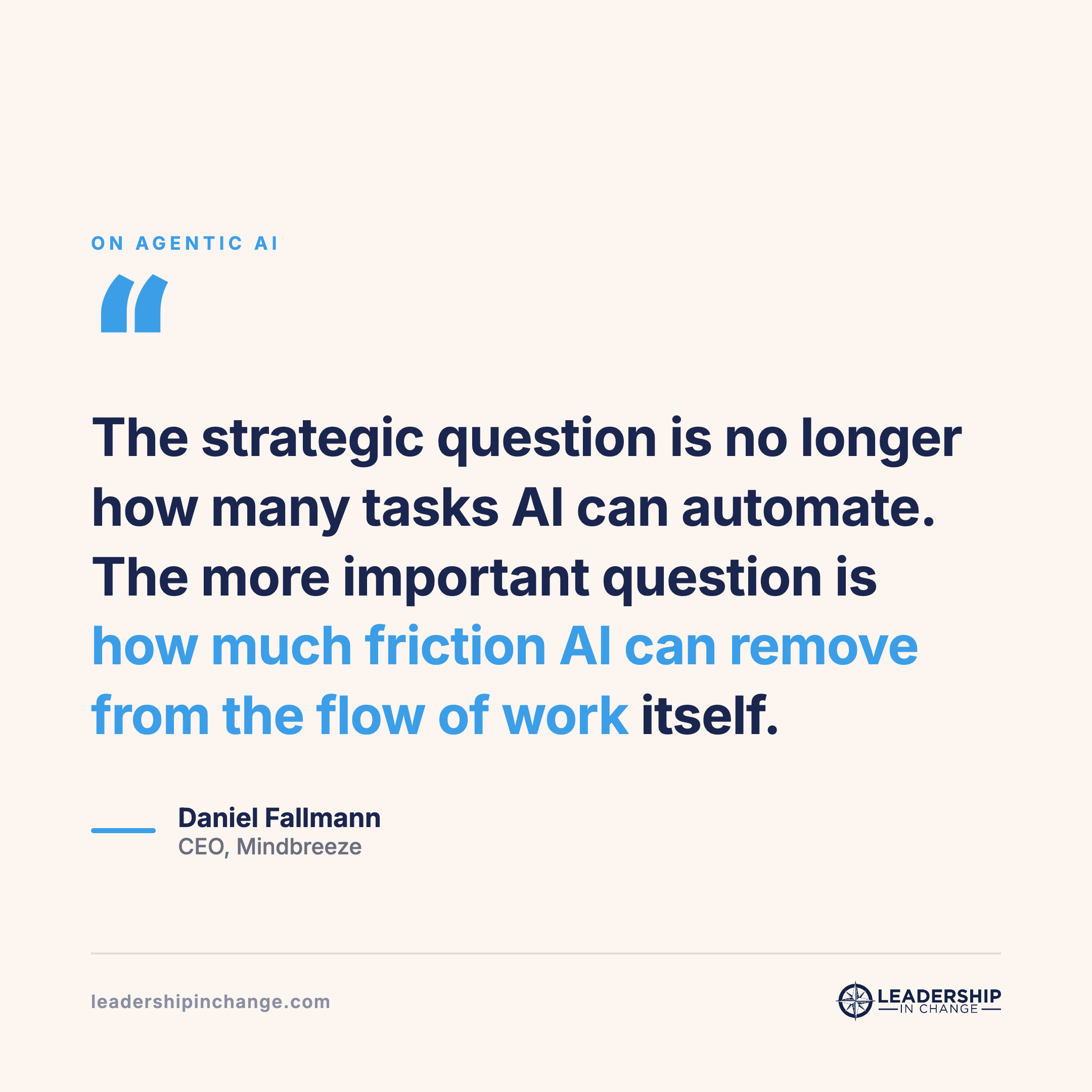
The strategic question is no longer simply how many tasks AI can automate. The more important question is how much friction AI can remove from the flow of work itself.
Organizations that successfully deploy agentic AI may not necessarily operate with dramatically smaller workforces. But they are likely to operate with significantly less organizational drag.
Over time, that may become one of the most important competitive advantages enterprise AI creates.
Thank you, Daniel!
Here’s where I come down after sitting with Daniel’s argument. You might not run a procurement department or a support desk. But if you’re the leader who’s also the ops team, the grant writer, and the person formatting the board deck at 11pm, the friction he’s describing is the same friction, it’s just concentrated on one desk instead of spread across a thousand. The hours still go to finding, formatting, chasing, and reconciling, not to the work only you can do.
The leaders who win the next few years won’t be the ones who shrink their teams the fastest. They’ll be the ones who free their best people to spend more hours on the work only humans do well, while AI carries the drag underneath.
That’s the whole game for me. I want AI doing what it’s good at so the people can do what they’re good at, which is the same idea behind the AI Leadership Triad I keep coming back to, and the same reason I keep asking whether complexity is killing the mission.
So before you go shopping for an agent, try this Monday. Look back at last week and write down the three tasks that ate the most time, then circle the ones that weren’t actually the work you’re good at, the searching, the formatting, the approval-chasing, the copying of data from one place to another. That circled list is where to point AI first.
Point AI at the drag, not the people.
If you want help finding where that drag actually lives in your organization, and where to point AI first, that's the work I do with leaders in my 90-Day Judgment Engagement. And if you'd rather start smaller, the AI Judgment Workshop waitlist is open.
Daniel Fallmann is the CEO of Mindbreeze. You can read more of his thinking at mindbreeze.com or connect with him on LinkedIn.
Questions Leaders Are Asking
What is agentic AI, in plain terms? Agentic AI is software that takes action across your systems instead of just answering a prompt. It can retrieve information, route an approval, trigger a process, and carry context from one system to the next. Think of it as a coordinator that carries a task through its steps, where a chatbot would hand you a draft and stop.
How is agentic AI different from a tool like ChatGPT? A standard assistant responds inside a single conversation. You ask, it answers, you copy the result somewhere else. Agentic AI works across the gaps between your systems, doing the searching, moving, and coordinating itself. That is why its biggest payoff shows up in workflow friction, not in faster individual answers.
Does agentic AI mean I’ll need a smaller team? Not necessarily. The clearer near-term win is removing operational drag so the team you already have spends more time on high-value work. Many organizations that deploy agentic AI well keep their headcount and simply operate with far less friction, which becomes a real competitive edge over time.
Where should a leader point agentic AI first? Start where friction compounds. Look for the approvals delayed by fragmented systems, the repeated searches across repositories, the data your people reconcile by hand. Those small inefficiencies create enterprise-wide drag. Pointing agentic AI at the flow of work, rather than at one isolated task, is where the gains hold.
Why do AI efficiency gains often fail to show up in business results? Because efficiency on a fragmented structure still leaves the structure fragmented. Faster answers inside a broken workflow do not fix the workflow. Real gains come when AI operates inside enterprise context, with the right permissions, knowledge, and continuity across systems, rather than as an isolated assistant bolted onto the side.
What’s the biggest mistake leaders make with agentic AI? Evaluating it by how many tasks it can automate instead of how much friction it removes from the flow of work. Task-counting leads to scattered pilots that plateau. Friction-removal leads to workflow redesign, which is where the durable advantage lives.
Joel Salinas is an AI Strategy Coach for leaders at small and mid-sized businesses and nonprofits. AI is everywhere; judgment is scarce. Joel helps leaders adopt AI without outsourcing their judgment to it, through live workshops and 90-day engagements. Creator of the AI Leadership Triad. He writes Leadership in Change.
Daniel Fallmann is the founder and CEO of Mindbreeze, an enterprise AI and insight platform. He has built the company around product-first engineering and out-of-the-box solutions that work without heavy professional-services overhead.
Written by a human, for humans.
I frequently use the description operational chaos but I really like the term operational drag. I’m actually not sure I’ve ever heard it described quite that way but it’s super relatable. Great read- I listened on a walk and have to go back through and save some great takeaways.
Operational friction quietly costs more than most teams realize.