


Thanks for reading! To access our community, full prompt library, coaching, and AI tools saving leaders 5-10 hours per week, check out our Premium Hub.
Survey Methodology: This analysis is based on a comprehensive survey conducted in late November 2025 of top Substack AI creators. I reached out to 50 creators from diverse industries and focus areas, from practical AI implementation to leadership strategy, marketing automation to technical workflows. The 50 responses provided detailed, honest insights into their real-world AI usage.
We live in microcosms. Facebook shows us people who think like us. Twitter amplifies voices that sound like ours. LinkedIn connects us with professionals in our bubble. Before long, we’re convinced that everyone sees AI the way we do, whether that’s essential, overrated, scary, or transformative.
Microcosms lie to us. They convince us that our reality is everyone’s reality. If your network is full of AI enthusiasts, you think everyone’s using Claude daily. If your circle is skeptical, you assume AI is just hype… But neither is true.
So I decided to step outside my bubble. I surveyed 50 Substack leaders and creators who I know use AI at different levels, some I knew, some I didn’t. Some use it sporadically, others are deeply technical, building custom workflows and agents. They come from different circles, different industries, different sectors. Nonprofit directors. Church leaders. Business founders. Creative professionals. Consultants. The only thing they have in common? They all use AI in some capacity.
I wanted to know: What’s the actual state of AI leadership in 2025? So I sent out a survey to 50 top AI creators…

All responded with detailed, honest answers. What they revealed wasn’t a unified vision of AI’s future. It was three distinct paradoxes that define how leaders are actually using AI right now, not how we think they should be using it.
I’m going to show you three paradoxes that define AI leadership right now.
You’ll see why 77.5% of leaders use AI multiple times daily but still don’t trust it.
You’ll understand the 30% problem holding leaders back.
And you’ll figure out which of three leadership types you are, because your next steps depend on it.
I loved what the survey revealed, and I think you will too. Let’s dive in.
77.5% Use AI Multiple Times Daily… What That Actually Means.
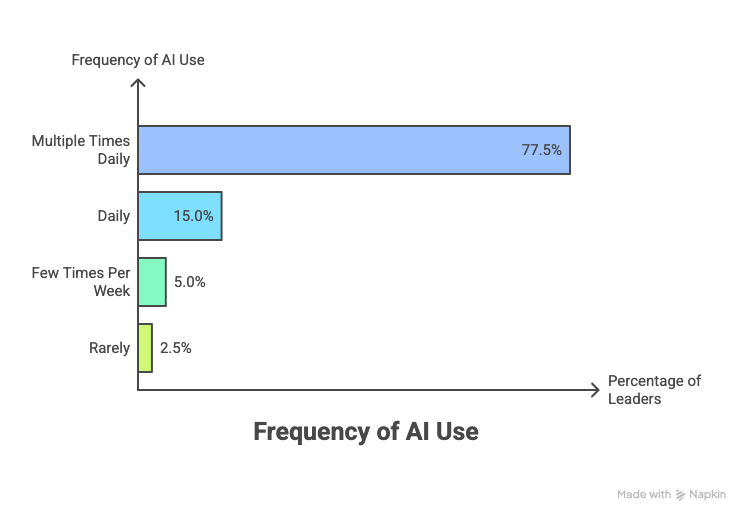
According to our State of AI Leadership survey, 77.5% of mission-driven leaders use AI multiple times per day. Not weekly, not occasionally, but multiple times daily.
Read that again.
When I started this survey, I expected to find cautious adoption. Maybe 40% to 50% use it regularly, with the rest testing occasionally or waiting on the sidelines. Instead, I found something closer to dependence.
The numbers:
77.5% use AI multiple times per day
15.0% use it daily
5.0% use it a few times per week
Only 2.5% use it rarely
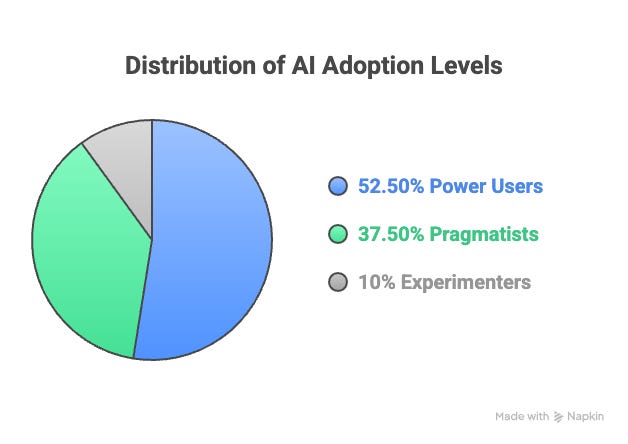
But frequency doesn’t tell the whole story. When I asked how AI fits into their workflow, 52.5% said it’s essential; they can’t imagine working without it. Another 37.5% said it regularly saves them significant time. Only 10% are still experimenting, treating AI as something not yet core to their work.
Most leaders aren’t experimenting with AI anymore. They’re dependent on it.
This matters because it destroys the narrative that AI adoption is slow or uncertain. Among leaders who welcome it, adoption isn’t creeping. It’s exploding.
But that 77.5% isn’t uniform. When I looked closer, three distinct groups emerged.
Which of These Three Types Are You?
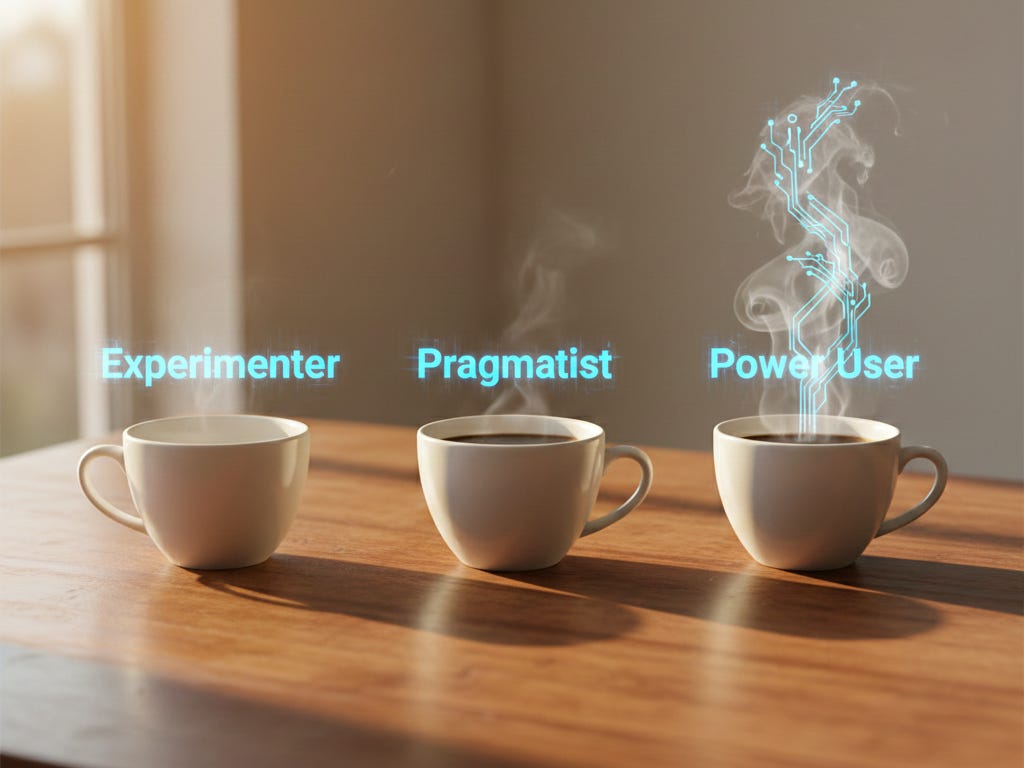
The survey revealed three distinct groups. And if you’re honest with yourself, you know exactly which one you are.
Brought to you by COZORA👇, learn AI live!
During December, All Subscribers get 10% with code CHRISTMAS25.
Premium subscribers get $360 off (50% per year) through the coupon in the Premium Hub.

52.5% are Power Users. AI is essential to their workflow. They use it multiple times daily and have integrated it deeply into how they think, write, analyze, and decide. These leaders have crossed the adoption chasm and aren’t looking back. They’re the ones building custom GPTs, chaining prompts together, treating AI like a thinking partner instead of a search engine.
Then you’ve got 37.5% who are Pragmatists. AI regularly saves them time. They see clear value and use it often, but they’re still building habits. They haven’t reached the point where AI feels indispensable. Not yet, anyway. They’re in that middle zone—using AI enough to see the potential, but not enough to reorganize their entire workflow around it.
The final 10% are Experimenters. AI isn’t yet core to their work. They’re testing, learning, trying to figure out where it fits. Some are constrained by time. Others haven’t found their use case yet. They want to believe the hype, but they’re not seeing it in their daily reality.
The gap between these groups is widening, not closing. Power Users are accelerating. Experimenters are struggling to find the upfront investment (what scientists call “activation energy,” the initial push required to get a reaction started) to cross into regular use. And the Pragmatists? They’re slowly tipping toward one group or the other.
Which type are you?
Your answer determines your next steps. Power Users need advanced strategies for organizational adoption and sophisticated use cases. Pragmatists need consistent workflows that turn helpful into essential. Experimenters need to solve the time problem. And that brings us to the first paradox.
Paradox #1: Leaders Use AI Constantly While Questioning It Constantly
The first open-ended question in the survey was:
What’s your BIGGEST concern about AI right now?
This is where it gets weird. Leaders are using AI constantly while simultaneously questioning it.
The most common barrier to AI adoption isn’t budget or access. It’s time, as we’ll see next (30% of leaders cite “time/capacity to learn and implement” as their biggest gap). But what concerns them most once they’re using it?
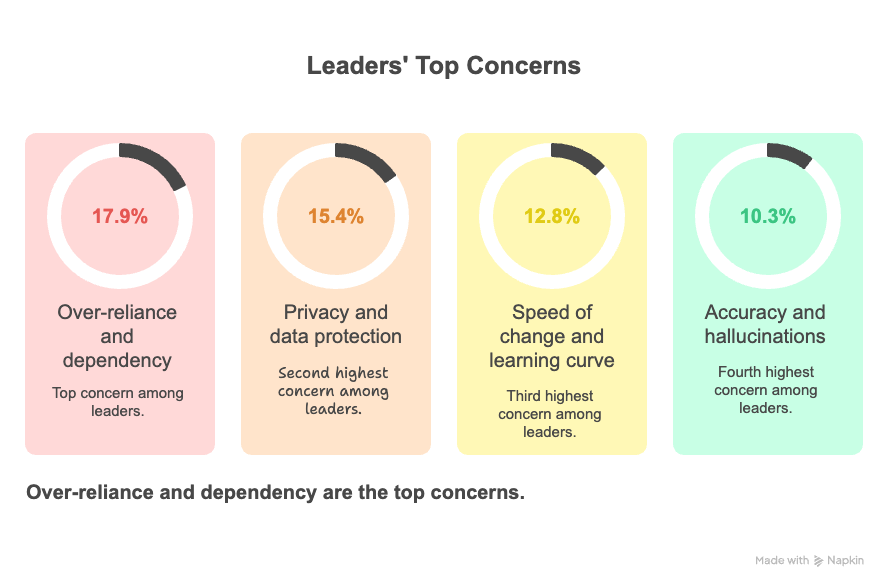
Leaders’ top concerns reveal a trust paradox:
17.9% cite over-reliance and dependency
15.4% worry about privacy and data protection
12.8% fear the speed of change and the learning curve
10.3% cite accuracy and hallucinations
One leader captured this perfectly:
“That I’ll use it to sound smarter instead of think clearer.”
Another wrote:
“Too easy to get lulled to sleep and make it an easy button.”
These aren’t skeptics refusing to adopt AI. These are daily users. People who depend on AI while actively managing their distrust of it.
“I fear that I’ll use it to sound smarter instead of think clearer.”
— State of AI Leadership 2025 Survey
Sound smarter versus think clearer. That’s the choice every leader faces with AI.
Sounding smarter is easy. Copy AI’s output. Use its vocabulary. Let it polish your rough edges until you sound like everyone else using the same tool. You’ll write cleaner emails. Tighter reports. More professional everything. And you’ll sound exactly like the thousand other leaders whose AI used the same training data to polish their rough edges the same way.
Thinking clearer is harder. It means using AI to challenge your assumptions, poke holes in your logic, show you patterns you missed. It means treating AI like a sparring partner, not a ghostwriter. It means feeding it your half-formed ideas and asking “What am I missing?” instead of “Make this sound better.”
The leaders getting the most value? They’re choosing to think clearer.
See more on that in my How to Create your AI Second Brain post.
So what do you do with this? It means verification workflows matter. It means treating AI as a thought partner, not an oracle. It means the leaders succeeding with AI aren’t the ones who trust it blindly. They’re the ones who’ve built systems around its limitations.
In future posts, I’m going to dig into how to use AI in ways that amplify your thinking instead of replacing it. How to avoid the creativity death that comes from outsourcing your brain. How to prevent the laziness that creeps in when you make AI your easy button.
But first, you need to understand the landscape. And the landscape is full of leaders using tools they don’t fully trust.
Paradox #2: The Tool That Saves Time Requires Time You Don’t Have
The second paradox? Time.
The tool designed to save time requires time you don’t have to learn it.
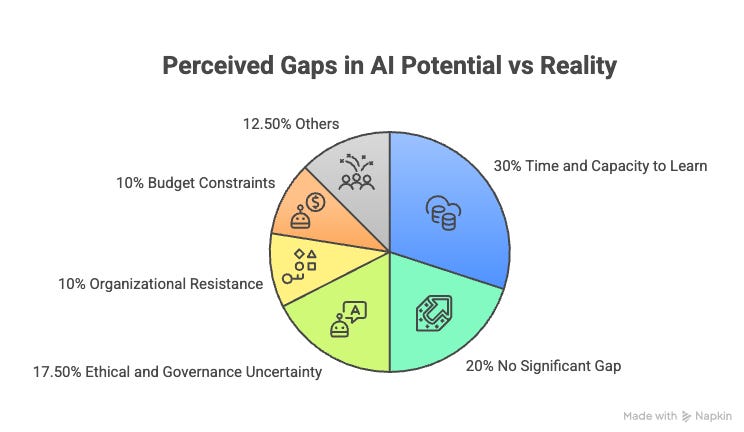
When asked about the biggest gap between AI’s potential and their current reality, the responses clustered around a few key themes:
30% said time and capacity to learn and implement (the overwhelming winner)
20% said there’s no significant gap—they’re doing well
17.5% cited uncertainty about ethics and governance
10% pointed to organizational resistance or culture
10% cited budget constraints
Notice that spread. Almost one-third of leaders can’t find the time to learn AI. But one-fifth report no gap at all. They’ve figured it out.
This matters because the barrier isn’t AI’s complexity. It’s the activation energy required to cross the learning threshold, the upfront investment needed to get started.
I get this. When I first started learning AI, I’d sit down for 30 minutes, get frustrated with a bad result, and think “This is taking longer than just doing it myself.” I almost quit three times before something finally clicked. The problem wasn’t AI. The problem was that I was trying to learn everything instead of finding one killer application that would pay me back immediately.
Once you invest that time, AI returns massive dividends. One leader wrote:
“(With AI I got) efficiency gains, and (it’s) given me skills that I would have needed years to develop.”
Another said:
“(AI for me means) Speed, insanely fast iteration loop.”
But getting to that point requires time leaders don’t have. And this creates a vicious cycle: the leaders who need AI’s time-saving benefits most are the ones who can’t afford the upfront time investment to learn it.
If you’re in that 30%, the 20% who’ve solved it would tell you this: you don’t need to master everything. You need one killer use case that saves you 5 hours per week.
Once you experience that return, you’ll find time to learn more. But until you cross that threshold, AI feels like just another thing competing for your attention.
Paradox #3: What Leaders Value Most About AI
I asked an open-ended question in the survey:
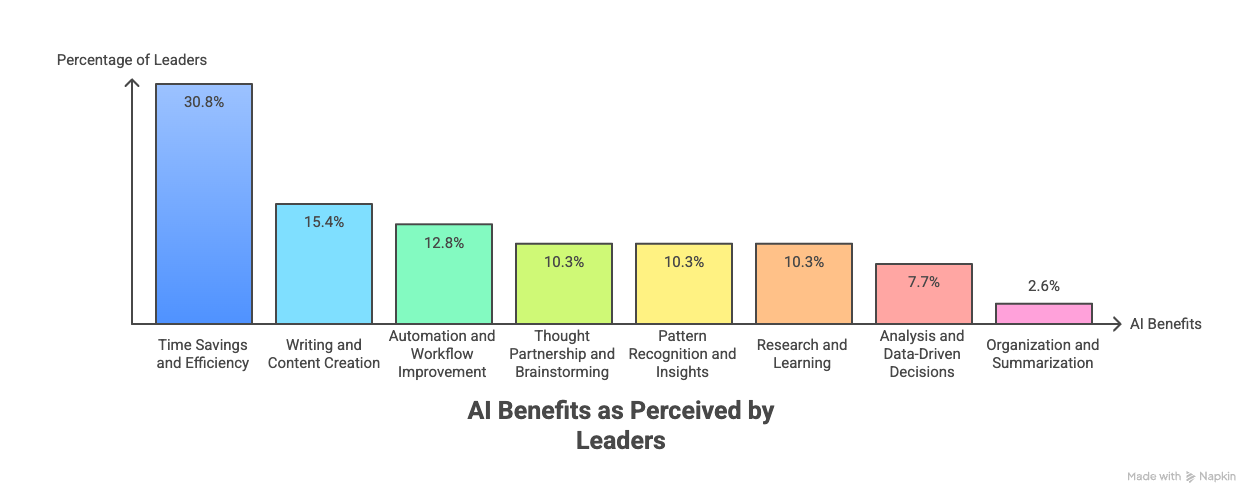
In one sentence, what’s the most valuable thing AI has done for your work this year?
Time savings dominates at 30.8%. But look at what comes next. That’s where it gets interesting. The most valuable piece is not AI spellcheck; it’s much deeper.
According to our State of AI Leadership survey, here’s what leaders said AI delivers:
30.8% - Time savings and efficiency
15.4% - Writing and content creation
12.8% - Automation and workflow improvement
10.3% - Thought partnership and brainstorming
10.3% - Pattern recognition and insights
10.3% - Research and learning
7.7% - Analysis and data-driven decisions
2.6% - Organization and summarization
Notice what comes after time savings. Thought partnership at 10.3%. Pattern recognition at 10.3%.
One leader wrote:
“Shows me patterns in my own thinking I couldn’t see alone.”
Another said:
“AI helped me integrate insights across systems, clients, and timeframes, revealing patterns no single conversation could.”
These aren’t people using AI for spell-check. They’re using AI as a cognitive tool, something that helps them think better, not just work faster.
AI’s real potential doesn’t live in replacing tasks. It lives in augmenting thinking.
And this sets up the question I’ll be exploring in upcoming posts:
How do you use AI to maximize your skills, talents, and impact while minimizing the harmful effects? How do you avoid killing your creativity or breeding laziness?
The answer starts with understanding what AI is actually good at, and what it’s not. The leaders getting the most value aren’t using AI for everything. They’re using it strategically, for specific applications where it genuinely makes them better.
The #1 Thing Leaders Want
Another open-ended question:
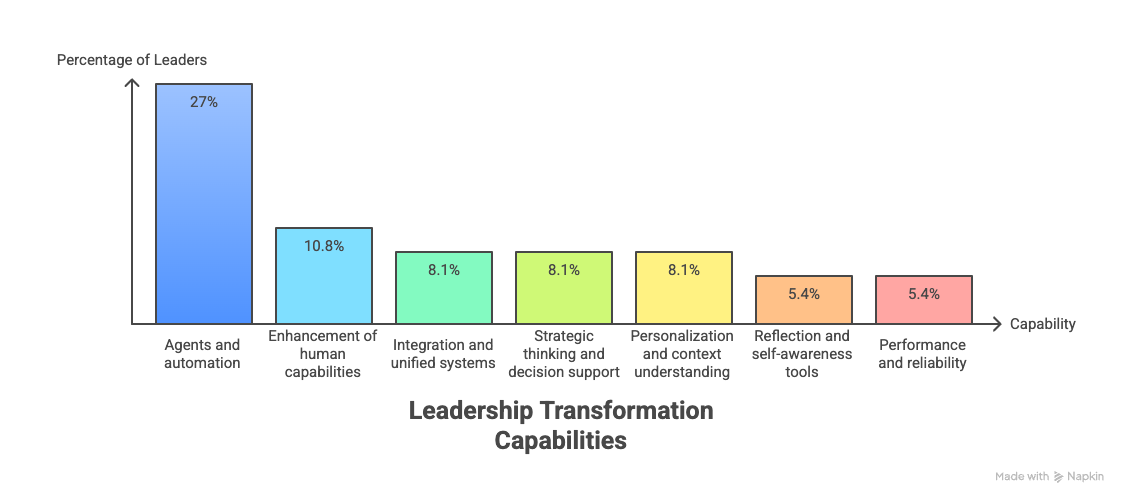
If you could wave a magic wand, what’s the ONE AI capability that would transform your leadership most?
When I asked this question, one answer dominated.
On what would transform their leadership most, 27% of leaders named the same capability: Agents and automation that handle entire workflows, not just individual tasks.
Think about that. More than one in four leaders, across different industries and roles, landed on the exact same answer.
The breakdown:
27% - Agents and automation
10.8% - Enhancement of human capabilities
8.1% - Integration and unified systems
8.1% - Strategic thinking and decision support
8.1% - Personalization and context understanding
5.4% - Reflection and self-awareness tools
5.4% - Performance and reliability
Leaders wrote things like:
“An AI assistant agent that could take care of all my systems and flows”
“Clone myself”
“AI Agents doing my daily repetitive tasks so I can focus on things that truly move the needle”
Let that sink in… what the future leaders want is autonomous AI teammates, not better chatbots.
But here’s the paradox: almost no one in the survey is actually using agents yet. They’re using conversational AI, ChatGPT, Claude, Gemini. They can envision a future where AI handles entire workflows autonomously, but current tools haven’t delivered it.
This gap between desire and capability tells us something important about 2025: we’re in the awkward middle.
Leaders have moved beyond “Can AI help me?” to “When will AI do this entire thing for me?” They’ve experienced enough value that they can imagine the next level. But the tools aren’t quite there yet.
And honestly? That’s probably a good thing. Because before we hand entire workflows over to autonomous agents, we need to get really clear on how to use AI well. How to maintain our creativity. How to avoid outsourcing our thinking. How to keep AI as a tool that serves our judgment, not replaces it.
If You Only Remember This:
77.5% of leaders use AI multiple times daily, but 17.9% worry about over-reliance and 10.3% cite accuracy concerns. The trust-use disconnect is real. Build verification systems around AI’s limitations.
30% cite “time to learn” as their biggest barrier, but 20% report no significant gap. The problem isn’t AI’s complexity. It’s crossing the activation energy threshold. Find one killer use case that saves 5 hours weekly.
27% of leaders want agents and automation, but almost no one is using them yet. We’re in the awkward middle between conversational AI and autonomous agents. Use this time to build good habits.
The three leadership types, Power Users (52.5%), Pragmatists (37.5%), and Experimenters (10%), are diverging, not converging. Know which type you are. Your next steps depend on it.
“AI shows me patterns in my own thinking I couldn’t see alone.”
State of AI Leadership 2025 Survey
The most sophisticated AI use isn’t about speed. It’s about seeing what you couldn’t see before.
What You Should Do Next
This survey reveals where AI leadership actually stands in 2025. Not where the think pieces say it should be. Not where the vendors promise it’s heading. Where it is.
It’s messy. Leaders are adopting AI faster than their organizations, using it daily while questioning it constantly, saving time but unable to find time to learn.
A 72-year-old creative director told me recently… “I’m a bit jealous of what I’ll miss in 30 years.”
He’s not resisting it, he’s grieving the future he won’t see. That’s the kind of honesty this survey revealed: leaders who love what AI can do while wrestling with what it means.
If you’re an Experimenter struggling to find your activation moment, I’ve created a simple framework in the Premium Member Hub: FutureProof 6 Month planner. It helps you identify the path to becoming a power AI user based on your skills.
If you’re a Pragmatist, you’re ready to cross into Power User territory. The next few articles will give you the verification workflows, advanced prompting strategies, and organizational adoption frameworks you need to make that jump.
If you’re already a Power User, you know the real challenge isn’t personal adoption anymore. It’s bringing your team and organization along. Over the next month, I’m releasing the AI Leadership Implementation Series, everything from building trust systems to navigating the ethics questions that keep you up at night.
Which of the three types are you?
PS: Many subscribers get their Premium membership reimbursed through their company’s professional development $. Use this template to request yours.
Let’s Connect
I love connecting with people. Please use the following connect, collaborate, if you have an idea, or just want to engage further:
LinkedIn / Community Chat / Email / Medium
Yes, sounds pretty accurate.
I think there are something like 2.5 billion Ai chats/day. Crazy.
Adoption always gets messy when the pace outruns the trust.