




TL;DR: AI Amplification uses AI to stress-test strategic assumptions before committing resources, compressing months of expert consultation into twenty minutes. The Bed Bath & Beyond bankruptcy demonstrates how five AI-tested questions could have reframed an entire strategy before momentum made bad decisions irreversible.
There’s a difference between being smart and being right in unfamiliar territory.
Mark Tritton had an MBA from Harvard and had just led one of retail’s biggest transformations as Chief Merchandising Officer at Target. When Bed Bath & Beyond hired him as CEO in 2019, he brought a playbook that had generated billions in value.
Three years later, the company filed for bankruptcy.
Nick Connor writes about cross-domain pattern recognition and decision-making at The Convergence Project. He’s currently developing AI-powered tools for Type 2 problem-solving and exploring universal patterns across domains. His recent work includes Immune Systems vs. Fortresses on government design and The World Engine Blueprint for creative frameworks.
I’ve become a fan of his work because he asks questions most people skip. Not “what should AI do for you?” but “how do you test your thinking before momentum makes bad decisions irreversible?”

This piece shows what twenty minutes of the right questions could have revealed, and what that means for your next high-stakes decision in territory you don’t fully understand yet.
In this article, you’ll learn:
What AI Amplification actually is (it’s not what you think)
Five questions that stress-test strategic assumptions in unfamiliar markets
How to compress months of expert consultation into a twenty-minute conversation
A framework you can use on Monday morning on your next decision
Here is Nick from The Convergence Project.
AI Amplification: Testing Strategic Assumptions in Minutes, Not Months
How a 20-minute conversation could have changed Bed Bath & Beyond’s fate—and what that means for your next big decision
By Nick Connor
November 2019.
Mark Tritton was in his second week as CEO of Bed Bath & Beyond.
In five days, he would present his strategy to the board. The plan was taking shape: reduce the heavy couponing that hurt margins, replace national brands with higher-margin private labels, and modernize stores with a cleaner, more curated look.
It was the same playbook that had transformed Target into one of retail’s biggest turnaround successes. [Retail Dive]
Three years later, Bed Bath & Beyond filed for bankruptcy. [Reuters]
This Isn’t About Incompetence
This is not a post-mortem about incompetence. Quite the opposite. The more interesting question is this:
What if the real problem wasn’t intelligence or experience—but the inability to test assumptions fast enough before decisions became irreversible?
AI Amplification
AI Amplification is using AI to test your strategic hunches before you commit resources.
Think of it as an on-demand expert panel—available 24/7 to stress-test your thinking in domains where you don’t have deep experience.
This is not:
AI making decisions for you
Automation replacing judgment
A substitute for research or teamwork
This is about accelerating orientation—compressing months of expert consultation into minutes, early enough to change course.

Why This Matters to You
This isn’t just a retail story.
Whether you’re:
A founder entering a new market you don’t know
An exec hired to turn around a struggling business
A CEO evaluating M&A in an unfamiliar industry
A leader applying lessons from your last role to your current one
You face the same problem Tritton did: How do you make high-stakes decisions in unfamiliar territory when time is running out?
The Constraint Every New Leader Faces
Tritton had roughly 30 days to present a credible strategy.
The company had suffered years of declining performance. Activists were pushing for change. The market expected momentum. [Wikipedia]
The Target playbook made sense. It worked. Reduce inefficient promotions. Invest in owned brands. Simplify the store experience.
Here’s what Tritton didn’t have: Deep knowledge of treasure-hunt retail—a business model where browsing itself is the product and discovery is the value.
Normally? You’d hire consultants who specialize in this analysis.
But consultants take months. Tritton had weeks.
So he made the best decision he could with the information available.
That’s where the real failure mode lives.
Two Paths Diverge
Path A: What Actually Happened
By late November 2019, Tritton presented his vision. The board approved it unanimously.
Over the next two years, Bed Bath & Beyond reduced coupons, replaced national brands with private labels, and redesigned stores around a more curated aesthetic.
The result? Customer defection. Long-time shoppers migrated to HomeGoods and TJ Maxx—retailers that understood the treasure-hunt model. [CoStar]
The customers who preferred Target-style efficiency were already shopping at Target.
Once the strategy locked in, each subsequent decision reinforced it. By the time the data was undeniable, too much capital and organizational momentum had been committed to reverse course.
Path B: What Could Have Happened
Now imagine a slightly different Week Two.
Five days before the board meeting, Tritton pauses.
He’s noticed customers browsing longer than Target shoppers. He’s heard executives talk about wedding registries with unusual reverence. The famous blue coupons seem to matter more than he expected.
Instead of finalizing his presentation, he opens his laptop and starts a conversation with AI.
Not to ask what to do. But to test the assumptions behind what he’s already planning.
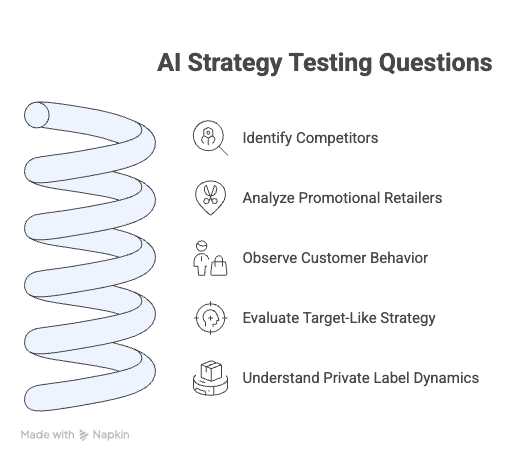
Five Questions
What follows isn’t theoretical. Every insight below emerged from an actual AI conversation—the kind any executive could have in 20 minutes. See the full transcript here.
Excerpts below are from the full AI transcript.
1. Who are we actually competing against?
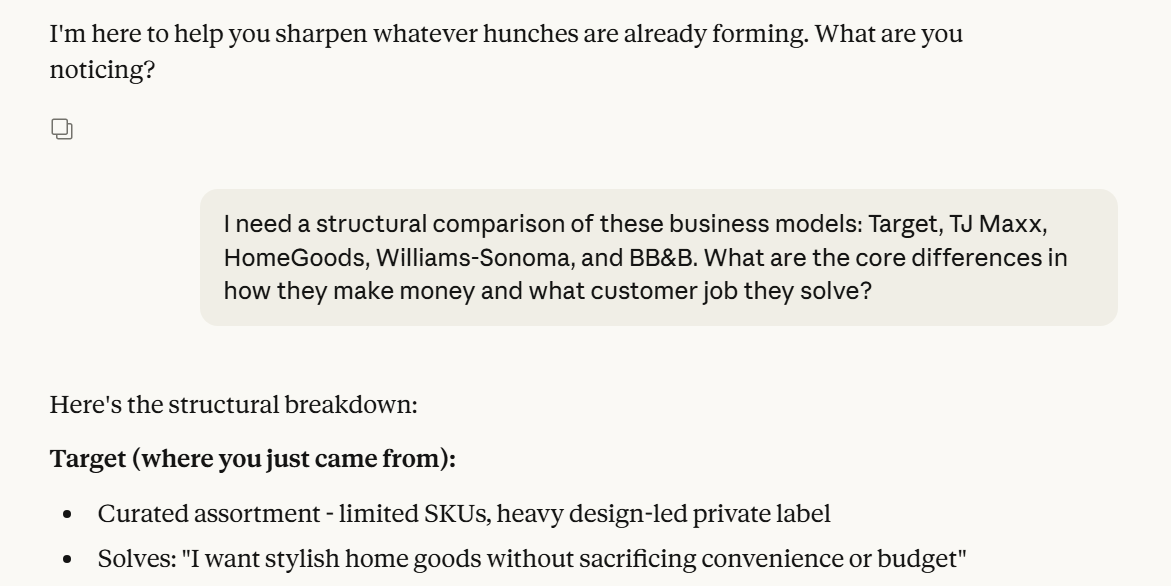
Assumption: Bed Bath & Beyond competes with Target and needs to become more like Target to win.
Insight: Structurally, BB&B resembles treasure-hunt retailers like TJ Maxx and HomeGoods more than efficiency retailers like Target. [Newsletter Pro]
Reframe: Applying Target’s playbook wouldn’t reposition BB&B—it would push it into direct competition with Target while abandoning its existing customer base.
Cross-Industry Application: The tactics that work in one might not transfer to the other.
2. What happens when promotional retailers eliminate coupons?
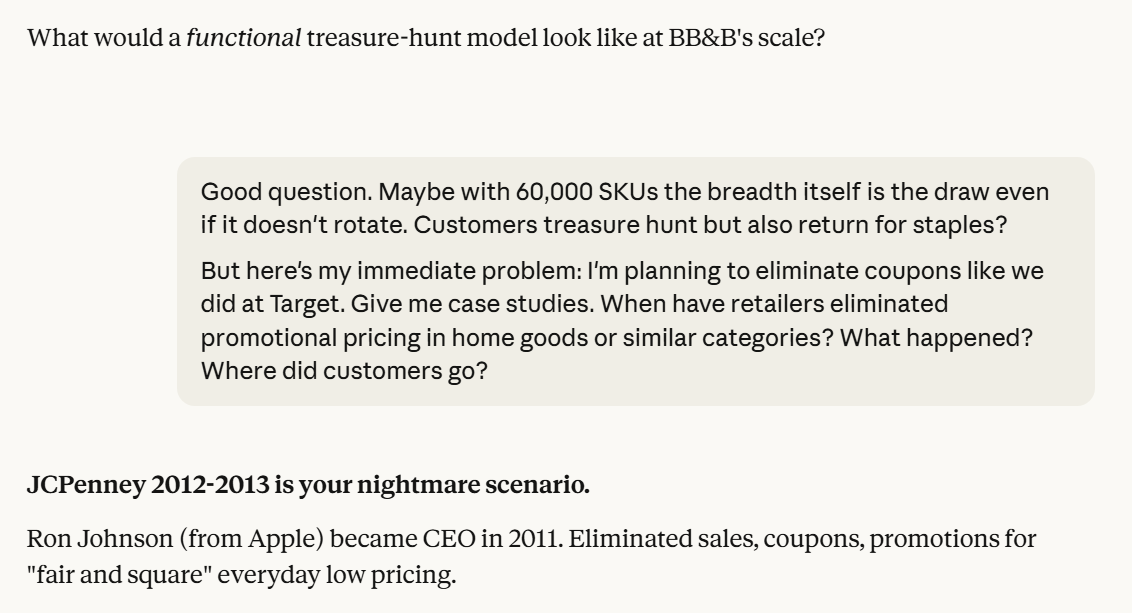
Assumption: Coupons are inefficient and train bad behavior. Customers will adapt to everyday low pricing.
Insight: When JCPenney eliminated coupons in 2012, traffic collapsed. [Time]
Reframe: Eliminating coupons doesn’t retrain customer behavior—it accelerates customer loss to retailers who still offer the hunt for deals.
Cross-Industry Application: Don’t eliminate what customers love just because it’s inefficient. Ask: “What are customers actually hiring this for?” The feature you think is a problem might be the value proposition.
3. How do our customers actually behave in-store?
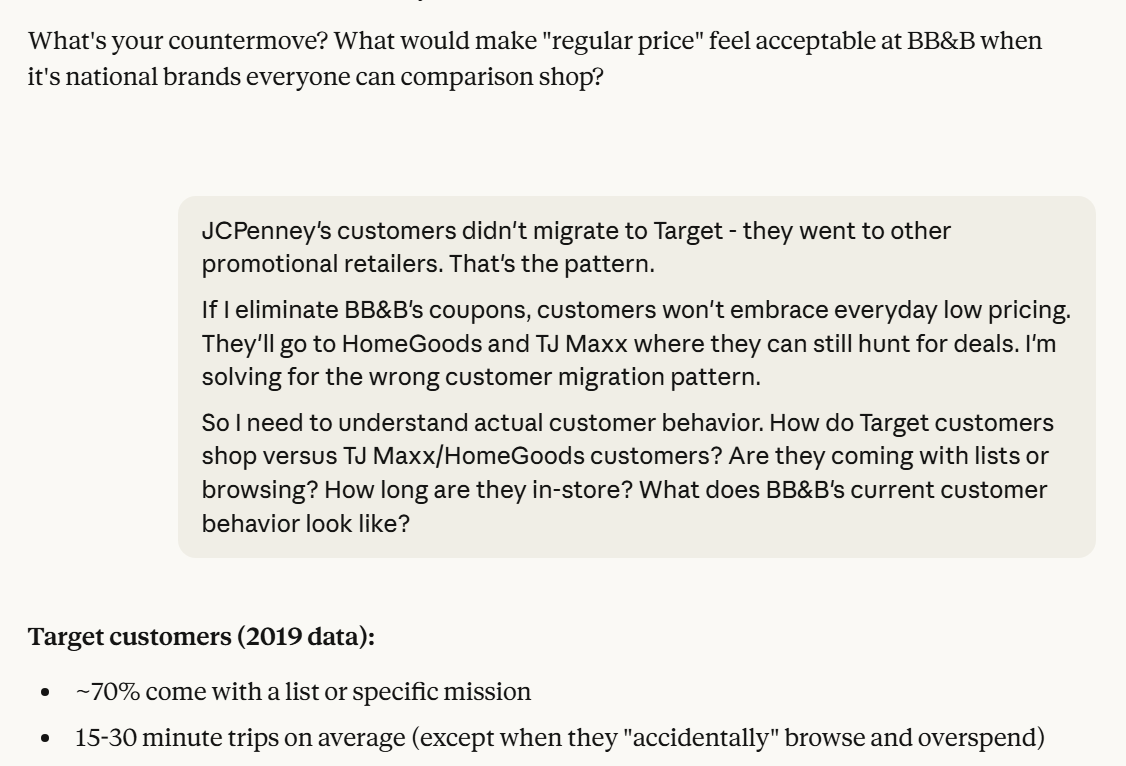
Assumption: Long store visits and time spent browsing are problems to solve through better curation.
Insight: Target shoppers are mission-driven and list-based. Treasure-hunt shoppers browse for extended periods because discovery IS the value. [Indeemo]
Reframe: Long visits weren’t a problem to solve—they were the value proposition. Reducing browse time would reduce the reason customers came at all.
Cross-Industry Application: Distinguish between bugs and features. What looks like friction to you might be engagement to your customer.
4. Who do we lose—and who do we gain—if we look more like Target?
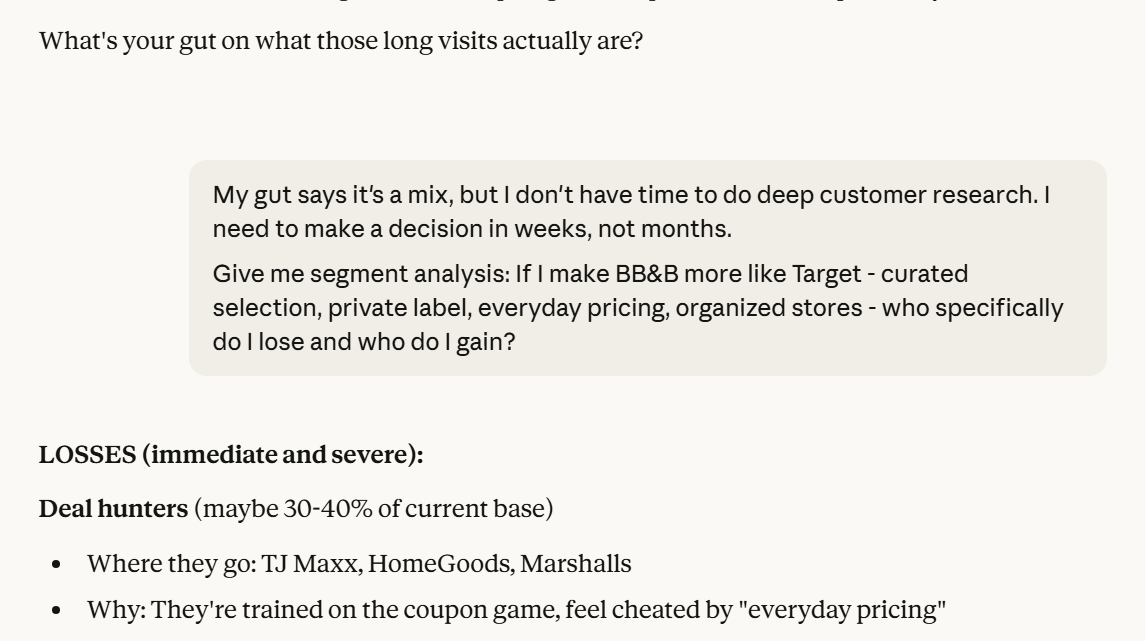
Assumption: Modernization will attract new customers without losing existing ones.
Insight: BB&B would lose discovery shoppers to TJ Maxx and HomeGoods while gaining few efficiency shoppers already served better elsewhere. [RetailWire]
Reframe: This wasn’t transformation—it was erosion with no replacement.
Cross-Industry Application: Before pivoting, model the customer swap. Will you gain more than you lose? Or are you abandoning your base to chase customers who already have better options?
5. Why does private label work differently across retailers?
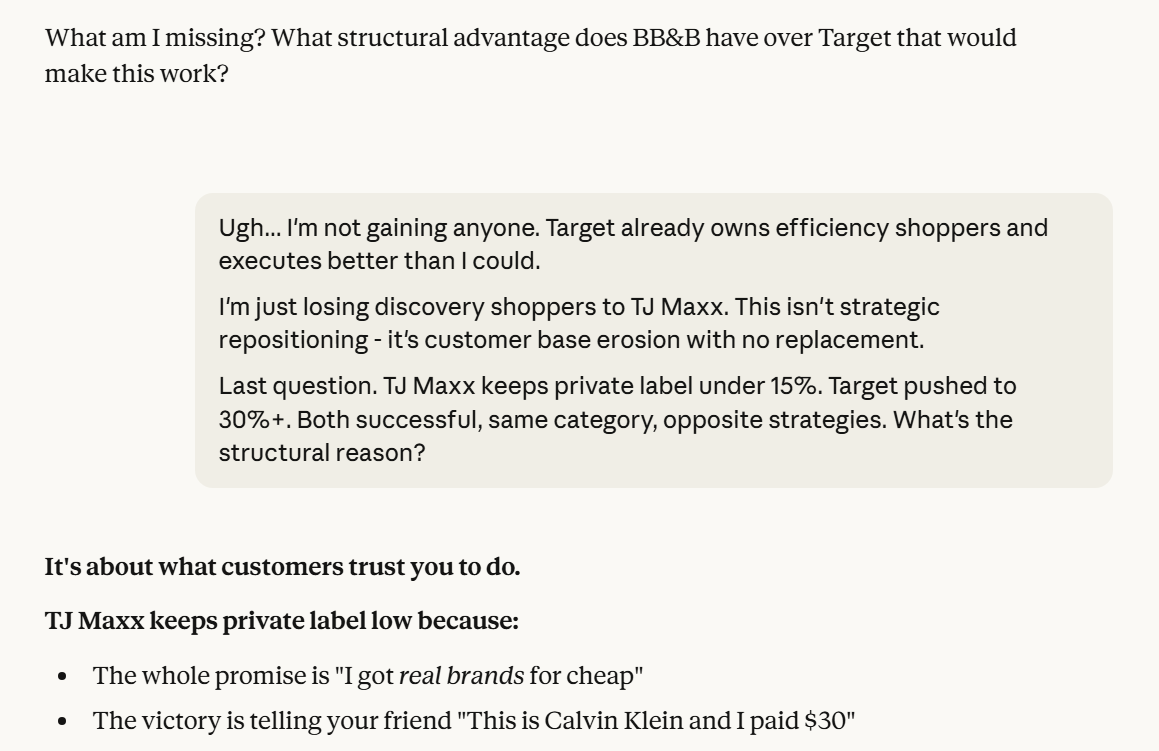
Assumption: Private labels work universally because they improve margins and differentiation.
Insight: At Target, customers trust Target’s taste. In treasure-hunt retail, recognizable brands ARE the treasure. [Retail Dive]
Reframe: Replacing brands removed the very thing customers came to discover. Margin improvement became revenue destruction.
Cross-Industry Application: Context matters more than tactics. A growth strategy that works in one market can fail in another.
What Changed
Twenty minutes of AI conversation didn’t produce a new strategy.
It produced different questions.
Instead of asking:
“How do we make BB&B more like Target?”
Tritton could have asked:
“How do we become the best treasure-hunt retailer in home goods?”
What AI Actually Provided (And What It Didn’t)
AI didn’t replace:
Market research
Customer interviews
Team input
Financial analysis
Leadership judgment
It changed where the work started.
Instead of beginning with assumptions imported from Target, Tritton could have started with tested hypotheses grounded in his actual industry—then validated those with his team, customers, and data.
AI Amplification isn’t a replacement for your decision-making process.
It’s a head start.
Why This Matters Now
Every executive recognizes this situation:
Decision window: weeks
Consultant timeline: months
Stakes: high
Intuition: strong
Domain knowledge: incomplete
It’s not whether you’d ask these questions.
It’s whether you can get answers fast enough for them to matter.
AI Amplification collapses that gap—not by thinking for you, but by letting you test your instincts in unfamiliar territory before momentum makes decisions irreversible.
How to Apply This to Your Next Decision
The next time you’re facing a high-stakes decision in unfamiliar territory:
1. Write Down Your Instinct (30 seconds)
What’s your gut telling you to do? Write it in 2-3 sentences.
Example: “We should apply our successful enterprise sales playbook to SMB. It worked for us before, it’ll work again with some adjustments.”
2. Open an AI Conversation (20 minutes)
Start with: “I’m planning to [your instinct]. What assumptions am I making? Where has this approach failed before? What am I not seeing?”
Let the AI ask you questions. Stress-test your logic.
3. Test Competing Perspectives (10 minutes)
Your team has different views. Ask AI to make the strongest case for each alternative approach.
See which arguments hold up under scrutiny.
4. Make Your Decision (Informed by Minutes, Not Months)
You still make the call. But now you’ve tested it against domain expertise you didn’t have this morning.
Final Thought
Mark Tritton didn’t fail because he lacked intelligence or experience.
He failed because accessing domain expertise fast enough to test his assumptions would have required resources and time he didn’t have.
AI Amplification changes that equation.
Not by replacing leadership—but by making it sharper, faster, and better informed.
Thank you, Nick!
The cost of untested assumptions isn’t measured in consultant fees or strategy presentations.
It’s measured in years moving in the wrong direction. Capital deployed. Teams reorganized. Customers lost. All because the questions that mattered most came three years too late.
AI Amplification doesn’t replace judgment, research, or leadership. It changes when you get access to the expertise that shapes those inputs. Twenty minutes testing your thinking in unfamiliar territory isn’t a replacement for decision-making. It’s what makes decision-making sharper.
Nick’s framework shows what happens when you compress months of expert consultation into a conversation that happens early enough to actually matter.
If You Only Remember This:
Smart leaders fail in unfamiliar territory not because they lack intelligence, but because they can’t test assumptions fast enough before momentum makes decisions irreversible
The next time you’re facing a high-stakes decision outside your domain expertise, pause for twenty minutes and stress-test it before moving forward
Your turn:
What’s one strategic assumption you’re carrying into your next decision that you haven’t tested yet?
Join 3,700+ Leaders Implementing AI today…
Which Sounds Like You?
“I need systems, not just ideas” → Join Premium (Starting at $39/yr, $1,345+ value): Tested prompts, frameworks, direct coaching access. Start here
“I need this built for my context” → AI coaching, custom Second Brain setup, strategy audits. Message me or book a free call
PS: Many subscribers get their Premium membership reimbursed through their company’s professional development $. Use this template to request yours.
This is amazing! Great contribution to the AI discourse.
Thank you so much for sharing, very helpful!