



TL;DR: The marketing engineer is an emerging role: a marketer who builds with AI, sitting inside the team to automate routine work. Marketing teams fighting AI anxiety often buy more software when the actual gap is this person, someone who knows which workflows to automate and can build the pipes that connect them.

So, a confession before I hand this one off. A lot of what keeps my own work moving isn’t a bigger team; it’s a stack of AI I’ve slowly taught to handle the routine parts, and I got there mostly because I had no other way to keep up. I didn’t set out to become the person Justin Taylor describes in this piece, I backed into a rough version of it because the alternative was drowning. I wish I had this guide before starting.
Justin runs The Landing Pad, where he writes about AI for marketers, and he’s named something I watch play out in almost every organization I coach. Teams get anxious about AI, so leaders buy tools.
More platforms, more seats, more Friday demos. And the anxiety doesn’t budge, because a tool was almost never the thing missing in the first place.
Every team I sit with already owns more software than it uses. What they’re missing is a person whose whole job is to know which of it matters and go build the pipes.
He calls that person the marketing engineer.
Read this one slowly. Then go look at your best marketer a little differently.
What to Remember
AI-nxiety is the low hum of anxiety on marketing teams as tools ship faster than anyone can keep up with. A lot of it is manufactured by “I cracked AI” content selling certainty.
Justin calls that person the marketing engineer, a marketer who builds with AI, sitting inside the team.
Hiring an engineer and pointing them at marketing usually ships work that’s off-brand in ways the team can’t catch and redirect fast enough.
You can start fractionally: bring someone in a day or two a week to map and build the highest-value workflows first.
Here’s Justin Taylor

The AI-nxiety on your team isn’t a tools problem
Why leaders keep buying software to fix something only a person can fix
I’m Justin Taylor, a marketing consultant who runs The Landing Pad where I write about the future of marketing, AI for marketers, and insights on what’s happening to the marketing industry.
Every marketing leader I talk to is doing some version of the same thing right now. Buying tools.
A new AI writing platform. An agent builder. A seat for everyone on the team, a mandate to “use AI more,” a Friday demo where somebody shows the thing they automated that week. It feels like progress. It photographs like progress.
I also hear all the time from marketers who keep getting forwarded articles and LinkedIn posts from their bosses telling them it’s something they should figure out.
The teams are quite anxious.
I’ve been calling it AI-nxiety.
It’s the low hum that sits behind the day. It’s the reason a perfectly competent senior marketer with fifteen years of experience suddenly feels behind. The tools won’t sit still. A new image generator on Wednesday. A new agent that can apparently do half the job by Friday. Nobody’s caught up on the last one, and three more have shipped. The pace itself is the trap.
The senior marketers don’t know how to figure it out so they’re pushing it onto the more junior “tech savvy” employees who don’t have the means to meaningfully implement anything.
Here’s the part worth sitting with as a leader. A lot of that anxiety is manufactured. Your team is being marketed to.
Half the “I cracked AI” content aimed at them is a comment trap dressed as a framework. Type a word, get the playbook, feed the algorithm. The promise is the bait and the reader is the product. It works because it sells certainty in a moment when nobody has any. Your team is buying it, in attention if not in dollars, and carrying the residue into work on Monday.
So the reflex from the top is to buy that certainty back. And I get it. A tool is a line item you can approve this quarter. A tool has a demo. A tool doesn’t require admitting you’re not sure what your team should look like in two years.
But here’s what I think we’re getting wrong
We’re treating a staffing problem like a software problem.
The work piling up in every marketing org isn’t work a tool does on its own. Somebody still has to know what to build.
Let me be specific. I’m sure you have a list on your desk of things that should be automated and aren’t. Reviews from four sales channels pulled into a sentiment doc by hand once a month. A weekly recap written from scratch every time, even though the numbers come from the same five places. The connections between systems that should exist and just don’t. Maybe you have the tools. You have the access. But what you don’t have is a person whose whole job is to go find that work and build the pipes.
Not another marketer. Not another developer. Someone in the middle.
Think about the most routine thing your team does. Your social lead presenting last week’s numbers, say. Open each platform. Check the organic numbers per post. Pull the comments. Go to a third-party tool for sentiment. Check demographics. Compare against last week. Build the follower-growth chart. Screenshot everything. Drop it into slides. They’ll tell you it’s a three-step process. It’s twelve. And most of those twelve are routine, not judgment.
That gap, the routine work quietly swallowing the judgment work, is the real problem in the building. No tool you buy off the shelf closes it, because the tool doesn’t know which twelve steps your team actually runs.
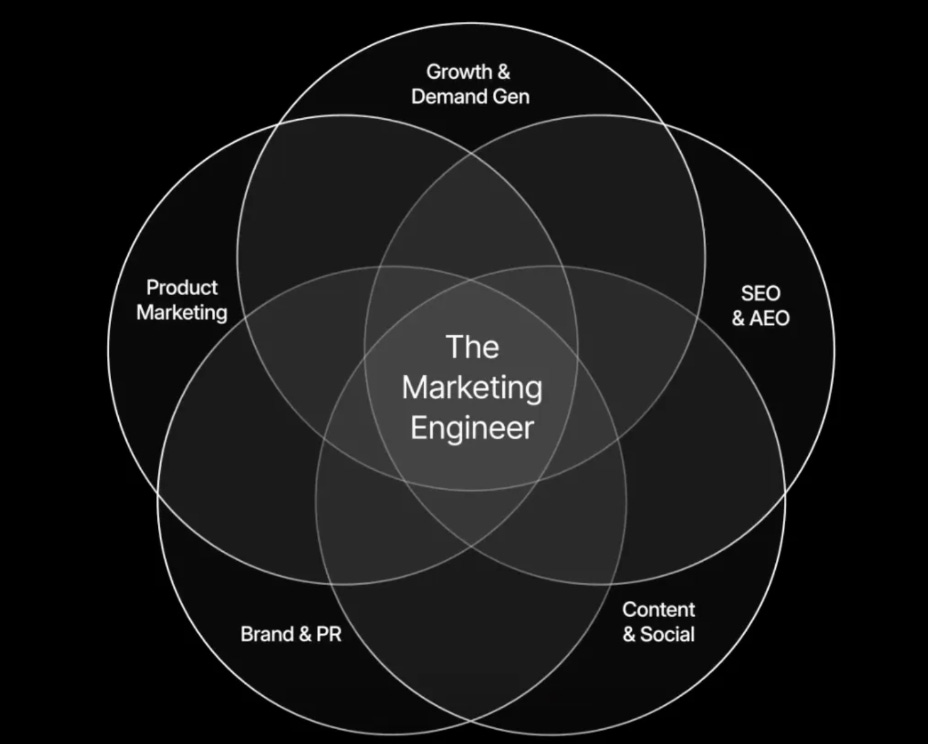
A person does. There’s a name forming for that person. The marketing engineer. A marketer who builds with AI, sitting inside the team. The work that used to take an account team plus a strategist plus a producer, done by one person with a few agents. Their job is to make the routine eighty percent invisible so the team’s energy goes to the judgment, twenty-first, not last.
And here’s the part that should change how you hire. This person is a marketer first.
Not an engineer who picked up marketing on the side. Not a developer who learned Claude last month. Someone who spent years understanding customers, briefs, brand voice, how a quarter actually comes together, and then learned to build. Knowing what to build is harder than knowing how to build it. The “how” can be taught in months now. The “what” takes years and can’t be googled.
I watch companies get this backwards constantly. They hire an “AI person” from an engineering background and point them at marketing problems. The output looks impressive. It’s also wrong, often, in ways the engineer can’t see and the marketing team can’t articulate fast enough to redirect. So the work ships quietly off-brand, and everyone decides AI just isn’t there yet.
AI is there. The role was wrong.
The move to make before your next tool contract
So if you’re feeling the pressure to do something about AI, here’s the move I’d make before signing the next tool contract.
Look at your best marketer. The one with the taste and the context. Ask what they’d build if they had the time and a little cover. Then give them exactly that. Permission to stop doing the manual work long enough to automate it.
That costs less than most of the platforms you’re evaluating, and it does something none of them can. It turns the anxiety in the room into a direction. The person who was worried about being replaced becomes the one building the thing that replaces the busywork. That’s a very different feeling to manage.
You can start fractionally
And you don’t have to bet a headcount to start. This role works fractionally. Bring someone in a day or two a week to map the highest-value workflows, build the first few, and show the team what a marketer who builds actually looks like. You learn what the full-time version is worth by watching what the part-time version ships.
None of this needs a reorg. It needs seeing the role that’s already forming under the layers everyone’s worried about, and hiring into it on purpose instead of waiting for it to appear.
The teams that win the next couple of years won’t be the ones with the most tools. Most of you have too many already.
They’ll be the ones who figured out this was a person all along.
Thanks, Justin!
Justin’s last line is the one I keep coming back to: the teams that win the next couple of years won’t be the ones with the most tools, they’ll be the ones who figured out this was a person all along. If you take one thing from this, look at your best marketer, the one with the taste and the context, and ask what they’d build if you gave them the cover to stop doing the manual work long enough to automate it.
The person on your team most worried about being replaced by AI is usually the one best positioned to build the thing that replaces the busywork, which is the whole shift I wrote about in AI-enhanced or AI-replaceable.
That’s a role you can grow on purpose, and it’s some of the most useful work I do with the leaders I coach, so if you want a second set of eyes on where to start, my calendar is here and the first conversation is free.
If this piece was useful, subscribe to Justin at The Landing Pad for more on marketing in the AI era.
Questions Leaders Are Asking
What is a marketing engineer? A marketing engineer is a marketer who builds with AI from inside the team. Instead of only running campaigns, they automate the routine work, connect the tools you already own, and build small agent-driven workflows. The role sits between marketing and engineering: marketing judgment first, building skills second.
Does a marketing engineer need to be a developer or a designer? No. This person is a marketer first, someone who already understands customers, briefs, and brand voice, and then learned to build with AI. Knowing what to build is the hard part, and it takes years. The building itself can be learned in months. Hiring an engineer and adding marketing later usually gets it backwards.
Will buying more AI tools fix my team’s AI anxiety? Rarely. Most teams already own more software than they use, so another platform adds a seat and a demo without moving the anxiety. What settles a team is a person who knows which routine work to automate and can actually build it. The anxiety turns into direction once someone owns that.
Do I need a full-time hire, or can this be fractional? You can start fractionally. Bring someone in a day or two a week to map your highest-value workflows, build the first few, and show the team what a marketer who builds looks like. You learn what a full-time version is worth by watching what the part-time version ships, before you commit a headcount.
Does the marketing engineer role only apply to marketing teams? The name comes from marketing, but the pattern shows up in sales, operations, finance, and nonprofit teams too. Anywhere routine work is swallowing judgment work, the same fix applies: one person with domain taste who can build with AI, rather than another off-the-shelf tool nobody has time to wire up.
What AI tools does a marketing engineer actually use? Fewer than you’d expect. Most of the work runs on one capable assistant like Claude (Anthropic’s AI assistant, the main rival to ChatGPT) plus a couple of agents, connected to the data sources the team already pulls from by hand. The skill isn’t collecting tools, it’s knowing which twelve manual steps to turn into one.
Written by
Justin Taylor is a marketing consultant and the writer behind The Landing Pad, where he covers the future of marketing, AI for marketers, and what’s happening to the marketing industry. Follow him at @thelandingpad.
Joel Salinas is an AI Strategy Coach for leaders at small and mid-sized businesses and nonprofits. 1:1 coaching, team workshops, and AI strategy work built around amplifying what your team is already good at. Creator of the AI Leadership Triad. He writes Leadership in Change.
Written by a human, for humans.