



TL;DR: Open-source AI agents can execute tasks but cannot judge context, priority, or risk, which is why companies still hire AI agent developers to wrap them in memory, guardrails, routing, and human escalation. This guest piece by Srilakshmi Chiluvuri covers the ALIGN framework and a five-question checklist for deploying agents responsibly before you ship.

So here’s a question that’s showing up on more and more leadership desks right now: if there are so many free AI agents (software that takes action on your behalf, like reading an email and deciding where to route it) sitting on GitHub for free, why would you still pay someone to build one?
It’s a fair question. It’s also the exact question that cost one company three enterprise customers in 48 hours, which is where this week’s guest picks up the story.
I asked Srilakshmi Chiluvuri to walk us through it. She’s a full-stack professional with more than 15 years in IT and hands-on experience across AI and cloud, and she writes AI for Professionals, one of the sharper publications I’ve been reading on how these agent systems actually get built. You can subscribe to her here: AI for Professionals.

Her piece is about what happens after you download the free agent, the part nobody screenshots. Read it all the way through, and pay attention to the ALIGN framework near the end. I’ll get out of the way.
What to remember before you read
Free agents can execute tasks, but they can’t weigh context, priority, or risk. That gap is the whole problem.
The failure is almost always architecture, not the agent itself. A single misrouted escalation cost one company three enterprise customers in 48 hours.
Four things fixed it: agent memory, guardrails, multi-agent routing, and human escalation when confidence drops.
ALIGN is her deployment checklist: Assess repetitive work, Locate bottlenecks, Integrate context, Govern with guardrails, and measure outcomes (the acronym is hers).
Before you deploy any agent, answer five questions. Start with the one most of us skip: what happens when the agent is wrong?
Here is Srilakshmi.
Why AI Agent Developers Are Still Winning—Even in a World Filled With 10,000 Open-Source Agents
Anyone can download an agent framework. Almost no one can make it survive contact with a real customer, a real edge case, and a real escalation.
In late 2025, a mid-sized logistics company in India believed it had found the shortcut every modern business dreams about.
Its leadership team had discovered hundreds of ready-made AI agents on GitHub — agents that promised everything from customer support to invoice processing and sales automation. The CTO’s question was direct: why hire AI agent developers when the internet already offers thousands for free? It sounded like a fair question. Until reality arrived.
Quick context before we get into it: this isn’t a story about bad agents. LangChain, Microsoft AutoGen, and the community orchestration tools the company used are genuinely capable frameworks. The gap wasn’t in the tooling — it was in everything wrapped around the tooling.
The experiment that saved nothing
The company downloaded multiple open-source agent frameworks — LangChain, Microsoft AutoGen, and community-built orchestration tools on GitHub. Within weeks, they had assembled what looked like a modern AI operations stack. On paper, it was impressive. The agents could read emails, extract invoice data, query databases, generate responses, and trigger workflows.
Then real customers entered the system, and the cracks appeared.
The real problem was never the agent
✉₹shipment escalation → routed to billing (wrong)
A shipment escalation email, misclassified and routed straight to an automated billing response.
A client submitted a shipment escalation email. The AI agent read it, classified it incorrectly, and instead of routing the issue to operations, sent an automated billing response. Three enterprise customers escalated within 48 hours.
The company didn’t have an AI problem. It had an architecture problem. The open-source agents knew how to execute tasks. They did not understand business rules, customer escalation priorities, regulatory obligations, internal approval chains, or context switching across departments.
What the developer actually did
That’s when the company brought in an AI agent developer. Instead of building everything from scratch, the developer redesigned the system around business outcomes — connecting the existing agents to Slack for team escalation, Salesforce for customer history, SAP for supply chain data, and internal databases for decision memory. Then four critical capabilities were introduced.
1. Agent memory
The system remembered customer history instead of treating every request as a new conversation.
2. Guardrails
Controls were added to reduce hallucinations, misclassification, and prompt injection attacks.
3. Multi-agent routing
One agent classified intent. Another validated business rules. A third executed the required action.
4. Human escalation logic
Whenever confidence dropped below a defined threshold, the workflow was automatically handed to a human expert.
Result, 60 days later: response time dropped by 43%, operational errors fell by 61%, and customer retention improved. The business didn’t win because it found better agents. It won because it found better developers.
The leadership lesson hidden in the story
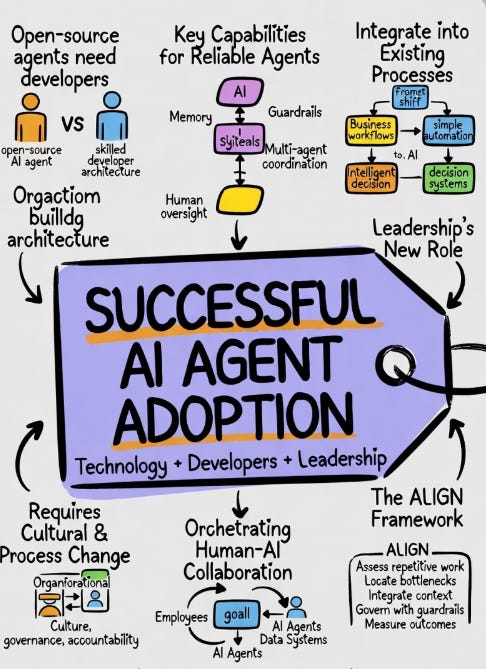
The real leadership question is not “how do we automate more tasks.” It’s: how do we build organizations where humans and intelligent systems create better outcomes together? Forward-looking organizations are discovering that AI does not replace leadership — it raises the standard for it. The leaders creating the greatest impact are focusing on four critical shifts.
1. From automation to intelligent decision systems
AI agents can automate tasks. Leaders must design systems that align automation with business priorities, customer trust, compliance requirements, and long-term strategy.
2. From managing teams to orchestrating human + AI collaboration
Tomorrow’s leaders will not only lead people. They will lead ecosystems that include employees, AI agents, data systems, and digital workflows working together.
3. From technical adoption to organizational transformation
The challenge is not implementing AI tools. The challenge is reshaping culture, processes, accountability, governance, and decision-making. Technology is often the easiest part of transformation — people and processes are where success is determined.
4. From efficiency metrics to strategic value creation
The most successful leaders will measure AI not by how many tasks it automates, but by how effectively it improves innovation, customer experience, employee productivity, and business resilience.
Turning insight into action: the ALIGN framework
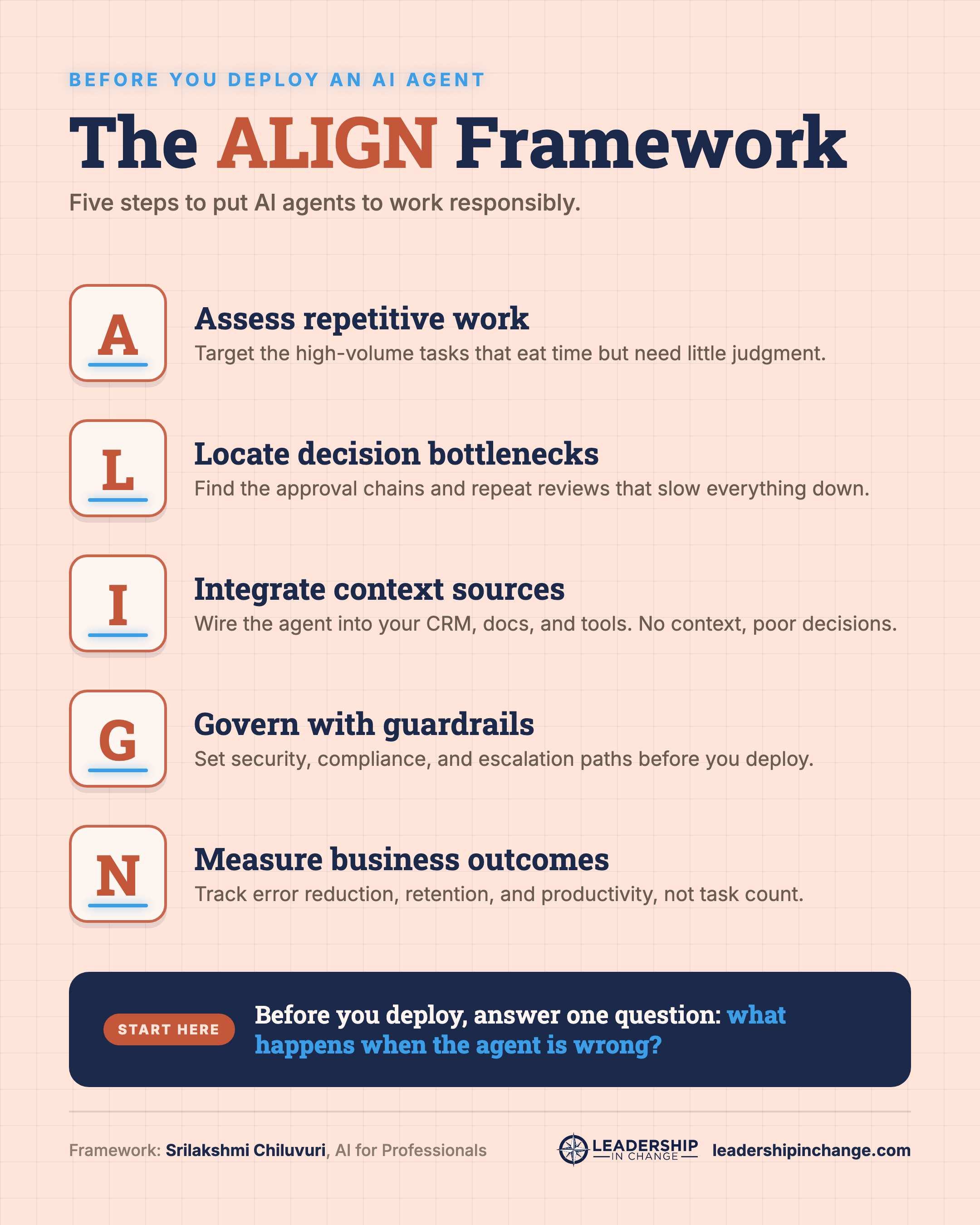
Understanding why AI agent developers remain valuable is only the first step. The bigger challenge for leaders is translating these lessons into repeatable business practices. Organizations that succeed with AI are rarely the ones deploying the most agents — they’re the ones building the right systems, governance structures, and decision-making frameworks around those agents. A practical starting point is the ALIGN framework.
A Assess repetitive work
Identify tasks that consume significant time but require limited creativity, judgment, or strategic thinking. These are often the highest-impact opportunities for AI support.
L Locate decision bottlenecks
Find approval chains, information gaps, and repetitive reviews that slow down business operations. These bottlenecks often create the greatest productivity gains when improved.
I Integrate context sources
Ensure AI agents have access to relevant business context through CRM systems, databases, communication tools, knowledge bases, and operational platforms. Without context, even advanced AI systems make poor decisions.
G Govern with guardrails
Define security policies, compliance requirements, escalation paths, and human oversight before deployment. Good governance prevents expensive mistakes later.
N Measure business outcomes
Track metrics that matter: customer satisfaction, error reduction, revenue impact, retention, productivity improvements, operational efficiency. If outcomes aren’t improving, automation alone isn’t creating value.
The 5-step AI leadership checklist
Before deploying any AI agent, leaders should be able to answer five questions.
What specific business problem are we solving?
Which decisions should remain human-controlled?
What systems and data sources must the agent access?
What happens when the agent makes a mistake or lacks confidence?
How will success be measured after 30, 60, and 90 days?
Organizations that can answer these questions clearly are far more likely to achieve measurable results than those simply experimenting with the latest AI tools.
The future belongs to leaders, not just technology
The future will not be led by companies with the largest collection of AI agents. It will be led by organizations that combine intelligent systems, skilled developers, disciplined governance, and strong leadership. In 2026, competitive advantage will come from knowing not only what AI can do, but how to deploy it responsibly, strategically, and at scale.
Open-source agents will continue to multiply. AI models will continue to improve. But the organizations that create lasting value will be the ones that understand a simple truth: technology may power the system, but leadership determines the outcome.
P.S. If you’re evaluating whether to build in-house or hire an AI agent developer, start with question four from the checklist above: what happens when the agent is wrong? If you don’t have an answer yet, that’s your first project.
Which part of the ALIGN framework is hardest for your organization right now — assessing the work, locating bottlenecks, integrating context, governance, or measurement? Reply and tell us, and we’ll dig into it in a future issue.
Thank you, Srilakshmi!
If you’re weighing build-versus-buy on your own team, start where she ends: what happens when the agent makes the wrong call?
I’m going to keep learning this one alongside you. For more, subscribe to Srilakshmi’s AI for Professionals.
And if you want help drawing those lines for your own team, what to automate, what stays human, and what to guard, that's what we build in the AI Judgment Workshop. Ninety minutes live, $99 (50% off for premium members).
Which part of ALIGN is hardest for your team right now?
Questions Leaders Are Asking
What is an open-source AI agent? An open-source AI agent is free software that takes action on your behalf, like reading an email, pulling data, or triggering a workflow, using a framework anyone can download from a site like GitHub. The agent can execute those tasks, but on its own it has no memory of your business, no guardrails, and no sense of priority.
Why hire an AI agent developer if the agents are free? The framework is the easy 20%. A developer builds the other 80%: connecting the agent to your real systems, adding memory and guardrails, routing work between multiple agents, and handing off to a human when confidence drops. That wrapping is what makes an agent safe to put in front of a customer.
What is the ALIGN framework for deploying AI agents? ALIGN is a five-step deployment checklist from Srilakshmi Chiluvuri: Assess repetitive work, Locate decision bottlenecks, Integrate context sources, Govern with guardrails, and measure business outcomes. It shifts the focus from how many agents you deploy to the systems and governance you build around them.
What are AI agent guardrails? Guardrails are the controls that keep an agent inside safe limits. They reduce hallucinations (confident but false answers), catch misclassification, and block prompt injection, where hidden instructions try to hijack the agent. Good governance defines these limits, plus escalation paths and human oversight, before deployment, not after something breaks.
When should an AI agent escalate to a human? Whenever the agent’s confidence drops below a defined threshold, or the decision carries real risk, cost, or customer impact. In the case study, routing low-confidence work to a human expert cut operational errors by 61% over 60 days. The rule of thumb: high-stakes and low-confidence decisions stay human-controlled.
Should my company build AI agents in-house or hire a developer? Start with one question: what happens when the agent is wrong? If you can’t answer that, you’re not ready to ship, whoever builds it. Free frameworks lower the cost of the agent itself, but the memory, guardrails, routing, and escalation logic around it are where the real work and the real risk live.
Srilakshmi Chiluvuri is a full-stack professional with more than 15 years in IT and expertise across AI and cloud. Srilakshmi writes AI for Professionals on Substack, covering how to build agentic AI systems that hold up in the real world.
Joel Salinas is an AI Strategy Coach for founders and leaders, from solopreneurs to teams. AI is everywhere; judgment is scarce. Joel helps leaders adopt AI without outsourcing their judgment to it, through the AI Judgment Workshop and the 90-Day Judgment Engagement. Creator of the AI Leadership Triad. He writes Leadership in Change.

Written by a human, for humans.

Sometimes we push AI into places where we don’t even need it yet. You also pointed out that starting from the worst-case scenario is actually a great approach. If everything goes really really wrong, what does that look like? The consequences of that wrong execution?
On another note, in the end of the day, it’s usually a lot less AI and a lot more “humans being humans” than any real system architecture situation. But that's a whole different topic, I know. Thanks for putting this together, Joel!!
The "framework is the easy 20%" line is the whole article in one sentence, and it's why so many build-vs-buy debates go nowhere, everyone argues about the 20% because it's the part you can screenshot. The shipment escalation misroute costing three enterprise customers in 48 hours is a great example precisely because it didn't require smarter AI, it required someone to have already decided where billing questions shouldn't go. Out of the five checklist questions, which one do you find leadership teams skip most often before they ship?