



TL;DR: Cross-domain thinking is the essential leadership skill in the AI era because AI handles single-domain execution faster than humans. Cross-domain leaders think in systems rather than linearly, and intellectual humility is the baseline requirement for bridging multiple domains effectively.

“What’s something I can do to prepare to succeed in the next decade?”
I get asked this question constantly by executives, nonprofit directors, and mission-driven leaders. They’re looking for the one skill, the one framework, the one strategy that will keep them relevant as AI reshapes everything.
Here’s what I tell them: Stop trying to become the best at one thing.
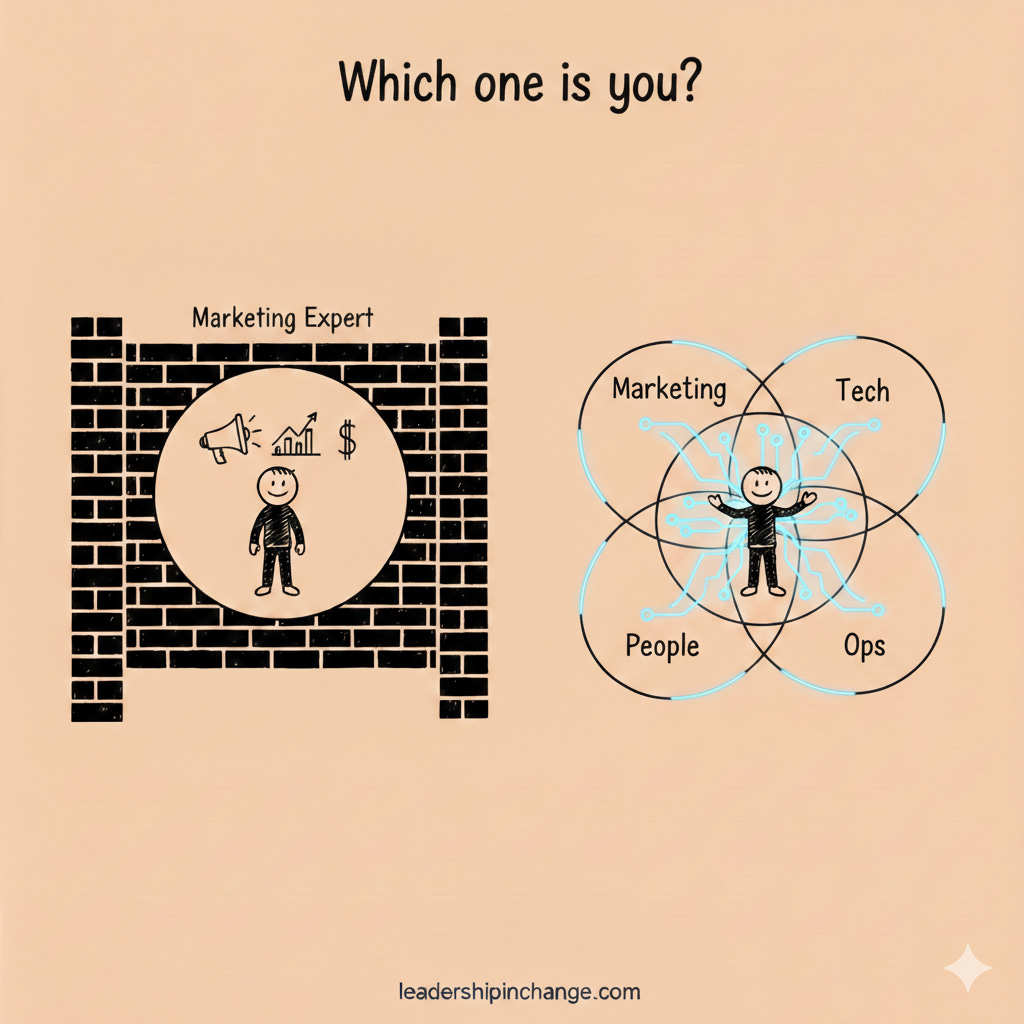
Take a quick look at the image above. In the next decade, those who thrive will have a full toolbelt of knowledge, not just one.
Think about it like this. You’re standing at an intersection where multiple roads meet. Most leaders spend their entire careers becoming experts on one road, knowing every crack in the pavement, every turn, every landmark. They can navigate that single road blindfolded.
But AI doesn’t need you to be the best on one road anymore. AI can execute on that road faster and more consistently than you ever could.
What AI can’t do is stand at the intersection and see how all the roads connect. It can’t understand that a decision on the marketing road creates problems on the operations road, or that a win for the product team creates a leak in customer support.
That’s cross-domain thinking, and it’s becoming the new leadership standard. It means avoiding siloed expertise… This is one of the patterns I see most often in coaching conversations with leaders navigating AI transformation, the ones who connect dots across domains consistently outperform the deep specialists.
According to recent PwC research, workers in AI-exposed roles need to learn new skills 66% faster than workers in traditional roles.
The leaders who thrive won’t be the ones who know the most about one domain. They’ll be the ones who can connect the dots across multiple domains and aren’t afraid to say “I don’t know” while they figure it out.
That’s why I asked Dawn Teh to share her perspective. Dawn wasn’t one of the “smart” students growing up. That gap sparked a curiosity about how she could become a better thinker, which eventually led her into a career in psychology. Today, she writes The Thinking Arc, where she helps leaders turn everyday thinking into clear, original perspectives that AI can’t copy. Her background gives her a unique lens on how we actually develop new ways of thinking, not just what we should think about.

In this post, you’ll learn:
What cross-domain thinking actually is and why AI makes it essential for leadership
How to shift from single-domain expertise to systems-level thinking
The mental skills that separate cross-domain thinkers from specialists
Why intellectual humility matters more than being “the expert”
4 practical moves to build cross-domain thinking starting this week
Here is Dawn Teh.
Why Cross-Domain Thinking is the New Leadership Standard
Titles are getting blurrier, problems are getting messier, and leadership now lives at the intersection of disciplines.
I was always told that success is about specializing and being an expert in one thing.
Then I met my client, who showed me another path.
He was the Head of Growth at a $1B unicorn startup.
(I was a newbie content writer who had to Google what a “Head of Growth” was!)
When we first met, I was expecting someone who knew the ins and outs of typical marketing areas, like paid campaigns and funnels.
Instead, I found someone who was just as comfortable solving problems across product, content, and customer retention.
He was only ever interested in answering one question: What do we need to do to achieve growth?
Where the answer came from didn’t matter to him.
That fascinated me.
Because I’d always thought that being the best in one thing was the goal.
He showed me that integrating ideas across fields was another path that was just as valuable.
To me, this ability to shape-shift between domains is where leadership is heading in the AI era.
AI executes, humans see the big picture
Growth marketing always sounded like something reserved for scrappy startups where money is tight, and things need to move fast.
But as AI takes on more of the execution, it doesn’t matter whether you’re managing a small team or a whole department.
A future in which individuals oversee a broader range of domains is fast approaching.
And this applies to leadership roles, too.
It’s no longer “Head of HR” or “Head of IT”.
We’re already seeing the emergence of roles like Chief People and Digital Technology Officer.
Most decisions now sit at a messy intersection.
Sometimes between technology and people. Or data and marketing. Sometimes all of them at once.
The reality is, no single domain contains the answer anymore.
To thrive in this landscape, the old way of defining “expertise” becomes less relevant:
Depth of knowledge in a specific area.
Optimizing the goals of a single department.
Reasoning within the “rules” of one domain.
Now, expertise is more likely to look like:
Connecting the dots between different areas.
Seeing the whole system and not just the parts.
Your ability to code-switch between thinking like a marketer and thinking like an ops person
So, what will thinking actually look like moving forward?
Single-domain thinkers reason linearly: Input → Output.
I gather data and produce a single spreadsheet.
Cross-domain thinkers will need to think in systems:
Problem → Context → Tradeoffs → Systemic effects → Decision
Customer renewals drop, and you notice it’s not just a pricing problem. The recent product update increased friction for your most loyal users. So, you pause a marketing campaign and forego short-term growth to fix the product, protecting retention and trust.
This type of thinking isn’t new.
But it’s going to become the baseline for an increasing number of people.
And because the demands have changed, our mental skillset has to adapt.
The mental skillset of the cross-domain leader
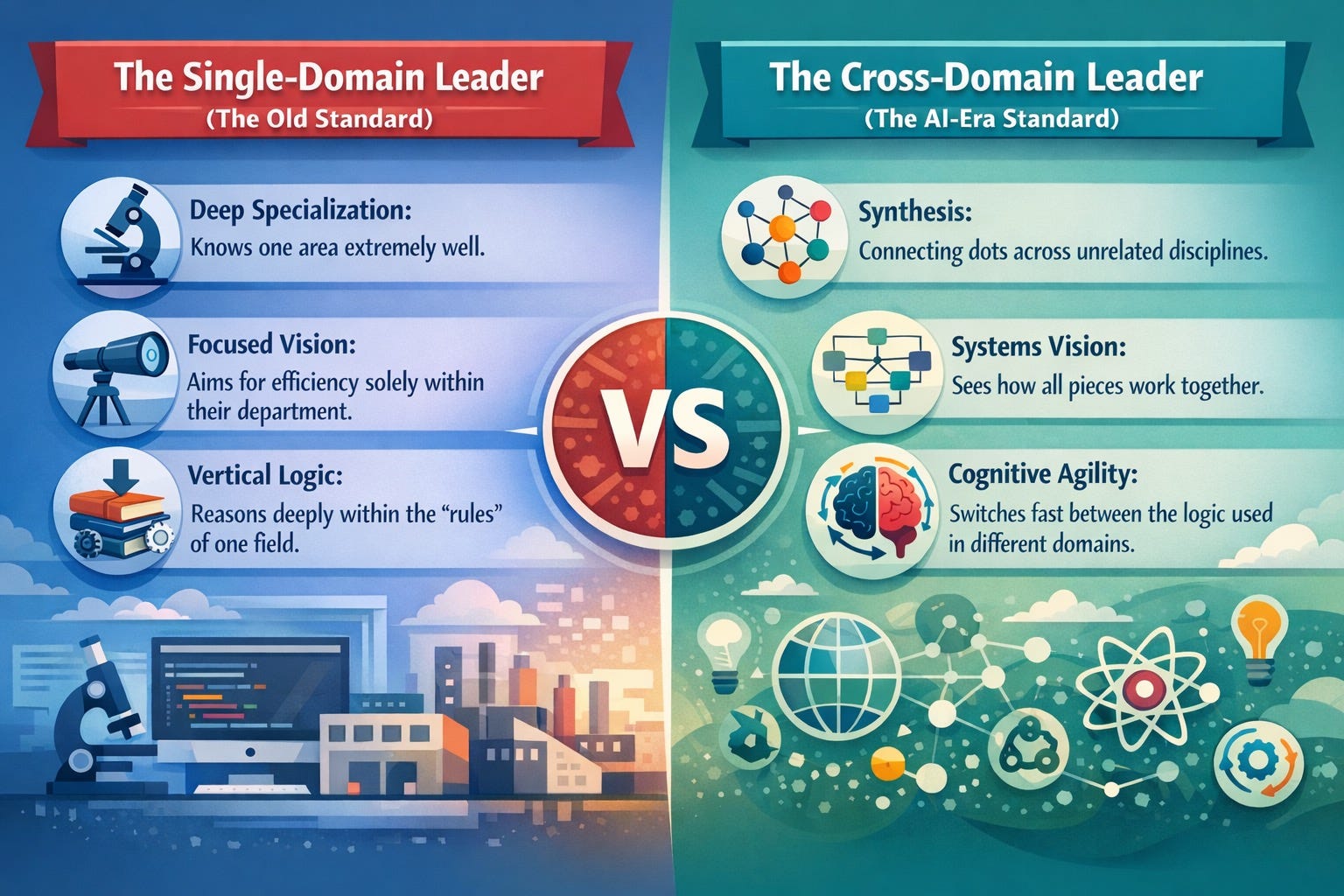
To thrive at the intersection between different domains, you have to move beyond “knowing things” and start “seeing connections”. This means developing mental skills like:
Visualizing how everything works together. You see how a “win” on the product side might create a “leak” in customer support. When you stop looking at the individual parts and visualize the whole plumbing network, you are practicing Systems Thinking.
Stripping a problem down to its naked truths. This means ignoring “how we’ve always done it” and industry jargon until you find the core issue. When you refuse to accept a “best practice” of a single department as an answer, you are using First-Principles Thinking.
Translating between different “tribes.” Being able to move seamlessly between the logic of the technical and marketing worlds. This “code-switching” is the heart of mental flexibility.
But apart from these thinking skills, there is one thing my Head of Growth client taught me about being an effective cross-domain thinker that I would have never learned in a seminar.
Most importantly, ditch the ego
When I had my first call with this client, I was a newbie freelancer doing content marketing.
I put on my confident voice throughout the call.
Tried so hard to sound like an expert.
Threw every strategy and buzzword I just learned two days ago at him.
He listened to me ramble on patiently and intently like a good friend.
When I was done, I waited for him to drop his wisdom or the grand plan for success.
Instead, he simply said:
“That all sounds good. We’ll try a few of the things you suggested. We don’t know what’ll work yet.”
The wave of embarrassment that washed over me was unbearable.
I, as a newbie, was trying to sound certain about things I hardly knew.
Meanwhile, someone who was a key part of growing a unicorn was comfortable saying, “I don’t know.”
That’s when it clicked: Intellectual humility is the baseline for cross-domain thinkers.
You cannot bridge domains if you’re afraid to be a beginner over and over again.
If your ego is tied to being the “expert” in one area, you will never have the curiosity to learn the mechanics of another.
Humility is the oil that keeps the cross-domain thinking engine from seizing up.
4 moves to build cross-domain thinking today
Now, there’s no need to completely overhaul your career immediately.
Cross-domain thinking can start with a simple shift in what you see and pay attention to.
Start with these four moves:
Notice how one domain affects another: Look for how a decision in one department changes the workload or culture in another. When Tech automates a process to save time, HR suddenly sees a spike in employee anxiety about job security.
Have a curiosity-only 15-minute chat: Meet someone in a different role just to discover what goes on behind the scenes of their work. Ask things like “What was your thinking behind that decision?”
Draw a system on paper: See how all the parts connect. For example, sketch the journey from “new customer” to “profitability” to find the handoffs and blind spots.
Think about how different domains clash and overlap: How do marketers see problems differently or the same as engineers? Sales defines success by “closed deals,” while the Product team defines it by “feature stability.” This clash explains why Sales keeps promising custom features that the Product team doesn’t have the capacity to build.
None of these requires new skills, new tools, or a career reset.
It’s just about training your mind to cross boundaries rather than simply staying within your domain.
In the AI era, the people who thrive may not necessarily be the ones who know a lot about one area.
It can also be people who can see how things connect, and aren’t afraid to say “I don’t know” while they figure it out.
Dawn also ghostwrites newsletters on behalf of C-suite leaders, helping them turn their thinking into clear and unique thought leadership narratives. You can find her on LinkedIn here.
Here is Joel again! I really appreciate Dawn taking the time to share this framework with us. What stands out to me about cross-domain thinking is how it flips the traditional expertise model on its head.
The instinct is to wait until you become an expert in the new domain before engaging with it. But Dawn’s point about intellectual humility is critical here. You don’t need to become an AI expert to lead AI strategy. You need to be comfortable being a beginner, asking questions across domains, and connecting what you learn back to what you already know.
The leaders I see thriving aren’t the ones with the deepest expertise in one area. They’re the ones who can move between marketing, operations, technology, and people management without their ego getting in the way.
If you're trying to build this kind of cross-domain leadership practice and want help figuring out where to start, that's exactly what I work on with leaders.
If You Only Remember This:
AI executes, humans see the big picture. Single-domain expertise focuses on Input → Output. Cross-domain thinking looks at Problem → Context → Tradeoffs → Systemic effects → Decision.
Intellectual humility is the baseline for cross-domain thinkers. You can’t bridge domains if you’re afraid to be a beginner over and over again. Being comfortable saying “I don’t know” is a strength, not a weakness.
“You cannot bridge domains if you’re afraid to be a beginner over and over again.” The most effective cross-domain leaders Dawn worked with weren’t the smartest in every room. They were the ones willing to ask basic questions and learn how different departments actually think.
What’s one domain outside your core expertise that you could start learning about this week?
PS: Many subscribers get their Premium membership reimbursed through their company’s professional development $. Use this template to request yours.
Great, great post! All of this stuff - systems thinking, cross-domain, it's been around in leadership for years (at least that's what I observed). What AI is doing here is make it so urgent that it's almost impossible to ignore it anymore. And nor should you :)
AI is forcing the timeline. It's not nice-to-have anymore, it's like, catch up or get left behind.
Thank you to both of you for this!
Love this take - in my current role, a more ‘systems’ approach to how we work and think is more critical than ever.