



TL;DR: Before automating any workflow with AI, apply Jurgen Appelo's Five Steps to Lean: Eliminate, Simplify, Amplify, Automate, Delegate, in that order. Most AI failures come from skipping the first two steps. AI agents execute bad processes faster, not better. An unnecessary workflow with AI bolted on is still unnecessary.

I get a version of this question almost every week: “Joel, which AI agent should I set up first?” My answer usually frustrates people, because it isn’t an agent recommendation. It’s a question back:
What are you trying to automate, and does that work even need to exist?
That’s the piece most leaders skip. We jump at AI because it feels productive, but wrapping an agent around a workflow that shouldn’t exist doesn’t fix anything. An unnecessary process with AI bolted on is still an unnecessary process. Nothing has changed. You’ve just made the pointless thing faster.
So what’s the framework for deciding which processes to kill and which to automate? That’s where Jurgen Appelo comes in. Jurgen is a founder, former CIO, and creator of The Solo Chief. He’s also one of our Cozora creators, teaching it live. I’ve written before about leading beyond automation; Jurgen gives you the decision tree. This is the kind of pattern I see that is so needed as I coach leaders.

Take it away, Jurgen.
Most people want to make a meaningful difference through their work—whether it’s designing intuitive apps, offering an online course, or baking artisanal banana bread. And whatever the goal, it always begins with ideas. Lots of them. Usually, way too many.
And in the age of AI, it is very easy to add yet another automation to implement one of those ideas. Maybe even too easy. So what if you have twenty AI agents doing work for you while you sleep? If you don’t have the headspace to review all the outcomes—congratulations!—You’ve implemented agentic productivity theater.
I’ve spent countless hours building automations for things I thought were important: customer orders, invoicing, and reports, only to watch the business models they supported crash and burn. The ROI was a solid zero. I could have saved myself months of frustration by asking one question first: Do we even need this workflow at all?
The answer, embarrassingly often, was no.
The Solo Worker’s Trap
Here’s what makes this especially painful for solopreneurs and one-person businesses. When you’re the single wringable neck—the only person accountable for everything—automation feels like oxygen. You’re drowning in tasks, so you grab the nearest AI agent and throw it at the problem. I get it. I’ve done it. And I’ve regretted it many times.
The trouble with automating too early is that you scale the mess. You don’t get efficiency. You get faster chaos and cognitive overload. Elon Musk admitted as much about his own Tesla factories: he tried to automate many steps before questioning whether those steps should exist at all.
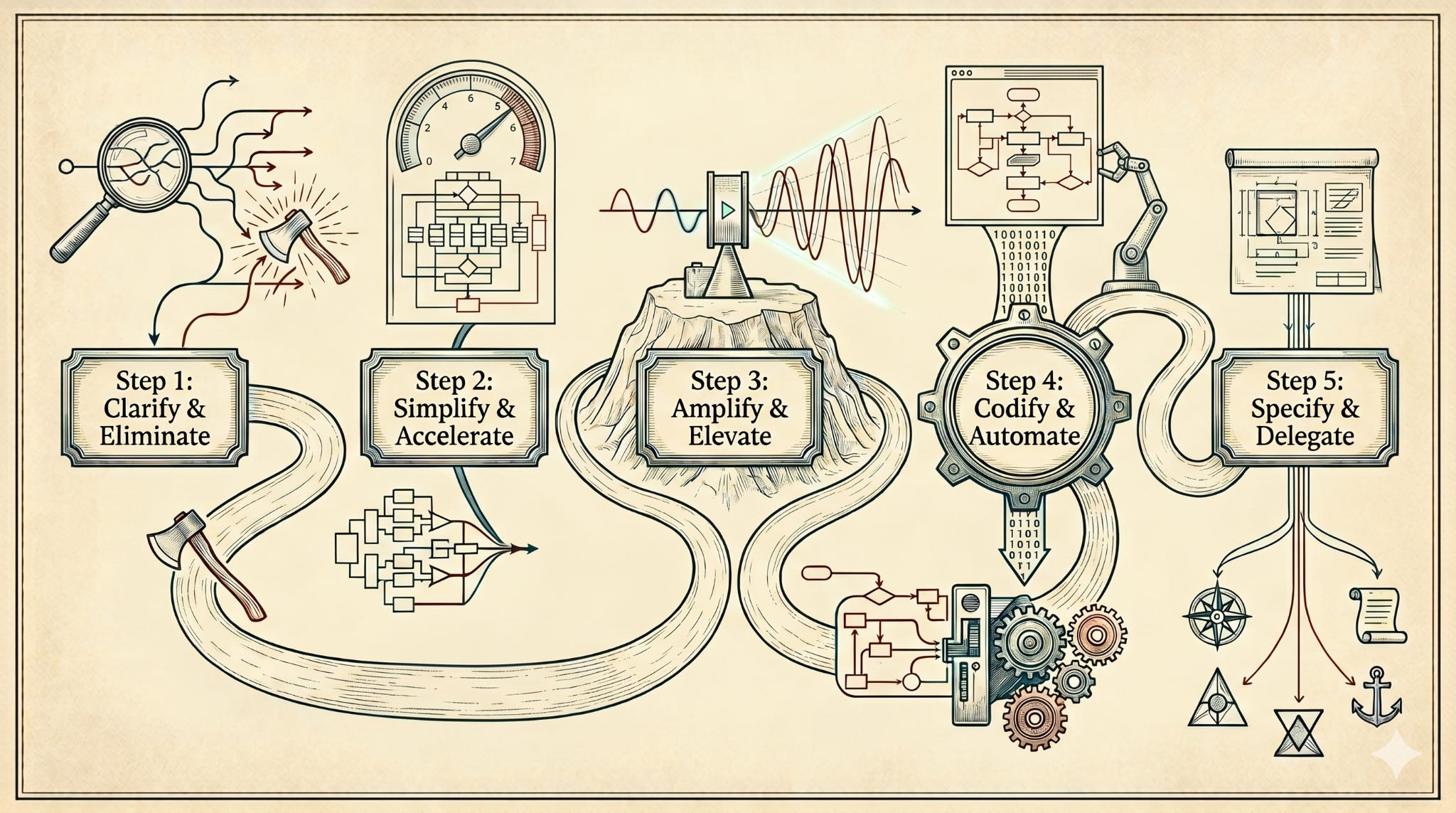
So before you hand your processes over to Claude Cowork, OpenClaw, or a shiny new n8n scenario, let me share a map I’ve been refining for years. Five orientations, not prescriptions. Five questions to ask before you launch a single automation prompt.
1. Clarify and Eliminate
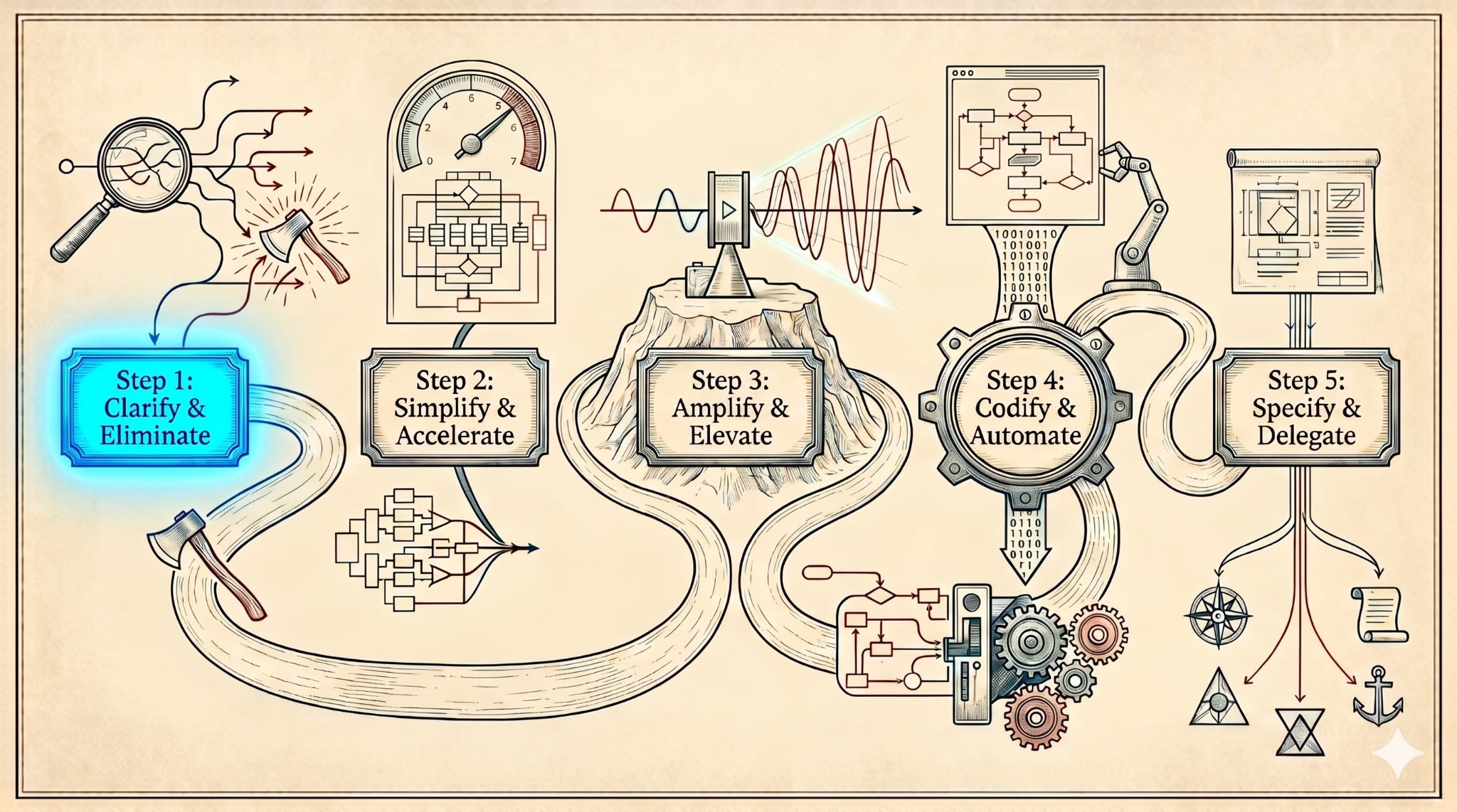
Start with the question Musk keeps hammering: what’s the point? Tie every idea to someone who really needs it. Not “the legal department”—point at a specific human who can explain why this request exists and what it means for them.
I once spent weeks building an onboarding workflow for a new business idea that collapsed less than two months later. Nobody needed it. Nobody cared. I just thought it was a good idea, until it wasn’t. The process shouldn’t have existed in the first place. The best requirement is the one you kill before it wastes your time.
2. Simplify and Accelerate
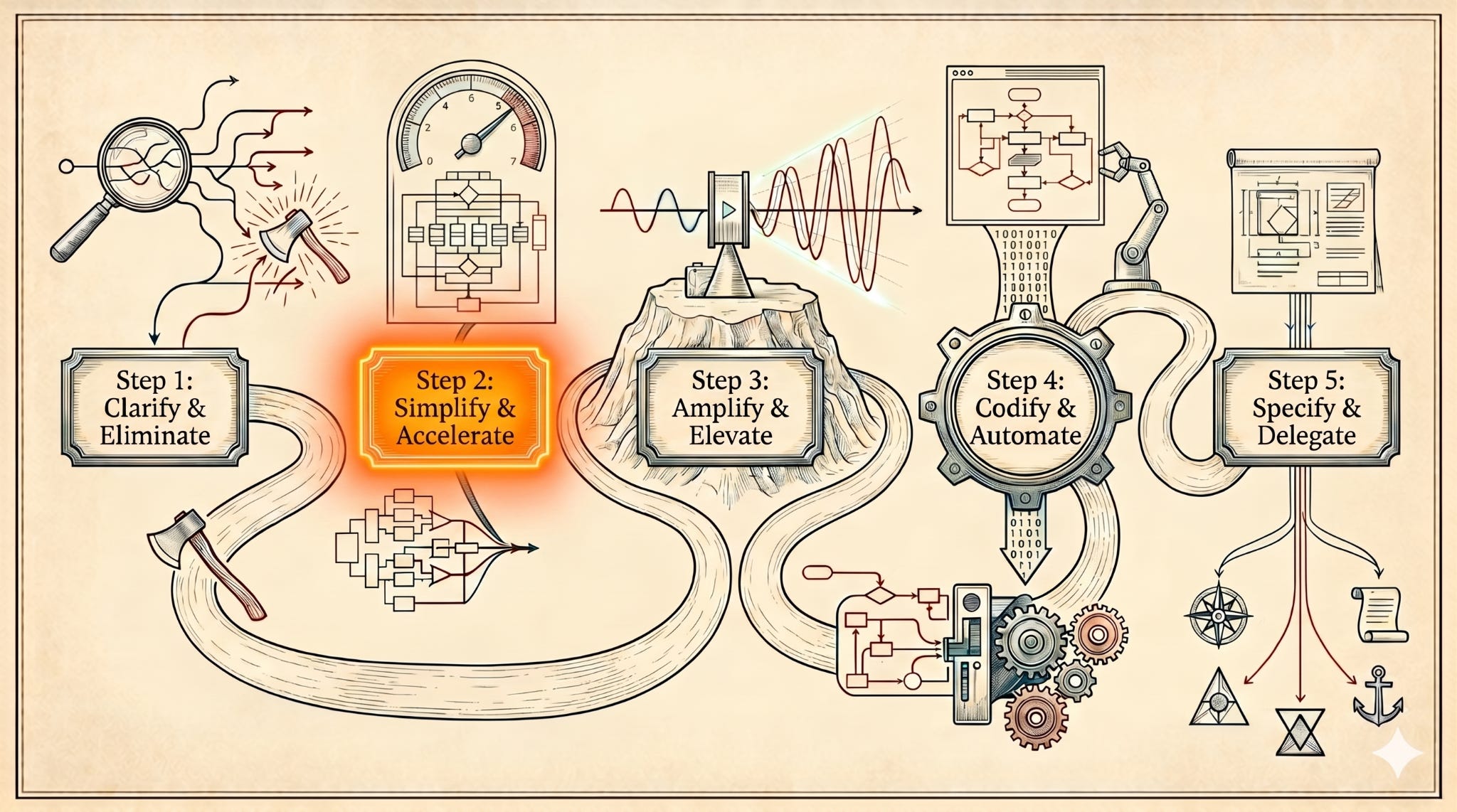
Whatever survives the kill list gets stripped down. Steve Jobs understood this with the iPod and iPhone—every button and widget faced ruthless scrutiny. Does this need to exist? If yes, make it so intuitive that people barely have to think.
Having fewer steps means fewer errors, faster results, and less of your evening spent debugging workflows. This is where solo workers and lone AI orchestrators tend to overcomplicate things, by the way. We add options because we can, not because we should.
Having no human team to push back makes it dangerously easy to build yourself an automated monstrosity with more bells and whistles than common sense. Human teammates have the decency to ask “why?” or at least roll their eyes. AI agents don’t. They happily execute whatever pointless task you give them.
3. Amplify and Elevate
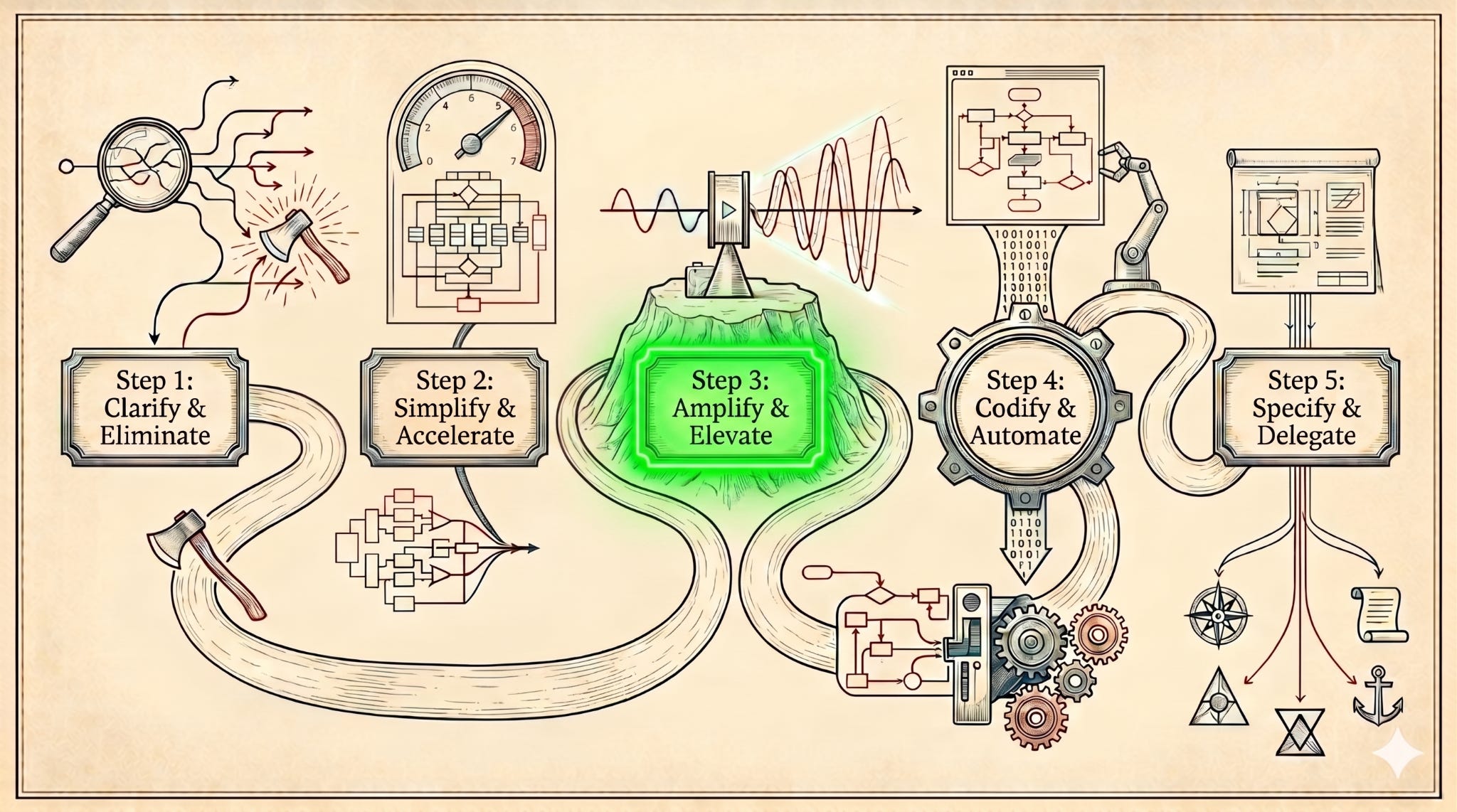
After eliminating and simplifying, you might feel the urge to add something. Good—but Hick’s Law says decision time grows with the number of choices. So only add options when they don’t complicate things, when they don’t add friction to other people’s experiences.
For example, when I publish a blog post, I share it on LinkedIn, X, Threads, and Substack Notes. That amplifies my reach without complicating the experience for anyone. It makes it easier for people to find me, not harder. The addition is orthogonal—it extends what’s possible without interfering with what already works.
The question to ask: does an additional feature idea create new possibilities without forcing people to deal with more options?
4. Codify and Automate
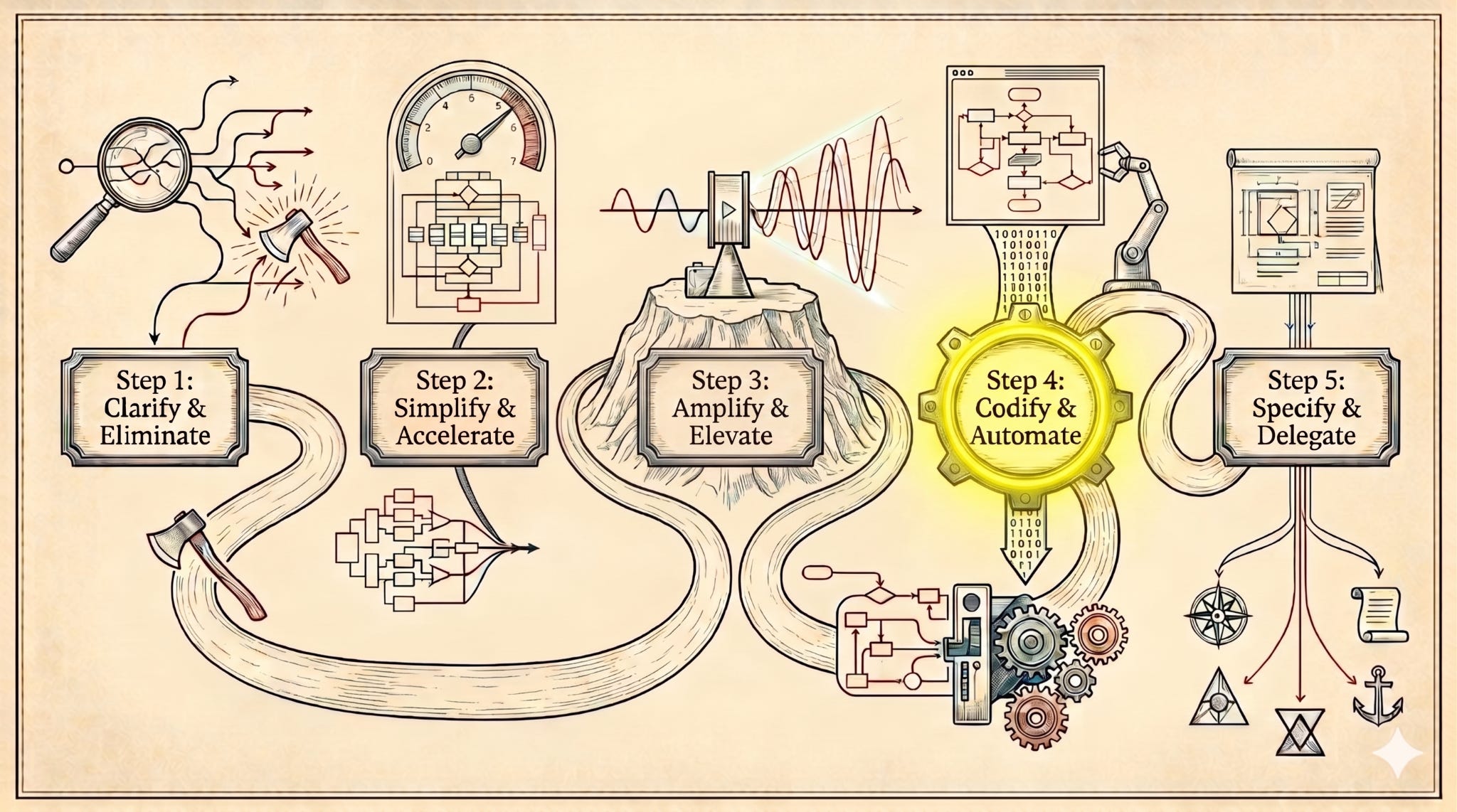
Now you can think about automation. This is where your specialized AI agents, workflow scenarios, and algorithmic managers earn their keep. But only after you’ve eliminated and simplified.
I once automated pan-European invoicing for a business that never even achieved product-market fit. What was the point? All my automations got switched off. Automation is the reward for doing everything else right.
The prerequisite for automation, of course, is codification. If you can’t describe a process clearly enough for a machine to follow it, you’re not ready to automate it. No codification, no scalability. And for Solo Chiefs running a “cockroach business”—one built to survive any environmental change—premature automation is one of the most effective ways to waste your time.
5. Specify and Delegate
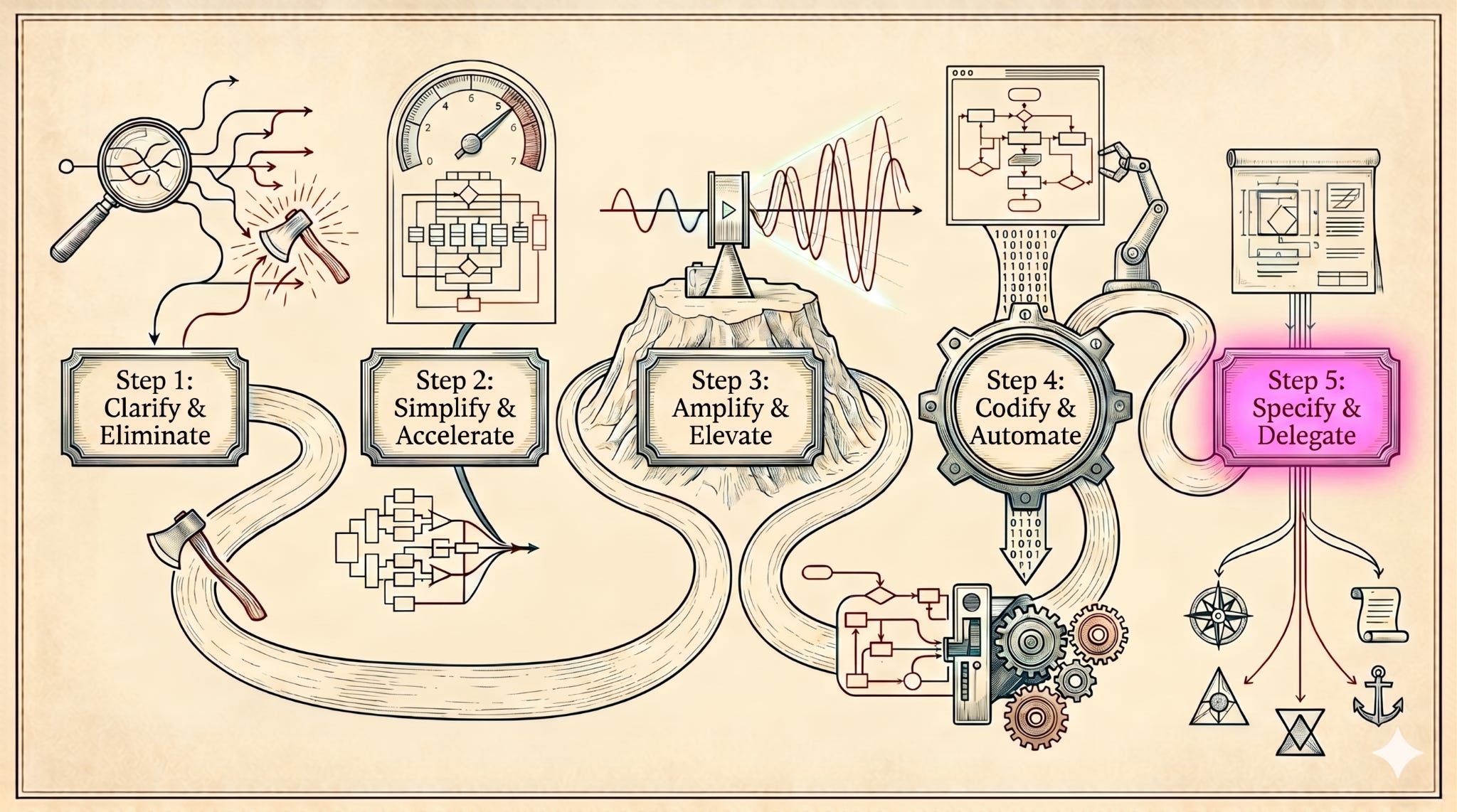
After you’ve automated what can and should be automated, you’re left with tasks that require judgment. The question becomes: whose judgment? Could you hand this to a personal assistant, a business partner, or a sophisticated AI agent orchestrator?
Here’s what you should never delegate: work that wastes time (eliminate it), work that’s too complicated (simplify it first), or work that a basic algorithm or simple agent can handle (automate it). Delegation is for what remains after you’ve been through the other four steps.
I know the operational loneliness of carrying the full picture. The temptation is to delegate everything that feels heavy. But passing down convoluted processes to humans or advanced AI agents is foolishness, not leadership.
The Order Matters More Than the Steps
To create these Five Steps to Lean, I borrowed from Lean Thinking, from Musk’s five-step algorithm, from the ESSA Framework, and from the “four steps to freedom“ that productivity bloggers keep reinventing ad nauseum. I added the amplification step in the middle because I wanted to balance efficiency with effectiveness. Claude and ChatGPT agreed.
👉🏻 Note: I count simple, specialized AI agents among simple workflow automations (step 4). I count complex AI orchestration (whether performed by humans or AI) as delegated management (step 5). The difference matters. 👈🏻
The real insight for leaders in 2026: AI agents make the wrong order more expensive, not less. When automation was manual and slow, premature optimization wasted your time. Now that AI agents execute at lightning speed, premature automation wastes your time and your money and creates problems at scale.
The map is simple. Eliminate. Simplify. Amplify. Automate. Delegate. In that order.
Jurgen Appelo is a founder, intrapreneur, and former CIO rethinking governance for the one-person business, navigating sole accountability in the age of intelligent machines—informed by plenty of scar tissue. Check out his blog at The Solo Chief.
P.S. Which step do you skip most often? Be honest—I already know mine.

Thank you, Jurgen Appelo!
If You Only Remember This
The order is everything. Eliminate, Simplify, Amplify, Automate, Delegate. Skip the sequence and you scale the mess.
Automation is the reward, not the starting move. If you can’t describe a process clearly, you’re not ready to automate it.
AI agents run at lightning speed, which makes the wrong order more expensive, not cheaper. Premature automation creates problems at scale in hours, not quarters.
Jurgen’s map lands because it puts judgment before velocity, a lesson solo operators learn faster than enterprises but one every leader eventually needs. You can go deeper with him live on Cozora — and Leadership in Change Premium members get $50 off Cozora annually, and Founding members get it free (link in the Premium Hub)!
Questions Leaders Are Asking
How do I know if I’m automating too early?
You’re automating too early if you can’t clearly name who needs the output and why. Eliminate first, simplify second, then automate. If the process collapses the moment you try to describe it to a machine, the process itself isn’t ready. Automation won’t rescue a workflow that shouldn’t exist.
What’s the difference between an AI agent and delegation?
A simple agent executes a coded workflow with inputs, outputs, and rules. Delegation requires judgment, the kind no simple agent handles well. Jurgen Appelo puts simple agents in step four (automate) and complex orchestration in step five (delegate). The test is whether the work needs thinking or just execution.
Why does Lean Thinking apply to AI workflows?
Lean forces you to kill waste before scaling anything. AI agents run fast, which means bad processes now scale faster than good judgment can catch them. Lean inserts the pause. Question the work first, then build the automation. Without that pause, every agent you deploy multiplies the chaos.
What should solopreneurs automate first with AI?
Probably nothing, until you’ve eliminated and simplified. The best first automation is usually something you already do well manually, because you know what “good” looks like. Automating a broken process produces broken output at a higher volume, which is worse than the original problem, not better.
Written by a human, for humans.
Thank you for sharing this. Found map is such an insightful framework to build upon.