


TL;DR: Anthropic’s AI watermark embeds an invisible, machine-readable mark into text generated by Claude, meeting EU AI Act transparency rules that took effect August 2, 2026. Anthropic states the mark shows content was processed by Claude and is not conclusive about authorship. The mark cannot measure whether your judgment is in the work.
In late July I ran three things through Substack’s AI detector.
The first was something I wrote entirely myself, with no AI anywhere in it. It came back 100% human, which is what I expected.
The second was text I copied straight out of Claude and pasted in without touching a word of it. That one came back 50%.
The third was a transcript of me talking in a meeting. My own voice, my own words, recorded and typed up. The detector said it was 100% AI.
Honestly, after that third result I stopped treating the number as information.
Which matters a lot more this week, because Anthropic just started weaving an invisible watermark into everything Claude writes, and European law is about to make that standard across the industry. Before long, most AI-assisted work you come across will carry a hidden mark saying a model touched it, and a lot of people are going to treat that mark as a verdict on whether the work is any good.
My take probably isn’t the one you’d expect from someone who publishes AI-assisted writing twice a week. The watermark is fine. I’m glad it exists, and I’ll tell you why. But it answers a question that’s on its way out, and the question that actually decides whether your work is worth anything is one that no watermark and no detector will ever be able to answer.
What You Can Expect
The line in Anthropic’s own documentation that decides what a watermark is worth to you
A ten-second check to run on anything before it goes out under your name
What Anthropic actually shipped
Anthropic, the AI company behind Claude (the main rival to ChatGPT), confirmed in an update to its own support pages, first reported August 11, 2026, that it’s weaving an invisible watermark into the text its models generate. A watermark here means a machine-readable pattern hidden inside the words themselves, not a visible label. It applies everywhere Claude is offered, worldwide, and the driver is the EU AI Act’s transparency rules, in force since August 2. Google already marks Gemini’s text and OpenAI has signed the same code, so this stops being news very quickly.
Here’s the part I’d want you to read before forming an opinion, and it comes from Anthropic’s own support page, not from a critic:
“Claude may not be the original author. People often use Claude to proofread, translate, summarize, or convert files. The output can carry a Claude mark even if the underlying ideas, text, or data originated from another source.”
So a paragraph you wrote yourself, ran through Claude to fix the grammar, and published under your name carries the mark.
Substack said close to the same when it added AI detection through a company called Pangram in July. CEO Chris Best wrote in the announcement that the tool “can only detect whether AI was used to make the text, not whether great human care went into creating it.”
Both companies shipped the detection and published the disclaimer in the same breath.
Why I’m not against any of this
I understand the need for people to have something they can trust. People have lied to each other for as long as there have been people, and we still trust people far more than we trust AI. That isn’t irrational, and if I’m giving someone my attention or my money I want to know a person was on the other end of it, so I see exactly why these tools are showing up now.
But we’re collapsing two different questions into one, and they’re worth pulling apart. Call them the two questions, because every argument about AI and trust is really one or the other.
Today’s question is “was this made by AI?” That’s a fear question, and the watermark answers it about as well as anything can.
Tomorrow’s question is “is there anything of you in this?” No watermark answers that one. No detector does either. My meeting transcript is the proof, because a machine looked at a recording of me talking and called it artificial.
Every tool shipping right now is built for the first question. Your work gets judged on the second.
Everyone can buy the same guitar
I play guitar. Anyone reading this can buy the same guitar I own and download the same sheet music I use, and none of that is the interesting part. What makes it mine is that I have things I like doing, my own take on different songs, and I’ll put them in whenever I feel like it regardless of what the exact sheet music says. The instrument was never the difference, it is everything I added to the music sheet.
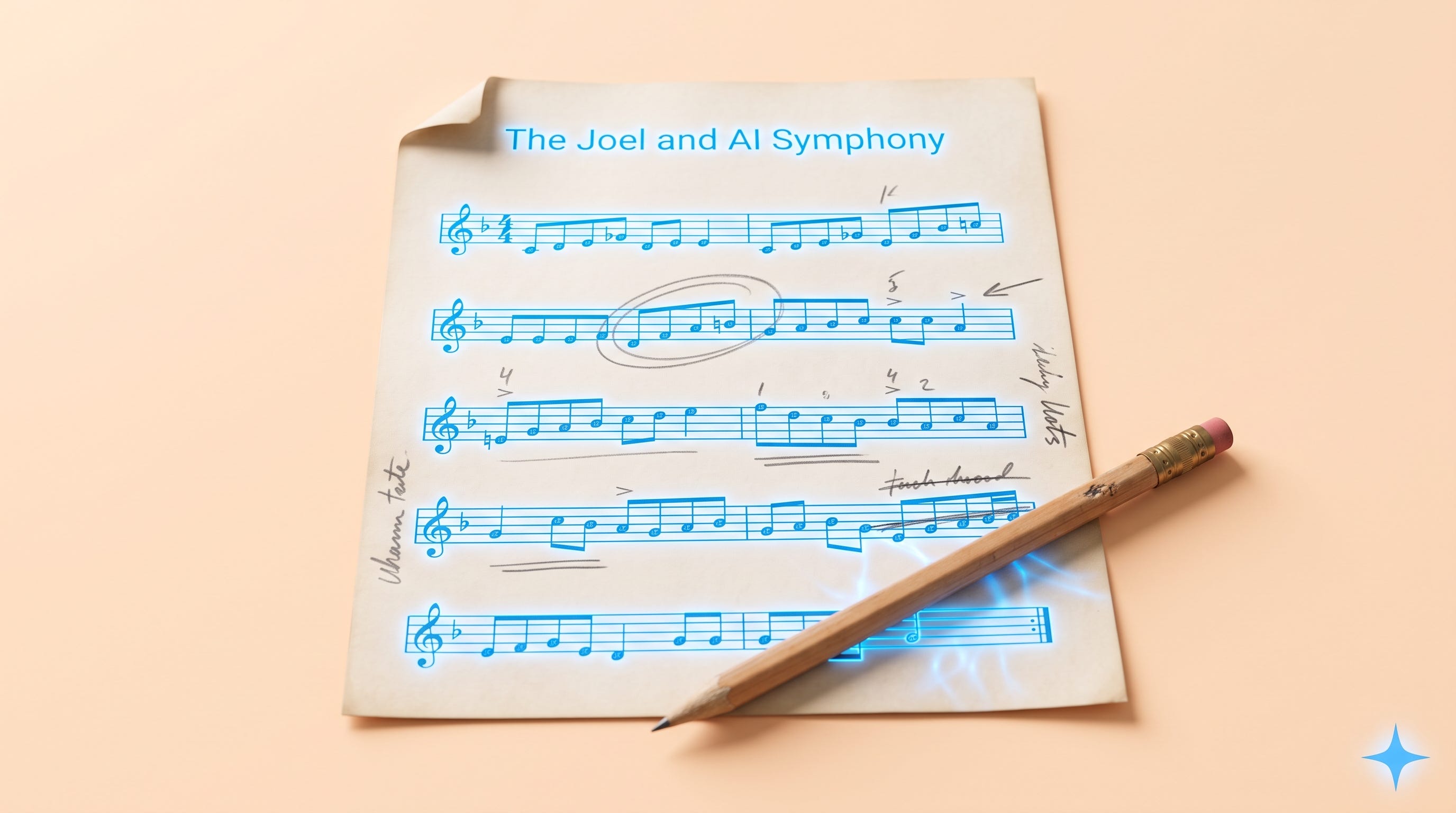
That’s what I’d want us to be honest about, because the risk was never that copy-pasted AI output is bad. It’s good, usually better than the rushed draft we’d have written ourselves at 11pm, and it improves every few months. The risk is that it’s good in exactly the way it’s good for everybody else running the same tool.
Millions of people have access to the same model you do, so if there’s nothing of you in what you publish, you’ve handed away the only thing you had that was scarce.
No detector has to catch you for that to cost you.
This is what I tell the leaders I coach too. A company doesn’t get ahead because it adopted AI, because everybody adopted AI. It gets ahead when its people put real expertise in and use AI strategically on top of that. That’s the real reason outsourcing your thinking to it costs you, and it’s where we ended up after testing eight AI humanizers for twenty hours and watching most of them fail.
How I actually make this newsletter
Since it’s fair to ask, here’s my process, unedited:
I start by researching a topic extensively. I feed that research into AI to synthesize it into a single reference document. I study that document, then dictate my thoughts into a long-form transcript. That transcript goes through Claude for an initial cleanup pass, adding headlines and an outline. From there, I take the draft through manual editing to produce the final post.
Set that against this week’s news and two things are true at once. The synthesis step and the cleanup pass would carry Anthropic’s watermark, and a detector would very likely score this piece as AI-assisted. Neither of those facts tells you that the research, the thinking, the dictation and every editing decision were mine. That’s the gap, and a better detector doesn’t close it.
The check to run before anything goes out
Before something goes out under your name, to your readers, your customers, or your board, point at the specific thing in it that only you could have written. A judgment call you made, a number from your own operation, a position you’d defend in a room full of people who disagreed, something you got wrong once and learned from.
If you can’t point at it, it isn’t ready. That’s the whole test, and it costs nothing to run.
Don’t focus on the tool. Don’t focus on the watermark. Focus on how you’re using AI, and on the judgment you’re bringing to it, because that was always the only part of this that was yours.
If You Only Remember This
There are two questions, and only one of them matters in a year. “Was this made by AI?” is what the tools answer. “Is there anything of you in this?” is what your readers are actually deciding.
Copy-pasted AI output isn’t risky because it’s bad. It’s risky because it’s good in the identical way for the millions of people running the same model.
Human expertise with AI used strategically on top is what puts a person or a company ahead. AI by itself moves everyone toward the same average.
What’s the part of your work that a model couldn’t produce even if you handed it your entire archive? I read every reply.
Worth Your Time
A few pieces from other creators I think are worth your attention.
Kamil Banc — Your next business decision might already have an AI mistake in it. His line that clients aren’t paying for information but for someone who already checked it is the cleanest version of this whole argument I’ve read.
Oliver Patel — Banning AI is not an effective AI policy. The case for governing how your people use AI instead of whether they use it, from someone who reads the EU AI Act for a living.
Andreas Welsch — Your Anonymous AI Usage Is Coming To An End. Written in June, and it called the traceability wave that Anthropic’s watermark is now part of.
Questions Leaders Are Asking
What is Anthropic’s AI watermark? It’s an invisible, machine-readable pattern embedded directly into text that Claude generates, plus signed provenance data attached to generated files. Anthropic says it applies to models launched on or after August 2, 2026, across every Claude product, worldwide, and that it’s being added to older models.
Does a watermark prove something was written by AI? No. Anthropic’s own documentation states that a detected mark shows content was processed by Claude and “is not fully conclusive.” Text you wrote yourself and ran through Claude for proofreading or translation can carry the mark. Anthropic also says the absence of a mark doesn’t prove content is human-written.
Can the watermark be removed by editing? Anthropic says the mark travels with copied and pasted text and “may persist through some editing,” and that heavy rewriting, translation, mixing with other text, or passages that are too short can make it undetectable. The company has not published how much editing removes it.
Does Substack label my posts as AI now? Not automatically. Substack added an AI detection scan in July 2026 through a company called Pangram, and it runs on posts and notes over 100 words published on or after July 21, 2026. A reader or writer has to request the scan, the result shows only to whoever requested it, writers can run it on drafts, and writers can disable detection on their own posts.
How accurate is AI detection? Better than it used to be, and still not something to make decisions on alone. Pangram publishes a false-positive rate of roughly one in ten thousand. Princeton’s Arvind Narayanan has pointed out that even at that rate, running a student’s 500 to 1,000 assignments through a detector across a four-year degree would falsely accuse 5 to 10 percent of a student body at some point. Detectors also measure process rather than quality, so a careful piece written with AI help and a lazy one written by hand can score in ways that invert their actual worth.
Joel Salinas is an AI Strategy Coach for founders and leaders, from solopreneurs to teams. AI is everywhere; judgment is scarce. Joel helps leaders adopt AI without outsourcing their judgment to it, through the AI Judgment Workshop and the 90-Day Judgment Engagement. Creator of the AI Leadership Triad. He writes Leadership in Change.
Affiliate links included.
Written by a human, for humans.
The meeting transcript getting flagged as 100% AI is almost too perfect. Apparently the best way to fool an AI detector is to be a human speaking naturally in a meeting. Considering the meetings I've been in, maybe that's not too far from the truth.
I’ve been circling the same distinction from the creative side: a detector might tell you who typed something. It can’t tell you who decided it.
“Is there anything of you in this?” might be the cleanest version of that test I’ve seen.
Well framed. The thinking behind the writing still matters more than the label.