



TL;DR: Most AI pilots fail for three structural reasons that existed long before AI: mandate pressure that bypasses intake discipline, decision moments that do not survive the room, and intake systems that treat every request as equally urgent. Guest writer Mark S. Carroll names the pattern, maps the four-lens decision circuit, and shares the 5-step intake funnel that closes the front door before a pilot becomes permanent scope.

Here’s the thing about AI mandates… They almost never arrive as requests, they arrive as pressure.
Someone senior says “we should do something with AI,” and suddenly your sprint has a commitment nobody scoped, nobody owned, and nobody agreed to. Three weeks later, you are cleaning up a pilot that quietly became permanent scope.
Every leader I coach through AI adoption sees this same pattern. A VP asks for a “quick AI summary tool” in a Tuesday meeting, by Friday it is on the roadmap, by month-end it is an integration commitment, and nobody can remember who said yes. I have watched this play out with the startup CEOs, marketing VPs, and mission-driven leaders, which is one of the reasons most AI implementations fail before they even get a fair test.
Mark S. Carroll has much to share in this area. He writes Empathy Engine on leadership and team decision quality, and this piece names the three structural failures sitting underneath almost every AI pilot that goes sideways: mandate pressure, decision collapse, and intake collapse.
This is one of the most common patterns I see inside fractional CAIO engagements with mid-market teams. If your team is living it, you are not alone.
I will let Mark take it from here.
AI Didn’t Break Leadership. It Exposed the Decision Gap
You can feel it in every meeting now. More ideas, more urgency, more requests to “do something with AI” and somehow worse decisions. The room sounds productive. Risks get mentioned. Possibilities multiply. Then the meeting ends, and the actual work enters the same overloaded, under-owned system that was already vulnerable to the loudest voice in the room.
If you own a roadmap, lead delivery, or sponsor AI initiatives, this is about why your quarter keeps turning into cleanup and why the standard fixes keep making it worse.
Most organizations still misdiagnose what is happening. They think the problem is communication. Too many voices. Not enough alignment. Too much change at once. So they respond with the move that sounds responsible: more meetings, more stakeholder review, more sessions designed to get everyone on the same page. That can improve sequencing. It can surface disagreement. But it only solves the problem at the level of coordination.
A team that cannot answer who decides, based on what, and under which constraints does not need another alignment session. It needs a different operating condition.
This is not a communication problem, but a structure problem.
The Misdiagnosis and the AI Mandate Trap
AI did not create organizational chaos from scratch. It accelerated existing weaknesses. It multiplies options faster than trust can scale. It compresses timelines faster than governance can adapt. It raises perceived urgency without increasing decision clarity. That is why so many teams feel like they are drowning. They are not facing more work. They are facing faster consequences for old weaknesses.
This is the AI mandate trap. The mandate arrives carrying symbolic urgency before it carries a business case. A normal request must prove itself. An AI request often arrives pre-blessed. Teams start from social permission instead of disciplined intake. The social permission is not neutral: it signals that pushback reads as resistance, that asking for a business case sounds like obstruction, that the fastest path to safety is visible enthusiasm rather than honest triage. The result is familiar: more input, more escalation, less ownership.
The popular story is that the technology is not ready. The deeper story is upstream of that. The organization has no reliable way to convert excitement into accountable decisions.
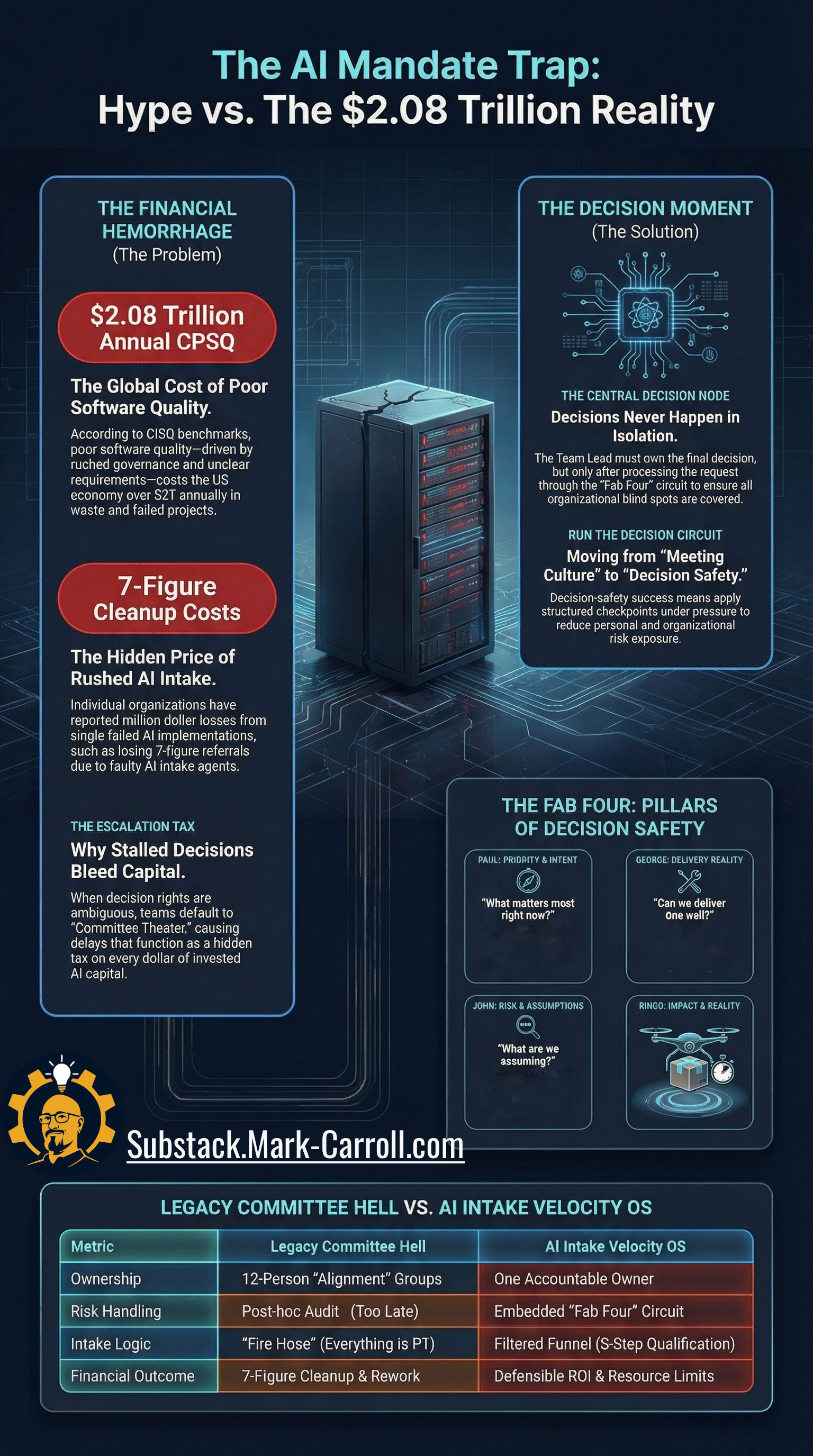
The financial pattern reinforces the structural one. Organizations that cut headcount to fund AI adoption routinely discover the savings were a myth. Technical debt compounds. Rehiring costs triple. Token overruns spike past the salaries these were supposed to replace. The cost-cycle reversal is predictable, and it starts the moment intake discipline gets skipped.
The Decision Moment
Every team hits the same moment. A decision must be made. The room is full. The stakes feel high. And something subtle breaks. Priority shifts without explanation. Risks vanish until after delivery. Execution reality gets replaced by optimism. The meeting ends, but the rationale does not survive the room.
The tempting move is to trust that enough senior people talking long enough will produce a sound answer. Under normal conditions, sometimes they do. Under pressure, that faith gets expensive.
That is not a personality problem. It is a decision survivability problem. Most teams trust the social chemistry of the room more than the structure of the decision. They assume that if enough smart people contribute, the answer will somehow become sound. Under time pressure, that faith is costly. The evidence is clear: under stress and social evaluation, decisions improve when cognitive load is lowered, the first step is obvious, the prompts are concrete, and the structure supports team communication rather than solo memory. Structure matters more when the room gets hot, not less.
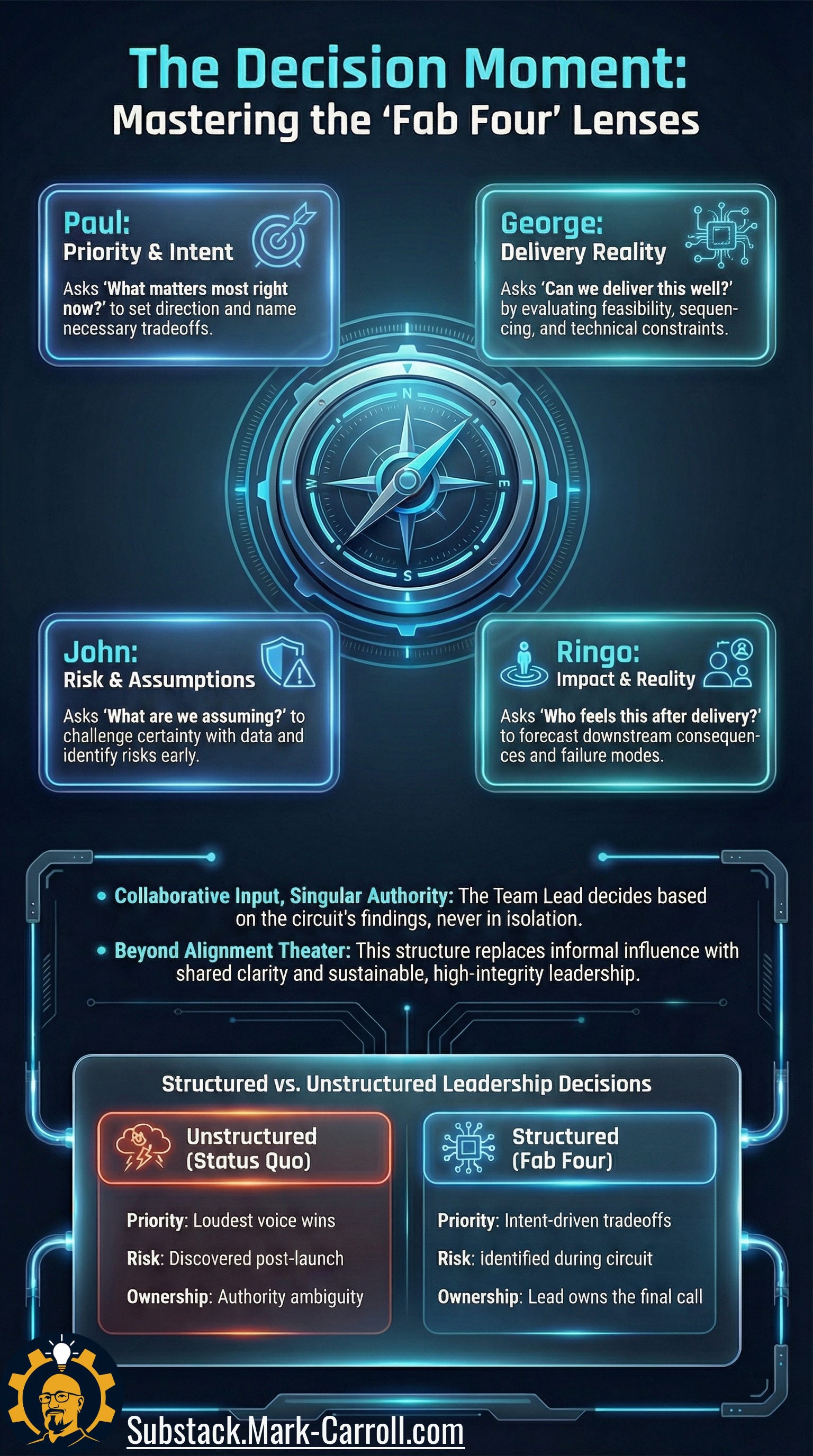
That is where the Fab Four matters (my Beatles inspired approach to assure there’s team within your team to manage ongoing decisions effectively). Each lens names what the room tends to leave out:
Priority (Paul): what matters most right now, not what arrived most recently.
Product Manager/Owner
Reality (George): what the team can deliver well given the people and systems available today.
Lead Engineer, Architect
Risk (John): what assumptions are being treated as certainties and should not be.
Quality Assurance, Testing
Impact (Ringo): who lives with the consequences after delivery, not just during approval.
Business Analyst
The point is not richer discussion for its own sake. The point is constrained lenses that make the decision strong enough to survive contact with reality. If those four things/perspectives are not explicit before the meeting ends, the decision is running on social chemistry, not structure.
Then comes the rule most teams avoid. Someone still must take the bet. The team lead decides not in isolation and not by consensus, but after running the circuit. Without that rule, the circuit becomes theater.
Without that structure, most organizations default to the same pattern: status meetings become forensic investigations, informal agreements dissolve under pressure because ownership was never documented, and reactive fire drills consume a fifth of engineering bandwidth before anyone names the drain. That is the decision ghost. It haunts velocity long after the meeting that created it ends.
The alternative is a structured decision circuit where each lens has a name and each decision has a single accountable owner. The Fab Four provides that circuit. Here is how the four lenses map in practice.
The Intake Collapse
Even teams that fix decision quality often fail one step later. Decisions do not arrive one at a time anymore. AI does not slow down after the first pilot. It accelerates. New requests keep coming. New experiments surface. New urgency keeps arriving.
Most teams believe they have a prioritization problem. What they actually have is intake collapse. That distinction matters. Prioritization assumes the work has entered a system that can see it clearly. Intake collapse means the front door is already broken. Every request arrives wearing the same urgent badge. Everything gets discussed. Nothing gets filtered.
This is exactly why triage and intake discipline is one of the strongest demand clusters among product and delivery leads right now. They are not asking for more AI inspiration. They are asking for a front door.
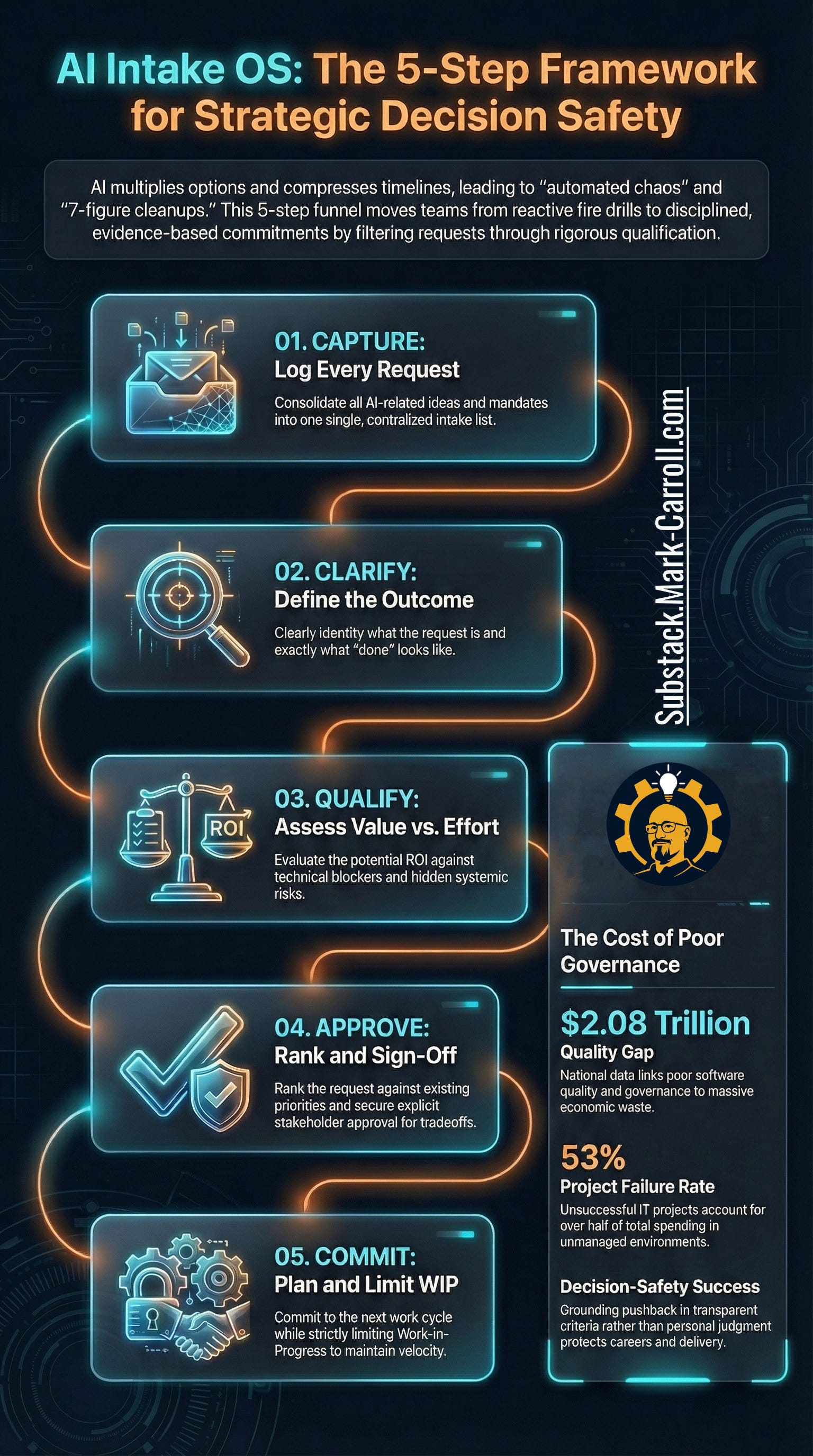
The five-step intake funnel provides that front door. Each step does a specific job:
Capture: keeps requests from bypassing visibility before they gain social momentum.
Clarify: forces someone to define what “done” means before work begins to sprawl.
Qualify: introduces value, effort, and risk before politics harden into commitment.
Approve: makes the tradeoff visible to the right people at the right moment.
Commit: introduces limits which is where most organizations lose their nerve.
Organizations are willing to discuss tradeoffs. They are much less willing to enforce them. The intake funnel exists to close this gap.
Consider what this looks like in practice. A VP asks for an AI feature to summarize customer calls. In the old system, it enters as a strategic priority because it came from above. In the new system, the team runs the map, discovers there is no named data-risk owner and no success threshold, and routes it into experiment rather than commitment. The meeting ends with a bounded pilot instead of an invisible obligation. That is the difference between a system that protects delivery and one that rewards escalation.
The evidence favors short, phase-specific, printable tools that fit inside existing rituals and can be run under stress in one to three minutes. A dense one-pager gets ignored. A shallow, concrete, role-anchored intake path has a fighting chance.
WHAT YOU NOW KNOW
The diagnosis is now complete. AI did not create these problems. It accelerated three existing weaknesses that were already costing teams their quarters: mandates that arrive pre-blessed instead of earned, decisions that do not survive the room because the room trusts chemistry over structure, and intake systems that treat every request as equally urgent until the sprint collapses.
None of those failures are communication problems but structure problems. And knowing that changes what you look for in the next meeting.
What this article did not cover is what happens once work gets through the front door. The cost of treating all work the same once it enters the system. What governance actually looks like when accountability travels with the work instead of sitting above it in a committee. How teams draw the line between a safe experiment and an invisible commitment before the pilot becomes permanent scope.
Fixing the front door is only half the problem.
The other half is what you do with everything that gets through.
Thank you, Mark S. Carroll.
Mark’s framing lands because it names what most leaders feel but cannot articulate: the front door is the governance moment. Not the committee meeting, not the slide review. The intake itself.
If your team is the one cleaning up after these mandates, you are not alone… in fact, most AI investments that fail do so for exactly this reason.
For more of Mark’s work, subscribe to Empathy Engine.
FAQ — “QUESTIONS LEADERS ARE ASKING”
1. What is the AI mandate trap? The AI mandate trap is the pattern where AI requests arrive pre-blessed with social permission, bypassing normal intake discipline. Teams start from enthusiasm instead of scrutiny, pushback reads as obstruction, and pilots quietly become permanent commitments nobody formally agreed to. The fix is structural intake, not more alignment meetings.
2. Why do AI pilots keep becoming permanent scope? Because most teams lack a structured intake funnel that forces every request to prove readiness before work starts. Without a commitment step that defines the experiment boundary, a pilot keeps absorbing new asks until it becomes an obligation. Bounded experiments need explicit success thresholds and named owners before the first sprint.
3. How should product or delivery leads triage AI requests? Run every AI request through a five-step funnel: capture so it stays visible, clarify what “done” looks like, qualify value and effort, approve the tradeoff explicitly, and commit with limits. Requests that cannot name a success threshold or data-risk owner route to experiment, not commitment.
4. What is the difference between an AI experiment and an AI commitment? An experiment has a named owner, a bounded timeline, a single success metric, and a kill criterion. A commitment has none of these and runs on whoever shouted loudest at approval. Most AI work enters orgs as an implied commitment. The fix is routing it back to experiment until the bounds are explicit.
5. How do I push back on an AI mandate without sounding like I am resisting AI? Run the mandate through the intake funnel publicly. Ask for the success threshold, the data-risk owner, and the experiment boundary. Frame the questions as “help me deliver this well,” not “should we do this.” Structure makes the pushback impersonal and makes the mandate answer for itself.
6. What does good AI governance actually look like for a small team? Short, printable tools that run inside existing rituals in one to three minutes. Dense policy documents get ignored. A one-page intake form, a four-lens decision circuit (priority, reality, risk, impact), and a single kill criterion per pilot carry most of the governance weight for teams under 200 people.
Joel Salinas is a Fractional Chief AI Officer for small and mid-sized businesses and nonprofits, offering strategy, hands-on builds, and change management. He writes Leadership in Change and also offers 1:1 coaching for individual leaders. Learn more at jsalinas.org.
Written by a human, for humans.
Joel, thank you again for the opportunity to collaborate on this.
One of the things I appreciate most about your work is that you do not treat AI adoption as a toy box or a panic button. You keep bringing the conversation back to leadership, judgment, implementation, and what teams can actually do on Monday morning.
That made this piece a real pleasure to contribute to.
My hope is that the “front door” framing helps leaders pause before the next AI pilot quietly becomes permanent scope. Because the issue is rarely whether people are excited enough about AI.
The issue is whether the organization has enough structure to turn that excitement into accountable decisions.
At the innovation ends of the cycle. Pilots are totally disposable and meant to fail. It's better to title then as "experiments" but finance hates that name as it sounds frivolous and wasteful so pilots it is. 😉