



TL;DR - AI gave every creator on Substack the same tools, the same speed, and the same baseline output. So I asked 13 of the best voices on Substack one question: what's been the biggest benefit of AI in your work, and what's the biggest detriment for the creator economy? The same answer kept showing up in different costumes. The creators who'll still be here in two years aren't the ones who used AI the most. They're the ones who kept their judgment in their own hands.
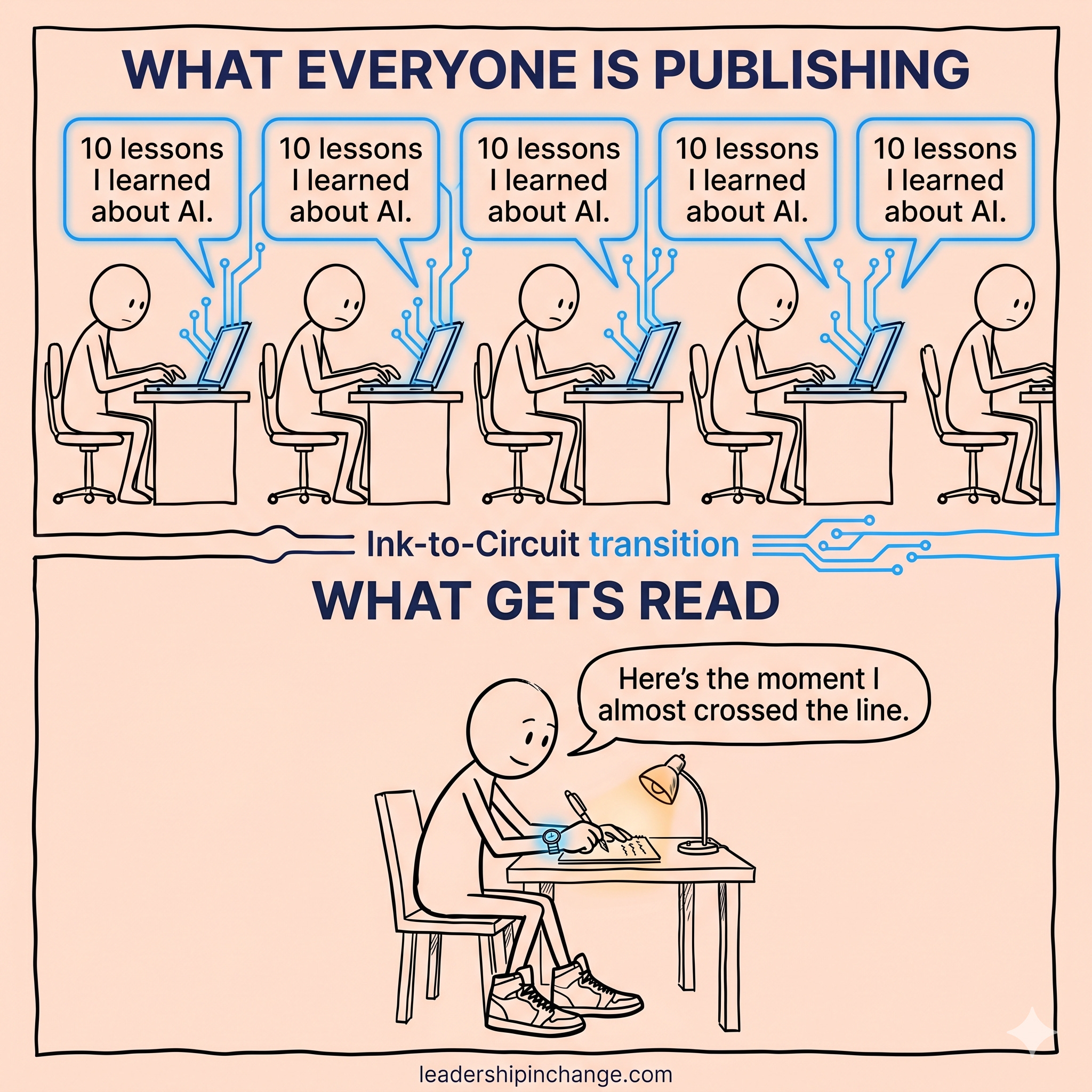
A post was running late, I had the idea but not the time, and the temptation was right there sitting in a tab, telling me to just say “do the heavy lifting, AI” and hit publish and move on with my life. So I did. And I read it back the next morning, and it wasn’t me, not in the small ways but in every single way. It was a tidy, technically competent, completely interchangeable piece that any one of a million people could have generated in five seconds, and there was no real value in it. So I unpublished it.
I waited a day, sat with the actual idea, and wrote it myself the way I’d write it to a friend I’m talking with over coffee.
That moment is what made me want to write this piece.
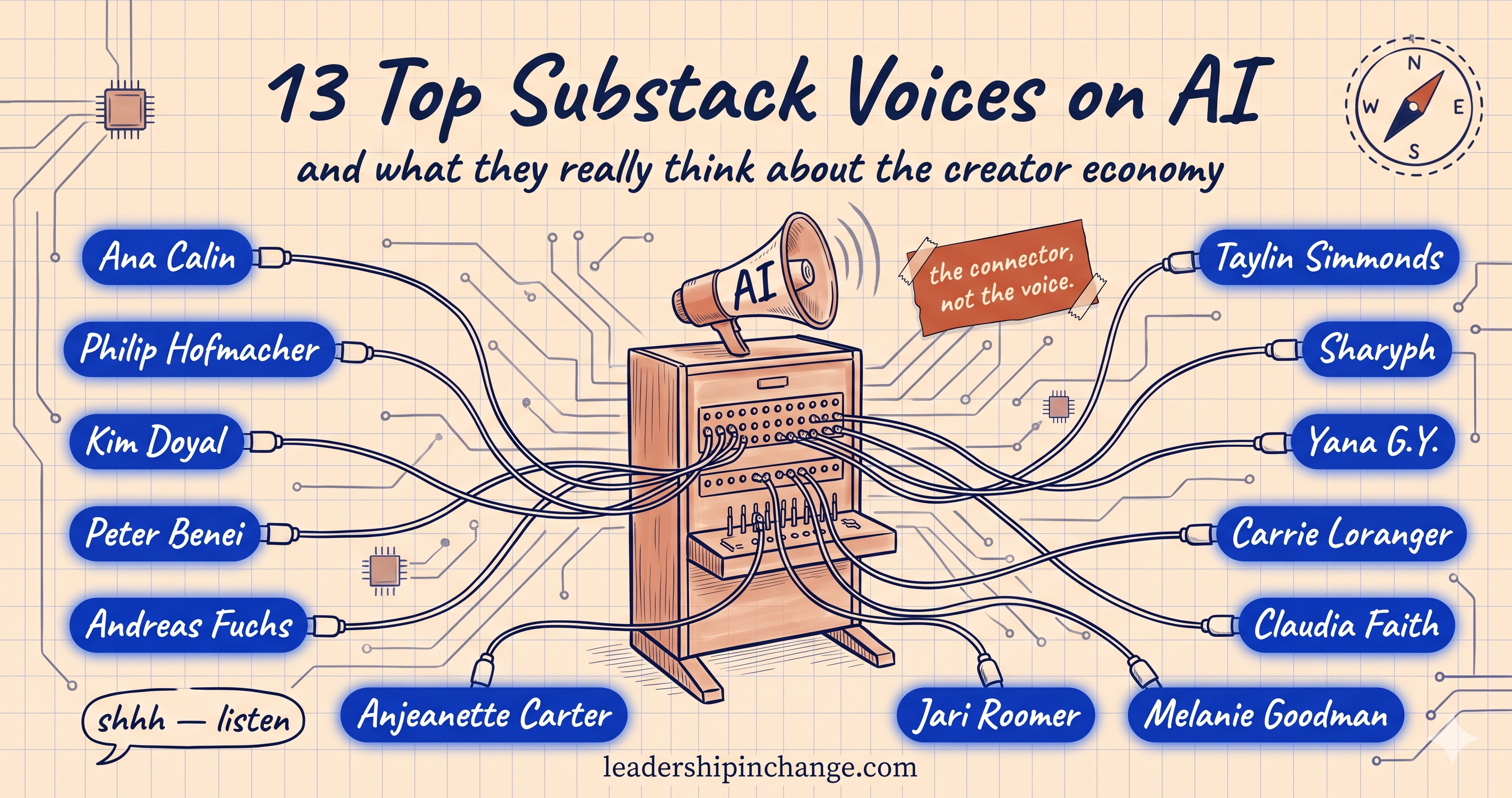
I’ve been on Substack for a year. There are creators on this platform who’ve been doing this for far longer than I have. They’ve built audiences, sold products, watched the field move three times, and survived every wave the internet has thrown at them. So I asked 13 of them one question:
“What’s been the biggest benefit of AI in your workflow, and what’s the biggest detriment of the AI evolution for the creator economy?”
I didn’t want a pitch for AI… I wanted real answers, pushback included, and we got it! What surprised me reading all 13 wasn’t the disagreement, but the agreement. Almost every one of them, in their own language, was pointing at the same thing.
When everyone has the same tools, your judgment is the moat.
This is the piece that came out of that. It’s long. It’s worth it. Read the synthesis if you’re short on time. Then come back for the thirteen voices in their own words, because that’s where the real work is.
The Floor Went Up
So here’s the first thing that hit me reading all thirteen answers. Every single one of them, in different words, said the same thing. Prof. Dr. Andreas Fuchs put it the cleanest:
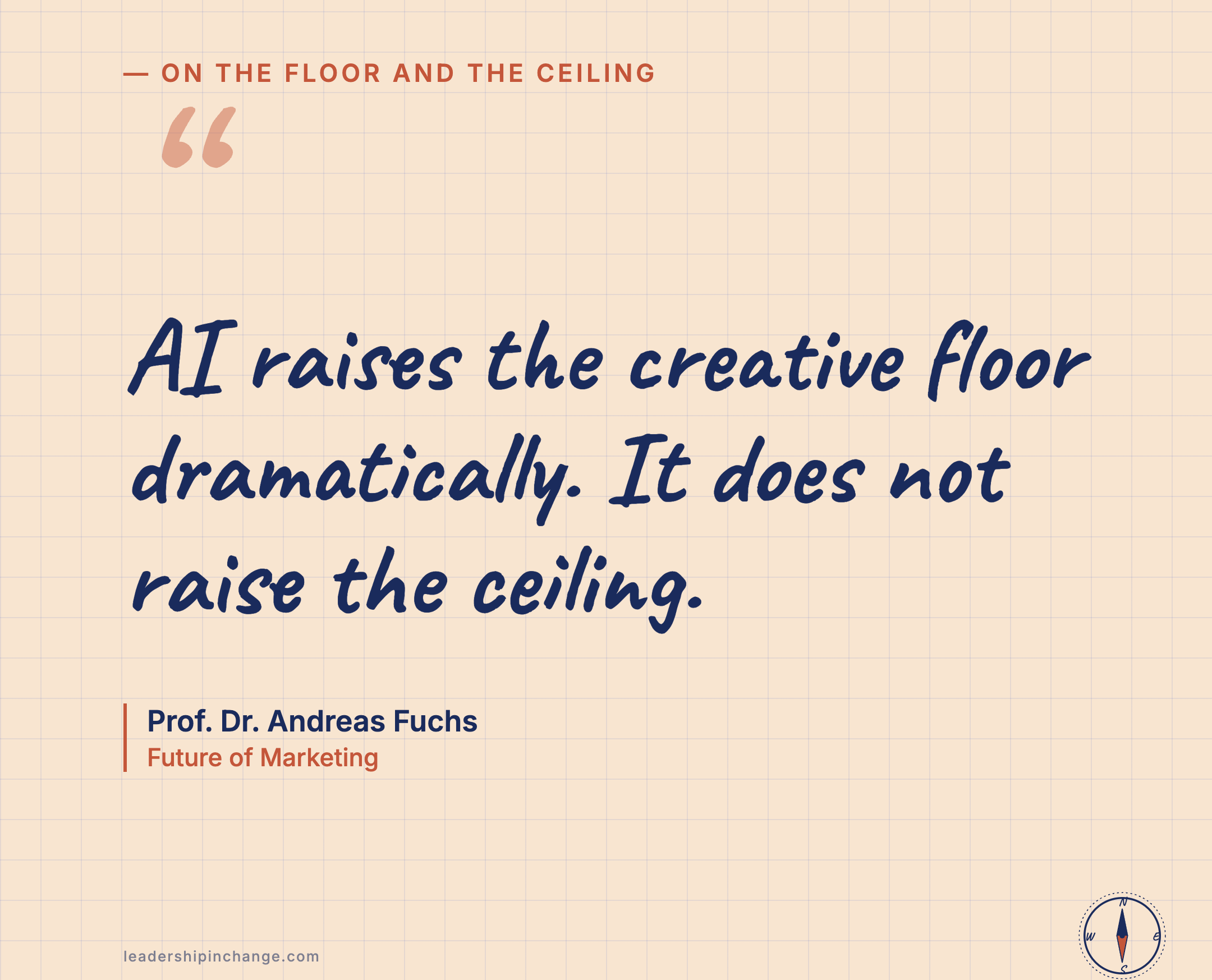
That one sentence is honestly the whole creator economy right now. AI made publishing free, it made decent content cheap, and now anyone with a working laptop and twenty minutes can produce a competent post about almost anything, which is exactly what you’re seeing in your feed every single morning.
Sharyph said the bar for good content just got lower, and the bar for trusted content just went through the roof. Melanie Goodman said the feed is flooded with content that’s technically competent and completely indistinguishable, optimized for volume over point of view. Anjeanette Carter said the slop is so loud now that you have to be sharper, more original, and more human just to cut through.
If you’ve been feeling the saturation, you’re not imagining it. Thirteen of the creators I respect most are all telling you the same thing. The floor came up, the room got louder, and the old playbook of “publish more” stopped working the moment everyone could publish more without thinking.
So if everyone can publish, what actually matters now?
When Everyone Has the Same Tools, Your Judgment Is the Moat
Here’s the synthesis. This is the line I’d write on a wall.
AI gave every creator the same tools. The ones still standing in two years won’t be the ones who used them most. They’ll be the ones who kept their judgment in their own hands.
When the production part of creating gets handed to a machine that everyone has, the thing left worth competing on is your judgment. Honestly, that’s what every one of these thirteen creators is pointing at, even when they use different words. It’s the taste to know what’s worth saying and what’s filler. It’s the discipline to know what to skip when AI is tempting you to do everything. It’s the lived experience to spot when a sentence sounds right but isn’t actually true. It’s the point of view you only get from doing the work yourself long enough to have an opinion that isn’t borrowed from someone else. And it’s the willingness to slow down when the tool wants you to speed up.
Every one of those is something AI just can’t do for you. You can’t prompt your way into having lived through something. You can’t simulate having an audience that trusts you. You can’t outsource the part of yourself that knows when something is wrong, even when it’s well-formatted.
So here’s the test I keep coming back to, the one every contributor was circling in different words:
Did the AI sharpen your thinking, or did it replace your thinking?
If the answer is “sharpen,” AI is your moat-builder. If the answer is “replace,” AI is the thing slowly disassembling your career while making you feel productive.
Thirteen creators agreed on this. Read on and watch how each of them lives it.
What Judgment In Their Own Hands Actually Looks Like
Here’s where this piece earns its keep. The thirteen creators who use AI well aren’t using it the same way at all, which surprised me, but the patterns underneath their answers are pretty much the same. I saw four of them.
1. They build what didn’t exist before
Ana Calin built six AI-powered tools her students actually use. Her Offer Stack tool alone has been used by 8,000 creators to find their first sellable offer. Carrie Loranger built an entire self-serve product in a week that would have cost her thousands of dollars and a full month the old way. Kim Doyal has built agents and automations through natural language alone, compressing eighteen years of online experience into the systems she now uses to run her business. Claudia Faith built a brand-voice engine so she could keep her voice consistent across four different brands at once.
Their judgment shows up in WHAT they chose to build, not how fast they built it.
2. They go deeper, not faster
Sharyph went from a 3,000-word playbook taking a full day to taking 2-3 hours, but the depth is the whole point. AI handles the structure, the formatting scaffolding, the research synthesis. He brings the ideas, the real examples, the point of view. Yana G.Y. uses AI to spot what's already converting in her business so she can do more of that, instead of building something new.
So here’s the shift, and honestly this is one of the most important moves in the whole piece. They went from asking “what should I create next?” to asking “what’s already working, and how do I do more of that?” That’s judgment talking, not output.
3. They use AI as a thinking partner
Taylin John Simmonds said something I have not been able to stop turning over since I read it. He said AI actually helped him think more deeply and divergently, that talking to AI helped him see his own worldview reflected back to him in ways he was struggling to articulate on his own, and the surprising result was that he ended up calmer. His mind had been running in too many directions at once, and AI made it more coherent.
That’s a creative tool making you a sharper, more honest version of yourself.
4. They double down on being human
Philip Hofmacher’s whole pivot was video and live streaming, because his thesis is that in the age of AI, trust gets built by showing you’re a real person, and the easiest way to do that is to step in front of the camera. Anjeanette Carter let her writers go because they got lazy and started giving her AI slop, and now her whole business runs on her own writing plus AI as a tool. The judgment call there was simple. Protect the thing nobody else can do.
Across all four patterns, the common thread is the same. These thirteen kept the thinking, the taste, and the lived experience as theirs. They handed AI the parts of the work that didn’t require those things.
📚📚 Most Substack writers publish great content that nobody finds.
Newsletter Compass fixes that — SEO, subject lines, content gaps, and LinkedIn repurposing, all in one AI toolkit built for writers.
Free for 7 days…
The Thirteen Voices, In Their Own Words
This is the goldmine. Read every one. These are the creators I follow most closely on Substack, and honestly, they’re the ones who taught me how to think about this stuff. Every one of them earned their seat at this table.
🧭 Ana Calin — How We Grow
Topic Tag: Build Less. Sell More. Use AI to Need Less.
I didn’t use AI to work faster. I used it to work less.
Everyone talks about AI as a productivity tool — do more, create more, publish more. I went the other direction. I used AI to build a business that runs in ^2 hours a day while I raise my daughter while travelling through Greece this spring.
Biggest benefit: AI let me build things I couldn’t build before — not just faster, but at all.
I’m not technical. I don’t write code. But I’ve built 6 AI-powered tools for my business that my students actually use. One of them — my Offer Stack tool — has been used by 8,000+ creators to find their first sellable offer. Another scores whether a product idea will sell before you waste months building it. I built each one in an afternoon. No developer. No budget. Just me and a prompt.
That’s not a productivity story. That’s an access story. AI didn’t help me do what I was already doing faster. It let me do things I literally couldn’t do before.
Those tools are now part of the system behind a 7-figure business I run in about 2 hours a day. And to be clear — AI is one pillar of that. The other pillars are a tight product stack, an email system that sells daily, and a publishing rhythm I’ve stuck to for 18 months. AI without systems is just a faster way to be disorganised.
The downside? I see it in my students constantly.
AI made it so easy to BUILD that everyone’s building. New tool. New app. New product. New shiny thing. Meanwhile they have an existing offer that’s 30% optimized and an audience of 200 people they’ve never actually emailed.
The creators making real money right now aren’t the ones building the most. They’re the ones who built ONE clear thing and then actually sold it.
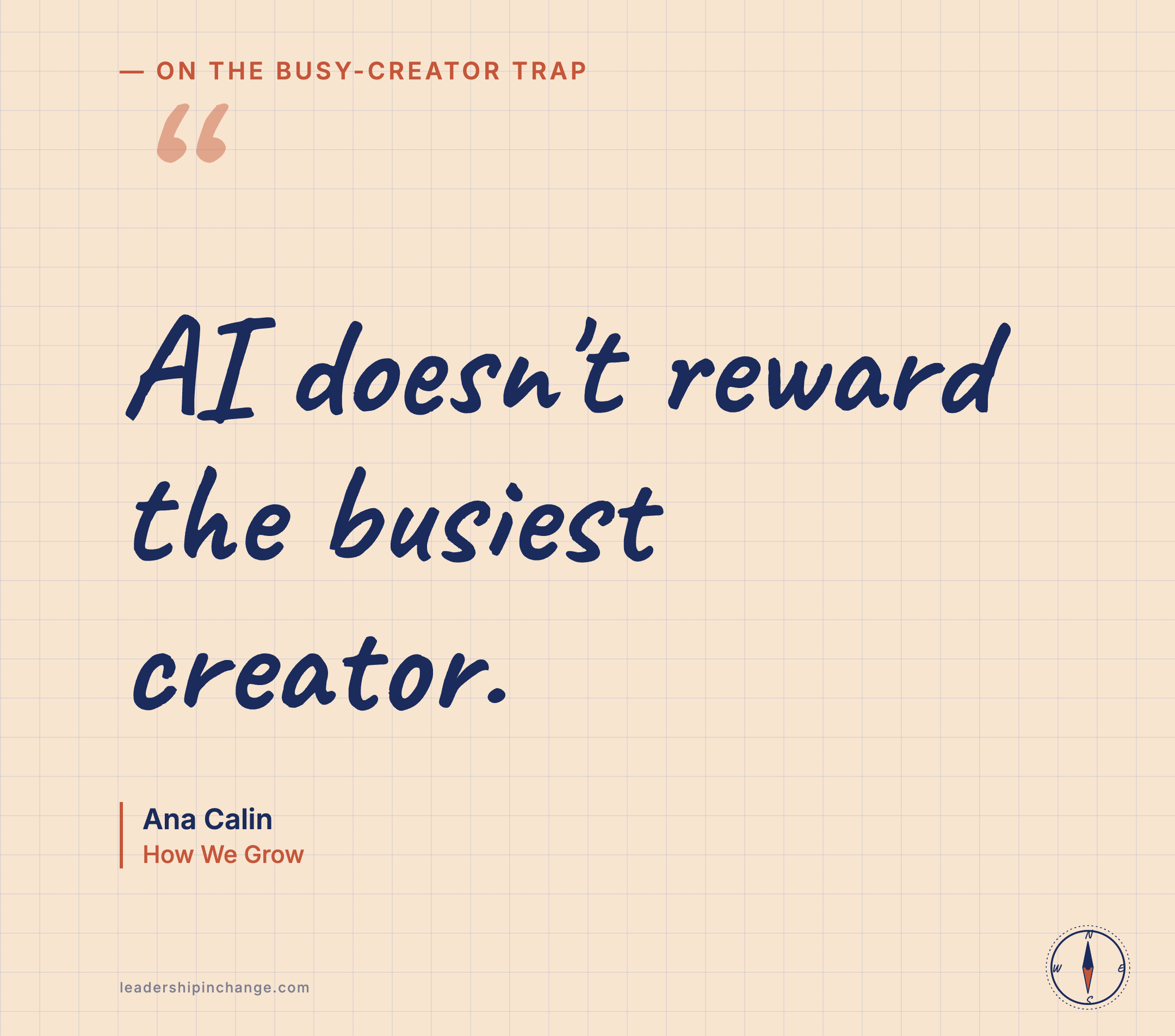
AI doesn’t reward the busiest creator. The creators who’ll win aren’t using AI to do more. They’re using it to need less.
🧭 Philip Hofmacher — Write • Build • Scale
Topic Tag: Trust Is the Premium. Be Human on Purpose.
The biggest benefit of AI for creators and digital entrepreneurs is speed without losing direction.
I treat AI like my personal assistant, helping me turn ideas into reality quickly. It helps me turn rough ideas or experiences into Substack Notes and content for one of our inner circle memberships. It also challenges our company’s strategy and points out blind spots.
What used to take hours now takes minutes, which means we have more time to focus on what really matters:
In my case, that’s helping my clients achieve their goals.
I can spend more time helping them solve complex problems and remove roadblocks while the AI, paired with smart systems, handles the busy work.
But the biggest downside is that it lowers the barrier to producing content without raising the bar for quality.
Years ago, it was all about providing “value” if you wanted to build a creator business. Nowadays, every amateur can create value with the click of a button.
Ironically, that’s pushing us back to what has always mattered most:
Humanity & Trust.
That’s why my team and I went all in on video and live streaming. In the age of AI, trust can only be built by showing that you’re human, and the easiest way to do that is by stepping in front of the camera.
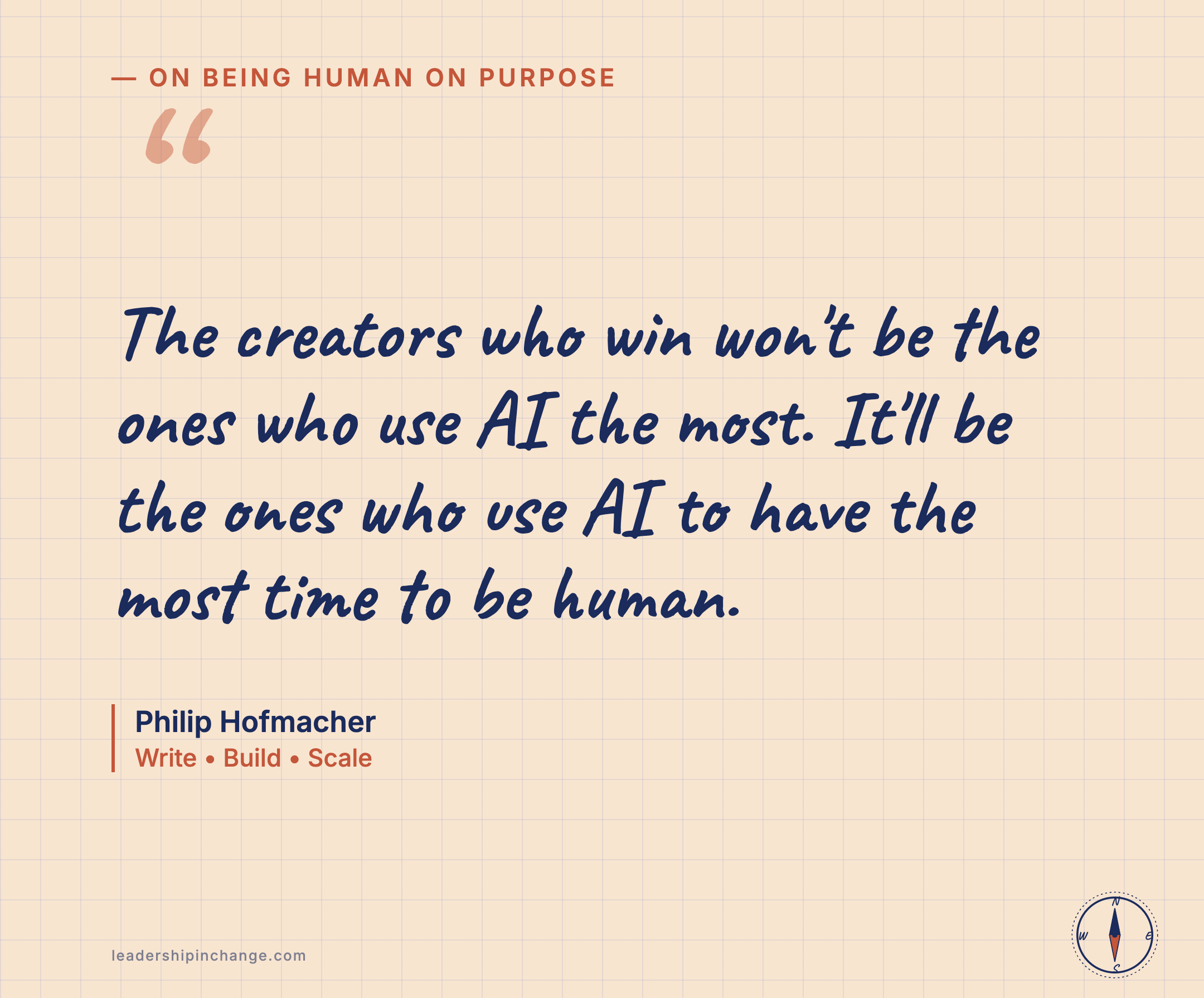
The creators who win won’t be the ones who use AI the most.
It’ll be the ones who use AI to have the most time to be human.
🧭 Kim Doyal — Kim Doyal
Topic Tag: Speed Without Depth Is the Real Loss.
“AI actually makes it so much easier to go deep. You can learn while you’re building.”
The biggest benefit of AI in my workflow is being able to build what I want.
I’ve been in the online marketing space since 2008, and I’ve seen more than my fair share of tools and processes... but nothing comes close to this. I can do deeper research, interpret data visually in a way that actually makes sense to me, and build real structure and systems that I never had the time for before.
I’ve built agents, products, and automations all through natural language and 18 years of experience.
AI gave me the ability to make better decisions because I can finally see the full picture.
The biggest detriment? People are choosing speed over depth. And that’s the real loss, because AI actually makes it so much easier to go deep. You can learn while you’re building, ask better questions, and get real answers.
But instead, most people are using it to crank things out faster… and they’re missing the opportunity entirely. Unfortunately, the tool that could help creators do their most meaningful work is being used to produce more noise.
🧭 Melanie Goodman — The Link Tank
Topic Tag: Don’t Outsource the Thinking. Ever.
“The technology is not the threat but the temptation to let it replace one’s judgment is.”
The biggest benefit for me is the speed of iteration: A LinkedIn article draft that used to take three hours of staring at a blank page now takes thirty minutes to shape into what I actually want it to be. That is significant, particularly for someone who produces a lot of written content. It has also made research faster, though I still verify everything before it gets close to publication.
The detriment is harder to articulate, but I think it comes down to this: AI has made the barrier to publishing almost zero, which sounds positive until you see what that produces at scale. The creator economy is now flooded with content that is technically competent and completely indistinguishable. It reads well, but says nothing about the author. It optimises for volume rather than point of view, and point of view is precisely what audiences pay attention to (and the new LinkedIn algorithm).
The creators who will survive this period are the ones who use AI as a production tool while keeping their actual thinking, opinion, and voice firmly human and personal. The ones who outsource the thinking itself will find their audiences quietly disappearing.
As I see it, the technology is not the threat, but the temptation to let it replace one’s judgment is.
🧭 Yana G.Y. — Unplugged by Yana G.Y.
Topic: Stop Building. Optimize What’s Already Working.
“Creation without a business plan isn’t a strategy. It’s just amplification of the grind - busy work that scales.”
The biggest benefit for me is helping me stop creating blindly.
Before, I was doing what most creators do: producing content, launching offers, building stuff. A lot of stuff. And hoping something would work. Most of it didn’t, but it was hard to understand why.
AI changed the question I was asking. Instead of “what should I create next?” it became “what’s already working, and how do I do more of that?”
I use AI to analyze my data, spot patterns in what actually converts, and optimize existing systems before touching anything new. That shift alone moved my creator business past the $5k/month mark consistently, and I do that on the side of my 9-5 job.
Here’s the thing, though. That same AI capability is also creating a massive blind spot across the creator economy.
Creators are no longer just creating content. They’re building apps, websites, products, tools. At a speed that was never possible before. And they’re getting addicted to the building, not the results. The detriment isn’t AI. It’s what AI triggers: a new, faster shiny object loop.
Most creators have existing audiences, offers, and workflows that are 30 to 40% optimized at best. AI could close that gap overnight. Instead, they’re using it to build something new.
Creation without a business plan isn’t a strategy. It’s just amplification of the grind - busy work that scales.
🧭 Carrie Loranger — 9-to-Thrive
Topic Tag: Lived Experience Is the Moat.
“The more we outsource our thinking to AI, the more we strip out the parts of communication that are the most human.”
I run a portfolio business with six income streams. AI allows me to run all six without hiring a team.
I’ve built multiple agents, apps, and SaaS platforms to solve problems for myself and also sell as digital products. For example, I built The Creator Profit Engine, a self-serve portfolio business building product that produces customized market intelligence reports, product and offer ideas, pricing strategy, buyer personas, and ready-to-launch marketing materials based on user inputs. To develop this the traditional way would have cost thousands of dollars and a month to build. I built it myself with AI in a week.
So that’s the upside. Here’s what worries me.
AI is making it way too easy to skip the thinking. Creators are publishing content that’s shallow, lacks substance, and is mediocre at best. And as AI gets better, the output is only going to get harder to distinguish from human writing. That’s not the win people think it is.
Because when we let AI do the thinking for us, we lose the nuances. The stuff that comes from lived experience, from watching a client’s face when something clicks, from failing at something and knowing exactly why. AI can’t know those things. It can’t replicate them. And those are the details that make someone’s work worth reading.
The more we outsource our thinking to AI, the more we strip out the parts of communication that are the most human. And those are the parts that matter most.
🧭 Sharyph — The Digital Creator
Topic Tag: AI for Execution. You for Soul.
“The creators losing right now are the ones who think AI fluency means outsourcing their thinking. It doesn’t.”
The biggest benefit of AI in my workflow is speed without sacrificing depth.
Before AI, writing a 3,000-word playbook took me a full day. Now it takes 2-3 hours. Not because AI writes it for me…it doesn’t. But because AI handles the structure, the formatting scaffolding, the research synthesis. I bring the ideas, the real examples, the point of view. AI gives me speed. I give it soul.
That’s the distinction most creators miss.
I went from managing 21 tools and spending 15+ hours a week on content operations to running everything on 4 tools for $88/month. That’s not magic…that’s AI used as actual leverage, not a novelty.
Now the detriment?
The creator economy is getting flooded with competent noise.
AI lowered the barrier to entry so far that everyone can now produce decent content. The result: a sea of polished, well-formatted, technically correct content that says nothing. No perspective. No lived experience. No skin in the game.
The creators losing right now are the ones who think AI fluency means outsourcing their thinking. It doesn’t.
The ones winning? They use AI for execution and bring something irreplaceable to the table…real results, genuine opinion, documented experience.
The bar for good content just got lower.
The bar for trusted content just went through the roof.
That’s the tension every creator needs to sit with.
🧭 Peter Benei — AI-Ready CMO
Topic Tag: Your POV Is the Driver. Your Will Is the Agent.
To be honest, the creator economy is over. There were barriers to creating things. You had to learn skills to make something meaningful. Editing, writing, designing, speaking, whatever platform you used, you had to be resourceful to create something unique. These skills acted as natural, democratic barriers. Anyone could learn them.
AI removed all of them. Creation is now instant and infinite.
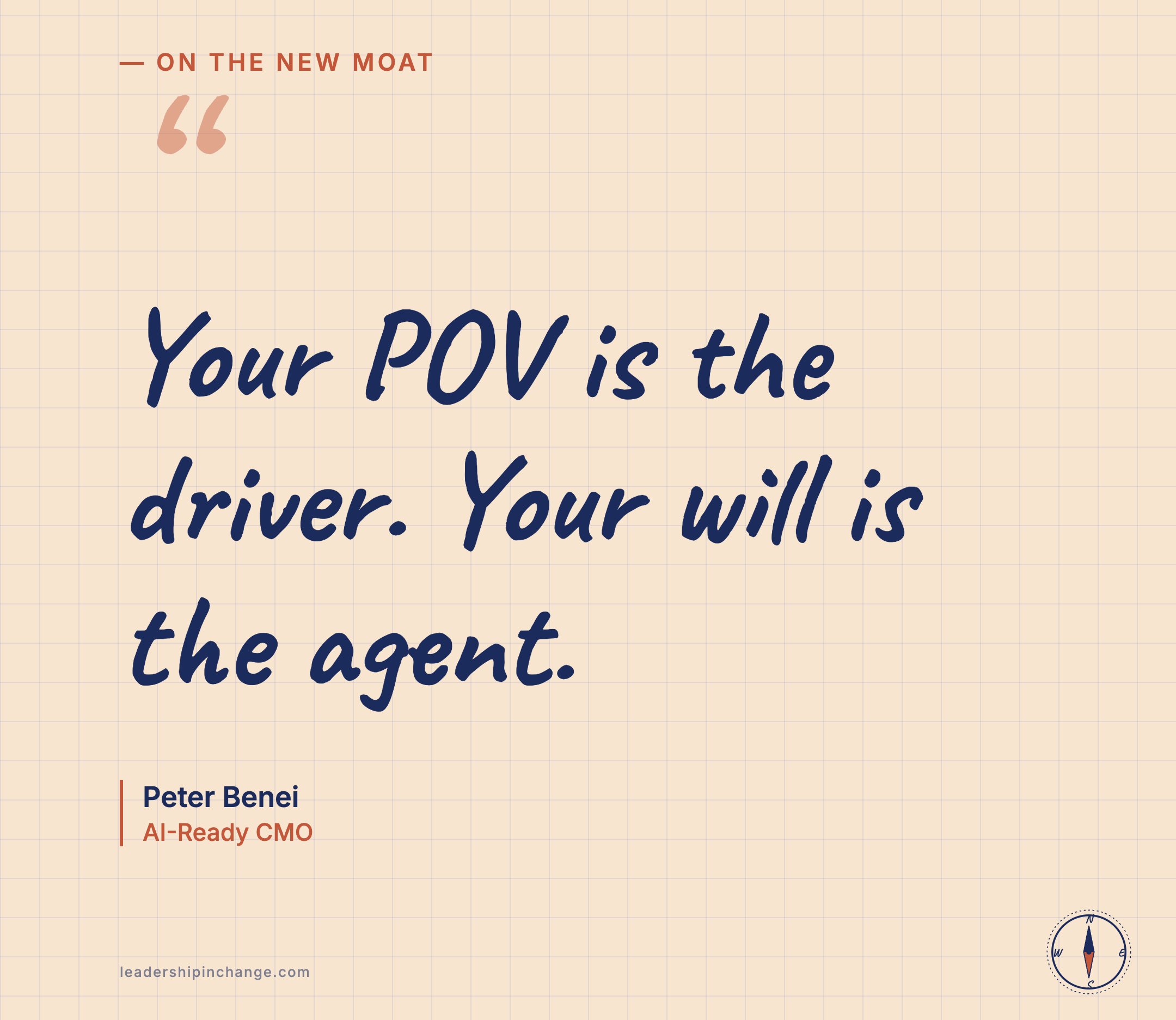
The only barrier left isn’t democratic. It’s hard to develop, if learnable at all. And with content growing more uniform by the day, not everyone will clear it. It’s your POV. Judgment, taste, and worldview mixed into something genuinely interesting. You have to decide what’s worth making. Your POV is the driver. Your will is the agent.
At AI-Ready CMO, we call this the human context window. Your accumulated time, taste, worldview, and judgment, held together by the act of curation and turned into creative action.
The creator economy is over. The curator economy is beginning. And not all POVs are created equal, frankly.
🧭 Claudia Faith — Level Up With AI
Topic Tag: Sell the Person. Not the Product.
“I think a lot of creators haven’t caught up to that yet. The ones who figure out how to sell themselves, not their product, are the ones who’ll still be here in two years.”
The biggest benefit for me has been that AI hands creators a tool to actually live out the ideas in their head. Here’s a concrete example. I run four brands, and the whole content engine behind them runs on tools I built for myself when I hit friction points. I couldn’t keep my voice consistent across all four, so one afternoon I sat down and built a system that writes in each brand’s tone. I’d been stuck on that problem for months.
The gap between “I wish this existed” and “I made this” used to be weeks, if it happened at all. Now it’s a few hours. And that’s not just about me moving faster. It’s about the people who were never going to build a thing, now being able to.
The biggest detriment is the flip side of that same shift. Things are easier to copy, easier to build, which means it’s a lot harder to have a real USP. Whatever I ship, someone else can rebuild in a weekend. For a while, having a specific tool or workflow was enough to stand out. That’s mostly gone. What’s left is taste, story, and the specific person behind the thing, and those are harder to sell and harder to protect.
I think a lot of creators haven’t caught up to that yet. The ones who figure out how to sell themselves, not their product, are the ones who’ll still be here in two years.
🧭 Anjeanette Carter — Anjeanette Carter
Topic Tag: Slop or Sharp. Pick a Side.
“The people who lean into personality and real expertise will win.”
Biggest benefit: my profit margins. I used to have writers on payroll, but they started giving me AI slop because they got lazy. So I let them go. Now it’s just my writing, my expertise, and AI as my tool. That combination makes me an unstoppable content machine. I’m faster, the quality is higher, and I keep more of what I earn.
Biggest detriment: the noise. There’s so much AI slop out there now. Everyone can publish, which means everyone is publishing. The bar for “content” has dropped to the floor, which makes it harder for quality work to stand out. You have to be even sharper, even more original, even more human to cut through. The people who lean into personality and real expertise will win. The people using AI as a crutch instead of a tool will drown in their own mediocrity.
🧭 Jari Roomer — Write • Build • Scale
Topic Tag: Stop Letting AI Be Your Cheerleader.
“The biggest downside of AI is that it’s too agreeable. It’s coded to be your friend.”
The biggest benefits of AI is that it has compressed my content creation timeline dramatically.
I’ve trained my AI on hundreds of my existing articles, coaching calls, and social media posts, so it can write exactly in my tone of voice and draw from my existing body of work. I then use voice mode to share all my thoughts and insights on a new piece of content, while AI does the actual writing of it.
So nowadays, content creation takes a fraction of the time that it used to take. This frees up a lot of time and energy to do the ‘unscalable’ work that actually matters, like serving more coaching clients and helping them get better results.
Without AI, I’d simply have much less time and headspace to serve the people who work with us, as I’d be spending a lot of time on content creation itself.
The biggest downside of AI is that it’s too agreeable. It’s coded to be your friend, which means when creators pitch ideas to it, it validates nearly everything.
I see a lot of creators pursuing mediocre content, product, or business ideas, simply because they’ve run it past AI, and AI told them it’s brilliant. They’ve outsourced their critical thinking to AI - and blindly trust everything it says.
If you want to use AI to validate your ideas (which you definitely can), you’ll need to actively prompt it for pushback and genuine feedback, otherwise it will just stay your personal cheerleader and agree with almost all of your ideas - even if it’s an idea that’s set up for failure.
🧭 Taylin John Simmonds — The Creative Minority
Topic Tag: The Atrophied Self. The Creator AI Builds vs. the One AI Erodes.
“The creative act shapes the creator. AI can deepen that act or replace it.”
The biggest benefit: AI helps me think deeply and divergently.
I’m multi-interested by nature, which means my mind is a chaotic mess of ideas running in too many directions at once. Talking to AI helps me get everything out, make connections, and see my worldview reflected back in ways I was struggling to articulate.
My writing got sharper. My ideas got more interconnected. But what surprised me most is that I ended up calmer. My mind had been running in too many directions at once without me realizing it. AI made it more coherent.
The biggest detriment is the inverse of that.
Most creators aren’t using AI as a thinking partner. They’re not even using it as a thinking replacement. They’re using it as a creator replacement. The surface cost is saturated feeds full of copied content. But the deeper cost is for the creators themselves. They end up with an atrophied self.
Your thinking, taste, judgment, creativity, business sense, the way you see the world—all of it develops through engaging in the act of creation. Outsource the act, and you stop engaging. Stop engaging, and you stop becoming. You end up wildly productive in one sense—a lot of product, a lot of content—while atrophying as a person.
The creative act shapes the creator. AI can deepen that act or replace it.
Those aren’t just two different workflows. They’re two different selves.
🧭 Prof. Dr. Andreas Fuchs — Future of Marketing
Topic Tag: The Floor and the Ceiling.
“AI raises the creative floor dramatically. It does not raise the ceiling.”
The biggest benefit of AI in my workflow is amplification. I run the Future of Marketing newsletter alongside my role as a professor, which means every hour counts. AI tools like Claude have become real co-workers: they read my past articles, follow my voice, and help me move from idea to draft in a fraction of the time. Not by replacing my thinking, but by removing the friction around it. The same thinking, the same standards, but with more reach and output than one person could ever produce alone.
The biggest detriment is harder to name, but easier to feel. AI raises the creative floor dramatically (almost anyone can now produce decent content) but it does not raise the ceiling. What follows is a flood of competent, forgettable work that all sounds vaguely the same. For creators, the real risk is not being replaced by AI. It is being drowned out by everyone who uses it without a distinct point of view.
The creator economy will split in two. On one side, generic output that algorithms can generate at zero marginal cost. On the other, creators with original thinking, credible expertise, and a voice that cannot be prompted. The second group becomes more valuable, not less.
The Piece Nobody Reads Is Better Than The Piece That Isn’t Yours
So here’s where I’m landing after reading all thirteen of these.
I’m one year into Substack, and the temptation to let AI carry a post when you’re out of time is real, and it’s available, and it’s right there in a tab waiting for you to click. The first time I gave in, I read the result back the next morning and didn’t recognize the writer at all, because it was tidy, technically correct, and completely forgettable; it wasn’t me, and a year of subscribers who’d actually come to read me would have spotted that instantly. So I didn’t publish it, because honestly, I’d rather not write than send out something that isn’t mine.
That’s the line, and that’s the moat. The judgment to say “this isn’t mine, so it doesn’t go out” is the entire game now, because the tools are only going to keep getting better and the temptation is only going to keep getting stronger. The creators who keep their judgment in their own hands are the ones who will still be here in two years, and the ones who don’t will be wildly productive right up until the moment they sit down to write something real and realize they’ve quietly lost the thread.
If you take one thing from this piece, take this.
The next time you’re tempted to let AI carry a post because you’re out of time, don’t publish. Skip the post. The piece nobody reads is better than the piece that isn’t yours.
That’s the test, that’s the moat, and that’s the work.
Big thanks to Ana, Philip, Kim, Melanie, Yana, Carrie, Sharyph, Peter, Claudia, Anjeanette, Jari, Taylin, and Andreas for saying yes to this. Every one of them has changed how I think about my work. If anything in this piece moved something for you, the right next move is to subscribe to their work directly. They earned it.
Joel Salinas is a Fractional Chief AI Officer for executive teams who want AI adoption that lasts. He writes Leadership in Change and coaches a small number of leaders 1:1. Book a free intro call.
Written by humans for humans
what a great collection, honored to be a part of it!
Such a great round-up, I'm so honored to be part of this. Sharing it 🤩